[00:00:00] Speaker A: What does it really take to build something extraordinary? Behind every thriving business is a powerful mix of grit, creativity, risk and the relentless drive to keep going when others would stop.
Welcome to the Next Venture alliance show. The podcast where entrepreneurs, innovators and trusted advisors come together to uncover the stories and strategies behind remarkable ventures with your host, Oliver Kotelnikov. Whether you're building, buying, scaling or selling, this is your space to learn, gain, get inspired and prepare for your next venture.
Good morning and welcome to the next Venture Alliance Show. My name is Oliver Kotelnikov. I'm an entrepreneur, a storyteller, mergers and acquisitions advisor, and a business and commercial real estate broker. On the show we talk with founders, business owners, self starters, industry leaders, and the trusted advisors who support them. Today, together we explore both the strategic and the human side of entrepreneurship.
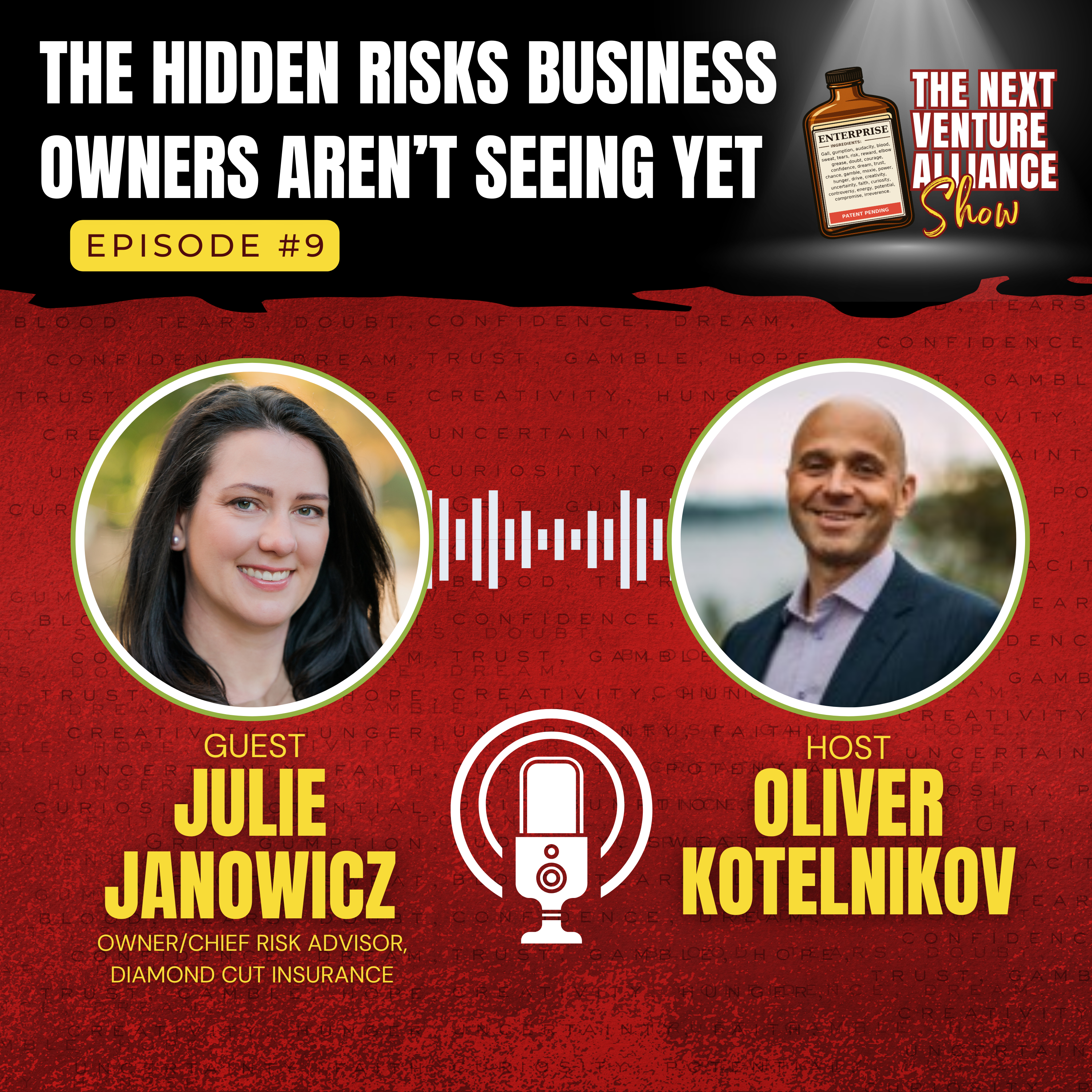
Our guest is Julie Janowicz and today we're going to talk about insurance.
Julie is a commercial insurance and risk advisor with Diamond Cut Insurance Group and is the owner of Diamondcut Insurance agency in Ballard, Washington.
Over the past 15 years in the industry, Julie's mission has been to help business owners and clients protect what they have built. She in turn has built the business model grounded in education, integrity and proactive support where clients and referral partners feel informed, protected and genuinely cared for. Diamond Cut Insurance can place coverage for auto, commercial homeowners and small business insurance. Julie specializes in high net worth personal insurance and commercial coverage for construction, real estate and professional services.
She has a degree in Business Administration from the University of Portland and is certified as a construction risk and insurance specialist through the International Risk Management Institute. Julie is an active member of the Master Builders association of King and Snohomish Counties and is a tremendous resource to the business community. Julie, I'm honored to have you on the show. Welcome.
[00:02:15] Speaker B: Thank you so much for that wonderful introduction and thank you for having me. I'm really excited to be here.
[00:02:21] Speaker A: Awesome. Glad to have you with us. I'm sorry I got your name wrong. My, you know, my last name is Russian Kotelnikov and I'm used to the last name mix up. It's just kind of part of my story at this point, so I apologize for that.
But you know, 2025 has been quite an eventful year on many fronts and you know, I'd say insurance is no exception and maybe even, you know, leading the pack in terms of volatility.
What's your general take on the state of the industry?
[00:03:01] Speaker B: General take is a little positive.
Which is, I'm happy to say that and be able to say that and believe just got so bad in 2020 during the pandemic that as we inch toward like the markets opening, carriers wanting to take business, it feels really that a lot more positive and the carriers are kind of opening up on what they'll ride. And sometimes turnaround times are even better.
That's not to say that you should not be super proactive when you're buying a business with Oliver's help to reach out to your insurance agent and make sure that you have everything that you need for closing. Because some carriers, they just, or brokers rather, for the more complex risks, if you will, can just take a really long time to turn around anything.
[00:04:03] Speaker A: Yeah, I mean, it's certainly the theme that we've all seen as professional advisors, I'd say across the board, whether it's lending or leases or contracts, I mean, everything seems to be taking longer. And so the idea of kind of the gift of time and then being proactive and then, you know, starting early seems to be the key that, you know, turns that lock.
But the questions that we see a lot is I'd say threefold, three main questions. Is something insurable right anymore?
Just placing coverage in general, can it be done at an affordable rate and what's the time frame? Because all of that has to align with the interests of a business owner, existing business owner to new business owner.
It has to align with the transactional timeline.
And then in the end we need the certificates of insurance or nothing happens. It's an absolutely critical third party consent that I would say gets overlooked.
And it's, you know, there's sort of an assumption that they will arrive.
But, but, but, I mean, are things insurable? If we're talking, you know, auto, commercial auto, property and general liability,
[00:05:35] Speaker B: I would say generally things are insurable.
I had one risk recently that was basically not insurable because they're importing foreign vehicles to sell here after the 25 year gray market, then we can import them. And I couldn't find a carrier that wanted to do that. But generally speaking, I would say things are usually insurable, but it depends on. So, like the cost that you brought up, like what, what is considered a affordable good cost? Like for instance, I worked with an excavation company.
They came to me paying 30,000 a year, but they had an exclusion on their policy that excluded any coverage for their main operation.
So is 30,000 affordable with zero coverage or is double the premium but being insured for your actual operations affordable?
So I guess you just kind of have to weigh the pieces there.
[00:06:51] Speaker A: Yeah. And you know, I'd say one of the challenging things in the transition is when there's a variance. Right. So let's say a buyer is looking at a business and they're looking. And you mentioned that in our kind of prior conversations, as well as, you know, when the buyer is looking at financials, they see a certain line item for insurance.
You know, it's been stable and reasonable for the past four to five years.
They go to reprice it, and it comes back significantly higher. Now everything changes. The value of the business changes to them. Their bottom line changes. How they're looking at it, changes what happens when an insurer, you know, an insurance carrier, reprices seemingly the same asset for a new owner. Is there a risk profile change? Is there?
I mean, why the change so often kind of for the same thing.
[00:07:48] Speaker B: So I would say maybe there's kind of two answers to that.
On one hand, the business could be rated wrong, and that's why it's so important.
[00:08:01] Speaker A: It just hasn't been looked at in a while.
[00:08:03] Speaker B: Yeah, Like, I don't know, maybe the current agent has it rated as the restaurant, but it's actually like more like a tavern where their gross receipts are maybe actually 70% liquor.
And maybe it was an error. Maybe that's how they started, and it was just never revisited each year.
But when you throw something like liquor in, that changes the rate profile and every. That just makes everything a lot more expensive.
[00:08:37] Speaker A: So because of risk, because liquor is a.
So, so what are some of those elements? I mean, liquor, gambling, late nights, you know, what are kind of the key?
[00:08:49] Speaker B: So if we're looking at a tavern, I would say, like, if there's live music, liquor, like, is there any food?
[00:09:01] Speaker A: Human beings. Lots of human beings.
[00:09:05] Speaker B: I was talking to someone last week who has owned bars, nightclubs, and he was saying that a huge, like, common lawsuit that they get is actually from ascap, the music industry, publishing, like music
[00:09:26] Speaker A: rights and copyright stuff.
[00:09:28] Speaker B: Yeah. Like, they try to sue them for playing music there.
And he was fortunately able to just turn it over to the jukebox company and they handled it because that's what they do.
But it's like sometimes there's just certain targets, classes of business where they're just riskier.
And then, of course, if it's a tavern and you serve someone, or maybe you don't even serve someone because they're too drunk, and then they go out and drive drunk and, like, kill someone, you're included in that lawsuit.
[00:10:06] Speaker A: Yeah. So that's, you know, obviously alcohol, you know, always throws A throws a range in things or if you have a business like, I mean we recently sold a business for instance that had, you know, the business, it was an ax throwing business. Right. So hey, very successful. Right. But people are, and I think they served liquor, I think so I
[00:10:30] Speaker B: was that insurable.
[00:10:32] Speaker A: So it got insured. And so and that's an interesting thing too. I mean the insurance industry has to keep up with the trends, right. The new business models, things that have never been. Somebody comes up with a new business, we don't know where do we place this. Right. What sort of a, what is the risk of throwing axes? You know, what are, what, what's the safety equipment? You know, what's the track record? Right. What's the history? Well, there is none. It's just, just started.
So but, but for things that are simpler maybe, you know, I had a, a sale of a commercial building to where an existing carrier denied coverage to the new owner, I think claiming deterioration and, and kind of done a like a remote almost a Google Earth type a policy review and said we're no longer interested. And I really got, I mean it was an interesting conversation for me. I was like, well tell me how you made this decision. They really didn't have a good answer, but it seemed like they were very happy to be done with that like single location, retail, commercial, you know, food business.
[00:11:49] Speaker B: Yeah. They will utilize Google Earth and do drone drive by drone inspections as well.
And I would say that's a reason why it's so important to have an agent to advocate for you. Because we've had people show up and do inspections at the wrong building.
Like our insurer doesn't even own it. And then you have to go through all the hoops of getting that straight straightened out and other things that I've seen like especially kind of during the pandemic, there was a whole lot of we don't want new business, we're going to re underwrite everything on our books.
So if I had to guess, I would say maybe that building was something that the carrier was happy with 20 years ago, but now with a new owner it just doesn't qualify anymore because it's outside of their guidelines. Which if I had to guess it'd probably be age of the building and then the year of the updates and maybe deterioration just to add some extra oomph to that.
[00:13:02] Speaker A: Yeah. And it was, it was interesting. Yeah. Just because it's, it just seems like the, it comes naturally not because it's almost like they've forgotten to look at it. They've been asleep at the wheel on some stuff for years and now it's on their desk. It's time to reprice and reassess. And it goes to the underwriter and they say, gosh, we haven't wanted this asset for seven years now. You know, so. Or something like that, like, oh, we're on this. So is that. I mean, do they. What are those cycles in the insurance industry? How often do they lose? Look, and actually for an existing policy and can a new owner expect that it will be, you know, subject to a full new sort of policy review process if they buy something? And
[00:13:56] Speaker B: that's a question.
And I would say so. I've been in the industry since 2011 and I don't really remember them inspect. I mean, I'm sure they did inspections, but re underwriting everything every year.
I just, it didn't really happen kind of until Covid.
And then in Seattle during that time, they had kind of some carriers had kind of selected neighborhoods that they wanted to get out of because the crime was so high.
So they knew like, we don't want to be in this neighborhood anymore.
[00:14:37] Speaker A: So that's a post Covid change because vandalism goes up and maybe there's, you know, less oversight. They're getting more claims, more windows being broken, more graffiti, all of that kind of thing. And they just start registering that.
[00:14:54] Speaker B: Yeah, because insurance companies, they'll do drive by inspections and if they see graffiti, then they're just like, no, we don't want this anymore. We're going to get off of it. Probably site condition. But what has been really challenging is when your clients are amazing property owners who take pride in their property.
And as soon as any graffiti happens, they paint over it.
And then you have the couriers drive by and say, oh, there's graffiti.
And it's like, okay, that was like from three rounds ago. He's cleaned it. And so it's just really hard to advocate for people when they're so obstinate about their decisions
[00:15:44] Speaker A: and talk about the, the advantage and the model of, you know, diamond cut and what, what you guys do and the advantage of working with a broker. I mean, I've certainly come to a realization that insurance is no longer a world that you want to navigate alone. I mean, any more than you don't want to fix your own teeth or defend yourself in court. Right.
You don't want to try to shop for your own policies. I mean, what do you guys do as brokers and what's the upside of that model versus Working directly with a carrier.
[00:16:22] Speaker B: Yeah. So there's actually like you actually get a pretty good bang for your buck working for a broker because we have lots of companies to write business with.
So maybe you have a general liability bond, commercial auto fleet and the commercial auto increases like, or just say it doubles. Like I'm able to go to other companies and see what's out there for you.
And if the risk is a little more complicated I have the brokers to work with.
So they're, they have lots of options as well.
And I would say that I've worked really hard to build my relationships with the brokers and the carriers.
So we have really good working relationships and usually I can get a hold of them which is really important if they need something.
And then also what I do, I do renewal check ins each year and see has anything changed in the business?
You know, we hire more employees.
Are these limits adequate for you?
Is this vehicle schedule up to date?
So I try to be very proactive for my clients and like I kind of view myself as like a special like kind of boutique experience.
And then I always encourage them, well tell them to call me if you are thinking about filing a claim or just have questions because that's my role, that's what I'm here for.
[00:18:11] Speaker A: Yeah, we certainly saw that. You know we crossed paths on a transaction and it, I would say it was, and correct me if I'm wrong but it was one of those policies that hadn't been looked at for a while and had to be dusted off and for the benefit of everyone involved.
It needed to be, it needed to be rewritten and the business had changed in all kinds of ways and the client may or may not have been adequately protected anymore for the size of business. And it was many tenants and all these kind of various elements that it had grown into. Insurance policy didn't necessarily reflect that if there was no broker to watch that the carrier isn't going to come to the client and say hey, you know, do you want to look at xyz? Can we talk about this? Right. They're not doing that.
[00:19:03] Speaker B: No, they're happy to collect your money. And then if they find out that you added this whole other axe throwing operation with alcohol and didn't tell them, they'll deny you.
[00:19:17] Speaker A: Which, which may actually be a legitimate beef. Right.
For an insurance. See that's an interesting one.
[00:19:28] Speaker B: But the like, I don't know if funny is the right word but sometimes we'll see like clients, social media posts.
[00:19:37] Speaker A: Yeah.
[00:19:38] Speaker B: And it's like oh, you're doing that now?
[00:19:42] Speaker A: I actually had that as well in the transaction where they got denied based on a Facebook post review, just because they posted.
They posted pictures of live music of people outside basically misusing.
Not misusing, but sort of being outside the scope of coverage. Like, they set up makeshift stages and things that were, you know, kind of really, actually made sense with the space. I mean, it just. It was a big space. But to an insurance company who isn't there, doesn't really know, you know, the city, the town, the people, the business model, what the business represents to them. It's just like that's not what we're ensuring here you're doing.
And it actually turned into a long delay and a big ordeal because they looked at a Facebook page, so.
[00:20:35] Speaker B: Wow.
And, you know, like, I'm sure if someone calls you, the first thing you would do is look at, like, Google them maybe and see what comes up.
[00:20:47] Speaker A: Yeah, I mean, the digital footprint is probably the first thing that people look at. You know, looking at businesses or buying products or, you know, it's. It's. That's the first. That's the easiest one, right? That's the.
[00:21:00] Speaker B: Yeah.
[00:21:01] Speaker A: Couple. Couple clicks away.
You know, a topic that I want to touch on. So transactionally, you know, insurance is always there, just a matter of when it enters the transaction.
I'd say one of the challenges is when in the contract stage, you know, it's all about. The contracts are about risk mitigation and parties want assurances from each other. Right. You get into certain representations and warranties. You know, business has been around for 40 years.
There are potential trailing liabilities. The buyer doesn't know what they don't know. The seller thinks they're telling them everything, but it's hard to tell someone everything that has happened in 40 years. And so sometimes there's kind of that gap where assurances are asked for or demanded, they're not given.
Negotiations stall. And then insurance is sort of used as a stopgap to say, well, you can give us this assurance or this rep and warranty, and you can get insurance for it. And I'm talking about things like directors and officers insurance, like tail insurance.
How does that work? You know, and does it really protect that, let's say the exiting seller?
And does it provide, you know, the necessary sort of assurance to. To the buyer if we're not. If something happens, you know, what is directors and officers insurance? What is tail insurance? If you could just explain that.
[00:22:51] Speaker B: Yeah. So the DNO covers, like the people who are running the business.
So CEO, COO or maybe president, vice president, depending on how it's structured.
And that is just like from basically lawsuits that are brought maybe by shareholders and then, or you know, other sort of claims pertaining to the fact that they're in power basically running the business.
And then the tail insurance would be like on a claims made policy. So that would be like your professional service type policy.
So the tail gives coverage after it's sold to protect from any claims that might pop up. And I think it's usually three to five years.
And I would say that that is usually an integral part of just offloading the business.
I've seen big huge international corporations that buy up companies here that require it.
So I would have to say that it works, protects them, protects all parties, otherwise they wouldn't write that into their contracts.
[00:24:20] Speaker A: Yeah, and it has to do with deal size too. You know, sometimes some of the misunderstandings occur when certain elements of a larger deal enter a deal for, you know, enter negotiations for a smaller deal where you know, there, there may be one CEO or, or one managing member and they're saying, well we need all this insurance, we need you to carry all this insurance.
And so sometimes it's right sizing what we can do and, but, but also I've seen it to where parties just don't understand.
They just want like the buyer obviously wants as much insurance as possible, is willing to grant reasonable assurances, but doesn't want to pay for it. They're saying, you know, what does this even cover? This seems like it's either overkill or it doesn't pertain to us. And so this term of claims versus occurrence based. Can you talk about those two different policies and what the difference is?
[00:25:19] Speaker B: Yeah, well first of all, I would say before we get into that, it's always worth a discussion because the big people will come in with their contract ABC we want this coverage for that.
And there's no reason that they can't go back.
An app may kind of negotiate about it. But then for claims made versus occurrence, like a regular general liability policy would be usually occurrence based. So that just means you can make the claim from like it doesn't have to be within the policy term limits.
Like if they had coverage at this time there usually covered.
[00:26:05] Speaker A: So that means that if something happened when the incident occurred, then the owner discontinued the policy, but because it happened when the policy was in effect, it will still be covered.
[00:26:19] Speaker B: Right, okay. And then with claims made, that's a little bit trickier.
So with claims made, if I was an accounting company.
And I had my coverage with like, I don't know, insurance company A from 2020-24.
And then I changed my company to insurance B, starting 24 to now.
You would want to make sure that you have a retroactive date in there if the new company is willing to give it.
Because since you don't have coverage enforce anymore with coverage A, and if something happened like in 23 and they tried to make a claim, there wouldn't be coverage for it.
[00:27:13] Speaker A: Yeah, so that's the gap that we're always trying to bridge. We want continuity and we want coverage
[00:27:22] Speaker B: that.
[00:27:23] Speaker A: I mean, it's not always understood even whether the coverage that someone's paying for covers what we're trying to address. So we're just throwing money out the window. So I think a course in insurance, you know, and coverage both parties should undertake just to understand that you're carrying, you know, the right amount of coverage and the coverage that addresses the concerns. Because so often, you know, in negotiations, the question that it comes down to is, what is your concern? What are you afraid of? Right. Either party A or party B. Right. Party B can say, well, I'm afraid that they're going to come after me for all of this.
Okay, how realistic is that? Is that a legitimate concern?
And can we put some insurance. Is it worth putting some insurance around that? And then on the buy side, it's the same thing. They just want to be insured against everything that may or may not have happened. And, you know, four or five decades, probably not possible. But what is the reasonable amount of insurance? And for the seller specifically, you know, I think it's the departing sellers, the owners who want to make sure that, you know, they're not going to be liable for some amount that's going to cut into the proceeds of their sale and they're left with. With nothing based on a kind of like a technicality.
I mean, it could be, but, but, but if they, you know, if they make a certain claim or representation and warranty in the agreement and, and then they have to indemnify for it. And, and there's.
So it's just understanding it, I think. And I, I think, you know, to me, insurance has to be a part of that conversation for sure in, you know, in the contract stage versus negotiating the contract and then saying, well, now we need some insurance, you know, maybe, maybe too late at that point. So, you know, we always, I always advocate for kind of a team approach so much like you want to talk to an accountant ahead of time. To understand, you know, your tax liability.
Talking to an insurance agent or a trusted advisor in the insurance space can help kind of proactively put things in place and you understand what insurance looks like versus being in the 11th hour of contract negotiations saying, no, we're not doing it. This is a deal killer. Or so just getting there, getting there ahead of time.
But that requires understanding and talking to someone like yourself.
[00:30:16] Speaker B: Yeah, that.
[00:30:18] Speaker A: Before on auto insurance, has anything changed for companies with fleets, large fleets and large. I mean, I'll say maybe medium size, let's say 10 vehicles.
Is that different than two or three vehicles? Is that different than 20 vehicles?
What do we need to know about auto?
[00:30:42] Speaker B: Yeah, I would say like anything over than 10. Like 10. So anything less than 10 can be kind of pooled like in one category. But then when you get 10 and above, you'll usually be working with a middle market company, which just means that they're more accustomed to that sort of like risk in terms of more vehicles. And maybe they could be more flexible on pricing because if you have X amount of premium for like 10 vehicles, it's not necessarily going to like double for 20.
So it just kind of depends. And that's why I like to keep everything with one company if possible because they are able to look at the bigger picture and maybe offer more credits which can save on the premium.
Commercial auto is still tough a little bit. Like it's really expensive here in Washington.
[00:31:56] Speaker A: Why? Obvious reasons for like what are the obvious reasons? Like whether, you know, cost of repairs,
[00:32:05] Speaker B: claims and litigation is a huge one.
So.
[00:32:11] Speaker A: And those are higher in Washington and in other places?
[00:32:15] Speaker B: I think so I don't have any data to support that, but at least in America were very litigious and they have people who will actually finance claims and attorneys going to court and then they get a cut of whatever they settle for.
So it's very litigious.
Medical bills, costs to repair trucks, vehicles.
That's really expensive. Now I would say just at least in Seattle with claims frequency, whether that means like stolen vehicles all the time.
I've had clients that have had multiple stolen vehicles or break ins.
[00:33:05] Speaker A: Right. For tools where they'll just break windows and they'll go,
[00:33:11] Speaker B: yeah, like it happens constantly. Pretty pretty much. And they don't have the, they don't investigate. They don't have enough people to investigate.
So I tell people that like if possible, make sure you have some sort of tracker in each car.
Make sure that you have like a maintenance schedule, like a safety manual so you can show the insurance Companies that you're, you know, running as tight of an operation as you can and keeping
[00:33:45] Speaker A: that meaningful savings there. I mean, if you proactively put those guardrails in place for.
[00:33:52] Speaker B: Yes, that makes it easier for me to go to the company and ask for help on pricing. If I can support, then I think they're at good risk.
[00:34:02] Speaker A: And they're things like dash cams, things like driving, speeding, touch, you know, phone and what, you know, being on the phone while you're driving, things of monitor.
[00:34:14] Speaker B: I've had companies that do. There's like a fleet Management through AT&T, I think, or, you know, there's like a whole slew of companies out there geared toward fleets.
[00:34:28] Speaker A: Right.
[00:34:28] Speaker B: And so I think those are probably a good investment for people to look into
[00:34:34] Speaker A: and those. And those generate meaningful savings for carriers. Look at that stuff.
[00:34:41] Speaker B: I would say, like they can. Yeah.
[00:34:47] Speaker A: So still on the topic of fleets, sometimes the company, the size of the company, they. They kind of quietly outgrow themselves and their parking capacity or, you know, maybe at seven vehicles, they were all safely parked in a secure yard. At 13, they're now parked outside. They're parked in different places.
Very often, employees taking vehicles home.
Right. And driving. So is that a factor? Is that allowed? I mean, what happens if.
If the vehicle gets vandalized or hit when it's parked not on the company property, not on company hours, but outside of the employee's house.
[00:35:34] Speaker B: That as long as the company knows that X driver gets this car and takes it home to Auburn or wherever they live and we rate for that in the policy, that's fine.
[00:35:47] Speaker A: As long as it's disclosed, that's okay.
[00:35:49] Speaker B: Yeah. And what I like to do is depending on the account, but at least at renewal, I'll send out a vehicle list and then a driver list and it'll have everything that's being rated for and then the address of where things are stored and who's driving what, just so we can keep that updated in case, you know, maybe.
Oh, we recently hired this employee and one of his perks is having a car. We just haven't told you yet.
So. And then I have another client who has a lot of auto changes, so I like to get together quarterly with them and go over that just to make sure that we're updated.
[00:36:34] Speaker A: And how often are. Is the driving record of the drivers reviewed? Let's say you have. I mean, you have to disclose how many drivers you have. Right. On. On calls. So tickets happen, speeding happens.
How does that impact policies? And how often do insurance Companies look at individual driving records of the employees.
[00:36:57] Speaker B: I would say that, I want to say they look at renewal each year, and that factors into the premium.
And also when we're looking at new business, they absolutely look at that.
And I've had business owners actually decide to not let their employees drive over their driving records.
So I would say.
[00:37:27] Speaker A: So they're still with the company, they're just not allowed to.
They're not allowed to drive a company vehicle.
[00:37:34] Speaker B: Yeah.
And I would say as a business owner, if you're thinking of hiring someone, just have them get an MBR for you. If you're considering having them be a license.
[00:37:48] Speaker A: What is an mbr?
[00:37:49] Speaker B: It just shows your driving activity, like any tickets violations, accidents, and you can get it.
[00:37:57] Speaker A: Okay, so that's your actual driving record. Yeah,
[00:38:02] Speaker B: yeah, yeah.
[00:38:05] Speaker A: I mean, I've, you know, I've seen.
And again, things never happen.
They always happen at the worst possible time. Right. And so, you know, critical employees, important key employees, crew leaders.
Someone in the middle of a large project gets in an accident, gets, gets a dui, gets their license suspended.
Right. You're in, you're in due diligence. You're two weeks from closing now. Right. This happens.
How does that impact the transaction? What will the insurance consequences be? What will the monetary consequences be?
You know, so I think all those things are. They're hard to plan for, but you're probably not.
Not a stranger to those types of developments. And sometimes I have to counsel clients, I assume on when they call you and they say Julie and then they pause and then they tell you something.
[00:39:10] Speaker B: Yeah, that pause is always a little scary.
Yeah.
So usually progressive is still an option for those types of situations, but like
[00:39:28] Speaker A: accident forgiveness, a little lenient, kind of.
Or what's.
[00:39:35] Speaker B: I would say they're usually okay with accidents and can usually accommodate like a dui, but it's very expensive.
[00:39:50] Speaker A: But it, but it does. It's either.
The options are, it's either not no coverage or just ridiculously expensive coverage at that point.
[00:39:59] Speaker B: Yeah. And usually if you're coming to a company new at that point, they'll want you to sign an exclusion form if, like, you don't want that driver to drive anymore.
It just kind of depends.
[00:40:14] Speaker A: Exclude them.
[00:40:14] Speaker B: Yeah, yeah.
[00:40:19] Speaker A: Well, in, you know, in that, in that spirit, I mean, you, as an insurance professional, you're probably having to have some difficult conversations.
You know, how do you handle that? What does it mean to be a professional advisor at that time? I mean, you need to deliver, deliver the news.
But, but, but you.
I You know, I probably want to be empathetic, compassionate, solution oriented at the same time. I mean, it's a difficult space to be. How do you navigate those types of hard conversations with clients? But the ones that start with the pause.
[00:41:00] Speaker B: Yeah, I would say I. As soon as I hear something not great, maybe from a company, then I will just pick up a phone and call them and I try to deliver just, you know, the facts and then reiterate that I'm here for you and we're going to find a solution for this to move forward.
And I would say I'm extremely empathetic. I found out last year that I'm an empath.
So I'm basically like extreme, extremely emotional and I feel everything.
Like I've had clients call me up, ask me for advice on things that aren't even insurance related but is impacting their.
[00:41:49] Speaker A: I'm sure those lines blur, can blur pretty quickly.
[00:41:51] Speaker B: Oh my gosh. And it's like, you know, I end up getting off the phone with her and then calling someone else who's not even in like the industry to ask what they would do because they have other contacts and then that I'm just like thinking about it like all night because I'm so upset for my clients.
And in those situations I just try to do like, take care of myself, self care, like, you know, spend time with the dog, make sure I'm eating a good meal because, you know, people's livelihoods can be us stake or there's like big, huge changes to their lives. And it's like on one hand I'm like, you know, honored that I'm on this path with them and happy to be able to support them. But like, personally it's like I wouldn't have it any other way, but it really hurts my heart sometimes.
[00:42:55] Speaker A: Yeah, I mean, you have to, I mean you, you process it. Right. It's just, you can't just run it through your professional lens, which I'm sure you're doing as, as well. But, but there is. As a, as an advisor and especially working with clients maybe for years or for a long time. Yeah.
You know, their stories kind of, you know, their life outside of their insurance policies and their coverages and their, their limits.
[00:43:23] Speaker B: Yeah.
[00:43:24] Speaker A: And, and so, and you know, ultimately, I think as a professional advisor, you, you, it ends up, it helps you deliver the best possible professional advice if, you know, you know, the, the, the personal narrative around it. And sometimes I think if you have that relationship, there are critical details. Sometimes they're, you know, less than Flattering, but they're related to whatever happened and they need to.
For legal liability for, you know, for insurance coverage in this, in this space or time being of the essence. Right.
Especially in insurance, like when you report something, it happened here. Why didn't you report it? How often do you hear? Well, I just, I was embarrassed. Right. I didn't, I didn't want to say anything of. Maybe I was too busy. Maybe I was thinking about it.
But, but so getting, having that relationship, I think allows people to open up and tell you and allow you to help them to the best of your ability professionally.
[00:44:30] Speaker B: Yeah.
[00:44:31] Speaker A: Part of a life journey with them. Right?
[00:44:33] Speaker B: Yeah. And that's why I try so hard to connect with people and get to know them like, you know, outside of their business or personal insurance or whatever, because that allows me to help them better.
[00:44:50] Speaker A: Yeah. Because I mean, it all, it all sort of runs, run, runs together. Right. There's, you know, people use that word, work, life, balance. I personally don't think I understand the concept or have never found it. You know, so there's, I think I
[00:45:06] Speaker B: understand, understand it, but I don't like, it doesn't like, apply.
[00:45:12] Speaker A: I mean, there's integration. Right. There's kind of work life parallels and integration.
But I think having outlets, it makes you a better advisor and it makes you a better professional. Knowing how to unplug, knowing how to recharge, knowing how and when to disconnect.
Having other outlets.
You're a painter, I understand. Is that correct? Yeah, I'll talk about that a little bit. I mean, does.
[00:45:44] Speaker B: Oh yeah, it's fun. I am a very creative person. I love art and I decided to get into painting a couple years ago and primarily I liked to do landscapes.
I've got, I, I say that I am a fair weather plein air painter, which means I paint outside, but only if the weather.
[00:46:09] Speaker A: Like Monet type.
[00:46:10] Speaker B: Yeah.
[00:46:11] Speaker A: Stuff. Okay.
[00:46:13] Speaker B: Yeah. It's not. I've painted outside once in the rain. It was not fun.
[00:46:19] Speaker A: If you can paint outside in the rain, then. Then you're also boating in the rain, you're riding your bike. I mean, there are people that. Yeah, I'm, I'm, I'm a fair weather many things as well. But where do you, I mean, I saw your, you mentioned you had your work showcased, I think in the Bellevue Museum and you had some exhibitions and it's oil painting specifically, is that right?
[00:46:44] Speaker B: Yeah, I've been a part of exhibitions at Bellevue Art Museum when it used to exist as Bellevue Art Museum.
They are unfortunately not a thing anymore.
And then I have displayed during another exhibition at Park Lane Gallery in Kirkland, and that was really fun.
I attend an art school and we'll have student exhibitions there. And I've done that before.
And up in this September, I'm going to have all my work in a coffee shop in Fremont called Lighthouse Coffee.
[00:47:23] Speaker A: Yeah, I know, Lighthouse. Yeah. Yeah.
[00:47:24] Speaker B: I'm super excited for that.
And it's like, extra meaningful for me because I've been going there for so long.
[00:47:33] Speaker A: When does the exhibition start and how long does it run?
[00:47:36] Speaker B: It is for a month, and it starts September 1st.
[00:47:39] Speaker A: December 1st.
[00:47:40] Speaker B: Okay.
[00:47:42] Speaker A: You already have work ready that you're going to display or are you actually make.
[00:47:45] Speaker B: No, I have a few.
It's just hard because I end up getting attached to my work and then I don't want to part with it.
But.
Yeah, because it takes a long time and not like, suffer, but you have to, like, problem solve a lot.
[00:48:09] Speaker A: You get invested, you're kind of. You're all in. You're emotionally invested. You're bonding with it. Right?
[00:48:15] Speaker B: Yeah.
[00:48:18] Speaker A: You know, they.
I.
I've heard the point of view, and I can't say that I'm successful at it, but I like it.
Writers, musicians have said the same version of this. Painters is that, you know, they look at it such that once they create something and they put it out there, it starts living a life of its own. They're no longer in charge of. They don't know they've written this song, but it's sort of not theirs anymore. Right. And the fact that they put. They channeled the words and the music and then, you know, compiled it at one point is a very small part in their head. It's like, yeah, I did it, but it wasn't me at that time. It just came to me. I put it out in the world and now it's doing its thing. Right. And it's almost. They're like almost disassociating from it, which is, you know, the opposite of probably what you and I do, which is we. We make something and we get super attached and go, look, I did this, I painted this, I wrote this, you know, etc.
But I think it's a really cool, healthy way of relating to your art, is just saying, it's really not mine.
It's out there in the world doing its thing. Right?
[00:49:36] Speaker B: Yeah.
And I think for me, I also like to paint from pictures that I take, so I have that emotional connection
[00:49:45] Speaker A: to the pictures you're out photographing.
And then at a Certain point, it becomes a painting.
[00:49:51] Speaker B: Yeah.
Or it's like, you know, this painting is from Hawaii and that was a really memorable vacation with my mom.
Or I was hiking or walking in Car Key park with my dog and the light was beautiful and I took this really cool picture.
But then I think to myself, you painted it once, just paint it again.
[00:50:16] Speaker A: Yeah. Because I mean, even if you take a picture that is you're creating something because you're. You saw a little swath of something in this giant universe. Right. And you captured it.
[00:50:30] Speaker B: Yeah.
[00:50:30] Speaker A: Never going to be the same again. That. Right.
That moment in time is gone.
[00:50:37] Speaker B: Yeah.
[00:50:38] Speaker A: You know, so it is an original work of art in that sense as well.
Does it ever.
Oh, go ahead.
[00:50:46] Speaker B: Oh, I was gonna say it's fun now because when I started, you know, I was just like, kind of new to it. I took a class in college, like 15 years ago that I didn't learn anything from.
So when I started studying with my teacher, I learned all of these fundamentals, color theory, like, techniques. And it took a while, but now I can problem solve on my own.
[00:51:20] Speaker A: So I problem solve the painting. Like a compositional issue.
[00:51:26] Speaker B: Compositional issue.
[00:51:28] Speaker A: Color schemes.
[00:51:30] Speaker B: Yeah. Colors, values. So lights and darks. And the thing that I maybe like the most is the critical thinking aspect of it all.
Because you can, like, look at a picture and you see maybe a tree, the shadows. But then like, your brain is like, telling you that tree is green.
And then it's like. Well, actually it's not.
But all the colors around it are making it read green.
And just like the whole having to challenge yourself on what you're actually seeing versus what your brain is telling you is.
Keeps me young, I guess.
[00:52:14] Speaker A: I mean. Yeah, you gotta keep reframing it. And it also helps you be a good insurance advisor because it's such a departure Right. From your professional world. Or maybe it's not. I mean, maybe. Do you ever paint like a. An image of somebody's vehicle damages, you know, in some other form? No, it doesn't have to be vehicles. It can be representative of it.
[00:52:36] Speaker B: But I think that would, like, follow along the lines of, like, modern art or abstract, which I'm not good at.
[00:52:45] Speaker A: I mean, one day you just. You're stressed out over, you know, a client's case and you just get some paint and just splatter the walls and be like, look, this is what. This is where we are right now.
No, but I. Yeah, you know, being able to. Being able to disconnect. And I'm a believer that it it makes us.
It makes us better advisors
[00:53:17] Speaker B: and just like more well rounded too, because I want people to know that I'm an insurance advisor who, you know, knows a lot is experience, will absolutely fight for you.
But that's not my only identity, and I don't want people to think that because there's more to me than that.
[00:53:38] Speaker A: And I mean, what was your journey into insurance? I mean, I saw you were you, you know, you have. You were writing a blog. It was you kind of in the Seattle hip hop scene. You're part of the Mercedes club. You've got a husky, you're a painter.
You know, you have a, I think a degree in literature.
[00:53:59] Speaker B: Yeah. So I.
[00:54:01] Speaker A: As well as business administration.
[00:54:02] Speaker B: So, I mean, so you are the third person who has read my full LinkedIn to know that. That I used to have a website and congratulations.
[00:54:14] Speaker A: Well, there may be more. You just don't know. I'm the. I'm the third person to. To make note of it and bring it up.
[00:54:19] Speaker B: Yeah, maybe.
[00:54:20] Speaker A: Yeah.
[00:54:20] Speaker B: Yeah. So when I graduated from college, everyone was like, oh, get an English lit degree, you'll get a job anywhere.
And it was 2009, so no one was hired.
[00:54:34] Speaker A: I don't think that was good advice.
[00:54:36] Speaker B: I don't either.
[00:54:37] Speaker A: There was never a time when that was a legitimate piece of advice. But yeah, professionally speaking, I mean, there's a ton of value in an English lit degree, you know, and I knew
[00:54:50] Speaker B: that I didn't want to teach, I didn't want to, like, be a professor.
I just like reading and writing.
So I had fun doing all of my courses for that degree.
And then I graduated, moved back up here, did a couple internships, and then I went to work for my parents who had an insurance agency.
And. Yeah, so my parents are the only people that want to hire.
[00:55:20] Speaker A: What was the insurance agency? What was it?
[00:55:23] Speaker B: So it was called Soundview Insurance.
[00:55:25] Speaker A: Soundview. Okay.
[00:55:27] Speaker B: And I started at, you know, front desk. So basically learned like everything from the ground up.
[00:55:34] Speaker A: I mean, you started.
[00:55:35] Speaker B: Yeah.
[00:55:35] Speaker A: On the ground level of the industry.
[00:55:38] Speaker B: Yeah.
And then to give you like the short kind of version of it is in 2016, my parents and their business partner decided to close the business because the other guy wanted to retire.
And so then they opened Diamond Cut Insurance and they gave partial ownership to my business partner now. Crystal.
[00:56:02] Speaker A: Crystal, yeah.
[00:56:04] Speaker B: And then my parents retired at the beginning of 2023, and then that is when I came into partial ownership with Crystal.
[00:56:13] Speaker A: With Crystal. Okay.
Yeah. Interesting story. And. And, you know, I.
Oh, the entrepreneurial piece of it Is interesting.
[00:56:25] Speaker B: Yeah. And so not to interrupt you, but I guess I am.
I was doing rap writing. Like, music writing just for fun.
And it's kind of cool that you mentioned it because this is like, you know, 10, 15 years after the fact. Like, I've kept in touch with a lot of those people.
Like, you know, usually they're the type of people where you don't have to talk to them for a while and you just pick up a phone.
[00:56:54] Speaker A: This was a Seattle hip hop, like, early 2000 Seattle hip hop scene.
[00:57:00] Speaker B: No, I'm not that old. No, I would say like 2010, 2015.
So I was working with a label at the time based here.
We had a couple artists signed, and then we would do DJ nights.
And at one point, we were doing DJ nights in Oregon, too. So it was. It was really fun. Like, really fun at the time.
[00:57:28] Speaker A: What were some of the artists? I mean, who were you working with?
[00:57:31] Speaker B: Okay, so we had State of the Artist, which was a trio.
They'd go by Soda, and then.
I might have to Google the other
[00:57:47] Speaker A: Blue Scholars, somebody like that.
[00:57:49] Speaker B: No, it wasn't Blue Scholars. Let me see.
I might have to get back to you on this.
[00:57:55] Speaker A: Yeah, no, no, I'm just trying to. Yeah. I mean, I'm drawing kind of pictures in, you know, in my head of that scene, because I remember that time well. And also the decade of kind of grunge and the beginning of the Seattle scene the decade before that.
Yeah, they were all kind of time and place chapters in Seattle history.
[00:58:17] Speaker B: Yeah.
And we did. So we did this one event at Seattle Fred Wildlife Center. Do you remember that venue? No, I think it was. It was just like this quirky Capitol Hill venue that there were a bunch of them.
[00:58:36] Speaker A: When you say Capitol Hill venue, you're really not saying anything, but.
[00:58:40] Speaker B: Yeah, okay. Yeah,
[00:58:45] Speaker A: but there was a. Yeah, I mean, every night there was a show someplace, right? I mean, the bigger ones, like, pretty much.
[00:58:50] Speaker B: Yeah.
[00:58:51] Speaker A: And the Baltic Rooms.
[00:58:52] Speaker B: And I was just thinking about Baltic Room the other day. Like, I had to ask Chat, gbt, what was that bar club like?
[00:59:03] Speaker A: It should have been a place that I own. I mean, I'm from. I was born in Estonia in the Baltic republics.
And when I saw that, I was like, man, that's such a killer name for.
For. For. For a bar. But it had that kind of downstairs and upstairs. And it was a. It was a swanky venue for Linda had good.
[00:59:21] Speaker B: Yeah. Good music.
[00:59:23] Speaker A: Yeah, it could have been anybody. That's the thing about any of those venues, right, Is that, you know, The Crocodiles. And maybe Crocodile was a little bigger, but some of those bar venues and. And sitting room, you know, some of those. Like, anybody could have showed up there and played, you know, a random Tuesday evening, you know, on a rainy January day like this, you could have got any playing.
[00:59:52] Speaker B: Yeah. And we would do this Monday night, DJ night at. It's called Sugar Hill now.
I forget what it was called before that, but that was always fun. There'd be lots of people rolling through. Like, maybe someone would do a couple songs.
I only have fond memories.
I used to be cool.
[01:00:17] Speaker A: You're still cool.
So if you walk through those venues back then with your insurance hat on, would you have been terrified?
[01:00:27] Speaker B: Yeah, basically.
[01:00:29] Speaker A: And is that a function of your evolution or the insurance world changing and getting more strict? Because it was looser.
[01:00:39] Speaker B: Right back, I would say it was looser.
And actually, to be honest with you, I don't remember anything being, like, too wild, too uncomfortable, where I would, like, tap into my insurance and be like, oh, my gosh, who's insuring this? Like, I do now. Like, if anything now, it would be a lot worse.
The person I was talking to a couple weeks ago that used to own a nightclub, he was like, I was looking at bulletproof vests online, and that's when I knew that I had to get out of it.
[01:01:15] Speaker A: That's what. That's. That was his.
His next buy.
[01:01:21] Speaker B: Yeah.
[01:01:21] Speaker A: Wow.
[01:01:22] Speaker B: Like, armed security.
So I think, like, now it would be. It's just different.
[01:01:29] Speaker A: And I mean, that's. That's. That's directly an insurance issue. Right. I mean, homicide and. And kind of the track record of.
Oh, yeah, again, you know, transactionally. You know, many, many businesses. Restaurants have liquor licenses. And they always look at. They look at the venue and the track record of the venue. How responsible are they with alcohol? And then they look at, you know, the transition of ownership. Okay. We know the existing ownership has a handle on it, or the people coming in, can they be trusted with an alcohol license and maybe an insurance policy?
Yeah, insurance policy for.
[01:02:08] Speaker B: Yeah. And so we talked about something earlier and kind of got off on a tangent, but I also wanted to mention, like, new ownership, like, what you just brought up.
Regardless of industry.
I've had companies ask for, like, a resume or a CV of, like, what's your experience in this industry?
And I've had companies come back and say, well, I don't care that she worked with her husband at their restaurant.
Since she wasn't an owner, she just worked there.
Maybe in three years, we can consider for Better pricing. But for now, this is our only offer for you.
[01:02:52] Speaker A: No, and that's a fantastic point. You know, relevant experience is a huge factor in. For basically everybody involved transactionally for banks or landlords and for. And for insurance, because. And which is probably the one thing that, you know, separates is a large separator of a business transaction. Purchasing a business or purchasing piece of commercial real estate. Real estate versus residential property. Because when you're buying residential property, what's the risk profile? Well, you know, do you know how to live in a house? Right. Do you. Do you have a job? Do you have, you know, some of those basic insurance underwriter questions? You shift it to the business world and that lens just explodes because now it's, do you know how to run this business? Okay, you ran a business before. You say it's relevant experience, nothing to do with this industry. Do you know how to operate in the specific industry?
There's other tenants. Have you ever. Do you know how to be a landlord?
You know, do you know XYZ about management of commercial assets?
So that's a good. I mean, how often does relevant experience, if somebody's buying a business is insurance asking that question, do they know how to run a business like this? Have they ever owned a business?
And does it become prohibitive? It's just a no. Or is it just more expensive? Is it just riskier and by extension, more expensive?
[01:04:27] Speaker B: I would say the last few people who I have helped that were purchasing a business, they have asked for a resume.
And I don't know that it necessarily made it more expensive, maybe cut down on the markets that are willing to help, but I was able to get coverage for them.
It was a reasonable price. I had more than one option for them.
And, like, one of the companies was more expensive and did not offer coverage for their main operation. So clearly that's not an actual. Like, why did you even send us a quote?
But I don't think it necessarily made it more expensive. And it was a contracting company.
So I think for a restaurant, though, that would be a different story.
I think they're a lot more.
I'm sure they're equally concerned on experience in the industry. Have you ran a business?
But it seemed that the carriers were more nitpicky about that with, like, restaurant bar owners.
[01:05:53] Speaker A: Yeah, and it's, again, I mean, it comes down to risk, right? It comes. I mean, a lot of insurance is. It's risk and liability, and that's kind of what you're underwriting.
You know, a couple other things. You know, we talked about experience and maybe these things are, you know, things that are outside of our control. And those would be one, the changing environment, just our, I guess, the environmental hazards. And I mean, fires, rains, floods.
Not a ton we can do about it, but would want to know your thoughts on that. And two is AI, again, to me, it's not something we control anymore. I mean, it's gonna become what it's already becoming.
But on the environmental front, I have done transactions in eastern Washington and have worked extensively in Meadow Valley, Chelan, Okanagan County, Douglas County, Grant county, all areas prone to wildfires.
And so we had a ton of trouble. I mean, just all kinds of difficulties getting coverage for businesses and for properties out there. Because that's coming up on the insurance company's radar as an increase risk.
[01:07:27] Speaker B: Yeah, basically it would just burn down.
[01:07:30] Speaker A: I mean, it's just, it. There's a history of wildfires. Right. And so, you know, and again, bank is assessing risk when they're lending on it and they're saying, okay, how does, how do wildfires impact business? That we're looking at different years and clearly there's some years that are better than others based on wildfires. Is this, is this a growing trend? And then for the insurance. Yeah, I mean, it's, it's a fire danger and they're looking at it.
You know, you have other areas, California, Florida. You know, there are areas in Washington state that are prone to floods.
You know, things like earthquake insurance in earthquake danger. I mean, how does, how do these kind of natural disasters, you know, dangers factor into underwriting processes?
[01:08:23] Speaker B: I would say that, you know, like wildfires risk can make it super tough to find coverage for those businesses.
And that is absolutely something that the insurance companies will look at and rate for.
So like I had someone that was looking at a brand new, like huge, beautiful house in Chehalis and the insurance was like $12,000 for it. So they did not buy the house and walked away from it.
[01:08:57] Speaker A: So what should it have been under normal circumstance? I mean, is that 5x10x what it should be?
[01:09:06] Speaker B: Maybe. Like why?
[01:09:08] Speaker A: And Chala, like. And that's a fire that, that was on, on account of fire danger. Is that why?
[01:09:15] Speaker B: Yeah, wildfire zone.
[01:09:18] Speaker A: So like California is famously, you know, California's residential real estate market is suffering, you know, from this, you know, grind to a halt at that point because people will come to agreement on a deal. They like the house. I mean, they're risk accepted enough to buy it, but they, there's, they just can't insure homes.
[01:09:40] Speaker B: Yeah, I know like my painting teacher about to place it, Carmel. And she had to state insurance fund in order to insure it.
And I suppose that's always an option, but it's a horrible option.
[01:09:59] Speaker A: And then you have, you know, Florida and rising sea levels. I mean there are companies that won't insure anything in Florida that have just, not only have they, you know, pulled out of certain asset classes, they're just geographically not ensuring anything in, you know, sizable regions.
[01:10:20] Speaker B: Yeah, like you see that in Florida, even Texas.
I've heard Colorado has more ENS policies than standard policies.
[01:10:30] Speaker A: What does es?
[01:10:33] Speaker B: It just means like the surplus lines where they can't get insurance with a direct company like Your Liberty or Travelers or Hartford, they have to go through a broker to maybe like a Lloyd's of London policy that's usually not protected by the state guarantee fund.
So it's just tough.
[01:10:59] Speaker A: Yeah. So I mean people in Florida are struggling to insure anything.
[01:11:05] Speaker B: Yeah.
[01:11:05] Speaker A: You know, and this, if you're living in a hurricane zone, you're near the water, you know, rising sea levels, How do you live someplace where you have a mortgage or, you know, or an asset that a bank funds that requires insurance but insurance, this seems like a disconnect where people.
[01:11:28] Speaker B: Yeah, I mean the people who have insurance are lucky enough to have insurance there. They better not make any changes or even complain if they can have a policy that's remotely affordable.
I always wondered if the bank is going to lend, can't they do force place coverage on the home if the homeowner is unable to find it?
[01:11:59] Speaker A: The bank can't mandate insurance companies to
[01:12:04] Speaker B: write policy, but yeah, so it's separate from the insurance companies. Like if you get like this is something that comes up frequently like oh, I bought a new car through BMW or whatever and oh, I got this letter because they're telling me I'm going to put, they're going to put force place coverage through whatever company they use on my car if I can't provide them with my insurance.
And I know home mortgage companies will do that too.
So.
[01:12:37] Speaker A: And yeah, maybe, I mean in the residential space. I'm not, I'm not super familiar. I know, you know, commercially banks will make certificates of insurance a deliverable and a requirement of a closing condition. And it does not close until and unless everything is insured and they can participate, they can recommend but to them it's, it's just, it's a buy side requirement that obviously sometimes it impacts everybody and it draws in the sellers and you know, you know, in our world, oftentimes we, we do work collaboratively. Right. There's kind of a tendency to see buyer and seller as these opposing entities, but they share common goal. At a certain point, you know, once the terms of the deal have been negotiated and contracts have been executed, they're sort of, you know, working together.
And so everybody ends up, you know, it's all hands on deck trying to figure out how do we reinsure this.
[01:13:42] Speaker B: Yeah.
[01:13:43] Speaker A: And, and so, and, and you know, in most cases there is a lender and they're saying, well, you know, let us know we're ready to close and just get a certificates of insurance. And I've seen, which is I think where we started this conversation.
You know, I'd say, you know, sources of things that can take the longest can be financing. Right. That can take a while to sort out.
And lease reassignments can take a while to sort out.
You know, commercial appraisals can take a long time to kind of complete and come in.
Insurance was never previously in that category of known delays. It just was so, but it recently, you know, I'm more and more, I'm saying day one, start shopping for insurance. Start talking to someone. Let me know if I can help you. Let me make introductions because by side, you know, in both parties mind, it's just something that they'll make a call a couple weeks before closing, send them the existing policies and then cois will arrive magically and then this box opens up. It's like no, you not only will it happen on this timeline, your entire and needs to be redone. We're not sure we're going to ensure any of it.
Pause, reset.
You're not back to square one. But you're not a week from closing either, right?
Yeah.
Yep, yep, yep. So and sometimes it is reasons outside of everyone's control like the fire, you know, danger or, or you know, like earthquake insurance. Can you talk about that? And is that something that you know, because that's sometimes again as a way of over hedging in my opinion, you know, they'll require for building that, you know, they'll need earthquake insurance. But is it possible to get. Is it. I don't know if it's the right question. Whether it's necessary or not, we don't know. But yeah, but, but if an earthquake happens, does insurance even pay because everybody's damaged? I mean, what's that space look like
[01:16:02] Speaker B: if we get the big one, then I'm sure it would be like FEMA coming in and insurance Companies would probably take a long time to pay.
Like in California, I usually see people opting for the earthquake coverage if they own something outright.
Like usually when they have loans on stuff, they just don't opt for the earthquake.
And usually, like I would say we can always get it.
Some companies might be more competitive than others.
It might cost a lot less to insure, you know, like a 2025 building versus a 1925 building.
[01:16:54] Speaker A: But then because of the cost of replacement difference.
[01:16:58] Speaker B: Yeah.
[01:16:59] Speaker A: And is that how insurance looks at it? I mean, they don't look at fair market value, they look at the cost of replacement. Because in your world that's what you're going to pay.
[01:17:09] Speaker B: Yeah. So they would look, the point of insurance is to get you back to where you were before the claim happened. So they would look at the cost to rebuild the building.
And usually it mirrors how much it's insured for on the property policy.
Just depends.
And like I live in a 1925 house, so it's seen its own earthquakes and it's still standing just fine.
So I sometimes have to wonder, like these hundred year old buildings have survived some already.
[01:17:50] Speaker A: Well, you're a professional. Do you have earthquake insurance?
[01:17:54] Speaker B: No, but I have a mortgage on my house and like I have a 4,000 square foot lot. My house is a little old Craftsman. So if an earthquake leveled it, you know, I don't think I would rebuild a 700 square foot house. Probably that's, that's the way I look at it.
[01:18:15] Speaker A: But would you be paid for rebuilding a 700 square foot house per insurance in that case? Is that how they would calculate it? Or, or would they, would they pay you to rebuild at 2025 prices?
So
[01:18:32] Speaker B: I don't know exactly.
I think that.
So at least on the residential side, they would look at the policy which would match the coverage on the homeowner's policy, and that's as much as they would pay out.
And I have heard that earthquake companies will not pay you your deductible back or start paying until you provide proof that you have paid for the first 10% of the losses. So like invoices paid because they're not, it sounds like they don't want to
[01:19:09] Speaker A: start the rebuilding process. Okay.
[01:19:11] Speaker B: Yeah.
[01:19:12] Speaker A: Because they don't want you to take the money and run or something.
[01:19:14] Speaker B: Yeah.
[01:19:15] Speaker A: They want you to be priced in.
[01:19:17] Speaker B: Yeah, I guess.
[01:19:19] Speaker A: Interesting.
[01:19:20] Speaker B: So maybe when I leave my house off, I'll get it, but right now my little house is doing fine.
[01:19:28] Speaker A: Yeah, I mean we're, we're on the Fault line. But we're also on geological time, which could be, you know, you know, if we're talking about the big one, it could be tomorrow or it could be a thousand years. All of which would be, you know, a drop in the ocean for.
In the context.
Yeah, it's an interesting piece. I mean, I think it. Whether someone gets earthquake insurance or not kind of tells you about their risk assessment and kind of their lens on life. Right. And what they think they're able to insure against.
[01:20:05] Speaker B: Yeah.
[01:20:06] Speaker A: I'm probably in the camp that we're all in more danger than we know and that's okay. And we're all in, you know, walking around with this false sense of security about all kinds of things, but.
And I don't know how much of that insurance can really, really mitigate, so.
[01:20:28] Speaker B: Right.
[01:20:29] Speaker A: So it's a bit of a philosophical position, but all insurance policies are reflective of someone's, you know, risk tolerance. Right. Or how they look at life or.
Well, if it happens, it happens, then we're all done. You know, if a big one hits, we all have bigger problems. Like, I'm not going to be looking for the insurance carrier's number if that happens, you know. So what about AI? I mean, what's your thought? I mean, how's that? I'm sure it's in. Not even creeping into the industry. It's there to stay or. What are your thoughts?
[01:21:02] Speaker B: Oh, yeah, I think it's here. It's. A lot of companies are using it.
The insurance industry is historically very late to adopt things or kind of like one of the most antiquated industries, which is funny to think about. When we're in Washington state and we have Amazon, Google, like the forefront of technology, yet we're some of the last to adopt changes.
[01:21:36] Speaker A: But insurance is also one of the oldest industries. I mean, if you were to rank. I mean, isn't that the kind of the foundation of probably of free market economy or was.
[01:21:51] Speaker B: Yeah, it's the. You have to like, adjust and stay with the times.
[01:21:57] Speaker A: So. So how well is it doing on that front?
[01:22:02] Speaker B: It's trying.
There are a lot of, you know, ways to adopt it.
And unfortunately, I think some of the carriers are trying to eliminate people with AI, which, you know, makes sense.
[01:22:20] Speaker A: People meaning, like people that work in the industry, they're trying to replace or
[01:22:27] Speaker B: working in the industry.
Maybe like support staff, basically people that can like critically think versus like AI. Like, let me like one example is Safeco reached out for an underwriting request. They needed information on an llc.
So I Replied and sent said information on llc.
And then the AI didn't know how to categorize it, so they sent me a cancellation letter.
And I called in.
[01:23:02] Speaker A: This is for a client.
[01:23:04] Speaker B: Yeah.
[01:23:04] Speaker A: Wow.
[01:23:05] Speaker B: And I said, hey, I sent this to you guys like, three months ago. And she's like, oh, yeah, I see it in here. The system just, like, miscategorized it. And I'm like, okay.
[01:23:17] Speaker A: The system didn't like your letter, miscategorized it and canceled coverage.
[01:23:23] Speaker B: Yeah, they sent a notice that they would be canceling coverage because they didn't comply with underwriting.
But it was.
[01:23:30] Speaker A: But there was no human being in that interaction. They just auto. They just decided all this through zeros and ones.
[01:23:38] Speaker B: Yeah. No human beings until I was involved in.
[01:23:42] Speaker A: Until you inserted yourself, I was still a human.
[01:23:46] Speaker B: Yeah.
[01:23:46] Speaker A: Humans are making decisions. Settle down. AI sometimes.
[01:23:51] Speaker B: Yeah.
And I know that there's other ways that we have not adopted AI yet, but just that can help with little kind of like mundane admin type stuff.
I use AI to sometimes help me, like, craft words or messages.
Not really to clients yet.
I like to think that I have my English lit degree, so I can write and sound, you know, not like AI. That's kind of a big pet peeve of mine. Like, I know you can train AI to sound like you, but sometimes it very clearly sounds like AI and you
[01:24:35] Speaker A: just still prefer to sound like yourself.
[01:24:38] Speaker B: I do, yeah.
[01:24:41] Speaker A: It's very refreshing, actually.
[01:24:43] Speaker B: Yeah.
And like, I don't know, because you can train ChatGPT. Like, here's this essay I wrote. Please remember it. This is how I speak. And now I did that once.
And ChatGPT tries to be all clever all the time, trying to be like me to me.
Nice try. You're trying too hard. That's the gist of it. AI just tries too hard sometimes.
[01:25:10] Speaker A: And then it will agree with you. Right. You will tell it that and it'll go. You're right.
I'm just trying to sound like you. Let me change it up. Frankly, everything is like, wow, that's such a good comment. You're right. Like, you know, the. It just.
I think it. Yeah, the. The. You know, the two. Two most.
I think noticeable traits right now are that it's wants to be very trainable. It wants you to tell it what to do and just reassure you that, hey, just give me the right prompts and I'll figure it out.
Right. And then it wants to be supportive, and it doesn't want to be critical.
Right. But sometimes you can't be supportive and you need to be a little critical.
Right. Whether that's in an email or in a conversation with the client. So I do think, yeah, we need to be selective in how we apply it. And we're probably somebody like yourself who's can craft good messaging and articulate. And it's probably too early to outsource your natural talents to a machine or a group of machines.
[01:26:23] Speaker B: Yeah.
[01:26:25] Speaker A: Is risk assessment being done by. I mean, is AI like looking at drivers, looking at buildings, looking at businesses and saying without the human involvement saying, hey, this is a riskier, you know, asset than you think. We need to increase A, B and
[01:26:41] Speaker B: C.
I, I would be shocked if AI was not being utilized in some fashion, especially with all of the like, drone inspections that they do with roofs and just programming it to say, oh, you know, there's moss, let's not redo this.
Like, I can't imagine a human going through the sheer scope of that, like them paying someone when a computer could be trained to do that.
But.
[01:27:14] Speaker A: Yeah, but then I went through that. But, you know, I think the disconnect occurred when the human behind the machine didn't know why their company that they're representing canceled the policy based on the drone feedback.
[01:27:28] Speaker B: Yeah.
And I'm sure that like calculating the risk, I know that they pull data from like, look, geographical location, like if it's in a wildfire zone, that polls that makes it more expensive or they'll decline it.
I don't know that they're like being forthcoming about the AI that they're using, but I'm sure it's being utilized in some fashion.
[01:28:02] Speaker A: I think, I think that's a big part of it is that it's kind of gray area and it's not the policy is to not openly or voluntarily disclose the extent to which or if it's being used. It's sort of.
Yeah, I mean, it's everywhere. Are we with the times? Yes, we are what we're using it for.
You know, don't worry about it, you're in good hands kind of thing. But, but like, I think that's the institutionally. That's the approach that's being taken. I do think that it's probably more pervasive than we think.
More of the human input has been outsourced than we think. And, and you know, just like you'd mentioned, sometimes you can just pick up on language and say, this was completely, this is completely automated. It's well written, nice job.
[01:28:54] Speaker B: Yeah.
[01:28:55] Speaker A: But there was no human involved here. They just made and sometimes a life Changing decision, you know, like to us, you know, in a transaction when you just, when a drone or AI just decides to deny coverage, that can extend the transaction. That can kill it because have to extend. Somebody can unilaterally say no, I'm not extending, I'm done. Right. You either need to close it and the price, well, I can't get insurance.
That's too bad. We're moving on or we're moving on to somebody who can get insurance. Right?
[01:29:27] Speaker B: Yeah.
[01:29:29] Speaker A: So again we're dealing with fairly like you know, important topics and life changing decisions and it would be nice to understand who's making them.
[01:29:39] Speaker B: Yeah, you know, definitely.
[01:29:44] Speaker A: What's on the horizon for 2026? I mean what should business owners be aware of, be thinking about? Is there stuff legislatively that's going to change things?
Is there anything new kind of in the industry or.
[01:30:02] Speaker B: One thing that I would encourage people is kind of like along the lines of risk mitigation is to be aware of the things that they can do to help their businesses or like their homes, their cars on offsetting some of the risk.
So I always err on the side of higher deductibles for people because I would not counsel someone to turn in like a claim for a window being broken. Like as much as that sucks, the insurance company doesn't want to pay out three times for the same broken window at thousand dollars a pop. Like just having a bar in Ballard where that happens. It sucks. I feel horrible for you that you have to go through this all the time.
But I recommend carrying a higher deductible versus like having the insurance company kind of just on the hook for that because they'll non renew you for that. They don't want to keep paying claims and then that'll make it even harder for you to get insurance and something like being involved in the community.
I know that there's like a fund or a grant that covers that sort of thing because it's so prevalent and happens to so many business owners.
So just like another reason that it's valuable to do business with someone in your community is because they understand what's going on here.
But so yeah, I recommend to help on the premiums whether it's for the business or personal policies you consider the higher deductible options.
[01:31:56] Speaker A: So it's just and so on some of that stuff like you know, broken windows, as annoying as they are or something like, you know, is keeps, keeps happening. I mean almost look at it as a cost of doing business versus I
[01:32:20] Speaker B: think like honestly at this point, I
[01:32:22] Speaker A: think there's more to that as not involving insurance.
[01:32:28] Speaker B: Yeah.
And then people are like, what do I have insurance for? Well, you're building birds down.
You know, that's the big thing.
[01:32:38] Speaker A: You know, it is. It is frustrating both as totally, you know, as an end user and, you know, as someone who's insured personally and someone who's advising people and trying to help them, you know, through a transaction professionally. It's. It just seems that the process for paying premiums is so easy and so streamlined, and the process for getting a claim paid is so difficult. Right. And then sometimes, yeah, philosophically. Right. This idea of, hey, I have insurance in case something happens. I haven't had something happen for 5 or 10 or however many years. Now something does. And I've been paying. I've been paying that money. Now something does happen, and you penalize me for it.
You know, that whole question of why do I even have insurance? It's.
We're in a new world of insurance. Right. And then kind of a new solar system where, you know, you don't want to be discontinued.
But that is a question that business people have is like, why do I have it if I can't, you know, tell them about anything?
[01:33:47] Speaker B: Yeah. And that's why I try to be so empathetic with people about it, because I live here, I see what happens here, and it's horrible.
But big picture, we want you to still be insured, and no company wants to pay out constantly on claims.
And I really try to, like, add value and help people when I can.
For instance, I had someone whose car was broken into and they stole her computer, and she's like, my deductible is $1,000.
And travelers is saying they'll fix it for $500 if I use their vendor and I should just go direct to them. And I was like, well, why don't you call this glass place that I've used and then tell me how that goes?
And then why don't you try this window tint place that did my car? And so, like, because I was able to help her, just being familiar in the area, I think the total cost to get a new window and have it tinted to match the rest was like $300 maybe, versus. And she got it done like that day versus safelight through travelers. Like, who knows when they could schedule you?
So try to just be a resource for people, too.
[01:35:18] Speaker A: And I will say it's, you know, you guys are rare in a sense. Like, you met with me in person on site, you know, and I look for that as well. And I, I meet clients in person, whether or not we end up working together or not. Usually an in person meeting.
[01:35:35] Speaker B: I love in person meetings.
[01:35:37] Speaker A: I mean, you have to know what the project is, what it looks like, where it is, you know, what is it about, what are you asking, what are you being asked to sell? Ensure, you know, buy finance.
Right. I like trade partners and referral partners who understand, you know, the project. And, and I think that's a big part of what, what you guys do in, in that kind of service. First approach.
Approach, yeah.
Is there an extra cost to working with the broker because you're an intermediary?
You know, I, I think the natural tendency would be to look at it and say, well, if, you know, they probably have to get paid, my policy is going to be more expensive because of it. How does that, how does the business model and the price model work in your case?
[01:36:34] Speaker B: Yeah, that's why I think I said earlier it's like a good bang for your buck or whatever because I get paid from the carrier so they don't pay any extra money to work with me to have access to my knowledge and expertise, the advising that I'll give on claims or otherwise.
So like it's a pretty good deal if you can find a good person like me because we have a lot to offer or I have a lot to offer.
I.
[01:37:07] Speaker A: And, and it seems like there's, you know, that world is also being automated. Right. And there are certain companies that are not finding value and then, or, or, or thinking they can maybe shortcut it. Right. And trying to eliminate that, that direct communication with the client.
Hey, I mean what, what's, what's different about you guys in comparison to maybe other brokerages? And I know there aren't really that many. It seems like there were. The broker world was bigger before.
[01:37:41] Speaker B: So Starting in about 2020, a lot of private investment equity companies came in and bought up. Insurance companies or agencies or the big ones like Hub or USI have acquired people too.
And unfortunately when that happens there, and maybe this isn't the same for your USI or Hub, but with the private equity companies, they'll look at like the total premium volume and how many employees there are. Well, they'll cut X amount of employees.
They know that they'll lose X amount of premium from the books because the service will go down.
But overall they still make money because they have less employees that they have to pay to service the remaining business.
So it's not, I mean it Kind of sucks.
Just doesn't feel good, but that's the reality of it.
[01:38:47] Speaker A: I think what's important to here is that the nature of the service that you provide, oftentimes it's. It's an emergency. It's a stressful situation.
You know, there are extenuating circumstances. There's, you know, something was destroyed, something burned, somebody was injured, you know, and at that time, you now have the situation, but you also have the coverage piece, you know, which a person probably understands, you know, in real time, or there's a lot of uncertainty. So I think just understanding the nature of how insurance, what it's for and when something happens, that at least not having to think about how insurance is going to work and being able to have, you know, one point of contact in a phone call.
[01:39:35] Speaker B: Right?
Yeah. And during a claim, I always tell people, you know, if we've talked and they decide to open it, please keep me updated. Like, if you're not hearing from people, let me know so I can step in.
Because I feel like that's also one of my roles as their advisor.
I would say that it's not uncommon for someone to start with maybe one claims adjuster, and because of the high turnover, that person will disappear, like, not be with the company any longer. And for whatever reason, the company will not assign a new adjuster for a while. So my client doesn't hear from anyone, and they're like, what's going on?
And so I call him, like, hey, we're not hearing from the adjuster. They're like, oh, yeah, they left the company two weeks ago.
[01:40:28] Speaker A: Know, it's pretty common. I mean, sometimes you send an email to one person and somebody else responds, and there's just not even an acknowledgment of the fact that somebody you talk to last.
[01:40:39] Speaker B: Yeah.
[01:40:40] Speaker A: Isn't there anymore. So having a familiar face, having a phone, a phone number to, you know, to me is invaluable. And also, you know, fortunately, you know, insurance accidents hopefully don't happen very often. But. But the flip side of that is that when they do happen, you're just not thinking about everything. You don't know what you don't know. Right. And it's an easy assumption to make as somebody who has a policy of saying, well, if something happens, I'll just call my insurance carrier and they'll take care of it. But then there'll be questions and. And then, you know, 1 through 10 of things that you weren't thinking about and you're being asked for things.
[01:41:22] Speaker B: Yeah.
[01:41:22] Speaker A: Having A one stop shop and one call.
I don't think there's a ton of value in what you do in that space.
[01:41:29] Speaker B: Yeah, And I will say too, maybe the companies have been like this for a while, but it's come up recently where they do a lot of investigation for vehicle thefts.
[01:41:46] Speaker A: Meaning was it real theft? Was it found? Like, what is, was it. Is it fraud? Or are you trying to address fraud? Okay.
[01:41:55] Speaker B: Yeah. So it's not just. Okay, let me cut you this check for 20,000. Like they want to make sure that it's legit or 40,000 or, you know,
[01:42:06] Speaker A: because that's been a problem. I mean, Maple. There's just been fraudulent.
That's a trick. Yeah, like fraudulent.
[01:42:14] Speaker B: I was talking to this company person and she was saying one of the claim that she ran across recently was essentially this person had a paper car.
So ultimately what happened was this woman alleged that she had this brand new $150,000 car parking on the streets in Seattle, like not garaged, had coverage on it for three months, and then it was stolen.
So long story short, the VIN belonged to the vehicle ID number actually belonged to a Canadian car, same year, make a model. But you know, Canada cars are different than here.
And they had fraudulent paperwork from Florida showing that it was bought and then insured it here.
And they didn't think that the car ever even existed.
And some man had the car in Canada the whole time.
[01:43:27] Speaker A: So this wasn't her car and wasn't stolen. I mean, this was just an entirely. No, she never owned it.
[01:43:32] Speaker B: Yeah, and there was a whole bunch of other red flags that had popped up over it, but, you know, they're not just gonna.
So it's hard for when, you know, the claims are legit versus, like the companies have to.
They have to investigate and cover for themselves too.
So it's hard when someone is frustrated.
[01:44:01] Speaker A: They have a real claim and they're being sort of questioned or doubted almost.
Yeah, yeah. You know, I mean, it's definitely a trust but verify space for good reason, it sounds like.
But it does make it frustrating for someone who actually did just have a real, you know, live event and.
[01:44:23] Speaker B: Yeah, like all the time here.
[01:44:27] Speaker A: Happens a lot, you know, Happens every, you know, every day. And, and yeah, I guess. I mean, it, it makes sense. The insurance company has to.
Has to do their own diligence and decide what's, what's real and what's not, or they probably wouldn't be in business.
[01:44:44] Speaker B: Yeah, yeah, but. And there's like, I mean, of course the fraud started In Florida? Not, of course, but it was like. Actually it turned out that there was like fraud rings and all of that.
[01:44:59] Speaker A: But the claim was in Seattle. But, and, but the triangle is Seattle, Florida. Canada, I guess.
[01:45:08] Speaker B: Except Canada doesn't know about it. Canada's all innocent.
I don't know, maybe they just went on like auto Trader Canada and found the car that they want.
[01:45:19] Speaker A: And I mean, did, did she actually have this car insured with an insurance company under her name when she made the claim, or was the whole thing made up?
[01:45:32] Speaker B: Yeah, she was paying for insurance on the claim or on the car involved in the claim, but they just couldn't ever verify that it was actually in her possession.
And then, you know, and then me, I'm like, wait, you're telling me that they stole a car from Canada and had it insured here?
No, it was a paper car. Because you can't have a Canadian car living here just because it's not federalized for our standards.
[01:46:01] Speaker A: See, and you know that I didn't know that. Right. So I mean, yeah, you could even, you know, even that bit of information right away saying, okay, here's the gap. Let's look at that first.
Yeah, I think is incredibly valuable.
[01:46:20] Speaker B: We have a law, America has a law where you can't import and drive a car unless it's 25 years or older.
Seems archaic to me, but what do I know?
[01:46:34] Speaker A: Or drive a car.
So you can't buy a car from out of the country that's more than 25 years.
That's before 2000.
[01:46:42] Speaker B: So I could buy, I could buy a Nissan Skyline that's 25 years old in Japan, which is like highly desirable car, and import it now that it's 25 years old.
But I couldn't buy one that's five years old and import it and drive it.
[01:47:04] Speaker A: But it has to be older than 25.
[01:47:07] Speaker B: Mm, yeah.
Yeah. I found out recently that there's companies in Japan that like, I can buy like a Skyline, I could buy, I don't know, like a 2005 Skyline and pay this company to warehouse it for the next five years.
They'll make sure it runs, they'll do maintenance, the battery doesn't die.
And then when it hits that 25 year mark, it's coming to America and it's probably worth a couple hundred thousand.
[01:47:45] Speaker A: Wow.
Interesting.
And why, and why that separator of 25 years? What's the idea behind that? Who knows?
[01:47:54] Speaker B: I don't know. It's a government thing.
[01:47:58] Speaker A: It's as good an explanation as any government come up with something and they say that's the, that's the law. Whether that's 25 years or 6ft or
[01:48:09] Speaker B: whatever else, you know, safety, safety standards, who knows?
[01:48:15] Speaker A: Awesome. Well, what's, what's a good way to get in touch with you, Julie? Where can people find you?
[01:48:21] Speaker B: Let's see, the phone is good. Email is good.
Text message is good.
[01:48:31] Speaker A: We'll put all that in the show notes and. Okay, cool.
I also read that we can commission you for a painting if we wanted to.
Yeah, okay.
[01:48:42] Speaker B: All right.
[01:48:45] Speaker A: We'll include that as well.
[01:48:47] Speaker B: Cool.
[01:48:48] Speaker A: Well, hey, it's been a great conversation. I really appreciate your knowledge and experience and the stories as usual and been a pleasure chatting.
[01:49:00] Speaker B: Likewise. Thanks again for having me. This has been the most fun insurance related conversation I've ever had.
[01:49:08] Speaker A: I appreciate it. I try to keep it entertaining and just, you know, part of the mission for me, for, you know, for this podcast and these conversations is that is just to bring the human element to what is often seen as kind of a transactional space, which it can be. Right. We're governed by lots of different laws and legalities and mandates and all of our practices, but there's still people behind it. Right. And I appreciate you candidly sharing your story and clearly things can run parallel and oftentimes are better off for it, the more diverse we are.
[01:49:52] Speaker B: So. Definitely.
Yeah.
[01:49:55] Speaker A: All right, well, hey, happy new year, happy 2020, and I'll see you soon.
[01:50:01] Speaker B: Sounds good.
Thank you.
[01:50:03] Speaker A: Thanks for listening to the next Venture alliance show. We hope today's conversation left you inspired, informed, and ready to take bold steps towards your next venture. Don't forget to subscribe and leave a review on Spotify, Apple Podcasts, Amazon Music, or wherever you're tuning in. It really helps more entrepreneurs discover the show. For resources, show notes, and more inspiring stories, visit us
[email protected] and stay connected until next time. Keep building, keep growing, and keep moving forward.