[00:00:00] Speaker A: What does it really take to build something extraordinary? Behind every thriving business is a powerful mix of grit, creativity, risk and the relentless drive to keep going when others would stop.
Welcome to the Next Venture alliance show. The podcast where entrepreneurs, innovators and trusted advisors come together to uncover the stories and strategies behind remarkable ventures. With your host, Oliver Kotelnikov. Whether you're building, buying, scaling or selling, this is your space to learn, get inspired and prepare for your next venture.
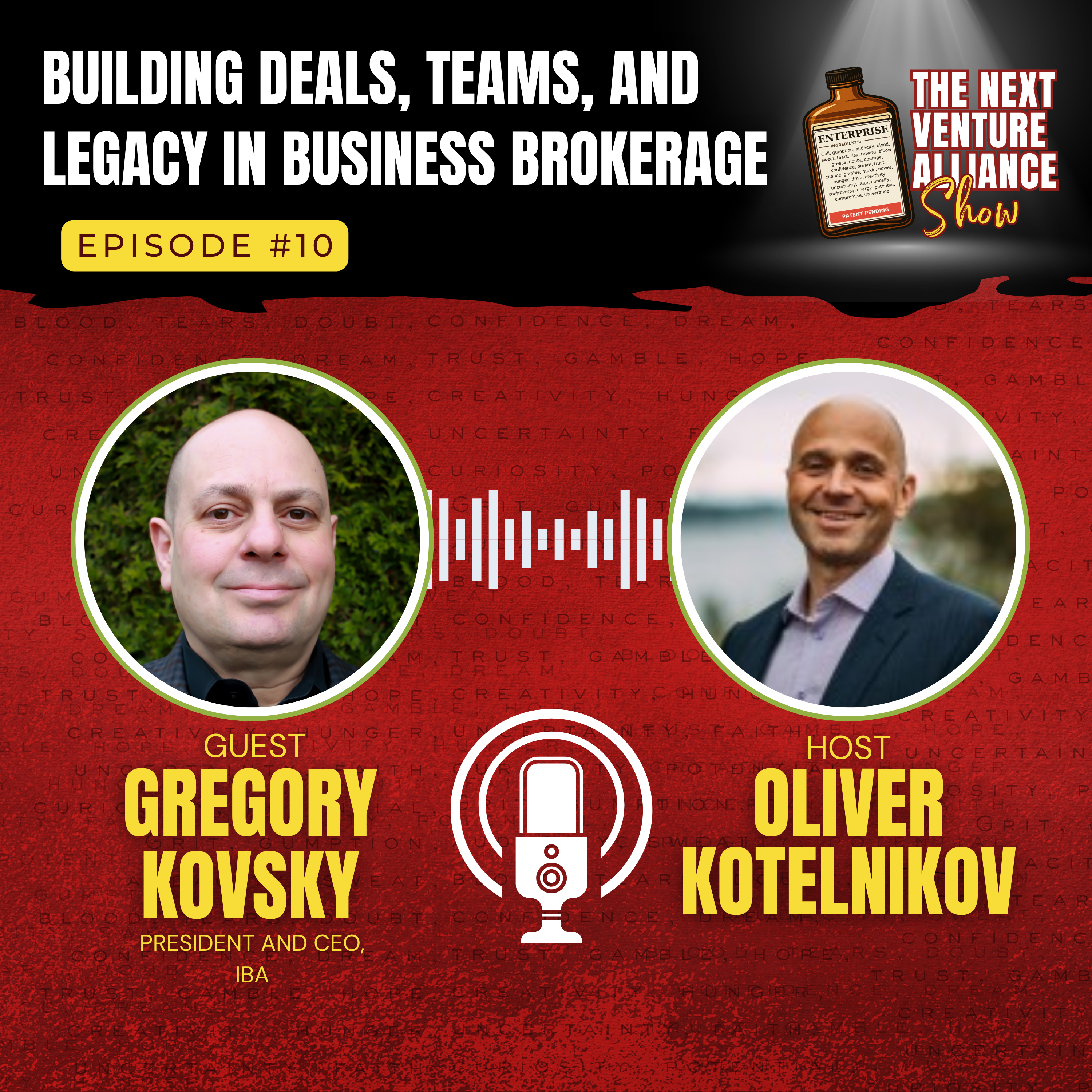
[00:00:34] Speaker B: Welcome back to another episode of the Next Venture Alliance Show. My guest today is the President and CEO of iba, Gregory Kofsky.
IBA is a mergers and acquisitions firm based in the Pacific Northwest focused on the sale of privately held companies and working closely with and advising founders, entrepreneurs and family owned businesses on succession planning, transition events and really some of the biggest decisions of their lives.
The firm has been serving the Pacific Northwest business community for over 50 years and in that time has completed nearly 4,500 transactions across industries manufacturing, distribution, technology, construction, hospitality, professional services, and the list goes on.
Now of those 50 years, Gregory has been at the helm for 32 of them and he's personally facilitated over 300 transactions.
So if you're in the M and A world or anywhere near the deal space, just pause on that for a second. 300 deals personally closed while raising a family, leading a company and overseeing 20 active, ambitious intermediaries as a designated broker.
Gregory's also proud Longhorn University of Texas at Austin investment finance major with a minor in physical education, which depending on the day may actually be more useful degree in this business. Now quick full disclosure. I am a broker at IBA and have proudly been with the firm since 2018.
Over that time I've come to know Gregory not just as a leader, but as a mentor and a friend.
We've had countless conversations over the years, some expected like EBITDA multiples and deal structure and negotiation strategy and what it means to be a professional advisor and others less expected like chess, poker, sports, meaning of life, benefits of the cold plunge, music, history, philosophy and the Egyptian pyramids.
And so if you're wondering how all those worlds connect, stay with us and we'll take you there.
This is a special conversation for me and I've been looking forward to it for a long time.
I might run a little long, but honestly that's probably a good thing. Gregory Koski, welcome to the show.
[00:03:13] Speaker C: Thank you Oliver. It's a pleasure to be here.
[00:03:19] Speaker B: You know we I mentioned earlier in your bio here just now that you know your education and investment finance, which you know Makes a lot of sense given your career.
But I'm going to lean into a little bit of insider trading here and say that to really understand your background and philosophy we probably need to unpack the minor in physical education.
What is, what where does that come from and how did that shape who you are today?
[00:03:49] Speaker C: Thank you. And I would add to your list of common experiences is being a father of daughters.
You have been a trusted sounding board as a male navigates girl's life from start into their 20s.
[00:04:10] Speaker B: It's a precarious position to be in, isn't it? Isn't it the most challenging and rewarding experience but it can test your mettle for sure. And so I appreciate that.
[00:04:23] Speaker C: Yeah, that's definitely especially young adolescent females. They can make very persuasive arguments utilizing tools that we do not have as
[00:04:36] Speaker B: men or, or knew that ever existed. So you know, but that's, that, that's a part of it. But yeah, thank you. No, and you know that's just a short list of both your accomplishments and, and our touch points and how we connect.
You know, that's why I mentioned it. Could be a long conversation.
But you know, let's, let's start with your, with, with your career as a coach first and how that informs who you are today and how you run a mergers and acquisitions firm certainly.
[00:05:14] Speaker C: So my first love in life was basketball.
I grew up in Portland.
Portland has one professional sports team, the Portland Trailblazers.
And they won their only championship during my formative years during elementary school. And was enamored with the game, learning it, watching Dr. Jack Ramsey coach the Trailblazers who was one of the best NBA coaches in the history of the game.
And I'm kind of like Rudy in a basketball sense for from the movie.
Not a lick of athletic talent. You know, when I stretch I reach 5, 9.
Not off the charts athletic ability, but the heart of a champion.
And I loved the, the strategy of basketball. It's very similar to chess in that you need to make real time decisions both as a player and a coach that have immediate implications that incrementally a 60 run in the second quarter could end up being the only difference in the game at the end of the day that could be the separation point or less.
And so intellectually the game fascinated me from a young age.
I was coaching youth teams before I could drive. My local athletic department for youth athletics, Walton Hills park and Recreation District tapped in me at 15 to coach a team of sixth graders that they couldn't find a coach for.
So I was doing that as long as well as playing and fell in love with the game and was engaged with it actively as a coach from 15 until 27. I played and coached throughout high school, attended coaching conferences before I graduated high school. To hear John Thompson at Georgetown and others talk before they, you know, before I was academically, even at a college level, was just fascinated to learn everything and anything about the game.
And I was blessed. Growing up in Portland, it's kind of interesting how different elements combine.
Beaverton, Oregon, where I grew up, was the birthplace in Nike.
So Nike was hosting these coaching conferences which you could pay to attend, where college coaches were coming in from around the nation.
And so I was at the right place at the right time to learn basketball. And I went off to the University of Texas, was a student manager for the basketball team there, was lettered by my head coach for my efforts. And I got to college graduation and was talking to my father. I had opportunities to go to Wall street and work in an investment and one of those slave 60, 70 hour a week jobs at Morgan Stanley that was the entry to Wall Street.
But my father said to me, you've wanted to be a coach your whole life.
I don't want you to be one of those people in their 40s always wonders, what if?
Go coach.
And that $18,000 a year job they're offering you is a step up from being a starving college student. You'll be fine.
Go chase your dream.
I chased my dream for four years post college.
Worked basketball camps to network from Dale Brown at Louisiana State up to Judd Heathcote at Michigan State to Roy Williams at Kansas to Paul Evans out at Pittsburgh. Many took a shine to me, mentored me. Worked camps for Rick Pitino and Denny Crummy in the state of Kentucky. I'm kind of proud that very few young coaches had the ability to navigate between Louisville and Kentucky, who are arch rivals, and was blessed to be offered positions. I'm a salesman by personality and became a recruiter. My mentors said, if you can recruit, there's always a place for you in coaching. And had opportunities to recruit the cities of Detroit, Chicago, Memphis, Houston, Seattle, and had success and was a wonderful impact on my life and I chase the dream. But after four years with several Division 1 offers on the table to join staff, I decided it wasn't right for me and exited.
[00:11:34] Speaker B: Yeah, and it truly is kind of a Rudy story. I mean, there are just, you know, frighteningly many parallels or impressively many parallels. However, however you looked at it, but, but you know, your Career started with work ethic, right? That, that was the foundational element was work ethic. And then your sales jobs came in at recruiting top talent. I mean is that, do I understand that correctly?
[00:12:01] Speaker C: Yes. I had been a salesperson from a young age.
I in high school sold timeshares as one of my income streams, I thought.
[00:12:14] Speaker B: And effectively you were good at it.
[00:12:16] Speaker C: Yeah, we were really good. I remember having a desk next to an ex Navy guy named Denver and all we had was kind of pictures of the places we were selling on the phone and we would dial for dollars and paint wonderful pictures of these resort properties to try to get people to go see them for a free three day weekend.
[00:12:49] Speaker B: So like a Glengarry Glen Ross type phone call?
[00:12:52] Speaker C: Yeah, exactly. Just thank you for taking my call. Mrs. Johnson, how long have you been married? Would you and your husband like to go to the Oregon coast for the weekend? We have a beautiful resort property and we're able to offer you as a chance to see the property in the location.
Two nights and three days and all you got to do is sit through a 90 minute presentation.
[00:13:25] Speaker B: Mm, wow. So, so then that translates into recruiting and that's a tough job, right? I mean recruiting top talent on some of these kind of inner city environments. I mean one, you got to scout talent and then you got to convince them to come play.
[00:13:44] Speaker C: Correct? I mean I was going to 100 high school games a year assessing talent because we only had 12 scholarships.
So if you err and you're judge of talent, you're going to struggle on the basketball court and would go into the inner city of Chicago, into Louisville, Memphis, some of the cities I like to recruit because the academics weren't necessarily good. And coaching at a junior college, you're recruiting MBA, high college level talent.
They just can't pass their SATs, they don't graduate from high school.
But it is the best talent. So you're assessing who they are and what they can do within your program.
And for example, I know you're a basketball fan, but the Jayhawk Conference, where I was coaching in Kansas, in my league when I was there, Reuben Patterson who played for the Sonics and Junior Ryder who played for the Blazers were junior college players. That was the level of talent on the court in a gym with maybe 500 people watching each night. I mean it wasn't the big lights and the big thing, but the level of basketball was incredible.
And the big name coaches would come to see your players because that's where they would matriculate to, to play at A higher level. Reuben Patterson went to University of Cincinnati and then on to the NBA. JR R Rider went on to play at UNLV and then into the NBA.
So it was a stepping stone for those very talented players.
But it was also a high failure rate. And it was one thing that contributed to me leaving the profession is that you had wing nuts who had MBA level talent who wouldn't go to school and would flunk out of a community college.
You had players who just wanted to play video games and smoke pot who would flunk out and leave and you would, your heart would just break for them. Again, I'm the Rudy ass person. If I had been blessed with their level of talent and athletic ability, I would be playing in the NBA because the work ethic would not have been the issue.
But this illogical world, and we can talk about it if you want, broke me down after a period of time.
I got a player who signed early at Boston College, a great school in the Big east, who failed to graduate and had to come play to junior college.
Not a logical decision.
[00:17:15] Speaker B: No.
[00:17:16] Speaker C: I had a player, an unbelievable point guard who I watched in a pro am league go for over 50 points head to head with Anthony Peeler who played with the Lakers. Yeah, dad was a drug lord who convinced his son to drop out of college to come work in his organization because he needed him to courier money from the streets into the corporate office.
These are types of things that do not exist in the normal world.
And it just made my head spin after a while.
You couldn't solve the Rubik's Cube. It's defaulting to answers that in a real world don't make any sense. Why would a dad tell his son, don't get a college education, don't potentially play in the NBA. I'll pay you 10,000 a week to work for my drug organization because I can trust you.
And this is the same kid who I had great heart to heart conversations with who went to three funerals of cousins while he was playing for me because they were shot in the streets.
So I mean it's just an unreal world. And I guess growing up in Portland I had a little bit of a utopian view of the world.
The Northwest.
When I would get into the inner cities of Chicago, Detroit, other cities, there are areas you don't want to go into East St. Louis at night.
It is not a garden spot in the United States.
It's the place that you park on the street and you come back and you don't have the tires on your Car, at least when I was there.
[00:19:31] Speaker B: Yeah. And the world's full of those kinds of dead zones. And we're, you know, we're blessed and we, we live. And sometimes you get into a, you know, a safe, assimilated environment and then a dose of reality hits. But it sounds like you, you exited the career of a basketball coach on a heartbreak. I mean, you, you, you, you left because it was, you know, disappointing on many levels to the extent that you couldn't handle or not handle, but absorb or didn't want to deal with.
[00:20:05] Speaker C: With that, not unsupport to your story in that I exited it on my terms. I mean, again, I had Division 1 offers to stay. I was a proven recruiter who had relationships with high school coaches through doing camps and recruiting.
So I would say the tank was empty, but the opportunity existed for me to stay on that path and continue.
But one of the things I learned in coaching that I believe has made me uniquely successful as a business broker is how to sell intangible assets.
What is more intangible to sell than a junior college education to a high school kid?
You are just selling yourself. Come play for me.
I will develop you to a level where you can go to the next step and fulfill your goals.
But what's the difference between one community college and the next?
It's not like you're selling Stanford or Duke.
[00:21:25] Speaker B: No, no. You don't have the program, so you got to find. Right. The value and the intangibles and many parallels there. And coach, we'll return to. But we'll return to basketball.
But, but how do you exit basketball and transition into business brokerage?
[00:21:43] Speaker C: Sure. So I come back to the Northwest to visit my folks who are living in Seattle.
And honestly, I don't know what my next step is going to be.
Part of me says I'm just going to spend a summer here and move on.
Because I like some of the other places in the United States better than the Northwest.
My grandparents were down in San Diego. I was close with, and I was thinking maybe try San Diego as my next city and next career.
So I got a job working in the pro shop at the Seattle Tennis Club. I had been a tennis player growing up as well and was involved with the Seattle Open for one summer.
Then I was talking with my father and he said, I think you would be good at selling businesses. You're a salesman by personality. You've got the accounting and finance background academically.
Let me introduce you to the founder of iba, Bill Osofsky.
So IBA had sold my father's veterinary hospital and real estate in Portland, Oregon.
And he had been impressed with them during the process.
And so he had a good relationship with the owner. And so IBA's corporate headquarters at that time were in Portland, Oregon. I went down, stayed with my mom's mom, who had a condo in Portland, my grandmother Pearl, and went and met with them.
And it intrigued me. And coming from basketball, I was used to being assessed on wins and losses.
So being paid 100% on performance was no different than coaching. If you don't win in coaching, you're fired.
I said, that's no different. I'm happy to do that.
And so decided to throw my hat in the ring.
Stayed with my grandmother while I was trained down in Portland, but chose to affiliate with the Bellevue office. IBA had extended up to Bellevue in 91 and decided I would affiliate with that new office. It's a bigger, more dynamic city.
And so was one of three brokers up here in Seattle starting in 94.
[00:24:38] Speaker B: Yeah, I mean, I can only imagine the industry in 94. I mean, one of the early pieces of wisdom you'd imparted to me is that this is a unique profession. It's a fairly rare profession, and that not many people know a business broker or even have one, you know, within a few degrees in their network.
So you know who is a business broker and what do they do. In your understanding or interpretation, business brokerage
[00:25:11] Speaker C: is a very unique profession.
It has a low barrier to entry, which I actually think is wrong, because the sale of a business is one of the most sophisticated, nuanced transactions that can be facilitated.
But a business broker actually needs to have knowledge in numerous domains.
We need to understand accounting, tax, finance, law, business, real estate,
[00:25:54] Speaker B: psychology, biology, physics, relationships.
[00:26:01] Speaker C: It's almost endless.
And you know, in my organization, my mom was a school teacher.
I have built it on an education platform where one of my goals as an executive is have the most knowledgeable team in the marketplace.
And monthly, if not more commonly, we have education sessions designed to prepare us for battle. For example, this month we had an attorney come in talking about selling medical practices.
So it wasn't just business sales and purchase and sales. It was a drill down to what specifically you need to know when selling a medical practice.
You're not getting that type of education at very many other firms in the nation. I know that for a fact.
[00:27:07] Speaker B: And I will add to that that there isn't, you know, you do this out of your philosophy and conviction for, you know, what the profession needs to Be.
There's no law that requires us to be educated on the sale of medical facilities or any number of, I mean, at this point, you know, two, 300 educational events that, that we have participated in.
We, we don't need that to maintain our license. Right. And, and so, so this is done.
This has to do with your philosophy of leadership and, and kind of what you believe the profession needs to represent, because the low end of the bar, as we know, is very low. Right. There are sort of, you know, examples in this profession where, you know, we're both business brokers, but the difference is so vast that it's, it's, you know, it wouldn't be clear to the naked eye that we're even in the same profession.
[00:28:19] Speaker C: Certainly. I mean, you're not required in many states to have a real estate license to be a business broker. I require that at iba and you can talk about if you hadn't been educated on real estate, could you have sold the iconic restaurant bar you just sold that required you to get DNR leases assigned because it was a waterfront property that people can come to by boat.
[00:29:00] Speaker B: Right?
Yeah. And, and there isn't. And, you know, that's absolutely a requirement whether you sell, lease or transition real estate or engage in landlord negotiations. I, I just don't know how, how that, you know, isn't a part of the business brokerage curriculum in some instances. But, you know, I find, routinely find myself going back to some of the educational sessions and things. I, you know, it could have been a full lesson or it could have been just something that piqued my interest and just, you know, I didn't know that, that whatever the topic was, was a part of things or was an important part of business transactions. But I'd go look it up or learn more about it, and then it would come up and I would find myself thinking, what would I do right now if I didn't have the background knowledge on this? You know, I just find myself endlessly deferring.
And I don't know that that's not a good look for a professional advisor in a transaction.
[00:30:09] Speaker C: Exactly. I mean, simple thing. You have a business with real estate being sold.
The family has owned it for 40 years.
It has appreciated significantly in value.
We know, to grab the tool of a 1031 exchange and present that as an option to the owner to mitigate the tax implications of sale.
If you don't know about 1031 exchanges, if you don't have a resource to do the 1031 exchange facilitation you are underserving your client. So that has been always. My focus is to give my team comprehensive toolboxes. And the reality is, things I educate on, you may not need for three, five years.
But if you know that you need a Phillips screwdriver of that size in that situation and you have it in your box, you just go grab it and you deploy it and tighten it down and move on. I mean, but if you are trying, you've probably done this. I have. If you're trying to screw a Phillips head with a flathead screwdriver, doesn't really work that great.
[00:31:44] Speaker B: Yeah, it's the wrong tool for the job. And part of it, you know, requires knowing where.
You know where your licensure ends and you need to outsource it to a professional.
You know, if we're, you know, we just traveled from evaluating a property from commercial real estate to accounting to a 1031 exchange and tax mitigation, there may be legal issues there that could be an estate planning consideration. Those are all different people. You know, if, if I'm able to advise on that, I will. If I, if I may, you know, if, if my job there is to, to recognize that this is a different domain and point them in the right direction, that's also a data point that we need to have.
[00:32:23] Speaker C: Well, and that gets back to the coaching. It's. I build quality teams.
Early on, I'm talking to my client and saying, do you have these people? Do you have an attorney?
Do you have maybe multiple attorneys? Because maybe it's a union shop and we need an attorney with knowledge on transferring union contracts. Well, I can introduce them to someone if they need a specialized attorney.
Do you have a CPA who is a good transactional CPA which is different than one that fills in boxes based on your QuickBooks report.
Do you have a wealth advisor? What are you going to do with this money?
What are your plans for retirement and legacy? Maybe charity.
All those things come into what we do.
And our job is to prepare our clients for success.
And frankly, we also prepare buyers for success because we want win win transactions.
I don't want a buyer underrepresented because if the two attorneys know the middle of the fairway, it's a lot easier than 1tr trying to learn on the run of what's reasonable in terms of reps and warranties.
[00:33:55] Speaker B: Yeah, if you're entering a business deal from family law, you know, it may be legally permissible, but are we bringing in the right advisor that best serves everybody at that point?
And you Know, business brokerage is often seen as a, as a borderless industry like it is. It's easy to work from anywhere in the world.
But you know, you were born and raised in Oregon and you live in Washington. And with rare exceptions, you know, IBA serves sellers in the Washington and Oregon markets. So you know, why the emphasis on the local knowledge and kind of the deep regional focus? And why not expand IBA nationally or globally or just go big?
[00:34:54] Speaker C: Local knowledge matters.
And let me give you a couple examples. We'll start with where we were.
If I need professional support for a client, I have a deep Rolodex in the Pacific Northwest.
If you drop me into Denver or Atlanta, I do not have the people I need.
If we're selling a property that used to be a gas station and we need an environmental inspection and maybe even environmental remediation, I can problem solve that effectively.
In the Northwest, I can't do it effectively in Boston.
I could maybe put deals together, but my Rolodex, my resources are diminished. So that's one reason.
The second reason is local knowledge matters in valuation.
Different areas have different market demand dynamics, different minimum wage employment rates, different state local taxes.
All of those impact value.
And unless you're swimming in that current, you, you're not going to know what the temperature of the water is. The best way to get to shore against a cross current where the bottom of the river is that you can actually put down your feet and begin to take land.
All of those pieces require local knowledge.
And you can try to navigate things from an air balloon.
I would rather navigate a terrain with boots on the ground.
[00:37:11] Speaker B: Yeah, maybe. I mean, the same can be said for the transactional team that we just talked about. If there's a lender that's underwriting the risk of an acquisition and they know, and maybe the real estate's involved, but they know the city, the county, they've been there as a customer.
That helps them in a unique situation like a business sale. Because again, we're not selling boats, cars or houses with the large comparative market data set or attorneys if they're writing contracts. If it's a real estate contract, do you have to have local knowledge?
You know, if you're living in Washington and an attorney practicing in Washington, you likely have experience with a waterway lease. Right, because we're surrounded by water. Like you'd mentioned Department of Natural Resources.
You know, if you're in a landlocked state and you've never come across water rights and you're trying to advise on a lease Or a contract.
You know, I think you're at a disadvantage.
[00:38:25] Speaker C: No, and you're right, Ryan. Rights can differ between states. They're different between Washington and Oregon.
And on the banker front, I would say it's so nice to be able to meet someone in person, discuss issues and problem solve. I'll give an example. A well known SBA lender nationwide is Lisa Forrest.
I have known Lisa through multiple banks because she's based here in the Northwest.
We were involved in the sale of a marine electrical contracting company.
Seattle is the winter port for the Alaska fishing fleet. They come down here for repairs and service at a high level.
In one of the sales we're working on, it looked like there was a significant customer concentration for a marine electrical contractor with Trident Seafood, a big company.
[00:39:39] Speaker B: Yeah,
[00:39:42] Speaker C: that was a concern to the lender.
Lisa and I, working with my client and the buyer, drilled down in the issue and it was determined that each vessel has purchasing power. Yes, they were all part of Tried in Seafood, but the captains of the ship, because they are responsible, decide who they bring in as service vendors.
So we were able to provide a chart of boats and show the rise and fall of orders, depending if it was just a maintenance year or maybe installing new equipment or something.
And rather than one customer, it became a broad spectrum of customers and the bank approved the loan and the transaction went successfully. And I remained friends with the buyer who actually hired me to help him acquire another competitor in the space.
So that's an example.
If you can't communicate effectively and problem solve with a known party, the deal may have failed, even though we had a willing buyer and seller.
[00:41:13] Speaker B: And I will say, you know, in testament to that, many of our collaborative partners are guests at our educational events or, you know, know, social gatherings to where we work with people who live somewhere near the projects that we're all representing as a team. And so, you know, there's a time in every transaction where, you know, it, it gets difficult and challenging. And at that time, I think you want those factors working in your favor if there is familiarity, if there is an understanding, if there's personal experience, which, you know, the sale of family businesses is, is deeply personal, you know, a commoditized approach doesn't work. I mean, you can, you can fund something from three states away, you know, maybe in a, in a different kind of transaction. But, but I think we've all had these points and transactions where you realize how important it is, that it's just all hands on deck and that local knowledge and presence is part of the equation.
[00:42:34] Speaker C: Exactly. Well, you helped launch and you manage IBA's office in Wenatchee. And for a natural national audience who listens to this podcast, I would challenge anyone to put Wenatchee on a map. If you don't live in Washington, it's not an obvious city or location that people know.
But based on the volume of transactions you've done in that space, if someone asks you for an attorney, a cpa, a banker, even a real estate broker to help them buy a home or lease a new space, I assume you have the ability to direct them to skilled people, even into a town that many people out of the state of Washington may mispronounce the name.
[00:43:37] Speaker B: And they often do.
Yes. And it's also important from the client standpoint because again, the sale of the business is so personal that if you don't have an understanding of the surrounding areas of the, you know, the kinds of people that live there, of what the community represents, it's, it's impossible to, to represent an asset like that for sale professionally if you don't have that narrative in those data points.
[00:44:13] Speaker C: So I, I mean, there's a local connection and that's important.
Out of all 10 of our offices, how much your life has your summer vacation as a family been spent in the Wenatchee area?
[00:44:32] Speaker B: Every, I mean, every, every summer. Right. And, and you know, Columbia river is different than the Hudson river, right? They're in the Mississippi. They're, they're, they're, they're all great rivers and, and, and have their, you know, their fan clubs. But, but they're, but they're different and the people that live around them are different. And
[00:44:56] Speaker C: your dad attests to the medicinal benefits of the local lakes there. And how old is he now?
[00:45:05] Speaker B: It, you know, dad's, you know, I'm blessed to have a father who's 85. And I mean, to him, so plague is second only to Lake Baikal. You know, that's so, so yes, you know, local knowledge and you know, these transactions you mentioned, it's a nuanced and complicated process and that's important to understand is that having the hands on knowledge, the narrative around geography, personalities, history, you know, culture, all of that is important, or you can't really sell a business effectively without it.
But I, I want to ask you about your leadership style. And you know, it's, it's unique in the corporate world. You wear your heart on your sleeve. You, you know, profess your faith. You don't believe in having a separate personality from your professional life. And I would say that you, you know, for the lack of a better term, bring your whole self to work.
And it's, it's very authentic and it's very effective, but it also carries a vulnerability. You know, in, in, in today's world, that's not always the, you know, the, the path of least resistance or, or the, the safest way for, for a leader to travel from point A to point B.
Talk about your philosophy and kind of why you've chosen to lead that way, certainly.
[00:46:50] Speaker C: So I would start with my life philosophy. That is to follow the golden rule of treating others as I want to be treated.
And that's professionally and personally is a governing element. I always look at every situation from the other side.
I also think it makes IBA and our team more effective as professional intermediaries. Is we, by design, look at the other side of the equation and encourage our clients to walk around the table and look at the deal from the other side? Are we being reasonable? Are we being fair?
Because the reality in our sales, yes, everyone wants the bag of gold, but they also care about their employees, their customers, their vendors.
Entrepreneurs run family businesses.
They've watched people get married, have kids, take care of aging parents.
They've heard the stories.
They truly care.
They care about their customers. It could be just a community flower shop, but they've provided flowers that were boutonnieres or corsages at prom, that were wedding flowers that were at childbirth, et cetera.
They know the communities that they operate in and they care about their customers.
And same with vendors.
It's an ecosystem.
When you ran your bakery, you got to know the people who sold you product, and their success depended on your success.
And so when we sell businesses, we can't control the executive management ability of the buyer, but we can do scrutiny and have honest discussions with our client in choosing a successor and hopefully set the business up for success in the future. So I'd say the starting point is the golden rule.
The next step, I would say with my management philosophy, and this gets back into coaching, and even when I'm a scrawny kid trying to play basketball, soccer, baseball, etc.
Is never let people outwork you so you can comment. I know many of your colleagues are.
People are regularly impressed at the level I show up and contribute to the company and them individually on every given day. So I don't believe I should ever be the weak link.
I should be appreciative of my team and support them to the best of my ability. So that's a piece for me.
And then I would throw out something my mom taught me, which I believe has borne true. I think I'd welcome your comment on her philosophy. But if you deliver quality, money takes care of itself, and that has been true throughout my life, is just deliver the best quality in the marketplace.
And as an entrepreneur, that has led to an ability to take care of my wife, my kids, travel, do the things that I wanted to achieve in life.
[00:51:02] Speaker B: Yeah, and I'm. I'm definitely a believer. I, you know, I spent my entrepreneurial career or baking career obsessed with product.
I. There were times where I knew very little about, you know, how much ingredients cost or what the purchase of a specific piece of equipment, you know, how it will impact the bottom line.
You know, I was almost, you know, unreasonably focused on the quality of the product. And there are times where, you know, it ebbed and flowed and got us in trouble. But, but ultimately it produced something that is world, you know, that is known worldwide.
And I, it didn't, it didn't affect me, you know, if I could save, you know, some money and I bought the best possible ingredients, I, you know, try to hire the right people and, you know, treat people right and sort of run a company that wasn't,
[00:52:14] Speaker C: you
[00:52:15] Speaker B: know, ultimately driven by the bottom line. Only at a certain point, it's a business and you need to make a profit. But I would say the obsession on quality of the product, which people contribute, equipment contributes, you know, people in large measure, but quality of the ingredients and, and then, and then the marketplace responds, right? And then, you know, people say, well, you know, how do you always have a line that, you know, common thing was always, well, it must be the, it must be the location. Well, businesses fail in Pike Place market. You may or may not know this, but if you're not putting forth a good product consistently, I think ultimately it. It catches up to you.
[00:52:59] Speaker C: So 100% agree. And that's where at IBA we will employ best practices, which honestly are like a seatbelt.
Most of the time, you are not going to need some of the practices we employ until you do or you're going through the windshield in an accident.
And an example for the audience would be, we always do an equipment inspection.
We want the buyer to test the equipment. If they want to take vehicles in a fleet to a mechanic before purchase, we encourage it because we want them to go in with open eyes.
And if there's a crack in a windshield, let's get that replaced for the sales completed, because it's probably free under our clients insurance.
But if they buy it with the crack, it's not going to be free as a pre existing condition under the buyer's insurance. And it may seem very minor, but we want to make sure the buyer goes in with open eyes, understands the as is condition of everything they're buying.
And if there is something that's not working, let's talk about it as a broker, as buyer and seller and say, yeah, you are correct.
This vehicle has a blown transmission, it's not operational right now.
How do we want to treat it? It's not a significant value in the sale. I disclosed it at a blown transmission.
Do you want me to take it to the junkyard?
Do you want to discount the price and allow me to sell it for what I can get for it?
Those are types of solutions.
But let's talk about these things. I mean, you know, my philosophy is let's put it all into sunlight.
Let's go into the transaction with open eyes on both sides.
From the seller side, you may think, oh, this puts the deal at risk. It could hurt me.
My answer is it mitigates liability.
Because if a buyer knows that your top salesman is 74 years old and has threatened to retire the last five years, but really needs the money, their spouse has died, is lonely, if they're at home, then you are okay.
If six months after the sale they do retire, they fall in love with someone and decide they're moving to Palm Springs and they're going to change their life, that's okay. But if we didn't disclose that employee had threatened to retire, they're 74 years old, and then it happens, now the buyer could be in a world of hurt because 12% of revenue last year was generated by that salesperson who had decade old relationships that he wouldn't let anyone else touch.
[00:56:49] Speaker B: Mm.
Yeah. And then it needs to be like you said, full transparency, full sunlight. Because that disclosure is different. If you say, you know, he's past retirement age, he's 74, but he needs the money, he's not going anywhere.
If you skip the part where he has threatened to retire five times, then you're not completely honest. And then if he does, then it turns from maybe an uncomfortable discussion and due diligence to a post closing trailing liability. And that can be a repair, that can be a disclosure, it can be any number of things.
Right. But when it.
[00:57:33] Speaker C: And I'm very proud that in my 32 years of doing this, and that was six as a broker working under the founder, Bill Osofsky, and 26, as the president CEO owning the firm, I have a very small number of transactions that have progressed to future litigation between the parties.
And the reality in our world is if a buyer fails, if the environment of full disclosure has been created with transparency, the only failure point is the executive management ability of the buyer.
And that's hard to litigate on.
But if a material fact has not been disclosed, that is an easy issue to litigate on.
[00:58:45] Speaker B: It's the easiest. Yeah.
[00:58:47] Speaker C: And so we want to. Our job's to protect the seller and the transaction.
And to quote one of my peers in the industry who's unfortunately deceased now, Bill Pirasal, he used to say, and it's probably not politically correct in 2026, he said, you want to take your client open kimono?
[00:59:17] Speaker B: Yeah, no, I mean, that's what it is. It is, you know, due diligence is, you can say looking under the hood, but it's really stripping down, you know, in a, in, in a lit room and, and, and, you know, open Komodo is a more accurate sort of parallel to, and description of, of, of what happens. And I, I say the same thing. You know, it's, it's due diligence. As difficult as it is or as cumbersome as it can be.
It's a timed event and it protects you. Right. There's this idea of we're doing this for the buyer.
It's, it's for both sides, but really it's the seller that bears most of the liability.
And, you know, full disclosure, once it's all said and done, you can sleep at night.
[01:00:19] Speaker C: Well, nothing on this earth. Perfect.
I've been married 26 years.
The closest person to perfection I've ever found is my wife.
But she definitely.
[01:00:32] Speaker B: Good job going on record with that. That's nice.
[01:00:35] Speaker C: But she definitely has idiosyncrasies that I adore but are not always easy to weather. One being my wife's from Germany. You, you've met Jeanette?
[01:00:51] Speaker B: Absolutely.
[01:00:52] Speaker C: Jeanette has no screens.
She is a blunt speaking German woman
[01:01:00] Speaker B: and
[01:01:03] Speaker C: she tells you all the time exactly what's on her mind.
In sales, I tend to be more politically correct, more complimentary.
She would not be a good salesperson because, you know, if you look fat in that dress, she's likely to blunt tell her best friend at their daughter's wedding.
I don't think that was a good dress choice. I mean, really?
[01:01:37] Speaker B: Yeah.
I mean, and again, that protects her from carrying around all that stress and internalizing and wearing a mask. Right. You, you let it out and let the cards fall where they may. And if, you know, if you lose some friends in the process or people that may not have been friends in the first place, so be it.
[01:01:58] Speaker C: Now, one of our frustrating things, coming to America and learning the culture when we had young kids, and most people can relate to this, she would meet someone at a party, like a birthday party for the kids or whatever, and in common American, they would say we should get together sometime and do a play date. Well, to my wife that meant we should get together and do a play date.
To many Americans, it's just banter with no desire for execution.
[01:02:37] Speaker B: Yeah, there's no. They forget it as soon as they say it.
[01:02:41] Speaker C: And that's, you know, a cultural difference, which is actually an interesting thing about iba, and maybe you can talk on it as well, is we work with a lot of first generation immigrants to this nation and handling cultural differences in how they look at the world, how they negotiate, how they run their businesses.
You sold hospitality businesses where the staff is basically one family, haven't you?
[01:03:30] Speaker B: Yeah. I mean, sometimes they're closer than family.
It's a very tight ecosystem. Yeah.
[01:03:39] Speaker C: And so we try to support that community, but it helps to be able to understand how they look. I mean, I've been complimented in the Korean community, which has its own business brokerage segment, where I've been told I would rather use a Caucasian broker than a Korean broker because you're going to be more honest with me and your skill set is higher in facilitating the sale.
[01:04:22] Speaker B: Yeah. And we're, we're all vastly different. I mean, language is one thing, culture is another.
History and sort of customary approaches in the business transaction.
I mean, I've had, I've had those headwinds and have needed to adjust, you know, what you think is a compliment, maybe an insult, and vice versa in some cultures.
And you know, I have a fairly good grass bunch or the European approach, but yeah, it can get you in trouble.
[01:05:01] Speaker C: Yeah. Do you know what color flowers Chinese use at weddings?
[01:05:07] Speaker B: I do not.
[01:05:09] Speaker C: Well, you would think a white wedding is beautiful from European American background.
Red is the color for flowers. And a Chinese wedding, white symbolizes death.
[01:05:23] Speaker B: Right. Yeah. And, and there are similar elements in numerology where I've been in transactions, where I've written offers or, or, or, or chosen dates that were just, you know, dismissed with disgust, dis and perceived as being insensitive.
And I had to learn that on the fly.
[01:05:49] Speaker C: Well, and again, those are the nuanced knowledge that a business broker needs. Where we were talking earlier.
Who thought you'd be in a profession where numerology could make or break a deal?
[01:06:05] Speaker B: It.
Yeah.
I mean, I didn't see it coming, I'll tell you that.
You know, sometimes you. You can predict, you know, the issues in a purchase and sale agreement or in a negotiation, but numerology blindsided me.
[01:06:25] Speaker C: Yeah. And that's. We didn't list that one earlier. I mean, those. Again, I think one of the challenges that you and I appreciate is each deal is different.
You are truly playing a new opponent with a new team on your side and a new opponent's team on the other side every time you enter the court as a business broker.
[01:06:53] Speaker B: And I think you and I both like the Rubik's Cube analogy. I mean, there are millions of combinations to scramble a Rubik's Cube cube. They're still the same colors and the same goal, but every transaction is a different scramble. And you get handed this Rubik's Cube in whatever state it's in, saying, here, put this together.
You know, and it's.
It's a different path to.
To that waterfall every time.
[01:07:24] Speaker C: 1. A different side of the Rubik's Cube can be near completion. Maybe we have 15 years left on their lease, and we know we need 10 for an SBA loan. So we're like, easy assignment. We're done with that one.
But at the same time, their accounting is a muddy mess.
And showing to a bank what the owner truly earns be a very difficult sign side of the Rubik's Cube to work through to get the price that is justified. The owner truly earns X amount running the business, and the buyer believes them, but maybe the paperwork does not show that value.
[01:08:17] Speaker B: Yeah. And it's not a linear equation. So if you've ever tried to put the Rubik's Cube together by just rudimentary. Rudimentary kind of collection of all trying to collect all the colors in the same side. It doesn't work. There's an algorithm. Right. You have to. To get to point 8 to point B is not a straight line.
You have to take four turns to get there.
And so the, you know, every transaction has a little bit of its own algorithm.
And yeah, different challenges. It could be employees, it could be buyer seller dynamics. It could be something that changed in the course of the transaction. And, you know, I mean, the list goes on, but we need to be. And they don't all appear in the same transaction, but we don't know which combination of challenges will appear. So you have to be ready for all of them. It's kind of like a, a test.
You know that there are 200 possible questions. 30 of them will be on the test. You don't know which 30.
You have to study all 200.
[01:09:26] Speaker C: Exactly. No. And that's where knowledge, experience and skill matter in selling a business.
[01:09:35] Speaker B: I want to return to sports and it's, you know, so we talked about it a little bit and it's a common recurring theme in, in your public Persona or I'd say LinkedIn posts. And they're very entertaining but also educational and, and they often travel, you know, and they sample far and wide to illustrate a point.
And you know, you said that the competitive nature of sports is a close proximity to business dynamics and you can learn a lot you know, about one by learning about the other.
This year in the NCAA tournament, your Longhorns are looking very promising. You recently praised your first year coach, Sean Miller, who credited his success to time spent as a player under another hall of Fame coach, John Calipari, and specifically a timely dose of tough love. Talk about that LinkedIn post and that particular incident and what are the takeaways from that lesson?
[01:10:50] Speaker C: Certainly a mentorship matters for me. Having the ability to learn from Bill Osofsky, who started IBA in 1975 and had nearly 20 years of experience doing transactions when I joined the firm, along with other senior brokers on the team, Rod Behr, Susan Howard, Wendell George helped me develop the knowledge and experience, even if it was secondary, to be successful. So anyone who thinks they can go through life alone without a coach, a teacher, a mentor, is being naive.
You can learn in the school of hard knocks, but it is much better to have a sounding board.
And I continue to try to do that at iba, where when you hit a problem, let's talk, let's whiteboard it, let's problem solve it.
But I also believe in honesty. And maybe you'll include the clip from Sean Miller in your notes. For this you need to be honest, and I do this with my team.
You can lose deals based on your skill, your facilitation, your negotiation.
And you need to be willing to look in the mirror and say, you didn't bring your A game.
You didn't value this business correctly, you didn't problem solve through that issue.
I often say within our walls that there are problems that three out of five business brokers can problem solve.
There are problems that one out of five, one out of ten, one out of a hundred, one out of thousand.
I would much rather be the person who delivers in that one out of a thousand situation, the Michael Jordan with the final shot against the Utah Jazz where he walked away a victor because he delivered at the right time in place.
A lot of other players could have taken that shot.
[01:13:36] Speaker B: This is the 11 against Byron Russell.
[01:13:39] Speaker C: Yes.
[01:13:40] Speaker B: Yeah, yeah.
[01:13:40] Speaker C: But if you look back at Michael, he also beat Georgetown with the game winning shot when he was in college at North Carolina.
[01:13:50] Speaker B: Hey, he shot a similar shot over Craig Hilo. Like, you know, that was the same kind of last second right around the free throw line.
[01:14:01] Speaker C: Exactly. And it was his skill.
And it doesn't matter what the profession is.
There are people who can rise to the occasion and problem solve and deliver under the bright lights against all odds when others can't. This is what makes humans so wonderful, is that, you know, you could be having surgery after a car accident and this may seem gruesome.
There may be a doctor who could save the leg and have you as a runner running marathons again in the future and another doctor who will lose the leg and you'll be with a prosthetic or whatever the rest of your life.
That surgeon skill matters.
And it will matter most when it is that challenging environment. When it's 28 degrees outside, it's sleeting, the wind is blowing, you know, that's when you got to step up and perform.
It's not the sunny day solution to a common problem.
[01:15:31] Speaker B: Yeah, and it's hard to quantify or understand what that magic quality is and how to cultivate it. So that competitiveness that's been pointed out, and we know all know who those players are, but we can stay with Jordan.
I mean the best of the best almost single handedly point to just an incredible will to win over anything else. I mean, ask 10 people, I mean, he had incredible leaping ability. How many of them are going to talk about how high he jumped?
Very few. It's, it's these other things that are.
How do you cultivate something like that? I mean, how do you, why, why do you at the age of 14 start sharpening your sales skills? You know, and why, why doesn't someone else, why don't, why does somebody else play video games while you have the drive or, or somebody else has the drive to do X, Y and Z and defer gratification and, and ultimately succeed and achieve at a very high level.
[01:16:44] Speaker C: But you look at Michael Jordan and he put in the effort to be great. So no one was in the gym with him during the summer when he was taking thousands of shots in preparation for that he was legendary also for his defensive ability that he may hit the game winning shot but if his opponent shot 33% in that game when they normally shoot 47%, those three other missed shots could have also been the difference between winning and losing or the assist or the rebound that he did.
You know, the great ones excel when the bright lights and the spotlight are on them, but they're also excelling when no one's watching or they don't get credit.
And that's part of my personality. I believe it's part of your personality.
I try to find people at IBA who have those type of characteristics. The high motor person who is in pursuit of excellence for excellence sake and again not thinking about the commission, taking care of that client who's retiring, selling their life work, getting them the maximum value in the transaction which as a byproduct will take care of us as brokers.
[01:18:28] Speaker B: And is that teachable? Do you find that, that particular quality?
[01:18:33] Speaker C: I, I believe if I recruit or find the right talent, you know, I am very selective on who joins iba. It's. I get asked to join IBA to learn under my mentorship regularly.
I go through a process where I will interview them face to face. If they will not come in and meet me in person, they're done.
Then I usually have a meet with three or four of the IBA team, have them ask them about the company, the industry, my management style.
But I also get feedback from those and historically if I get one black ball from any of those people they meet with, I'm probably not going to add them because I trust the judgment of my team and my team knows there's plenty of work here. We have an abundance mentality.
It's not going to detrimentally impact them that we want to increase the caliber of the team and our, our market share so positive. Then they'll meet with me again and we'll have an honest discussion and then maybe I will allow them to join the team.
But since you have joined iba, I can think of I believe two who have not ultimately been successful but during that same time we've added double digits who have achieved at a high level. Is my analysis correct?
[01:20:29] Speaker B: I would say that that's accurate. Yeah. Yeah. I mean, I don't know all of it, I don't think, but in my experience and from what I've seen, I'd support those numbers. Yeah.
[01:20:39] Speaker C: I mean as an example and one you helped me mentor and hopefully he'll listen to this.
We added a gentleman to the IBA Team who was an Olympic level boxer in Russia. Yeah, he came to America, was a successful entrepreneur, probably one of the hardest working people I've ever met in my life.
He will put in a 12 hour day for IBA and then go train people Golden Gloves to compete in boxing. I mean, it's impressive person, but he came new to the profession, very raw
[01:21:29] Speaker B: and
[01:21:31] Speaker C: I am very pleased with where he is in terms of performance in 2026.
I judged the talent, I believed appropriately.
What do you have to say about the journey that Broker took and where he is today with the mentorship he received within the organization?
[01:21:58] Speaker B: Yeah, and we can name him. This is our friend and colleague, Sergey.
I was there from the start and.
I think it took, I think it took all of his patience and energy and his background in boxing to become successful in this profession. And you know, he, like most of us, use one of our primary skills, you know, or two and we're all sort of wired a little bit differently. But I mean his work ethic and perseverance, I, I don't know, not only another person at iba, but, but, but I just don't know another person that kind of works that hard and, and you know, outworks the competition. Like you'd mentioned, you didn't want to be outworked. Right. You never wanted that red mark, you know, you got a bad break, you didn't understand something, someone was smarter, more educated, you know, all of that, you know, we can live with. But I, I think Sergey will never be outworked. And I, I think it took a little bit of time for him to buy in and, and stop applying certain things that he, you know, maybe didn't have bearing or didn't have a place.
And I think once he listened and saw the ball go through the basket a couple times, I mean, he's an asset, what can I say?
[01:23:37] Speaker C: No, I mean, but he.
A compliment to IBA's education platform.
Early on he was taking IBBA classes, thinking that that could get him up to speed more quickly.
And when he realized IBA's education platform was superior and stopped trying to do it on his own, lean into the group dynamic, ask for help, show weakness, he took a huge step forward.
And I'm very proud of Sergei. Already this year he completed a sale for approximately $5 million in transaction value. So a nice transaction.
And he brought a unique element to that transaction in that our client was a native Russian speaker.
And I touched on this briefly, but I love this about IBA concepts like reps and warranties indemnification tax allocation are hard to explain even in English to some people because it's unfamiliar territory.
Now try translating that concept from your second language back to your first language and be able to execute intelligently in a transaction, feeling you are pulling the levers, that you're just not blindly trusting someone with the biggest sale of your life.
[01:25:30] Speaker B: Sergey's ahead of me on that front because I haven't, you know, I haven't had that experience.
[01:25:36] Speaker C: And he did an exceptional job working on that transaction, taking these concepts back into Russian and getting his client to the closing line with a American buyer who spoke not a word of, you know, you ask them, do they speak Russian yet?
So, I mean, it was. But it was a good marriage and it was a perfect fit.
And I believe eight offers were generated for the client, and the client had the ability to select from that group and pick their successor from the business that they had started from, frankly, their garage and taken into a large automated manufacturing facility.
[01:26:32] Speaker B: Yeah, see, and I'd like to see, you know, a national firm that isn't focused on the Pacific Northwest deliver that level of a fit and that level of service to, to a business owner in Washington with language industry knowledge, regional local knowledge.
It's hard to find that kind of representation.
[01:27:03] Speaker C: And one of the joys of this business is the diversity of our customers.
They come in every demographic group you can imagine. I've sold, you know, male, female,
[01:27:24] Speaker B: gay,
[01:27:24] Speaker C: lesbian owned businesses, amazing gay lesbian entrepreneurs who didn't feel welcome in corporate environments and created a corporate culture that was accepting to them and built and grew the business.
And then we're ready to retire and sell and be able to hear their stories and facilitate their sales. We talked about international first generation immigrants, and that doesn't even get into all the industries that exist where businesses are sold that employ business models that we never even dreamed existed. One of the first e commerce companies I ever sold sold metal detecting and prospecting equipment.
You know, it was perfect for online because who's going to keep 30 variances of metal detectors? You'd go broke in a retail environment.
[01:28:38] Speaker B: Yeah. What a niche business model.
Yet we see them, you know, when the phone rings and you hear someone's story and what kind of business they run.
It's. You didn't think you could hear anything new, but. But there it is. And there's an endless quantity of them more.
[01:29:03] Speaker C: Exactly, yeah.
[01:29:06] Speaker B: Now you, you also talk about, you know, in your business model and ownership model and maybe a personal philosophy, you know, things like the need to recharge you know, take vacations, family first kind of growth mindset, keep learning new things.
You know, you seem to have carried that philosophy and it's served you well. Why is it important to stay fresh and grow in this business?
[01:29:35] Speaker C: Well, I believe professional salespeople need to get out of the game.
They need to recharge their batteries. So my business model has always been work hard, 45 weeks a year and vacation seven.
That's essentially one a quarter every three months, 100 days, getaway for seven to 10 days and then have an extended vacation or two throughout the year. Our business is wonderful in that it's traditionally slow when you want it to be July, August and December.
So those are prime months to travel.
And I believe it has made a difference and made makes a difference for our team and I encourage it. You, you get deal weary, you get tired of problem solving and you need to clean your mind.
I do have a family first life philosophy. My most important project in my life has been being a father and a husband. And the beauty of what we do is it's not brain surgery. No one is going to die if we don't respond in two hours.
So you know this traditionally from 5pm on Fridays to 7am on Mondays.
I don't check email. I don't often even have my cell phone on.
I always dedicated that to family and recharging my battery.
You know, not to get into religion, but you know, a very prominent individual said you should rest one day a week.
And I strongly believe it's good for people. I think the 247 economy isn't healthy.
I think everyone on a weekly basis, on an extended basis, every few months needs to stop doing their vocation and clean their mind. Many times my best ideas come on vacation or what, walking my dogs, where it's that quiet space, it's letting your mind just run and that stray thought that comes in.
[01:32:25] Speaker B: And how do you disconnect? I mean, in this ever connected world, increasingly connected world, how do you find the quiet, as you say, Why?
[01:32:38] Speaker C: I don't think, I think people are trainable if you're working on a transaction. The good thing about what we do is our clients turn over.
So my client who knew I went to Germany may not know that previously the year before and I went to Thailand and Cambodia.
So it's not like you've gone on vacation all the time because it's a different customer base. You as my brokers know it, but you also know my performance.
And then it's being attentive.
And on a weekly Basis getting back to people Monday through Friday in a timely manner, not ignoring them.
And even when you're traveling, being open and honest. I'm gone for a week.
This is going to be my surrogate when I'm gone. Or I may be sporadic and getting back to you, but you're still important. Send me an email. And if we need to connect, we can do it
[01:33:56] Speaker B: now. I think that that's an incredibly important skill. And, you know, we have these modern conveniences, but if they are, become a master and not a tool. And it's a fine line.
You know, it can get us in trouble. To where you're never disconnected. You know, there are parts of you that never rest because you're always expecting communication or there's an expected return communication, because everybody knows that. That's why we have our phones.
And it's a little bit about positioning and as you said, transparent, proactive communication and just being clear and saying, I'm on vacation.
[01:34:49] Speaker C: Well, and it's that the quiet, unengaged time that the inspiration happens. I'm a big music fan, I think.
Would Jimi Hendrix, who's from Seattle, or Kurt Cobain, who's from Aberdeen, would they have been the great musicians they were if they didn't have nothing else to do on a rainy day than write lyrics or play chords and develop things? I honestly worry about current generations who are filling time on Instagram or Snapchat or watching video.
What productivity could have been done during that lost time?
Because when you have idle time, I don't care what you're doing.
You could be doodling on a piece of paper. You can. You can create something. You could be playing with words for poetry.
And you go through history. And some of the.
The best things ever created were done by people in the middle of nowhere because they had nothing else to do but work on their craft.
[01:36:27] Speaker B: Yeah, it's not a crime to be bored. You know, that's when your mind activates and finds its individuality, is when it stops receiving other input.
[01:36:40] Speaker C: Exactly. And. Or notice the world around you. I mean, I didn't have headphones on and was walking my dog on a path not too long ago towards sunset, and there was an owl up in a tree hooting.
And I just stood there for a while looking at the owl and listening to them welcome the evening.
And it was special.
But if I even had been listening to a podcast or music, I would have missed that opportunity.
So I often listen to things when I walk the dogs.
But then I will challenge myself to unplug because things like that happen that just are the beauty and magic of the world.
[01:37:54] Speaker B: Well, welcome the evening. I like that, Gregory.
[01:37:57] Speaker C: Yeah,
[01:38:00] Speaker B: it, you know, I mentioned you sort of reach far and wide for, you know, in your LinkedIn posts and to illustrate points, you often talk in story and parable and, you know, another theme I've noticed, and this is maybe a little more recent, but there's, you know, an occasional tinge of nostalgia.
And you'd. In a couple posts, in one of them, you shared a memory of the late actor Robert Duvall and, you know, an absolute legend and we both love his movies. The list is too long to. To name, but, you know, an iconic role that you talked about and I think everyone's familiar with, is when he played Tom Hagen, the consigliere to the Corleone family and the Godfather. And you talk about a. There's a pivotal scene where, you know, the other party in the business transaction is dictating terms and Robert Duvall insists on meeting with his client before making a decision because, and I quote, my client prefers to receive bad news in person.
You know, it's an iconic scene and a powerful negotiation lesson, but also philosophy, and I think one that relates to what we're talking about here today.
What can you say about the benefits of, you know, meeting with people in person, looking people in the eye, and just the importance of personal relationships in an increasingly remote and digital business world.
[01:39:39] Speaker C: There's no replacement.
People do business with people they know like and trust.
And a business is almost like a child to many of our clients.
And as I said, they really care about its future. They've put so many blood, sweat, in tears into the business.
You were the successor to your dad at Piroshki Piroski.
How important was him that the product quality continued into the future?
Would he have been really happy if you started selling product with ingredients that were bought in a tub and spooned into the pastry?
[01:40:40] Speaker B: No. I mean, I inherited my obsession with quality from him. He really didn't have, you know, many other sort of beacons. That was the end all, be all we need to put forth a good product because he inherited that from his teachers and, you know, hundreds of years of baking tradition in, in Europe and he, you know, he remembers, you know, instances where he was at the end of the night shift and he would be called, you know, then they would be producing baked goods all night and then the cafe would open up and at the end of his shift he's ready to go home. The cafe opens up at 6 or 7, I forget what time. But he would be called out to explain in person to a client why the quality, why there wasn't enough filling or why the bread, you know, had a small shift in the quality or didn't meet the quality standards of a customer. And the baker would be summoned onto the retail floor.
You know, the retail staff would say, well, we don't know, here's, here's the baker. And he would have to explain himself to any customer that questioned the quality of the product.
So I mean after that you're just, it's ingrained in your brain. And he passed it along to me.
But they're different standards. You know, how often have you seen something like this here?
You know, a lapse in quality is nothing more than an oops. And maybe there's a gift card, maybe there's not.
[01:42:22] Speaker C: But, well, and we have seen it in the hospitality space for years where a restaurant has artisan level product that builds loyal customers.
And to save money for efficiency, they replace handcrafted product with Cisco product.
And it's not the same place.
And those small things can lead to a decline of the business because you incrementally stop losing, start losing customers who it may be losing 5% of your loyal customers a year, but over five years you've lost 25% of them.
And that really impacts the bottom line.
And it's because you made management decisions that were not prudent.
One of the first industries I did transactions in, whereas travel agencies or Expedia, classic mergers and acquisition opportunity where people would acquire other agencies to build out big chains.
Well, I remember selling a company with multiple locations in Oregon, cash flowing about a million a year in revenue. It was one of my earlier big deals. Think $1 million net in the 90s was more than $1 million net today.
And the buyer who actually was in the travel industry, eliminated the receptionist, put it in a system, push one for air, two cars, put push three for cruises, four tours, etc.
And it turned off the customers who were used to a receptionist picking up the phone and connecting them with an expert, frequently someone they've worked with in the past where they could say, I really like working with Jane or John.
Oh sure, let me connect you with them. Happy to have you back booking travel again.
And this business went from almost 10 million in revenue to 3.5 million in revenue because it was no longer a special customer experience and really a basic change.
The owner, who was a friend of mine, the buyer thought he was automating and improving, but he kind of took away the special sauce that people appreciated. People know even the receptionist by name. People discount it, but they're used to the smile in her voice.
And oh, good to hear from you again.
Are you going back to Korea to visit your family on school break?
Those types of conversations matter to people.
That's what creates the stickiness of business relationships. And it's like you said about us going out and meeting people in person.
Many times we win business because other people say, let's zoom, send me a tax return, let me take a look at it and I'll get back to you where we will say thank you for calling. When can I meet with you? I would love to learn about your business and why you're thinking of stealth.
And we're human, we all have feelings.
And I think if you navigate toward the emotion, the mental connection between people, it just makes the world a better place.
[01:47:01] Speaker B: I couldn't agree more. I saw recently a post on social media where a broker was I bragging about the fact that he had put together a transaction where the buyer and the seller and anybody the parties in the transaction had never met and it had been closed completely remotely through email.
And that was presented as an achievement and maybe as a hallmark of their efficiency. I'm not sure exactly what it was, but it was very, it was a point of pride that the buyer and seller had never met each other and he had closed this transaction. I mean, what do you think of a deal like that?
[01:47:49] Speaker C: Why worry the buyer? Again, I want to set the buyer up for success.
Do you put a 16 year old who's been driving for six months on their own in a Porsche?
I mean, yeah, they can put their foot on the pedal and accelerate until they wrap it into a tree.
The same thing with a business. Yes, you might be able to sell the business, but the seller cares about the business. As I've said multiple times. Their employees, their customers, their vendors.
The buyer is often putting a significant amount of their net worth into it. They're fulfilling a lifelong dream of being entrepreneur.
Don't you want to set them up for success?
It's just not about the broker getting the deal done and getting paid.
At least from my perspective. The IBA philosophy, that's just not who we are.
If you want an online broker who will do it efficiently with minimal amount of human contact, I'm happy to have you go there because you're, you're just not our type of customer.
[01:49:24] Speaker B: Yeah, and it's. And it's.
Yeah. I mean, I can't see how Something like that is sustainable, but it also gives you a range of the schools of thought out there.
And there's probably a larger range in business brokerage than, you know, than just about any other industry because you see people sometimes how they operate and they're successful. But, but the methods.
Yeah. Leave some questions.
[01:49:56] Speaker C: Well, it's, for example, people can try to value a business using AI and come up with a value.
And you know, I'm a bit of a guru, I love business valuation.
And you know, we six different principles to come up with our multiple down to a quarter point as far as using numbers. So we're not using 4 or 5, we're using 4.2, 5 or 5.5 as far as numbers in building a composite multiple.
And where sellers, I believe can be very detrimentally impacted. If you don't have someone who can truly adjust the dial appropriately, you can leave significant value on the table.
Let's use my 5.5 example.
Well, if a person values that business at a 5 multiple and we'll say it's a million dollar EBITDA, they've just left a half million dollars on the table, let's take it the other side and say they value it at a 6 multiple and it doesn't resonate with the market, it can't get financed.
It's just turned into a colossal waste of time for the seller. But the broker created an expectation of 6, not a 5.5.
So even if the broker did a wonderful job and delivered a $5.5 million offer, which they believe is the top end of the market, seller's perception is the reality, based on listening to that broker, that this person is lowballing me because the broker didn't have the knowledge, experience and ability to educate on value
[01:52:22] Speaker B: and set the wrong expectation right.
[01:52:25] Speaker C: And it can happen either way. People say pricing on the high end is low risk.
I believe it has substantial risk.
Because if we're right on the line with our valuation and it's at 5.5 and we get 5 people who are all interested at 5.5, market conditions can push that higher.
It's not uncommon for us to sell 10% above asking in a competitive environment where emotion and the uniqueness of the opportunity drive price higher.
So we may get that premium value, but that person who did their homework and offered 5.5 and the seller who rejects it because they want 6, they miss out on that maybe 5.7 opportunity that we have the ability to create.
Being able to articulate a good proposition, educate the buyer on why it's a good opportunity and then persuade the parties that this is the middle ground where you should shake hands.
[01:53:57] Speaker B: And I think it's important to note that we also start with the bear market evaluation. The market trues it up and in many cases confirms what we've delivered as an opinion of value.
But we don't accept the number or throw spaghetti against the wall and then see what the market brings. Because if you don't know, if you don't know and understand, you know, the inner workings of the value of the asset that you're selling, you're going to be a dandelion in the wind with, with zero agency in the process, because everybody will be telling you what the business is worth, right? You, you want to appear on the market with a strong narrative and the ability to back it up.
And I think that's also a difference in the process of how much effort is front loaded, you know, by IBA brokers up front.
And oftentimes at the risk of if we're not in agreement or if we're not working with the realistic seller, or if we're not in agreement on value or process, we will pass on the project and leave the client with the value of a, you know, proposition of a professional evaluation.
But that can look like a lot of work up front and that doesn't always pay off. Right. But I mean, what's your take on that and doing the evaluation up front?
[01:55:29] Speaker C: Well, our evaluation serves two purposes.
It lets a client sample our knowledge, experience, customer service, and learn what the business is worth.
On our side, we're deciding, do we believe in this business model? Can we work with this party? Are they realistic in value?
So we generally pass on two out of three businesses that come to IBA for representation.
But we sell 80 to 90% of our engagements.
And I ask my brokers to look backwards periodically and see the sale price relationship to their evaluation, to their listing price.
How good are you at what you do? I know two niches you work in very different.
One is bakeries, given your background.
The other is electrical contractors.
So in both of those, based on your body of work, I believe your crystal ball is very accurate in educating a seller on what's achievable in the marketplace.
But you don't want to work on a project that's not going to pay you, allow you to support your three daughters. You know, you have a time element where you would rather spend time with them doing things they enjoy, be it skiing up at Whistler, whatever it is,
[01:57:30] Speaker B: than
[01:57:33] Speaker C: not than work on a project that's not going to sell.
So, I mean, what's your experience in dialing in your valuations to what you can deliver as a broker in the market?
[01:57:49] Speaker B: I would say that I'm consistently within 10% and that can be high or low.
I, I think where I have occasionally missed the mark is when market conditions have changed. And you know, I've had Covet, for instance, and then, you know, I've worked, I've sold restaurants and Covid, you know, pre Covid, during COVID and post Covid. Very different dynamics and unclear, obscured, hard to gauge. So, you know, occasionally, you know, I think maybe there I've seen challenges in the construction and electrical space.
Same, I guess the same thing. Market conditions, you know, rapidly changing market conditions. You've evaluate the business based on recent year or previous prior year and current performance moving forward.
You know, the six months that follow are substantially, materially different from what was presented before.
And you know, I've had to, I've made recommendations to adjust price and you know, because we have to true it up to market and, and, but that's my feedback.
[01:59:19] Speaker C: Yeah, and I would say that's very true in that businesses are a running machine and our pricing is not static.
So things change and it's much easier to sell, sell a business that's getting stronger, that's running efficiently, that's on a growth curve then one in decline.
And sometimes our clients are very smart in their timing of sale.
Other times they stay on the train past the best station to exit and they can't go backwards.
So it's problematic. One that we are all aware of is in Washington State increasing minimum wage.
And I think back to a very smart client of mine who owned eight Arby's locations, and you would think very successful entrepreneurs. And they were.
They actually brought Arby's to Seattle. They had gone to Florida State's hospitality school for college and picked Seattle to bring the brand here when it was newly created and grew to eight locations throughout the metropolitan area.
But they noticed margins shrinking, minimum wage increasing, and they chose to get out before the frog in the pot got cooked.
Because people do not have empathy for the business owner. Unfortunately, everyone thinks the business owner is making bank.
But many times when cost of goods go up, right now, beef prices are skyrocketing.
When occupancy cost goes up, when labor costs go up, the owner doesn't get paid until everyone else gets paid.
And we have both seen a business that was doing great with the owner earning 12%.
Suddenly they're earning 7% at the bottom line.
And that hurts their cash flow and it hurts the value of the business.
[02:02:12] Speaker B: Well, like you mentioned minimum wage, specifically in the city of Seattle, the minimum wage went up over $3 from one year to the next.
From unrelatively short notice, I went from $17 to over 20. So if you're employing in a retail setting, if you're employing, let's say, 20 people, and those 20 people are working 500 hours a week, that's $1,500 a week, $6,000 a month for a retail business overnight.
So is that substantial? Is that going to have an impact on the bottom line earnings of the owner and the value of the business? Absolutely, yes.
[02:03:04] Speaker C: Well, and like in the army situation, at their price point with their customers, it's not like they can increase the food product a dollar.
[02:03:16] Speaker B: Yeah.
[02:03:17] Speaker C: Because they will go to Dick's or Taco Bell or somewhere else for product. And so customers are price sensitive.
So again, it's the owner who takes the haircut and it's not pleasant. And if you're retiring, that is also a haircut and sale price because let's say it's a 4 multiple and your profit dropped $100,000 year over year.
That's also a $400,000 drop in value of that business, which if it was doing 500,000 and was worth 2 million is now worth 1.6 million.
And no one is crying for you. Honestly, no one cares. And honestly, no one even knows what you're selling for. That's something where you cry in your beer alone because everyone looks at you.
Well, he's a rich business owner. Who cares.
They don't know.
They have a mom in a nursing home. They have a special needs brother who needs support.
They have two kids in college.
It may sound like they're killing it, but they may not be.
[02:04:54] Speaker B: Yeah. And you can't have that conversation with a consumer saying, look, you know, my minimum wage went up $3, so your coffee is now $7 instead of 4.
You know, no one wants to have that conversation as a consumer. Right. And, and, and so, and those are sort of the intangibles of the business ownership. And there are many costs and many factors like that, that, that impact business owners that, that people just aren't thinking about.
[02:05:22] Speaker C: Yeah. Entrepreneurship is the ultimate competitive sport and you need to adapt in real time to issues.
And it's challenging. I mean, we talk to a lot of buyers and honest, some buyers will never be successful.
I hope the lender turns them away from an FDA Loan because they don't have the relevant experience.
You may have been great in the tech world.
You may manage million dollar budgets.
It's another thing to manage people who are landscaping, you know, properties or cutting hair or preparing food. It's a different demographic and you, you may not be up to the challenge, you may not know their world and relevant experience matters. It's actually my favorite of the SBA criteria is I like looking and I have my clients look at what does the resume of this person look like. I remember selling a company that manufactured products to support the nuclear industry. So they sold to nuclear power plants, the Navy here in Washington, and a lot of private equity interest, a lot of buyers who are interested in it. But we ended up selecting a buyer who had been in the Navy. He had been on a naval ROTC scholarship and worked with nuclear vessels, understood purchasing within the Navy environment, understand the maintenance timetables on the nuclear reactors, and ended up buying it and being very successful.
It wasn't that we couldn't have sold to other parties, but my client wanted to pick the right buyer. And he actually worked six years for the company post sale because he discharged all his other responsibilities. But sales, because he loved his customers and engaging with them, was still fun and a joy. We negotiated extended vacation throughout the year.
And why wouldn't the owner who bought it, the new owner, want to keep him as a salesperson to cultivate those relationships?
That's what's possible in business bridge and entrepreneurship.
And again, it's the human element. It's building a marriage between a buyer and seller where they like and want to work with each other.
Because you could buy the most beautiful waterfront property.
It could be worth eight figures.
You never need to meet the seller. The buyer can buy it at arm's length distance and take property.
If you're buying a cafe that's known for its clam chowder and you pass up that recipe, the business will die. There needs to be a transfer of knowledge.
[02:09:24] Speaker B: Yeah. And those are kind of primary, but at the same time, kind of second and third order consequences and elements that people aren't thinking about and relevant experience, transition, company culture, chemistry between and compatibility between buyer and seller.
You know, and I honestly, I don't know how you do that without ever meeting in person.
But. But that's the level of drill down that, that we do as brokers.
[02:09:53] Speaker C: Well, I don't. You'll share the story. I know it. But you had a client who was on his deathbed who, once he knew the sale was final, let himself Go. Because he knew there wasn't that. Trailing responsibility.
Yeah.
[02:10:18] Speaker B: And an amazing story, you know, one that shook me on. On many levels.
But. But he ended up.
We had a celebration of life for this owner on the day of closing, and, you know, the buyer was present and we reminisced and had ice cream and, And. And then celebrated. And it was a very surreal event and a very surreal sort of order sequence of events, but it's. It's real life and family and business and, you know, we don't. We don't plan these things, but. But it did. It did sort of the timing of it worked out such that, you know, and he was very ill towards the end that it somehow coincided with the closing of that business, and then he was at peace. Yeah, well.
[02:11:27] Speaker C: And the value you got on that sale was much more than the check you received. I mean, the.
[02:11:35] Speaker B: What.
[02:11:37] Speaker C: The value you received as the broker was much more than the check. I suspect you will remember that transaction more vividly than ones that maybe paid you more.
[02:11:50] Speaker B: I mean, I remember it like it was yesterday. Yeah.
You know, and the business, by the way, is successful today. And the owner has expanded into another. The new owner has grown that business into another location. And, you know, we put the business in good hands collectively.
Yeah.
You know, on that note, I mean, you had a couple of recent kind of heartfelt posts honoring the memory of important people we've lost.
This was following the recent passing of the CEO of Commercial Brokers Association, Chris McDougall, and then your colleague, friend, and longtime IBA teammate, Billy Castronova.
You reflected on the lessons learned from your grandfather and the impact people leave behind.
And, you know, and you can talk about your grandma, grandpa, but, you know, something that Billy had impressed that you'd set upon you was the importance of seizing opportunity. And that when opportunity knocks, you know, you'd better answer the door. And. And this isn't the time to, you know, quote, unquote, let it go to voicemail and finish the Netflix episode.
How do we seize the day and make the most of our time here and the lessons that we learn from those that came before?
[02:13:21] Speaker C: Well, I believe in mentorship, as I've shared, and I can learn something from someone on a barstool, at a dive bar, or in a boardroom of a nonprofit I serve on. I mean, you.
There are so many people who have life experiences and knowledge they've gained that they can share, and life's a journey. I mean, I'm in constant pursuit and knowledge. My favorite question since I was a child is why?
[02:14:01] Speaker B: And
[02:14:04] Speaker C: you've.
You get the answer, you assess the information, but you still have to take the shot. You still have to put it into action. I've had businesses that have succeeded and businesses that have failed, businesses that were started and never got to critical velocity, either by design or a lack of continued interest.
But you do need to take things to logical conclusion.
You never want to have the unwritten novel, you know, half finished.
Finish what you start, lead things to logical conclusions. You can't do everything.
Your choices. I love to travel.
I've got a laundry list of places I want to go in my life, but I've also checked off a lot of boxes and I feel fulfilled on those trips. I may not go back to some of those places again.
But if you don't do, then how do you know?
[02:15:28] Speaker B: Yeah, the road, the road not traveled and the time slip slipping away, right. It's not, it's, it's a window of opportunity, you know, and one of the primary things about windows is that they can open and close.
Right. And, and so this idea that I'll do it tomorrow, I'll do this in 10 years, it's always been kind of preposterous to me because who gave you 10 years? You know, who, who gave you tomorrow? And, and we need to plan.
But, but seizing the day and the opportunity and, and the unique set of circumstances as it happens, when it happens without saying, I will do this when it's these set of circumstances, but that one thing is different. That that's when I will do it. Right. And how silly is that? Because that time probably never arrives.
[02:16:26] Speaker C: Exactly. I mean, what could have John Lennon created if he lived as long as Paul McCartney? Yeah, it wasn't his decision to exit the world early, but I do believe he made the most of his time on earth and probably is in heaven contempt.
I don't think he failed to do what needed to be done during the
[02:16:55] Speaker B: years he had and, you know, and left, you know, a lasting legacy in this short time here. And I want to touch on the point of legacy.
You know, you're in many ways just hitting your stride as a leader and an entrepreneur.
But, you know, you've also seen a couple seasons change. And I'd be surprised if you hadn't occasionally pondered the question of your own legacy.
I mean, do you feel the responsibility to leave the industry better than you found it? And, and, you know, what would you like your legacy to be?
[02:17:41] Speaker C: Well, I want perception to be that I was honest, that I delivered quality information and product.
I like teaching. So I mean I am my mother's son and I, I like educating and it brings me great joy to see others that I teach to fish have success and I actually do not. And you know this, but the listening audience doesn't. I don't ask anyone to sign a non compete when they join IBA.
[02:18:23] Speaker B: This is 100% true. Yeah.
[02:18:26] Speaker C: I believe I need to give you the reason why you should stay here and try to rise to that challenge continuously. But I've had brokers leave iba, stay in the profession, start their own firm and they also give me joy because I have given them an ability to support themselves in the their family and I have an abundance mentality.
It's not that there isn't plenty of work for us all and I would rather it's one reason I do podcasts. It's been something that's been evolving in the last couple years.
I would like to raise the standard of what the public expects out of a business broker and the way to do that is to get out there and educate them how we do business and comparison shop. There may be peers, there may be even better companies than iba, but there are also companies that underperform what we're doing.
And people need to know what is possible. You can go to Denny's and get spaghetti and meatball.
You can also go to Carbone, which I am blessed to know people in the family in New York, Vegas or Miami.
And I guarantee the pasta selection will be vastly superior than is found at Denny's.
So I want to be the Carbone of business brokers. I want it to be the meal you talk about that you recommend to family and friends, that someone comes to you and says, you know, would you ever consider selling your sauce?
You may say, no, that's a compliment that someone deems it's good enough to bottle because people want to take the Carbone experience home.
So I love family owned businesses and what people are able to do.
And so I guess I'm an advocate for that space. I want to see the robust component of the American economy continue.
Family owned businesses employ more people than anyone else in America. There's a limitless ladder of opportunity available to all to climb up into the stars and if I can, in a small point part, allow that to remain for future generations like it has was there for me, I would consider myself to have lived a quality life.
[02:21:53] Speaker B: And do you, do you believe it's your responsibility to leave the place, in this case the industry better than you found it?
[02:22:03] Speaker C: I don't know if it's a responsibility.
I think it's more an obligation.
I mean, if you, if you go camping, do you clean up your campsite when you're done?
[02:22:21] Speaker B: Well, it's the campsite rule, right? Leave the campsite better than you found it. But it's applicable across the board.
[02:22:28] Speaker C: Right. And so I fall into that. I'm trying to leave IBA better than I found it, and it takes a lot of work. As you know, I'm constantly evolving, adapting, trying to improve on multiple levels, the company, because it's the pursuit of excellence.
That's an unachievable goal.
Do you think Michelangelo thought he painted his best picture when he left this earth?
[02:23:08] Speaker B: No. I mean, I highly doubt it. I think he felt the best was yet to come.
[02:23:13] Speaker C: And that's why you pick up the paintbrush and you do it again.
I take pride in doing quality work, and I am better on each transaction because of the body and knowledge, experience, skill development that has occurred over time.
Ask yourself, how does the Oliver compare as a business broker to the Oliver at 20, 20, 22, 24, and 26? Are you progressively getting stronger?
[02:23:48] Speaker B: I. I feel like I am, yeah. Because I'm. It's a concerted effort on my part. I mean, I, you know, I have a.
I, you know, I have an issue with people who lead with their. Their years in the industry, but. But haven't, in my opinion, put that time to good use. If they're saying, I've been doing this for 35 years, and based on the conversation we just had, I want to tell him that, yes, but you stopped learning 30 years ago, so you're just coasting.
You have. You don't have 35 years of active engagement. And so I. I do feel like I'm better on every transaction. And. And sometimes it can feel like a regression, you know, but. But if I'm looking at objectively at factors within my control, I do think I'm better at handling those.
[02:24:46] Speaker C: But that's no different. I know you're a chess player, and you're going to still today be confronted with chess positions you haven't seen, which you don't know how to navigate out of.
But once you're faced in that situation and you tried to navigate out of it, even if you failed, the next time you're put in that space, I suspect you will do better. You may not win that position, but you will do better. And maybe the fourth time you're faced with that scenario, you unlock it and you come away victorious from what was Previously a losing position.
[02:25:37] Speaker B: I mean, I think I carry pattern recognition and frameworks. Right. If you're taking the chessboard. Have I been in that specific position? No, but what do I know about rook and same color bishop endings still applies, you know, or, or a, you know, disproportionate materials, material values. So, you know, maybe my opponent has a queen and I have a, you know, three minor pieces. It's a very strange dynamic.
But, but understanding the specifics of the position in that setting, you know, if you know the rules and the guidelines, you kind of have something to go off of, which is what I look for. I look for some level of familiarity because transactions specifically, I mean, we all want, we all come off of transactions thinking, okay, now I've really seen everything until you go into the next one, and it's, it's something new yet again. But hopefully at a certain point, you know, the, this kind of. The elements take on a repeat and you may not see the same combination, but you've seen, you know, you've seen them in, in, in. In a different configuration elsewhere and are
[02:26:57] Speaker C: recognizing that and skill matters and skills developed over time and practice.
You're a very talented chess player, I can honestly say.
I would never bet on you against Magnus.
[02:27:14] Speaker B: No, of course not. And you shouldn't, you shouldn't even bet on me against some people that hang out, you know, in, in chess specific online rooms where, you know, that's what they do, they're just better. But, you know, I'll. But I'll tell you, you know, my level in chess is probably, if you make a mistake, if Magnus makes a mistake and hangs something, he can get himself in a position to where I can, I can take it to a win. So he needs to pay attention with me. That's kind of where my level is, is he can't play with his eyes
[02:27:48] Speaker C: closed, but on a level playing field, his skill level matters. And that's where I. At iba, our skill level. And again, we're trying to negotiate a win win transaction.
Not a win lose, but our ability to navigate through legal issues, through lease or real estate issues, through tax issues, financing issues, we can consistently get things done that others can't. And I, you know, even as talented as you are, having won our broker of the year award in the past and been a finalist numerous times, there are times when you value my sounding board in problem solving no different than I valued Bill Osofsky's sounding board at stages of my career. Because it's good to talk things through conceptually often surgeons talk things through conceptually with their colleagues before they do brain surgery.
There's a benefit to having peers you trust. And the nice thing about IBA is it may not be me. It could be Sally, Seth, Jeff, Andrea.
You may reach out to them and say, I got Gregory's take.
Give me your take too. I want another or a third opinion before I execute. Because I only have one opportunity to negotiate through this situation.
And that's really one of our values as a firm is the scale. There's a lot of talented business brokers who are at firms with one to four people.
We have 20.
My VP of business development, Kurt Meyer, owned his own firm and then he, after he sold it, joined IBA as part of our brain trust.
I think that's a value proposition created here that is very hard to duplicate nationwide.
The strength of 20 is significant versus the strength of 1. An old basketball analogy I always loved is which is more powerful, five individual fingers or a fist working together.
Very simple.
[02:31:00] Speaker B: Good, simple analogy. Yeah.
[02:31:02] Speaker C: Five people working in unison or four times that of 20 creates a dynamic that is powerful.
[02:31:12] Speaker B: Yeah. It starts becoming exponential versus linear.
You know, math. And everybody knows the maxim of, you know, strength in numbers. But there's also a saying by a president, I think it was Woodrow Wilson who said, you know, I admit I, I use all the brains I have and all the brains I can borrow. So, you know, the idea of a brain trust and a, you know, a talented group of individuals who all have different experiences but then share it and bring it to sort of a communal party, you know, that's not something you see every day.
[02:31:53] Speaker C: I mean, my favorite part of our annual off site retreats is usually I pick two brokers to lead a discussion on topics.
I know you've led it in the past.
You know, the ideas that flow, flow around the room are there's no telling
[02:32:17] Speaker B: where it's gonna go. Yeah. It always runs long because everybody has so much input and, and this isn't theoretical knowledge. Right. We're. These are, these are all active brokers in the field bringing their often like real time happening right now, transactional experience to the discussion.
[02:32:39] Speaker C: Exactly. So, you know, you asked about legacy that I am supporting about 25 families with IBA.
Yeah. Makes me very happy. I mean it's. We've created an ecosystem that supports numerous families.
[02:33:00] Speaker B: It's a nice leave behind. It's a nice legacy piece. I mean I. Having something like that. Yeah, I like it.
Let's talk World Cup.
Come. Coming back to North America for the first time since 1994.
Three countries hosting, 48 teams, 104 matches, 16 cities.
I mean, the biggest global event. What does it mean to you?
[02:33:30] Speaker C: Well, I love the beautiful game. So it's, it is a lot like basketball in that it's a flow game and the weakest element of the team can lead you to victory or take you down as a team. I mean, it's the, you know, one defender on one run fails to.
The wing, who puts a head on a cross into the back of the net.
It's in 10 seconds in the knockout rounds.
[02:34:16] Speaker B: Yeah.
[02:34:17] Speaker C: To victory. I mean, is a beautiful game. I'm excited. I mean, we both attended World Cups.
When I went In Germany in 2006, it was such a wonderful event where it was a street party, then everyone went into a game and then the street party continued.
And what a sense of community.
Just talking to soccer fans from around the world.
It was a visual of a special proportion. I hope America can create my memories. I mean, I remember whether it was seeing Ukraine play and the crowd singing, seeing Ivory coast play or seen England play and Rooney make his appearance in his first World cup and not cast a negative shadow on the Three Lions, but I actually remember seeing three generations of drunk British fans from about 14 to 70 coming into the game arm in arm, which in its way was beautiful.
In its way as a father, it's like, really, you're going to let your 14 year old son be three sheets to the wind at 1 o'? Clock?
[02:36:03] Speaker B: Yeah.
Well, you're going to an England game, right? In Houston.
[02:36:08] Speaker C: No, I did not get any Germany game in Houston.
[02:36:13] Speaker B: Germany game. Okay. I'm gonna go see Portugal in and in Houston most likely.
[02:36:21] Speaker C: So Renato's last World cup and that's a special thing to see.
[02:36:26] Speaker B: I'm gonna, I'm gonna go farther. I'm gonna, I'm gonna take Portugal to win it. I think there's going to be, I think this is going to be a. I two predictions. One, it's going to be the tournament of the veterans. You got three Messi, Modric and Ronaldo, probably more, but those are the marquee ones and I don't know why, but I feel like this is going to be Ronaldo's year.
[02:36:51] Speaker C: Now. My chalk pick is Spain. I think they are the best team in the world right now.
I instinctual pick just because of the law of averages is Brazil talent is Brazil's gonna rise. Yeah, it's just been too long since and kind of like when the Trailblazers won their First NBA championship.
It spurred the Sonics to win theirs because couldn't have their little brother, the south, be the only NBA champion.
Argentina winning the last World cup has to be a bur in the saddle of Brazil.
[02:37:46] Speaker B: Yeah, yeah. No, that's the most painful one to them is number one is not winning it. Number two, Thorn, is Argentina winning it. And they're, they're bringing that energy to the dance, for sure.
[02:38:00] Speaker C: No, I could see them, you know, trying to be able to say to the Argentinians, yeah, you were a historic World cup winner. Look at our Cup.
We are the World cup winner.
[02:38:18] Speaker B: Yeah. Yeah.
[02:38:19] Speaker C: So that's my take. I mean, I, I love the US team. I will root for Germany, but don't think. I hope both of them make maybe the quarters. I don't know how much further either will go beyond that.
[02:38:37] Speaker B: Do you think Seattle will be a good host city and what do you foresee happening in Seattle? You know, it's hard to be hard. Never had an event of this magnitude. I don't think visit for, you know, it's going to be here for a couple of weeks.
[02:38:50] Speaker C: I think Seattle will do very well.
As you know, our sounders are well supported.
Our female professional team I think is near the top in terms of attendance.
So I think the regional turnout strong for the World Cup.
It'll be interesting to see which sides they take and who they support because we don't have a local interest in any team other than the US versus Australia, which should be a biased crowd.
[02:39:36] Speaker B: Yeah, I mean, I think we'll see a lot of people. I mean, obviously you'll get a lot of visitors and, and people showing up, kind of ethnic communities and, you know, and expats showing up to support their teams. Do you see the geopolitics of the world getting in the way and wreaking havoc on the tournament or casting a shadow?
[02:39:59] Speaker C: I hope not. I mean, sports are designed to bring us together as a world. That was the goal of the Olympics, World cup, etc.
Who knows?
[02:40:11] Speaker B: Yeah, who knows?
[02:40:13] Speaker C: I mean, we're in a different world with instant media and something can go viral, even taken out of context or created from AI.
That's not true. I mean, it's. Yeah, there can be things presented online that do damage, that later are disproved. I mean, it said it's a new world.
[02:40:43] Speaker B: I'm a little concerned, you know, and just for those very reasons. Just because the world is such a different place and there's so many different new ways to disrupt and I don't Know, I, I feel like the world's in a bickery mood. You know, any, any, any little ember can, can cause a flame. So I hope not as well. I'm with you on, you know, this needing to be sports events are meant to be a break and I, you know, I hope it doesn't sort of appear or have an impact or sort of dilute the, the wonderful event that the World cup is.
[02:41:23] Speaker C: And I have friends who from Texas love the Mexican national team and from here who love the Canadian national team. And it's interesting that even the try hosts are not singing Kumbaya right now. I mean, I haven't seen North America have less unity than it has today.
[02:41:50] Speaker B: Yeah. Yeah. No. So we'll see. I hope this will serve as a platform for unity rather than division. And even if it's for a short time, you know, I would embrace it and look forward to it.
Who wins the NCAA Tournament?
[02:42:09] Speaker C: Now you're coming after me for all these predictions that are being recorded. I.
[02:42:16] Speaker B: What's your take? I mean, I know you're, you're partial, but what's, what's your realistic basketball coach say?
[02:42:23] Speaker C: Well, I think the best conference was the Big Ten this year.
And we see that in this Sweet sixteen with them having more teams making it to that level than anyone else.
So Michigan, Illinois, Michigan State, I think are all viable contenders to win the championship.
But if you push me up against a wall, I think the ghost out of the old PAC12 will rise and I think Arizona is going to be. Wow. National champion. Wow.
[02:43:12] Speaker B: Well, that's an interesting prediction. I love it.
Yeah. And then definitely, I mean, do you like the energy of this year's tournament? Is it.
How does it compare to some of the others you've seen?
[02:43:27] Speaker C: Oh, it's, it's been wonderful. It's, it's a lot, a lot of good games. I mean, I like the World Cup MC2A tournament.
I like the win or go home athletic contests.
[02:43:43] Speaker B: I'm with you.
[02:43:44] Speaker C: It brings out the best in people.
I mean, I love the NBA, but they don't really play until the playoffs.
They go through the motions. They may try to get home field or home court in the playoffs, but there's so many games, it's problematic.
But when it's today, show up or shut up. Yeah, I love that those are my favorite athletic events.
[02:44:19] Speaker B: I think that's the best, you know, for, for, from the fans perspective, that's, that, that's where the value is. That's what you want to see.
Top five Recommendations. This could be books, movies, podcasts, show shows, new beliefs, you know, anything. What, what's on your. What's top of mind? What do you want to share?
[02:44:44] Speaker C: You know, so many areas to go. I mean, I.
We can maybe talk, travel a minute and end with that.
You know, there's so many places in the world I would love to see. I mean I'm a scuba diver and I'm blessed to have dove at the Great Barrier Reef and in the Red Sea off of Honduras and Roatan.
Lots of beautiful places. I've kind of been moving north. I think this year my wife and I are going to go see the leaves change in Canada, the maples and the Maritimes. So that's kind of Newfoundland, Quebec, some of that area.
To see the big maple leaves turn red, orange, yellow and witness that.
I'd like in my life to go to Antarctica and see that desire to go to Africa and see the natural beauty and the wildlife.
Many places I'd still like to see in the world.
I mean, a lot of gas still in the tank. I.
There's so much to do. I'm still having fun working, plan on being here for a while, but I don't see any problem filling my days when I depart.
[02:46:23] Speaker B: It's a great place to be, great place to be in a great mindset and you know, you're focused on doing things more so than watching or listening to other people doing things.
So I, I think that's part of your longevity and part of your secret. You're a doer and it's about action. So Gregory covered a ton of ground. I really appreciate your time and thank you for the enlightening conversation.
To be continued, I'm sure.
And I just want to say it's an honor to been a be a part of the the IBA ecosystem and grateful for friendship and the mentorship. So thank you.
[02:47:08] Speaker C: Thank you.
[02:47:09] Speaker B: All right, hook them, coach. We'll see you soon.
[02:47:14] Speaker A: Thanks for listening to the next Venture alliance show. We hope today's conversation left you inspired, informed and ready to take bold steps towards your next venture. Don't forget to subscribe and leave a review on Spotify, Apple Podcasts, Amazon Music, or wherever you're tuning in. It really helps more entrepreneurs discover the show. For resources, show notes and more inspiring stories, visit us
[email protected] and stay connected until next time. Keep building, keep growing and keep moving forward.