Episode Transcript
[00:00:00] Speaker A: What does it really take to build something extraordinary? Behind every thriving business is a powerful mix of grit, creativity, risk and the relentless drive to keep going when others would stop.
Welcome to the Next Venture alliance show, the podcast where entrepreneurs, innovators and trusted advisors come together to uncover the stories and strategies behind remarkable ventures with your host, Oliver Kotelnikov. Whether you're building, buying, scaling or selling, this is your space to learn, gain, get inspired and prepare for your next venture.
[00:00:34] Speaker B: Hi everyone and thank you for supporting the Next Venture Alliance Show. This program exists because of listeners like you and the guests who generously share their experience for the benefit of the business community.
Today, we're talking hospitality, an industry that as many of you know, is near and dear to my heart. It's also a space that was disproportionately impacted by the pandemic, with many beloved community gathering places and multi generation family businesses disappearing along the way. And while some challenges have eased, many linger and new ones continue to test the long standing assumptions about what it takes to survive and thrive in this space.
To unpack where the industry stands today and what the road ahead looks like, I'm joined by a couple of true leaders and experts who bring not only deep knowledge and experience, but genuine passion for the industry, both professionally and personally.
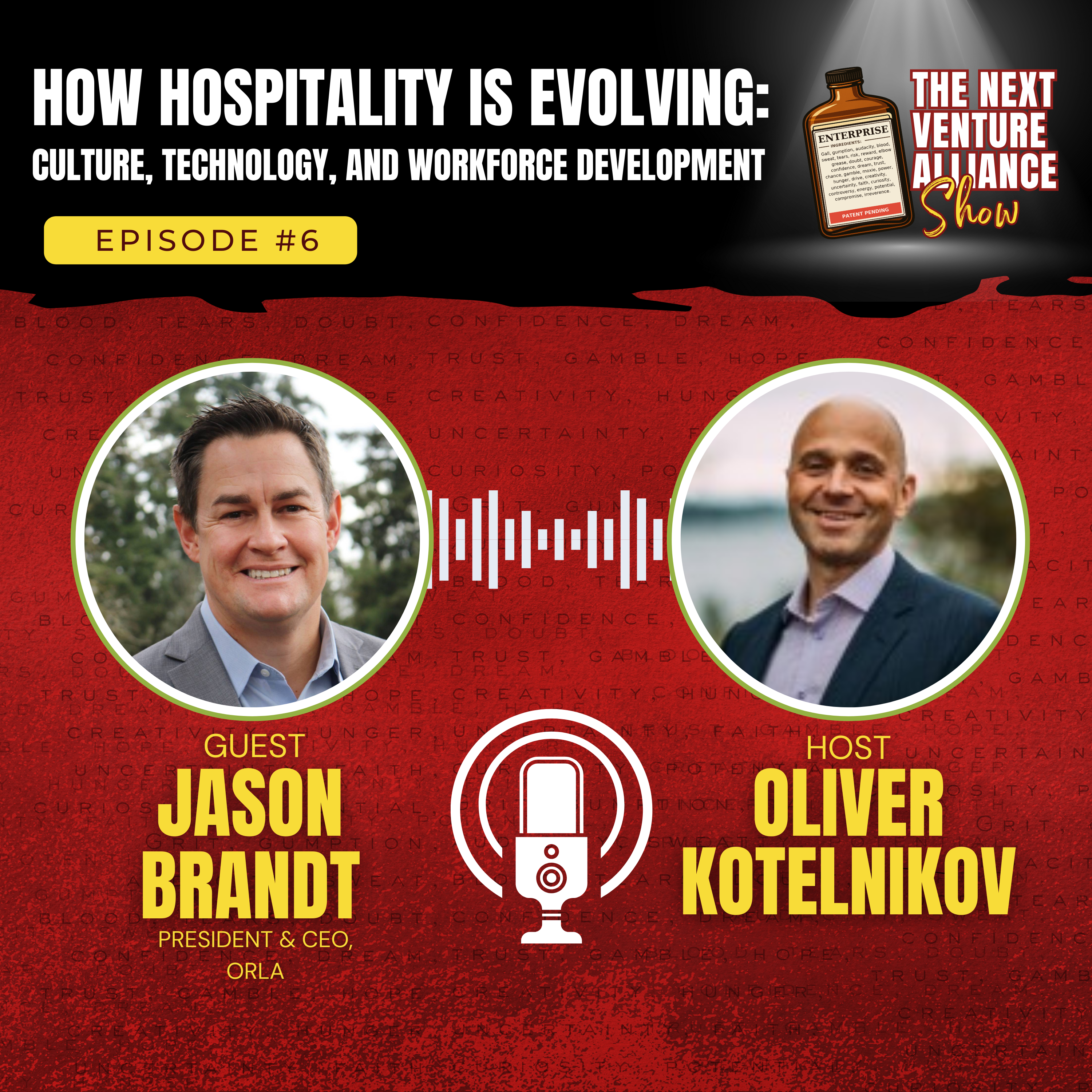
Due to a technical issue, the formal introductions in the first few minutes of this recording were cut off and I apologize for the technical difficulties, but assure you that the spirit and the substance of the conversation has remained intact. And here's a brief recap of the panel. Our first guest is Jason Brandt and the President and CEO of the Oregon Restaurant and Lodging Association. ORLA represents Oregon hospitality business owners with elected officials, private stakeholders and the public, and serves as a vital hub for the state's hospitality ecosystem. Jason brings decades of leadership experience across the public and private sectors and previously served as the CEO of the Salem Area Chamber of Commerce. Also with us today is my esteemed colleague Joseph Holcraft, who's the Director of the Hospitality transaction division at IBA's headquarters in Portland. Joseph began his career in tech in the early days of the Internet era, achieved success, and after a sabbatical, return to the professional world as an advisor, investor and real estate professional.
Today, Joseph is a mergers and acquisitions intermediary at IBA with a focus on retail and hospitality sectors. So without further ado, let's jump in and enjoy the show.
[00:03:01] Speaker C: For our perspective at Orla, I mean we got 2,500 members spread across the state. I have the pleasure of working with 16 teammates on the staff at Orla. And we oversee three to three to four different entities depending on how you look at it. A pretty large political action committee for those legislative engagements you mentioned earlier, Oliver.
A for profit corporation that helps with product and service vendor partnerships to try to help our independent owners compete with some of the bigger guys out in the market.
And then of course all the government advocacy plus workforce development. So we have a foundation that's our 501C3 Oregon Hospitality foundation that is kind of the hub of all the workforce development efforts to build a pipeline for our industry.
But yeah, I mean, I often talk about the post pandemic era being a whole new era for the hospitality industry. So what was just discussed in terms of going back to the 2019 model is pretty rare these days. You know, our full service restaurant operations that still have all those labor cost centers, you know, through the process of hiring front front of the house staff and servers and bussers and hosted hostesses, those folks are, can be running at one to one and a half percent margins right now in that full service model.
The average before the pandemic was really 95 cents of every dollar a customer spends goes back into the food, the people and the place.
So back to that 5% profit. That's, that was pretty typical. 95 cents of every dollar. You think about that. That's an incredibly challenging business environment to operate in.
So the three of us just decided we wanted to open up a bar to sell a million dollars just to get our hands on 5% in the best kind of case scenario.
So 50,000 bucks, I mean that's, that's pretty rough, right? So a lot of our restaurant hotel owners, they're putting it all on the line. We lost a lot during the pandemic sitting across the table from folks that just were bawling and lost their life savings. And we don't even know where they are right now because they're, they're out of the industry, hopefully, you know, embracing a new positive chapter after trying to live through the, the crisis that was the pandemic.
And then some of our biggest name members are dealing even the most iconic names in the hotel scene, some of which are dealing with receivership.
The keys are back in the hands of the bank.
They might be working with a company like IBA to find new asset owners and they're, you know, giving tours to folks that would have the ability to acquire the asset and then carry the brand of whatever is currently there.
So you know, for, for the hotel side, it's kind of kind of known inside the industry that the hotels have to run at 50 occupancy just to pay their debt obligations 50%.
So anything above that is, you know, gives first provides some opportunity for, you know, sustaining profit and so forth. But yeah, we still don't have a state that's fully recovered from the pandemic and all of our tourism regions when it comes to occupancy levels, when it comes to performance. And we still see far too many restaurant closures now not to be completely doom and gloom because there are some bright spots. We still have savvy operators out there that are eking out more than 5% profit in their full service restaurant models. So those, those do exist, but it's almost like you have to have a great deal of experience operating really tight ships as a business entrepreneur or investor.
And if you're able to translate that into the hospitality industry and you know, be okay with moderate margins or maybe very, very slim margins, then there can still be a pathway to sustain your profitability. But it's been a, it's been a rocky road for sure these past five.
[00:07:20] Speaker B: Yeah. And I would say, you know, one of the challenges and that's good to just be, you know, psychologically post pandemic is, you know, discovering what is the new normal. Right. There was a time period where people were hoping to go back. There was a waiting of sorts happening where when are we going to return to, let's say, 2019 and beyond? It became apparent that that return wasn't possible and we need to build something new.
That new likely hasn't arrived yet and we haven't clearly defined what that sustainably can be. So, you know, we've kind of gone over things that aren't working and maybe this is a perfect world question, but what does a functional hospitality model looks like or at least what are its pillars, in your opinion? What absolutely needs to be there and needs to change.
[00:08:16] Speaker C: So I'll start off and then kick it up, kick it over. But the full service restaurant business model, that's a tough model.
We're the third most expensive place to dine out in the continental United States.
California being the second most expensive, in Washington state actually holding the medal for being most expensive. So all three of our states on the west coast, they're not including Alaska or Hawaii, just the continental United States were the third most expensive. So you can feel the pressure that's caused by the wage rates on the west coast, the labor costs in general, the food costs and how much those accelerated during the pandemic. And post pandemic due to supply chain issues and then just general operational costs that all business owners can relate to. Insurance premiums going up, utilities going up. If you don't own your own rent, you don't own your own land and you're a renter and you're leasing, that can be a differentiator. And whether you're able to actually sustain a profit or not is if you have the viability to actually be the landowner. So we see that that dynamic play out as well on the restaurant side. But for me, and I think we see this when we travel up and down the west coast and other places in the country, the future is high quality food and more, more counter service models is what I'm anticipating. Ways to do a better job at controlling just the ability to manage your labor costs and hopefully do that in a little bit more systematic way by still providing a really good customer experience without having to take on the additional labor cost that's required by having a full service staff, including front of the house staff.
Now having said that, well, I think we'll always have full service restaurant models. They just might be harder to launch.
But those tried and true mom and pop locations that have been in business for decades, I think many of them are here to stay.
And it's really just a matter of figuring out what that dynamic looks like. So, you know, special occasions, anniversaries, birthday parties, those are the types of things that create, you know, full service restaurant experiences that really do operate like the cornerstones of our community.
But I think in terms of new launches and new models, you're, you're much more likely to see the counter service model with a, a promise of high, high quality food that you might, might experience at a full service restaurant. Just the, the service delivery looks different.
[00:10:51] Speaker D: Yeah, and that's, that's a really interesting point, Jason, is that the, the Runway that a business owner needs, their restaurateur needs to get their reputation out enough to justify through experience, through reviews, through word of mouth, the price point that they'll need to operate at in order to carry that full service labor expense.
I think that Runway has gone from, you know, shorter to longer in the past couple of years. And, and that's just, that's not going anywhere. That's not going away. There, there is no cost control and I'm not saying there should be, but without that kind of concept in place where, where price increases are limited artificially, you know, prices are going to keep going up at the cost cost of either inflation or CPI or what have you.
Rising insurance costs you touched on. I am in the process of valuing two restaurants that are linked and their insurance in the last three years went from 10,000 to 33,000.
There are insurers who have stepped out of the hospitality market. You know, they care a lot more about hours of operation. If you're open past midnight, if you're serving alcohol, that's an additional premium. Its risk is being mitigated in a way it really hadn't been before.
Rising utility costs, obviously rising cost of goods the year over year, increases in cost of labor is mandated by bills passed in the state houses of Oregon for sure, and I believe Washington as well. I'm less familiar with California.
But that all puts a burden on ownership. The reality of being a restaurateur, if you're making 2 million gross, your staff is probably around 20, give or take 2 or 3, if not higher.
And so to generate that level of gross, you need to have that level of expense that's commensurate with that. And the reality is when you're managing 20 people, you're managing your public image, you are taking on the burden of, you know, that 60 to 80 hour restaurant tour entrepreneur week that just, you're not going to get away of or get it, get away from unless you manage to create an absentee model with a GM or something and with the profit margins that exist right now, that's, that's not reasonable. That's not something. So, you know, you take on these humongous burdens, this humongous stress level, and in return you're making, you know, $0.04 on the dollar. Like is that a winning proposition?
But if you want to deliver your product, deliver your nonna's recipes, whatever it is, your culture, bring it to the table.
For the average person to just show up, sit down and experience the culture of the world, you can't break in with full staff. I mean, maybe if it's just your family running it, but counter service and food cards to an extent.
And then fine dining, like I, I think what we're going to see also is if there is sort of a break in new offering a new restaurant that has enough capital to do that, whatever the Runway needs to be to get the reputation out there that we're going to start seeing more tiered fine dining where, you know, a mom and pop can't charge $22 for a cheeseburger, but you know, a lower, lower on the spectrum fine dining restaurant, you know, not like something with $80 steaks but you know, that, that kind of like an entry level fine dining and then that will sort of be a counterpoint to that high level fine dining on the one side and the food cart counter service on the other. It'll be interesting to see if those kinds of businesses start emerging.
[00:14:58] Speaker B: And you know, and interesting kind of topics where ping ponging back and forth, you know, we have the prime costs and costs of occupancy, costs of labor, cost of goods, you know, all of these things a professional can understand. But ultimately the success of the model is going to come down to is the end user going to accept it and do they need to understand all of this? Right. How much, how much of this new model needs to be consumer education?
Because people can come in and say, well, I don't understand what's happening here, but I used to just come in and sit down and hang out and now I have to come sit at the counter. I don't get enough service. It's more to go, you know, they may not, the client may not be understanding or it may take a long time to kind of catch up to the real reasons why the model is changing.
How do we address that and get the public to buy in? Because if they're not, if we don't have the customer, we don't have the model.
[00:15:58] Speaker C: Yeah, there's a generational divide there for sure. I mean, the research we have access to shows that you can still retain a lot of your millennial customers and definitely your Gen Z customers by offering high quality food with less service.
Now that's not always going to be the case, but I'm talking just like, hey, I'm in the mood to go out. And then you go out and you're willing to, you know, engage that experience versus like the thing that all generations can relate to, which is for the special occasions, the more, you know, coordinated family nights out or friend hangouts, social gatherings, sometimes those things will, you know, they'll go towards the full service model just because of the, the experience they're looking for. But yeah, I mean, I think the reason that we're going to see more counter service models emerge that are able to sustain profit better longer term is because the consumer base, as the generations change, are more amenable to that. They're more willing to accept the fact that yeah, maybe 20 years ago it'd be really hard to get really high quality food at a, in a counter service model, but now I'm pretty sure all of us and all of the listeners can, can attest to somewhere where they love getting food and they just don't have a waiter or a waitress and there aren't bussers in that establishment.
Yeah.
[00:17:21] Speaker B: And they don't have that reference point.
You know, they may have, may remember going to the old model with parents, but they're probably more acceptant of something new if some of these other core and the different things are important to different generations. Right. It's more, maybe this gets us to convenience, which tends to be a very important aspect of the new, you know, the new customer base and millennials and Gen Z's and will probably continue to be so, you know, third party delivery apps.
The consumer expects to have access to every city in the restaurant from the palm of their phone with really not a substantial drop in quality or price point at their sort of at their leisure. So I mean, is that sustainable and is that something that, you know, part of the future?
[00:18:18] Speaker D: Yeah. So that specifically is more of a Jason question, but if I could throw back just for a moment because I have some context to offer on this in 2020. So I joined IBA late 2021 and I didn't have an understanding at that point of what it was like to be an entrepreneur in the restaurant space. And in 2020, all of this food service conversion began. Restaurants that in 2019, 2018 I went to that I wanted to enjoy. And I would sit down and oh, you have to order at the counter now. Oh, okay, well, now I'm annoyed. Now I'm, now I'm saying negative things to the people I'm eating with. Now I'm saying negative things when people are asking me for good restaurants around town.
And it wasn't until I got sort of an understanding of what the back end looked like from inside the financials of these businesses that I understood, okay, this isn't about the pandemic. This isn't about reduction in gross revenue leading to a need for reduction in service during a point where not that many people were going out really, you know, a lot of people were frightened and they were staying home, but that this was in fact a pivot that was necessary to maintain a profit margin that made sense to take on the burden of ownership. And I think that education is going to be important for two reasons. One, because that's just the reality, but two, because there is, there is a threat to an extent that those not business savvy, that those not economically educated restaurateurs that just have an exceptional product, you know, a lot of those are immigrants. I'm thinking Ethiopian food. I'm thinking Lebanese food, like that kind of a thing. And they just want to make a living in the United States. They want to bring their culture to bear for their community.
And if, if they don't have support of the community coming in and sitting down, then, you know, they're going to be challenged at best to keep operating. You know, Jason, if you can, if you can remind me the name of the business, but there was a, I don't know, I think it opened in the 60s or 70s. There was a restaurant in downtown Portland that was about to go out of business and the Oregonian ran an article about it. And the community responded, responded tremendously. And now that business is not under threat of going out of business anymore. What was, what was that name?
[00:20:59] Speaker C: That one?
[00:20:59] Speaker D: Do you recall?
[00:21:00] Speaker C: Probably thinking of Higgins.
[00:21:01] Speaker D: Higgins, yeah. Thank you. Yeah, so it was Higgins. And you know, the community showed up and saved the day. And if we can get that to happen on a broader scale, the industry can be buoyed, you know, at least for now. At least for now.
[00:21:17] Speaker B: Yeah.
[00:21:17] Speaker C: I mean, a lot of folks too. I mean the education is important.
We'll continue to provide collateral for restaurants that want to be a part of educating their customer base. But we all know that's not exactly the reason people come in. They're not looking for a classroom experience. They're actually there to escape probably whatever is going on in their lives and get a little bit of a reprieve from that. So it's kind of a tough, double edged sword when it comes to how you get the attention of the customers while maintaining the experience thereafter when they're in the walls of our restaurant. But having said that, we have collateral that talks about, you know, how 95 cents of every dollar a customer spends goes back into the food, the people and the place.
So we did have a number of independent restaurants utilize some of that collateral before the pandemic, kind of switch that collateral to kind of certified safety emblems and collateral that people could, you know, follow a checklist. And then if they completed the checklist, Orla would send them some collateral to show that they're, you know, a safe place during those pandemic years to either visit overnight or dine out at. So that's all helpful. But that, that message we know, resonates based on some pretty comprehensive research.
It's a great way to frame the messaging for customers is like, wow, every dollar I spend here, 95 cents goes back into this experience.
It's, it's, it's more positive than it is like an Owner complaining or whining that they only have 5% profit margin in the best of months. Right. And again, the, the recent data for that out of the Northwest shows that we're at one to one and a half amongst a subset of our operators that were willing to take a recent survey. So one to one and a half is nothing. Right. So that million in sales being actually 10 to 15,000 instead of 50,000 profit without. And if that doesn't happen, then the owner taking all the risks, he's nothing. So, yeah, it's, it's challenging. And then of course, we don't, I don't know that we want to go down the deep dive of tip credits, but there's. There's 43 states in this nation that have a different wage model than the seven other states. And included in those seven states are Oregon, Washington and California. But in essence, if the three of us wanted to open up a restaurant right now in Oregon, we could only afford to hire one server for the price of over five that we could hire down in Texas because of the way in which the tip credit works, where tips count towards your minimum wage and beyond as part of your total compensation.
For us here in Oregon and in California and Washington, it doesn't matter at all how much money you make in tips. 20, 30, $40 an hour, no matter what, you still have to be paid the minimum wage in addition to that.
And of course, that seems like kind of a foreign concept for a lot of people on the west coast, but there aren't servers like revolting at the restaurants they work at in these other states where they have tip credits. And frankly, a lot of servers love the tip credit model because it incentivizes upselling. And then they're also able to keep more of their tips instead of sharing them across what we call tip pooling models.
In states like Oregon, where you are paying the full minimum wage, you do have more discretion then to take the tips that are earned at the table and spread them through the line of service so the employees, not managers or supervisors or owners, but whoever was involved in making that meal a possibility at the table, can share in the tips. And so that whole cultural dynamic across the country looks different with different realities in the United States of America for the restaurant business model. So most consumers, I don't think, have any idea about how different those labor wage rates look when you, when you just compare it state by state throughout the nation.
[00:25:24] Speaker B: Yeah. And I'd say, you know, in Washington, King county is a good outlier example where you Know, recently the total compensation went away and it immediately, you know, the minimum wage went to close to, I think, $20.84. Right. Regardless of tips, insurance, anything else, like you mentioned, it just has to be in the paycheck and everything else is over and above, you know, an overnight.
Overnight in the sense that it was coming. I mean, they knew that it was coming, so there was some warning. But still, you know, from the standpoint of payroll, you know, as a small business in Seattle, you're now paying $3 an hour extra per employee.
You've also, you know, leveled the playing field with the larger companies and the Amazons and the Microsofts and, you know, the small company, the small employer, which was, I think, 500 employees exception, went away and all of a sudden you're at, you know, $21 an hour for a coffee shop. So what is it in Oregon? What's the minimum wage now, just for reference for folks?
[00:26:31] Speaker C: Yeah, we have three different regions, so there's three different minimum wage rates depending on what county the business is located in. And those three rates are really easy to find. But we are among the lowest minimum wage rates on the west coast when compared to both Washington and California that don't have a statewide preemption where those rates are set by the state.
My counterparts both to the north and the south, they have to get their teams rallied and fired up to fight against arbitrary wage increases that aren't taking into account all the tip income that's made. So really, it should be a total compensation conversation if we're going to mandate increased wages. Right. So what's, what does it really look like out there? But in Washington and California, it's something that cities and counties can change at their discretion. So you can imagine running around the geographic expanse of those states trying to constantly put out fires and try to educate people on how slim the margins are. And it's like, hey, these wage increases might be great if the business was actually alive to provide them after the fact.
[00:27:40] Speaker B: That.
[00:27:41] Speaker C: So that gets lost sometimes in translation. And fortunately, in Oregon, the dynamics around how labor laws are governed look different here because of a number of what we call preemptions that are in place that kind of create a blanket approach across the whole state instead of having all these checkerboard policies that make it really hard for small businesses to operate.
[00:28:04] Speaker B: And I, I mean, to me, it does come back to the, the consumer and valuing hospitality and valuing the experience, you know, and understanding that, that it's a privilege to be served and then to be able to dine out. And so, you know, some of these, there's this sort of divide where if you talk to folks, they'll say, well, I really, I love small businesses.
I want to have small family owned businesses.
But on the other hand, we also want convenience and third party delivery and we want wage increases on the other side.
And somewhere in there is a middle ground where maybe all of it works.
But I think the same consumer in one day will tell you three different things that they're supporting and they're conflicting because all those things can't work together.
So that's why I come back to the consumer education and maybe a shift in what hospitality is and what it costs to operate a hospitality business because again, it is a privilege to just be able to go, to be able to stay at a hotel and have great service, good atmosphere, all the things that people expect without being sort of compelled to go and write a bad review and say, gosh, things just aren't what they used to be. You know, I came here, you know, I've been coming here forever and it just has really gone down the tube. So again, it's hard to educate consumers. But I think at some point we have. They have to join the conversation and be a meaningful part of the solution.
[00:29:50] Speaker D: Yeah. And not just join the conversation, but join the conversation as stakeholders, not, not as just customers.
You know, there was.
Yeah, I'll just, I'll leave it there.
[00:30:05] Speaker B: Yeah.
[00:30:06] Speaker C: Actually, by the time this recording goes live, one action item that anyone listening can, can take advantage of is we're actually in the process of launching kind of a micro site for coalition building to protect tourism jobs, hospitality jobs in the state. Cause we are under assault in the Oregon legislature. We have a 35 day short session coming up. It runs from February 2nd to March 9th.
So thankfully they won't be passing laws for long and there's restrictions, about how many bills can be introduced. But we're launching a microsite called savetourismjobs.com and that will be a place where everyone can add their name organization to a list of similar stakeholders that are really concerned about the direction we're heading as a state when it comes to economic development and economic outcomes.
And remind our state legislators that the most important jobs we could protect right now are those that are in the business of bringing in visitor dollars, dollars we would never see in Oregon unless we sent those promotional dollars out as an export so that we could import the visitors spending because they have so many places they can go. Right.
So how do we do that. Well, we have to save the jobs that are in the tourism ecosystem that are, you know, putting on the festivals, the parades, the concerts, all those community events that happen don't just happen by happenstance. Right. There's people that have to work day and night to produce these signature events. And those events fill up our hotels. In some cases, they fill up the dining rooms of restaurants. So there's so many examples of that. Whether it's like hood to coast or the huge volleyball tournament they do on the beach and seaside, the seafood and wine festival, I mean, you name it. There's a whole laundry list of really cool things that we can do as Oregonians just traveling within our state, but also events that bring in people from outside the state that otherwise would never maybe come here and spend their money here. So that's. That's absolutely essential to save those tourism jobs and just would welcome people to join us when that site gets launched. SaveTourism, jobs.com.
[00:32:24] Speaker B: Save tourism, save. Okay, well, we'll put it in the show notes, but say it again, please. What is it?
[00:32:29] Speaker C: SaveTourism jobs.com.
[00:32:32] Speaker B: Okay.
[00:32:33] Speaker D: Yeah, I think, you know, in the Portland market, certainly, we're so used to having amazing dining experiences that we don't, I think, appreciate the influence that it has had on the rest of the country around the tourism. Like I mentioned earlier, people would, you know, come here to spend a weekend and just eat for two and a half days. And, you know, in addition to us sort of just being so used to amazing food and an amazing variety of genres of food that we have access to that there's. There's a level that we just kind of take. Like, as a. As a society, you know, America in general, we just kind of take for granted the ability to go sit down at these restaurants to.
[00:33:18] Speaker C: And that.
[00:33:19] Speaker D: That's changing a little bit now with kind of the move to counter service and the closures that we're seeing. But, you know, it's. I don't remember the first time I went to a restaurant. I don't remember the first time I sat down and picked up a menu, because I've been doing it since I was little.
[00:33:33] Speaker B: Little.
[00:33:34] Speaker D: You know, it's. It's just so ingrained in our culture that people maybe can't imagine it actually going away.
[00:33:41] Speaker B: Yeah. What do you mean it's not going to be there? It's always been there. Right.
[00:33:45] Speaker C: Well, you know, this is a fascinating conversation because I'll just give you some research that I found really interesting. Like, two years ago, Axios came Out with this heat map that broke down the entire United States with the number of new restaurant concepts that are opening per, like, x amount of people. So it was like a per capita basis, like, who has the access to the most, you know, new restaurants. And Oregon was the deepest color red out of the entire country.
Now that might sound like a great thing, right? Like, oh, we're so entrepreneurial here. We're constantly creating new restaurants, and we have more new restaurants per capita than any other state in the country.
Well, no. And this is where it becomes hard with elected officials and also with customers who enjoy always seeing new things pop up and trying new things. Right? They want their staples to stay in business. They don't want them to go away, but they also want the new stuff to try it out and everything. I think the heat map that came out is more a reflection of the challenges in sustaining a restaurant operation longer term.
And definitely has an element of entrepreneurial activity for sure. But it's a blend of how difficult it is to keep your restaurant in business and new people coming in and trying to take advantage of that, those sunk costs that are left behind and.
And the reality of the entrepreneurial spirit. But I. I don't. It's hard to get elected officials on the same page when they're just like our customers and they love a new experience, right? No one's. No one's gonna be against the most possible new restaurants popping up as possible if you're a consumer and you love to eat and you want to try new things, right?
So that's just something that I found really interesting in the last couple years.
[00:35:38] Speaker D: And there's. There's something. Maybe, Oliver, you've seen the same thing, but I valued one of the. One of the biggest names in Portland. I took a look at them recently. They were interested in exiting the ownership was. And in order to have the appropriate kitchen for their genre and the level of offering, they had to spend something on the order of $100,000 installing freezers and fridges that went into the. The walls of the building.
Those are fixtures now. Those belong to the landlord now. And the landlord doesn't necessarily, depending on the terms of the lease, have to compensate that business owner when they. When their lease expires and they choose to leave. So like Jason was mentioning, there are these kitchens that are being created at the highest level.
And when a business owner exits or when the business fails, they don't. They don't get that money back. And then that next person is that next, you know, lessee of the kitchen of the space is getting the benefit of these capital investments from prior ownership. You know, and, you know, there's another, there's another kind of aspect to this that plays in the majority. I mean, I think it's pushing 80% of startups of any business type, but this includes hospitality, come from SBA financing, you know, the Small Business Administration, they guarantee portions of loans that are actually distributed by financial institutions. But these financial institutions, they have very tight risk profiles. And as it becomes more and more difficult to sustain enough profit to pay that debt service, the sba, those guidelines of those lenders will get narrower and narrower and narrower. And you know, we, we don't have a crystal ball. No one knows the future, but we may start seeing a situation where those new startups have to be counter service to get financed from the sba. You know, that, that may be a direction that we're heading in.
[00:37:46] Speaker B: I mean, there's a lot there, Joseph, and there's certainly a domino effect. You know, when, when you're, you're starting with the legislative mandate and restaurants now need to comply, it ties into their lease.
There are things that they are now not provisioned for in their commercial occupancy agreement.
It goes down to the lender and kind of refinancing considerations.
It's complex.
Any new change triggers other new changes and there aren't always provisions and the business owner doesn't always know. And a landlord may not know what to do. But tell me again, where did this, who required them to make these expensive upgrades?
[00:38:32] Speaker D: Oh, no, it was a choice of ownership.
It was to provide the highest quality, using the best equipment to their customers. They had some specialized products that required freezers and fridges and, and food items being prepped and moved between them. And there was no real space in the space.
So they had to go into the walls to mount these things.
And then they become a fixture. You know, they're in the walls, they can't take them out with substantial damage. And that's against the lease.
[00:39:09] Speaker B: So, yeah, it becomes part of the landlord's property. And I mean, you certainly see all kinds of clever uses of space. Space where you'll have a walk in refrigerator that has a door on the inside of the restaurant, but the box sits outside utilizing, you know, parking spaces that may not be being used. Right, and so is that part of the bill? Yeah, something like that. You're probably, you know, recouping the investment if you own the land, but if you don't. Yeah, it's, it's, it's tough.
[00:39:38] Speaker C: Yeah. To summarize this segment, to Joseph's point, I mean, never under, never underestimate the value of sunk costs to the savvy operators out there, the folks that may have one or two locations that are considering a third, or the folks that are maybe tied into a hybrid model where some of the small businesses are owned as a chain, like under corporate ownership, but they have a franchise model as well for certain locations.
So there's a whole myriad of different ownership structures that exist in hospitality. But I think those that are most savvy and are in a growth mindset are looking at opportunities to capitalize on someone else's challenges or headwinds that just didn't allow them to sustain the operation. So they can go in and get something.
Sometimes pennies on the dollar, depending on what we're looking at, what the actual equipment is that's left behind. So it's a pretty big deal. It matters.
[00:40:40] Speaker B: Yeah. And it's a whole separate market, second and third generation spaces. And, you know, savvy entrepreneurs can, can certainly take advantage and play to their strengths in that market.
But you know, Jason, and this question's to, to you for being solution oriented. And some of these things are you know, still sort of concepts out there that we're trying to work out, such as public image and consumer education. But what can business owners do? How can they utilize ORLA and a trade organization to save on some of those prime costs?
Because you're keenly aware of kind of the pain points of the industry and have many programs that have, you know, that are addressing these very issues. So what should new or existing business owners know and how can they benefit from being a member of orla?
[00:41:35] Speaker C: Yeah, you know, we, we really do four things. So it's the government advocacy, the products and services of value, the industry intelligence, some of which we're sharing, you know, through research and stuff that we have access to on this podcast, and then fourth, workforce development.
But as it relates to our vertical for products and services for the operators out there that are trying to control costs, I mean, we have a whole laundry list of really strong partnerships with what we call our allied members.
So about 200 of our Orla members are in the business of providing products and services to restaurants and hotels.
So it's very easy to pay for the entire cost of your membership by picking up a 10% discount here or 20% discount here for things that you already need, things that you're mandated to have, whether it's, you know, getting a better quote on your Property and Casualty insurance through our partnership with Risk Strategies, or whether.
Which has now been recently acquired by Brown and Brown, or, you know, things like making sure you're taking advantage of your FICA TIP tax credit. You know, for those of us that some restaurants out there still are don't have that customized CPA support where they're getting their full tax credit on tips that they never actually kept but got dispersed out to the employees. So are you taking advantage of that, that tax credit? Some restaurants, we believe, are not still doing that, but there's a whole list, music licensing, different, you know, products that are actually, you know, in place within restaurants or hotels. A whole list that can be accessed through our website, oregon rla.org but it doesn't take long to have the total savings pay for your membership and then some.
We also have a lot of different templates and documents that people can use that are behind our member wall, where you have a log, you know, a login and a username, password kind of a thing. But then you can have access to templates that can help with things like TIP pooling, access to things about, you know, unionization, what to do when you have workers that are interested in maybe trying to organize more formally. Like, what are, what are the rules around that?
You know, we have a lot of things going on with ICE right now, sometimes investigations by the US Department of Labor who will just show up at the business.
So these are all resources that we provide to our members as a part of that membership experience.
[00:44:07] Speaker D: And it's just chime in. Oliver, as an allied member of orla, like, the benefit has been substantial to, to me, even, you know, with what I do, I've. I've been able to see up close and personal the real, the power and the pull that ORLA has at sort of the political level and the, the connections and their ability to bring groups together and, and create positive outcomes. Like, aside from everything else, it's just a. It's a wonderful organization just to support on behalf of the hospitality industry.
[00:44:44] Speaker B: I think the important part to understand, one of many but is that, you know, the government affairs arm of the trade organizations in ORLA specifically allows you to, you know, take some of these concerns and questions and actually affect change on a legislative level, which business owners cannot do individually.
You know, we can gripe and complain and, you know, maybe post things on social media, but unless it, unless in an organized way, it makes its way on the ballot, the change, meaningful change is unlikely.
[00:45:17] Speaker C: Right? And so, yeah, and it, it's even more challenging in our industry. Right, because the last thing you want to do as a business owner is alienate a subset of your customer base because of a policy stance or a political view. So you. So most of our members, of course, tend to stay very Switzerland, you know, in this world of politics, and they need us as a trade association to lead for them. So, yeah, I mean, at times we have to get aggressive.
We try to be very direct, but with respect when it comes to the real headwinds that many of our owners are facing just to stay in business.
And yeah, I mean, we. We take the. The work really seriously while, you know, trying to have a little bit of fun while we do it, because it's an awesome industry to support. And, you know, we get to work full time in an industry that most people spend their vacation hours in or their special occasions in. So there's. There's a beauty to that just in terms of being able to travel around the state, meet with small business owners on a regular basis, see where the bright spots are. And there are bright spots even with these headwinds, but also acknowledge how serious we have to take the real dynamics and barriers that are facing some of our members right now just to keep their people employed and be a part of that community fabric where people can gather. So, yeah, our relationships in the legislature are absolutely critical.
We also do quite a bit of engagement with local governments, whether that's mayors or city councilors or county commissioners or city or county staff.
A lot of stuff can pop up at the local level, too. And we have to be positioned to assist the members if that's where the opportunity for solutions arises from.
[00:47:03] Speaker B: And explain the mechanics of how and why Is a trade organization able to do for a member more than what they're able to do for themselves, Whether that's insurance or credit card processing or any of these services that you're offering.
[00:47:17] Speaker C: Yeah, well, there's a lot of benefit in a capitalistic society when it comes to creating scale. Right. And so if you think about Oral as a collection of a whole bunch of independent businesses that are bulking their purchasing power together to get a better deal through volume, that's something that the association can leverage on behalf of its members. That would be very difficult for a member to do on their own.
[00:47:46] Speaker B: Right.
[00:47:46] Speaker C: Because when we're part of something that's bigger than any of us can accomplish on our. On our own, then it creates, you know, opportunities for multiplier effects, for increased savings, for better deals.
I'm really excited about our new partnership with imb. Independent merchant brokers, because they're, they're one of those folks that can take a look at your specific business model in our industry. And they have all these relationships with software and hardware providers because that's their full time job. So they can operate really like a consultant, meet our members where they live and then probably find the, the person they're helping a better product, both software and hardware, and save them money at the same time. And if they can't, then they'll just be like, you know, thank you for the opportunity to take a look under the hood of your restaurant or hotel. It looks like you have the best deal out there. We're not going to be able to help you. And they'll be honest about that. But those are the types of things we set up that members might not ever be able to uncover by themselves because of the processes we put in place to make sure we're partnering with the best folks that we possibly can. And frankly, we were selective about who those partners are. They have to meet our criteria and they have to go through a process and an approval with actual restaurant and hotel operators before any of those agreements or partnerships are brought online for the broader membership.
[00:49:18] Speaker B: So it's a co op and really the idea of strength in numbers and yeah, presenting a unified front.
[00:49:25] Speaker C: You should have just answered that question for me because that was way more succinct.
[00:49:30] Speaker B: No, I mean, it can be, it can be tough to understand, you know, and I sort of vaguely get, you know, how, how an opera industry or organization of that size operates. But, but to a business owner, they may spend a lot of time, you know, running around and saying, you know, I can, I can find these services. But really, I think the reality for some of the smaller businesses is that they're busy running these restaurants and these organizations, they don't have the administrative time, overhead to necessarily do all this research that a member organization will do for them.
[00:50:09] Speaker C: So.
[00:50:10] Speaker B: Right.
[00:50:10] Speaker C: And also the due diligence of partnering with people that aren't going to stick their brand name out there and have us answer, amplify it across the other industry, across the entire industry, unless they're a reputable op vendor that has the capacity and the bandwidth to accept a new influx of small businesses that are probably going to be interested in a quote or to learn more, which is what can happen with some of these partnerships. So, yeah, we have, we have a lot of responsibility to make sure we're partnering with the right people that are going to provide great service with transparency and integrity. And so I'M really confident in what we've built to make sure that only the best partnerships make it across the finish line. That, you know, and if you're just an operator on your own, trying to research what the best solution is, you know, it, it could be easy to get caught up in a deal that ends up being too good to be true and then they're escalating prices on you once you sign the initial contract, and then it's just a huge headache. Right. So we're trying to avoid as many of those administrative barriers and challenges as possible for the members so that they can either keep working inside their business or focus more on that growth mindset, work outside the business and look for, you know, additional opportunities. So, yeah, it's, I think it's a good model and it's a whole, long, whole, whole long list of reasons why it makes sense to be a part of something that's bigger than yourself through, through an industry association, no matter what business you're in.
[00:51:40] Speaker B: And their needs change too. And the best partnership of yesterday may not be that today. Right. And so much like a restaurateur needs to, let's say, watch their vendors and pricing and keep their eye on that every week.
You know, same can be said for credit card processing, insurance, and some of these other services.
So that the partnership certainly is a value add to many members. And just like Joseph, I mean, I've certainly seen that same benefit to members of, you know, your sister organization on the Washington side. And yeah, especially through Covid. I mean, I can just say, you know, I cannot imagine. And you know, some businesses didn't make it, but the ones that did, I do not know how they would have made it without the support of, you know, both Orla and Wha.
[00:52:33] Speaker C: Yeah, I mean, Washington's about 60% bigger than us, so there's, you know, population wise, there's kind of a correlating factor there in terms of food service, lodging establishments typically. But here in Oregon, you know, we have over 10,000 food service locations, over 2,000 places to stay overnight for short term accommodations, not including all the short term rentals. And some of those are members as well. So, yeah, it's a massive industry employing 200,000 people in Oregon. That's 10% of total employment. One in one in 10 paychecks comes from someone in our industry that's providing that paycheck.
And just the amount of opportunity you can, you can garner too, by working in this industry. A common straw poll I'll take from stage when I'm Speaking at different events is how many people have worked in a restaurant or a hotel at some point in their life. And the national average is over 50%.
Oh, easily, yeah, 400 million. Over 400 million people in this country. And over half of us have worked in a food service or lodging establishment. I mean, that's incredible, right? So we really are a critical component to developing future workers too, and determining, you know, when it's a job that propels someone into a different industry that they may be more passionate about, or when a job turns into a full fledged career like it has for many of our members, where they started as a dishwasher and now they're making six figures as an executive. That's not an uncommon story for us to hear. And maybe one of the beauties of our industry is the fact that there really is no glass ceiling. So, yeah, I mean, a lot of work to do on all these different fronts. Workforce development, providing those savings to independent operators and even chain operators, but then also not taking our eye off the prize on the government advocacy, the relationship building with elected officials and all the industry intelligence that comes with that.
[00:54:32] Speaker D: It's so important that the right voices, or at least, you know, good voices, quality voices are in, are spread throughout the political sphere. You know, everywhere.
[00:54:42] Speaker C: But certainly, yeah, I mean, regardless of political affiliation, what we need are more active listeners that don't show up in these elected official positions thinking they have all industries figured out. They're open to real information, real observations in the market in real time that should really help inform the policy decisions or changes in policies that may already exist.
And I just feel like we have too many folks that are running for office that have their lived experience and that is going to be central to most of the things that inform their voting decisions.
Whereas maybe admitting that there are certain areas of the economy that they haven't had a vast amount of experience in. And so having that open mind to think beyond the lived experience and be open to whatever the economic realities might be, that should have an impact on the laws that we're asking all these business owners to follow. So, yeah, there's. I mean, we could talk all day about just nonsensical decisions like not updating our corporate activity tax in Oregon to the consumer price index every year.
So here we are. We passed this, basically a hidden sales tax within the prices of everything that we're buying everywhere in Oregon. 0.57% is this new tax that all of all businesses have been paying since 2019 for all sales above a million dollars. But A million dollar. That. A million, that 1 million exemption in 2019 is nothing like what a million dollars equals in 2026. I mean, just think about all the inflation we went through. So at the very least, the legislature in the last couple years should have passed an adjustment to allow our restaurants and hotels to have a higher threshold than just a measly 1 million in sales before they have to start paying that 0.57%.
But no, I mean, they haven't even been willing to offer or form a solution there. And if we don't have all these voices coming to the table to demand action on things like that, then that's money right out of the restaurant's pocket that might result in them not being profitable. I mean, we have restaurants that have taken out loans to pay their corporate activity tax. So ridiculous it is.
[00:57:16] Speaker B: That should be a pointer right away in the direction of, hey, this isn't good policy. Right. And I really like what you said about nominating Joseph for public office and speaking to reason.
Reasonable voices.
And you know, in our business, you know, we often say, you know, clients will ask, well, what's your perfect client? Or what's your range of a client? And, you know, my response is always that, you know, I want to work with, with a reasonable seller or reasonable or realistic client. And they asked me what that means. And I say, willing to look at the data that's realistic. Just please be willing to look at the data. Don't, like you mentioned it, lived experience.
And that's a nice way of saying, you know, of having just a composite of historically kind of maybe information of 10 to 20 years going back of just maybe some incomplete and inaccurate information with blind spots and saying, this is what I'm. This is the data set that I'm using to make a decision.
Right. And then, you know, I think this can be applied to professional advisors and politicians alike because, man, we got to keep updating our views. Things are changing so quickly. You just cannot operate on stuff that you knew a year ago. Some of it may still. Some things are timeless, absolutely. But many things aren't, you know, so.
[00:58:39] Speaker D: Yeah, and that's a, that's a strong case, I think, for sort of movement of the younger generation who hasn't had that solidified sense of what the reality of everything is yet. You know, that you get, as you just develop more experience and see the same patterns over and over, and then you're kind of biased towards believing those, those patterns are, are really the truth of the map. Right.
[00:59:03] Speaker B: And.
[00:59:03] Speaker D: But younger people more nimble minds, more agile in their opinions. That kind of a thing would benefit every municipality with a government entity. Right.
But I also want to say just specifically to the CAT tax, because what, what you said, Jason, in part highlights the importance of, of skilled tax preparers, because there are ways, and I see this when I'm analyzing books, there is a dramatic difference in the CAT liability between a company that uses a CPA and I don't know if ORLA has allied members that kind of do this kind of thing. If they do, I'd love for you to plug them for a second. But additionally, like just the most common one is you put productive labor into your cost of goods and that increases your cost of goods, and then your cost of goods is an offset against the revenue that you're liable for on the CAT tax. Right?
[00:59:58] Speaker C: Yeah, absolutely. Yeah. And in our, on our website, we have kind of three different tiers of partners, and those do include CPAs that specialize in hospitality operations. So one of the best places to look is just in that section of our website. It will show you our preferred partners, our allied members that are in what we call our hospitality hub. And then we also have consulting partners that just because of our experience working with them, we know they take care of industry members. They're not paying anything extra for that badge of honor. But including, and, you know, whether it's employment law or help with, you know, financial preparedness, staying on top of your financial controls, all those types of folks are in our consulting network to hopefully save our members both time and money by connecting with the right folks that know what they're doing and are confident that they can deliver superior service. So, yeah, that's one of the, I think key things that trade associations can do for their industry, whether they're members or not, is, you know, vet these types of relationships, understand who's the best in the market in a particular service or product area, and then amplify those partners to hopefully save those members money.
[01:01:20] Speaker B: You know, I think it's absolutely critical having the right partners and if you're an operator today, and I'll kind of connect this back to my own history and hospitality and, you know, I started in 1992 with, you know, what you call a mom and pop shop and Pike Place Market, you know, and it ended up growing into, you know, six locations and, you know, close to 70 employees when I exited.
But my, the reason I got into it and the reason I stayed was because the industry was fun and safe.
And it just seemed like really you just had so Much room and time to goof around and make mistakes and play around and have a good time. And there was a lot of margins, margin for error. Business has still failed, but, but the margin for error and, and kind of the fun loving atmosphere was, was everywhere. And it seemed like if you wanted to open a bar with some buddies, you could just do it for not that much money and have a good time. And maybe you then, you know, exited and went, did something else and it was just a great experience.
And then at some point it changed and I mean Covid was certainly a turning point, but, but you just can't run a business like that today. And you need accountants, you need, you know, trade organizations, you need to stay on top of, you know, some of the legislature and kind of look ahead to what's coming and prepare.
And so that's the reality is that that's the industry and you know, that it is today. And part of the reason why I exited is because it wasn't something that I recognized anymore and, and I had 25 years in the trenches by then.
So it may have been time for me to exit one way or the next.
But it is a different model now and it highlights the value whether you're entering. Are you buying a business, starting a business, running a business, selling a business in the hospitality space, Partner up with the right folks and certainly, you know, ORLA is an organization like ORLA is a great place to start where you can then get kind of, you know, next steps and guidance from there and, and you can, and you can be connected to the right partners.
[01:03:43] Speaker C: Yeah, I mean, the mark, you're so on point on a number of those observations.
I mean, particularly the margin of error now slim to non existent versus maybe a little more padding pre pandemic. So that's definitely on point.
The thing about the industry being fun, that's where we're seeing some divergence too. It seems like the folks that are intentionally building their corporate cultures and holding on to kind of the amenities, the benefits, the perks of being on a particular team are the ones that are able to keep that environment fun and alive and energetic, even if there is a higher standard for, you know, quality control and kind of slimming down on those margins of error.
But yeah, I mean, you can't underestimate the power of a strong corporate culture, even if you're a mom and pop.
That sense of belonging, doing something that's bigger than any of us can do by ourselves, being a part of that team that has different strengths, that drives outcomes Those types of restaurant and lodging models are some of the bright spots. And I think that that correlate that correlation exists for a reason. It's not, they didn't just get lucky.
They're constantly working on opportunities for employee empowerment, for internal promotions, for the unique benefits and perks that may only be able to come with a hospitality type company.
So we really need to help each other out. That's part of what we do too, is amplify those best practices. That's part of industry intelligence. And you know, we want to shine a magnifying glass on the folks that are figuring it out, are seeing their profits improve and sustain themselves and give other people the opportunity to kind of share in those best practices in whatever way that means for their customized model. So yeah, there's a lot of power in that, especially for younger generations. Do not underestimate as an owner the power of that sense of belonging to and showing authentic care to your teammates. It's not, it's, it can't just be a job in your eyes as the owner. It has to be something bigger that those younger generation employees want to be a part of because they have choices.
[01:06:07] Speaker D: They do. And you know, I'll say not just in hospitality, but across the spectrum of businesses, the, the difference between that, that corporate culture, you know, I, there's a gentleman named Dylan Wentworth who has his, has a story posted on the IBA blog about his, his journey as a business owner, you know, from creation to exit his business especially. But I see this, you know, time and time again is those businesses that have that culture, that have that family atmosphere, that genuine care, care between individuals under the employee and then that, that is almost always a top down thing. You know, almost always if you want to have employees that are loyal, you want to have employees that don't want to look for other jobs that pay them an extra 5% or 3% or something because they love the place that they do the thing even more than the thing that they do.
[01:07:07] Speaker C: Yeah, well said.
[01:07:09] Speaker D: It's, it really is.
It can be a game changer in so many different ways from coverage flexibility, specifically in the hospitality industry, to quality of service. You know, that server for those, those establishments that are doing full service that, that server that shows up with a smile not because they're putting on their hospitality face, but because that's the way they feel and that comes through that really matters.
[01:07:35] Speaker B: Yeah, that's the. Beyond the paycheck. And I think I'm also always pleasantly surprised what an important piece that is for employee retention. Which it's a tight labor market and understanding how to retain employees and the tendency to focus on the wage piece of it and maybe the benefits is understandable, but they really do care about the place where they work and kind of having agency in the process. And there's almost a pride of ownership right. On behalf of the employees. Oftentimes as a customer, I feel when I come in, sometimes I look around and I say, well, I don't know if this person waiting the tables is the owner, but they're certainly radiating it, which is a beautiful thing to see. But you know, to that statistic of, you know, you mentioned, Jason, you know, younger generations and kind of the generational divide and you know, the statistic of 50% of respondents at one point having worked in the hospitality industry, how do we get, and this is the topic of workforce development, you know, how do we get the young gender, younger generation excited about the hospitality industry, whether it's a college job or whether they're, you know, moving to be a hospitality professional. And you know, do you think in 10 years, if that survey was given, where's that number going to be? Are we still going to have 50% or more people at one point having held a job in hospitality?
[01:09:15] Speaker C: I think it's possible because I see our future leaning more towards service centric sectors of employment as AI continues to automate so many different tasks. So obviously I'm not like an, an AI doom and gloomer. I think it can be a compliment and we have to approach things kind of on a case by case basis. But I do think that that potentially leads more people into our industry as opposed to out of it. And employment departments like the one here in Oregon are projecting pretty significant growth in our industry through the year 2033. We're one of the fastest growing industries.
[01:09:53] Speaker B: That's very encouraging.
[01:09:54] Speaker C: Yeah, it is encouraging. So we, we try to share that with folks and let them see the, you know, at least what the analysis from our government counterparts is saying about the future for our industry and the opportunities that that will present.
But yeah, I mean, I think our biggest, for better or worse, our biggest ally or enemy, depending on who you're talking to, is just those, all those folks that have worked in the industry, hundreds of millions of people that have had a job in, in the hospitality industry. And whether that was a positive experience or a negative experience or possibly both, like what you were just describing, Oliver, depending on the season you were going through, where it was fun and then not so much. And like how, how you present that to people that trust you in your circle of influence. Right. So we're, we're fortunate in that were somewhat job attractors, you know, receiving I think a regular pace of applications for job openings to some degree just because we are the cornerstone of communities. And you know, if you're going to a viable city, town, region of the, of the country, you're definitely going to be experiencing the restaurant and lodging scenes. Right.
We have kind of like these, you know, ongoing advertisements across all the interstates throughout America. It's like you look at your blue sign. Oh, those are some, you know, brands, restaurant brands for food. If I get off at this exit. Oh, here's a place where I could stay for lodging. If I get off at this exit. So there's these constant visual imprints that we get to leave because we're the front door to the public. We serve anyone that walks into the door if they need a place to stay or need something to eat.
So thankfully I think that will help us to some degree keep the job applications flowing in. But there are those that have had poor experiences working in industry or don't think that it's a viable career path, whether that's parents, counselors, maybe a teacher.
And then at this, in the same respect we have parents, counselors and teachers that are proponents, you know, and they see the value of what the industry can provide in the way of a full fledged career with high compensation, six figures and in compensation. So it's kind of a mixed bag. Right.
I do think we have some things going for us in the workforce development space. Currently, Orla has 54 high schools across this state that are tied into our Pro Start curriculum, which is nationally recognized industry certification for both culinary and management experience for restaurants. Something that you would want to put on your resume if you were in the Pro Start program.
So those 54 year round programs in those 54 high schools are serving over 8,000 students in real time throughout each school year.
So there's, there's a lot of opportunity to take advantage of whatever your school district might be providing if you're, if you're a student or you're involved in a community college or looking to take a class.
We got a Post K through 12 opportunities at Oregon State University's Cascade campus. Four year hospitality degree that you can get while enjoying the amazement of the Bend area. Who doesn't want to live out there?
So you could get a four year degree there. You could take an online course in hospitality tourism management from Chemeketa Community College, which is an online program, but also in person. So if you're not close to their campuses, you could still be a student just on the online, the online framework, no matter where you might be located. So yeah, there's, there's opportunities I think, both within high school programming and also community college and, and full four year degree programming for folks that are interested in looking at this.
[01:13:50] Speaker B: And I'm a, you know, I've been a judge on Pro Start for, for many years now. So it's, it's a fun, fun event and it, it really re. Energizes me because the kids are so excited, you know, and oftentimes the panel of judges, I tend to bring other kind of former existing hospitality business owners and sometimes their known names and their eyes just light up when they see someone who's, you know, sort of in a position to where maybe where they want to be at one point. Right. And you have your idols in many cases giving you feedback. And so again, it's that it, you know, it erases some of those barriers and gets, gets young people excited, which is probably the ultimate currency if you're talking about the younger generation, is excitement. Are they excited about something?
They're doing it. If they're not, they're not doing it.
[01:14:43] Speaker C: Yeah, that's.
[01:14:44] Speaker B: How do you get them excited?
[01:14:46] Speaker C: Yeah, that's definitely the case. Yeah. So our foundation, the Oregon Hospitality foundation, produces this annual event. It's happening on March 2, 2026 at the Salem Convention Center.
And that's on top of the year round programming. Right. So the, the foundation for Pro Start is the year round coursework that those 54 Pro Star teachers teach within the course of a, of a class in the school year. But on top of that, as an extracurricular activity, some of those 54 high schools will compete, voluntarily compete in this high school championship event that you've participated in. That's awesome, Oliver.
But yeah, we'll probably have 100 volunteers at the Salem Convention center, probably 12 to 15 high schools that are competing against each other, creating three course meals as well as business competitions, kind of like a shark tank for like a restaurant model and presenting that to actual restaurant owners. So lots of, lots of fun things that will be happening with hundreds of people on site all day on March 2nd, if it's open to the public too. So if anyone wants to just happens to have a free day that's a Monday, they can swing down on March 2nd and just kind of check out all the activity in both the culinary and the management competitions that the kiddos are participating In Sounds fun. Yeah, it's a good time. It's one of my favorite events of the year. Just because you can see the real impact you're having on kids that haven't even graduated high school yet. And you also get a chance to see and remind yourself of how you can't cook worth crap. After looking at what these kids, these kids create with no running water and two butane burners, a three course meal in 60 minutes. And if I had like six hours with a full kitchen to create the same stuff, I still wouldn't be able to do it.
[01:16:44] Speaker B: Like campsite environment. And they're, they're, you know, they're putting stuff out there and the atmosphere is kind of Top Chef where there's the sizzle and the sound and the smell and the, the excitement and people walking around and checking out there's, you know, ticking clock and they're presenting and it's, it's incredibly exciting. So it doesn't surprise me that that's the, the highlight event for you, Jason.
[01:17:11] Speaker C: Yeah, another cool thing they do too. So these, all these high schools compete, and then we have one winning team for the management competition and one winning team for the culinary competition. And then we spend over $20,000 out of the foundation every year to send those two winning teams to compete in the National Pro Start Invitational. That happens a couple months later after our March 2nd competition. It'll be in May, but that's out in Baltimore, Maryland. So, you know, flying the, flying the kids, the teachers, their mentors from typically PDX all the way out to Baltimore, plus their lodging stays and the equipment shipments and all that, it's an expensive proposition, but it's one of the things that you can support if you're involved in our foundation is just what a core memory that creates for these kids. Also the industry mentors that are, they're helping the Pro Start teachers in the classroom, help these kids get ready for the state competition and then if they're lucky, the national competition, competing against the best school from each state.
It's pretty awesome how organized and produced it all is.
But, yeah, it's a great experience for anyone that just wants to see it, observe it for themselves.
[01:18:26] Speaker B: Who did Oregon send last year to the nationals?
[01:18:29] Speaker C: So we've actually, within a recent year, just a couple years ago, gotta give a shout out to McNary High School. School.
[01:18:36] Speaker D: All right.
[01:18:37] Speaker C: Because McNary High School finished in sixth place a couple years back in the entire nation. Sixth place.
[01:18:46] Speaker B: Wow. Sixth place nationally.
[01:18:48] Speaker C: Sixth place nationally. So they won the state competition and Then they went off.
Recent years, we haven't, we've been more middle of the pack. But both our, our business management team and our culinary team two years ago placed in the top 10 in the nation. So that was a pretty proud Oregon moment.
Yeah. So I mean these team. And it's cool because there's a different team that emerges from the 54 schools pretty much every year.
They're. The competition is completely overseen by industry judges that know what they're doing.
And it's just, you know, there's always a new class of, of kiddos that are coming through, usually combination of seniors, juniors and. And sophomores that make up these four to five person teams that are representing their high school to come to our event.
So it's, it's typically like the most committed culinary or business management kiddos from a bigger class and then they're selected by their teacher to double down, triple down practice either before or after school or both to get ready for these competitions. So it very much is an extracurricular activity being a part of this championship similar to, you know, being in a marching band or a choir or a football team. You know, it's, it's a lot of extra work to do the championship event. But the kiddos always impress every year.
[01:20:10] Speaker B: Oh, they rally. They were there at 7am in the last year just running through their paces and they had note cards, they're checking each other, they're correcting one another. You know, they're checking in with their mentors and the coaches.
[01:20:23] Speaker C: Yeah, totally. Yeah.
[01:20:25] Speaker B: Intense.
[01:20:26] Speaker C: Yeah.
[01:20:26] Speaker B: For us it's like, you better bring it to the judge too, because it's just like.
[01:20:31] Speaker C: Yeah, I know. It's a lot for the volunteers too. For us on staff, we're there like 6:30am till probably 8:00pm at night just making sure everything goes off without a hitch. And you know, a breakfast, a lunch, a dinner, all those things are actually going to be provided by Cisco this year. And we have McDonald Wholesale as a massive sponsor of the foundation as well. So it's been really great to see the food distributors step up and support the kids and the teachers. So we're very fortunate in our partners. Definitely can't pull this stuff off alone without all of you as volunteers and then the folks that help us pay the bills to feed all the kids and the teachers throughout the day.
[01:21:09] Speaker B: Yeah, we got a band together. And again, strengthen numbers and share resources and good things will happen.
Absolutely stuck about the Portland scene a little bit. Joseph, I'll throw it to you specifically on Portland just The general gist or.
Yeah, I mean, what have, what have you seen? Obviously, big city and you mentioned, you know, it being, when we say Oregon, you know, I'd say Portland specifically has for years been, you know, a foodie central destination.
You know, lots of, lots of create creative kind of fusion type stuff going on. Lots of emerging cutting edge, you know, restaurants and concepts. I mean, what, what are your, what are you seeing now? Both positive and negative.
[01:22:03] Speaker D: Yeah, so I mean, negative. I feel like we've touched on enough. It really is just the rise in expenses that is coming from a number of different sources. But the positive is sort of the ingenuity and creativity around entrepreneurship and restaurateurship.
You know, there's, there's a consultant that I know that he says that if you want to be successful in the Portland market and this, this isn't like you have to do this, but one, one path is doing the food service and bar service. And so you're, you're doing these little extra bits that help drive revenue up and help drive customers to your businesses. And I'm seeing a lot of that, you know, everything from drag shows to arts and craft nights to comedy nights, to open mics like, like in these coffee shops, in restaurants that have the space, you know, offerings around. Free pool.
There is a really cool place in downtown Portland called River.
Not River Pig, just River.
And I'm, I'm looking at their Instagram and I'm seeing all their offers that I used to go there all the time. It's one of my favorite spots. But like Free Pool or Pizza Night, you know, come in, pay $3 all, all you can eat pizza like, or whatever the price is. But like this ingenuity and this creativity that's helping the market spring, but it's also adding character.
So it's not anymore just about the Pok Pox, the Andinas, the, the, the Kotchkas, you know, these big names with exceptional menus, exceptional quality of recipe and, and food that are sort of dominating the scene. But there's this, this fun aspect to it that I'm seeing kind of be more and more injected. Just as someone who is, you know, a patron of, of the nightlife and the food scene around here.
And you know, in a way it's just, it's very Portland, you know, that it's, it's a little eclectic, it's a little off, it's a little. Not what you'd expect, but it's enjoyable. You know, it's fun. It's, it's, it Kind of rounds out the experience. So you're not just sitting down, having a meal, tipping well and going home to, to rest off your food coma. It's, it's your, there's a value add to it. There's a value add and like, I just, I don't know, it's a lot of fun. And then on top of that, the downtown is bouncing back as far as population, people walking through there, more offices are opening up, more tenants are coming in. And so these foundational businesses that really took a hit and had a hard time surviving post pandemic, they're, they're starting to rebound and there's just, there's more money going into it now.
So these increase in prices that are a necessity of being in, you know, one of the top three most expensive markets in the country.
It's, it's starting more and more to become feasible in the downtown and inner east side spaces.
At least that's, that's my observation from the outside. Like, I valued a couple of these businesses that were struggling and. But they're still there. Like I valued them a year and a half, two years ago, a handful of them, they're still there. And you know, it looked, it looked grim when I was looking at their books.
It, they, they pulled it off and they're coming back and then there's all those. So I have this kind of notion around the, the first through fourth generation foundational businesses, and I won't dive into that, but we're seeing the fifth generation emerge. We're seeing the next wave of what the Portland food scene is going to look like. And it's just, it's really cool. It just, that's, that's long short of it. It's just really cool.
[01:26:12] Speaker C: Yeah, the cool thing is that Portland is still, still very much a foodie town.
[01:26:18] Speaker B: Right.
[01:26:19] Speaker C: So as we're seeing kind of a resurgence happen with entrepreneurs bringing their own skill sets to the, to the community.
We know that people can still fly in here and eat like we've been talking about, like Joseph has mentioned, for two and a half days and have an exceptional time, like experiencing the food scene in Portland.
It's still that dynamic and that, that reputable.
[01:26:47] Speaker B: Right?
[01:26:48] Speaker C: So just the amount of offerings that, that exist and the ones that are continuing to emerge, not to discount the headwinds that are there because they are very real. It would really help to get more government employees working in their offices just to throw a little, a little note out there for anyone that might be listening.
But you know, we could use the public sector's help joining the private sector in having the workforce re engaged during the middle of the day. Right. And creating that, that electricity and that energy.
[01:27:21] Speaker B: You're talking about like a weekly weekday lunch culture.
[01:27:25] Speaker C: Yeah. I mean, because, you know, breakfast and lunch looks a lot different for restaurants that have to have those, those opportunities in order to sustain their operation. Right. So it's not just specific to Portland. I mean, this exists elsewhere in the post pandemic area. But post pandemic era, but you know, the days of the week your favorite restaurant or place to, you know, favorite restaurant might be open looks different now.
They might not be open the same amount of days during the week. They might not be open the same amount of hours during the day.
So there's a lot more careful customization that's been happening in the post pandemic era to control costs that are loss leaders. Right. Like if you have hours that used to be open in 2019 and you're really taking a fine tooth comb to your, your sales numbers and you're like, oh my gosh, these hours, I don't even make any money. These are loss leader hours. Why? And so they're shaving those hours off. They might not be open those hours anymore. Or to Joseph's point, you know, I mean, everyone, I think has experienced this. The bars that used to always be open until 2am that now are closing at midnight to save that additional cost on top of their premium because the insurers don't want to take on that liability.
So it's, it's harder to find a bar now that's open until 2am Even though that's allowed by law, versus those that close at midnight.
[01:28:50] Speaker B: So I mean, they used to, couldn't stay open, you know, late enough. Like they, they were always wanting to be open later and, and now they're wanting to seem like they want to close earlier now, you know.
[01:29:01] Speaker C: Yeah, it has a lot to do with consolidating those hours of profitability, the days of profitability and trying to hedge your, hedge your losses, I guess.
[01:29:13] Speaker B: Yeah. Because the business, the business community was built around conceptually the idea of a downtown and you know, what downtown meant for so many years. And it meant people going to work. It meant people, you know, coming out of their offices from the hours of 11 to 2 at different times and going to get lunch and, and maybe grabbing something before they head home, maybe, you know, going to happy hour.
And now that downtowns, you know, aren't organized that way anymore, you know, hard to say how they will be organized, but they don't operate that way.
The businesses are having to, to adjust. And sometimes those adjustments are reflected in hours of operations, and sometimes they're just massive shifts and, and pivots and, and kind of concept and business model.
[01:30:02] Speaker C: Yeah. And that's not something, of course, that's specific to Portland. Right. All like mentioning it's really something that all metro areas across the country are grappling with is the reality of hybrid work when we all experienced this once in a lifetime, knock on wood, once in a lifetime pandemic, and everyone immediately had the ability to do these types of engagements and work because of the fact that they downloaded Zoom and Microsoft Teams emerged. I mean, how long would it have taken unless there was a, like, inflection point for everyone to basically have the ability to work at least to some, some degree, virtually, if, you know, you're not in the service industry like we do today. Right. And so all of those 50 years.
[01:30:50] Speaker B: Of progress packed into what, two or three?
[01:30:53] Speaker C: Yeah. I mean, if there's a silver lining, depending on what kind of business you're in, I mean, it cuts both ways for us in hospitality. But if there's a silver lining of the pandemic, it showed how quickly we can all adopt a solution culturally in one moment, you know, we can mobilize quickly.
[01:31:11] Speaker B: Right. It's crazy. Yeah.
[01:31:13] Speaker C: I mean, it would. I think you're right. It would have taken like 4 to 40 to 50 years or something for everyone to be like, oh, okay, I guess that's a subscription I should buy and maybe I'll do a couple meetings on it as opposed to being forced, you know, that's the only way you could do your work is, you know, downloading Zoom or teams or whatever. So.
[01:31:32] Speaker B: Oh, yeah, you know, not take the business trip and just do it online. Oh, I can't do that. I need to be in the room with people.
[01:31:40] Speaker C: Yeah, that's another.
[01:31:42] Speaker B: Yeah.
[01:31:42] Speaker C: The business, the business travel looks different. And some, some experts feel like that's never going to come all the way back in terms of the frequency, volume, the number of conferences and business events that take place. I mean, we really rely heavily on our great friends at Travel Portland to be on the phone recruiting, recruiting and getting people to locate their conferences and group events in Portland. And it feels like that pie has just gotten smaller overall. So because of that, it's, it's fiercer competition as we're, you know, competing with the, the, the mix, the destination mix that Portland competes with to try to get different types of Conferences and events to bring their, their dollars here.
So yeah, that whole world has changed too from like a professional aspect. So I think the same amount of folks fighting over maybe a smaller pool of meeting event planners and conference producers and the like. So that's a, another, I guess, sub segment of the world that we're living in right now in hospitality is bringing in all that visitor spending back to Portland and the surrounding areas across Oregon.
[01:32:55] Speaker B: Yeah, because I think ultimately, you know, to experience Portland in my mind, you need to visit Portland and say, you know, and then. Or Oregon. Right. And the same thing for any other place. So I, you know, I, I'm hopeful to see in just a generally kind of a, a wide acceptance of a return to in person engagement across all fronts.
[01:33:20] Speaker D: It's hard to take a spoonful of soup through a zoom call, right?
[01:33:24] Speaker B: It is. It's hard to experience, you know, what Voodoo Donuts feels and tastes like, you know, on Instagram. I mean, you can, but you're not going to get the full, you're not going to get the full spectrum.
[01:33:37] Speaker D: Nothing like Captain Crunch on a donut.
[01:33:39] Speaker B: Yeah, you got to bite into it. The only way to experience it.
What are some of the top resources in the kind of statewide or nationally for hospitality business owners? You know, beyond what we've shared, you know, is there stuff that folks can look at virtually or, you know, and this could be podcasts, newsletters, anything. Books.
[01:34:06] Speaker C: Yeah, I mean, nationally, I think it's really important that operators take a hard look at the National Restaurant association and all of their research, the American Hotel and Lodging association and the work they do. There's also the Asian American Hotel Owners association on the lodging front.
All of those resource, all those partners of ours create incredible, incredibly helpful insights and research projects that help, I think operators see what might be trending, the new things that might be coming down the pike that are interesting to consumers, but also research that tells us how generations are changing and how they spend and how they engage in our establishments. Like just an example, last spring when I was in Washington D.C. there was some research shared about how breakfast, lunch and dinner sales are, have been basically flat or even declining.
But the real increase in opportunity has been in the snack segment.
Think about younger generations. You mentioned convenience earlier.
Not just third party delivery companies, but also the convenience of having open hours and being able to get something that you want when you want it, when maybe most of the rest of the world is asleep.
So that snack segment is really, has really taken off and that tells me that generations that are coming after me.
Don't think about the world in like a three meal box.
Like I need to eat breakfast now and then lunch and then this is my lunch hour and I'm gonna eat in my lunch hour and then I need to have dinner from 6. They don't think like that. It's, it's very much like a, it's kind of like a fluid sphere with like wanting access to what they want, when they want it. And if you're not in that space and don't have those offerings available, then you're, that's a growth segment that you would be missing out on. So that's the type of research I think that can inform the entrepreneur to make smart decisions about how they're operating and what they're providing.
[01:36:19] Speaker D: It's interesting that you mentioned that a dear friend of mine has moved recently into the refrigerated vending machine space.
And it's like you can get fruits, you can get, you know, those, those meals, those you know, that you buy online. I won't mention any names, but you can get them from these vending machines and go plop them in your microwave or just you know, have, have a piece of fruit and they're, he's putting them in the bottom of these large apartment complexes and he says he's selling out with tremendous frequency. Has to go back and restock these, these things. But you know, I would add to what Jason said around national resources software, cost of goods management software, that this is a resource. I, I spoke earlier about cost controls not existing on like a municipal level, but with, you know, when you think of the free market, free market dictates prices to an extent. The more someone, the more an industry is willing to accept and price increases, the more price increases that there will be. But if there was this wider adoption of these AI based cost of goods awareness management ordering programs that are becoming more and more prevalent from what I've seen. And Jason, maybe you can chime in on that too in a sec.
[01:37:34] Speaker A: But.
[01:37:37] Speaker D: It is forcing or it will force vendors to compete with each other in a way they don't have to right now.
In a way, you know, when, when an AI can find something that shipping plus purchase from Kansas makes more sense than shipping plus purchase from Washington state to get to Portland. I mean, so you're not going local anyway. You're, you're, you're going outside. But you know, suddenly maybe we have this benefit of regional and, and local vendors that are taking advantage of the higher price points on the west coast.
They're competing with the lower price points in the Midwest. Right. Like, I don't know that that is, that is what's happening of course. But like as a concept, a broad adoption of, of something programs, strategies that keep vendors in competition with each other can only benefit the hospitality industry.
[01:38:32] Speaker C: Yeah, I think that's one of the benefits. Just looking at it from a service industry lens, like artificial intelligence innovations is going to be, I think, huge, huge for helping our operators get the best bang for their buck because of how fierce that competition will continue to be. And I, I do agree with you that there will be an exponential rise in how fierce that competition becomes given all of the AI embedded into creating the best possible value proposition for whatever product or service you're providing. And then of course there's all the components of AI that are already being incorporated into to our industry.
One of our new allied members, Robot Labs, you know, they have partnerships with, you know, Disney and Hilton among others.
And so just trying to figure out like where you're actually automating and putting robots in places that can handle some of the ancillary work that you were paying someone an hourly wage for. Not, not necessarily replacing jobs, but repurposing the jobs that exist for, for human touch. Right. And the things that can maybe provide more opportunity for those employees. So yeah, there's, and then also I have, I mean there's one restaurant owner that I'm aware of in Bend right now, so full service restaurant model. And they recently decided to have AI take care of all of their account receivables. So all sales coming in that they still manually handle with the help of an accountant firm, all of the bill paying go getting shipped out of the restaurant. For all the sales coming in, the whole team is trained to take a photo of, of the receipts and it's all just automated AI just takes care of it all. And you can see all ports that you need to, you know, they probably were paying their, their contracted accountant twice as much and now they're probably paying them half as much with the utilization of this software. So they can just focus on accounts payable with the human support at the accounting firm. So I mean the list will just continue to grow and grow as to how AI is used within the operations of hospitality businesses. But also hopefully the better deals that will result from it as well when they need those vendor partnerships.
[01:40:53] Speaker B: Yeah, no, and I mean sky's the limit obviously with technology and we don't even know what's coming. I mean the rate of acceleration I think is one of the things that nobody predicted on AI. So what's going to happen in the next month or 12 months and how that list of recommendations will expand, we can't even predict. But it will expand.
But I'll go kind of old school with my recommendations and I'll recommend, if you haven't read it, Anthony Bourdain's Kitchen Confidential for entrepreneurs. If you have read it, reread it, I mean, it just delivers an unparalleled candor and authenticity about some of the, I'd say, timeless challenges and struggles of the hospitality industry. And you can read that book and marvel at how relevant it is still today and literally, you know, laugh and cry in the same sentence over and over and just a wealth of knowledge. I don't know. Have you guys seen it?
[01:42:02] Speaker C: Read it.
[01:42:03] Speaker B: Yeah, check it out. I had a chance to meet Anthony Bourdain, I think I was. When no Reservations came out. I was the fourth or fifth stop ever on his tour. And kind of in those early days, it was, it was an experience that I remember fondly. And again, and second one, also just the book recommendation. And I'd say, yeah, Danny Meyer and the Union Square Hospitality Group. The book is Setting the Table.
And again, to me, I mean, philosophically, hospitality, it's a philosophy of welcome, right? And what is, you know, what is the end product that we're all trying to create with whether that's legislature or business models and all these changes that we're making? And it should embody empathy and caring and make people feel welcome. And so I think it was Danny Meyer who reframed the old do onto others maxim that said do onto others how they would like done onto them.
And that requires kind of depth of understanding and fundamentally requires us to do the most difficult thing for us as humans, which is to understand how someone else feels. Right. And, and we're just not wired that way. And you know, but, but to me, that's what hospitality is truly about.
[01:43:32] Speaker D: It's about caring about that, about understanding paths to bettering that about someone else experience.
[01:43:40] Speaker B: Right? Yeah, my own might be whatever. I mean, I may want snacks in the middle of the night and be okay with that level of hospitality. Right. Someone else wants a grand piano and, and be welcomed by the faces they know. So, yeah, do I understand that as the operator?
[01:43:56] Speaker D: And actually there, there's a. There's an app that is running beta in Portland, I believe.
I don't know what its market reaches at this point, but it is an experiential sort of increase.
It's an app designed to increase the benefit of the experience of going to a hospitality establishment. So basically the way it works is you show up, you have a dining experience or whatever. The experience is some kind of program.
[01:44:31] Speaker B: You.
[01:44:32] Speaker D: You sign up for the app at the time, and then the app tracks, remember what you ordered. And then if you want to make reservations for this establishment, you make them through the app. And if you have preferences, you can put them in there. Hey, I want this whiskey and a glass waiting for me at my table. Then you show up and the whiskey's there.
[01:44:49] Speaker B: Right.
[01:44:50] Speaker D: It's ordering ahead of time. Or, you know, you came in for an anniversary and your server reads your profile basically before they come to your table and they say, oh, you know, how was your anniversary trip? Or whatever nugget that the previous server picked up on and put a note on in this app? So it's like a CRM almost for the hospitality, hospitality CRM. Really cool.
Really cool. Yeah.
[01:45:16] Speaker C: I'm gonna have to touch base with you offline. I want to figure out what.
[01:45:19] Speaker D: Yes, absolutely.
[01:45:21] Speaker C: That definitely sounds like the future we're heading.
[01:45:24] Speaker B: Yeah.
[01:45:25] Speaker C: Where the experience in our member establishments is even more customized than we could have ever imagined was possible.
Like the efficiency of showing up with my wife for a special occasion. And the table is exactly like I want the table is. Everything's on the table exactly like I want it to be. As if I set it up in my own dining room.
And I still have that experience of, you know, engaging the staff and all of that. But at least from inning number one of the baseball game, it's like off to a. A grand slam start. And that's. That's incredible. That's really cool that, that type of. Yeah, that type of innovation is taking place, which is. Is to be expected. I think that. But that's great to hear.
[01:46:08] Speaker D: Yeah. And then practically speaking, it increases quality of reviews, you know, the number of stars, and it. It increases, in some cases at least turn time on the tables, you know, because you've already established those first five minutes have been taken care of before your guest arrives.
[01:46:25] Speaker C: Ah, yeah, I like it.
Win. Win.
[01:46:29] Speaker D: Absolutely.
[01:46:30] Speaker B: Well, speaking of the future, you know, not going to look too far into it, but predictions for 2026, I think.
[01:46:38] Speaker C: It'S going to be a flat year for our industry. I mean, I'd love to be more optimistic, but I think based on we go around, every time we have a board of directors meeting, we go around the room and we have hear from different restaurant and lodging operators that are operating in different markets with different models.
And there are some bright spots, some are doing better than the same time last year. But for the most part, it seems like it's kind of a flatline year. Like people are base, have basically budgeted for 2026 to, to hope and aspire to hit the same sales numbers that they hit in 2025. So I wish it was more optimistic. I wish we had more folks that had a growth mindset. And there are those folks, for sure, that are embracing and are growing, taking advantage of maybe some opportunities they see in the marketplace.
But I think I'm feeling like a lot of our folks are just kind of battening down the hatches, kind of holding on. You know, we've had this like kind of whisper about a recession here or there from different folks, and that seems to have dissipated at least recently.
But it seemed to be something that kept on popping up during 2025. Hopefully that's not our future and we can just kind of cruise through 2026, holding sales where they are and use that time to propel ourselves to higher levels of success in 2027 and beyond.
[01:48:07] Speaker D: Yeah, I mean, I would call it cautious optimism. You know, it's.
There's nothing that seems to be on the horizon, you know, barring some economic something or other that none of us can predict. Right. But there's nothing that, that I'm seeing on the horizon that that would lead to necessarily a retraction of the industry. And there is this additional innovation, these additional value adds that are going into this hospitality based, you know, traditionally food and drink program businesses are now offering. Entertainment is kind of the succinct way to put it. And you know, I can only see that expanding. But then what that does is it increases engagement with the business, it increases times, productive money spending time at these establishments. You know, Jason said earlier that hours of operation are changing.
The number of times in the past year I've shown up somewhere on a Monday only to find out that it's closed. I Google everywhere I go now before I go, because that's just, that's the shift that has happened. And getting those additional hours through additional, additional programs or an entertainment program, it just, it's wonderful. And then, you know, as, as these, you know, you see a lot, or at least I see a lot in the news about how these bigger companies are starting to require and especially government, you know, public sector organizations, municipalities are starting to require more in office time. And you know that that can be a burden on employees. And I'm not going to give an opinion on that either way. But it can only benefit hospitality. It can only benefit the downtown sectors. It can only, you know, benefit the gross revenues of all of these restaurants that were as profitable as they were and had the revenues they did because they're lunch service was so popular. Right. So yeah, it, we're in a transitionary time in our culture and it's, it's just going to be a question of, of what that looks like. But I don't see anything about another shoe dropping in 2026. And you know, I'm, I'm seeing a lot of positive signs around creativity and ingenuity and that's the human spirit, that's the entrepreneurial spirit. It can only benefit us all.
[01:50:26] Speaker B: Well, we'll take cautious optimism. I think that's good and I certainly appreciate both of your time and then your input and knowledge and I think this is a good place to stop.
You know, folks have questions and want to reach out.
Where can they find you? What's the best way to get in touch with you?
[01:50:51] Speaker C: Go ahead, Joseph.
[01:50:52] Speaker D: Well, for me it's, it's The IBA website, ibainc.com we have a wealth of knowledge for people thinking about selling in the future or looking to buy a business. It's hundreds of blog articles. It's just, it's an amazing resource for any business owner that's contemplating an exit. And you can reach myself, you can reach any other IBA broker there and you know, we're, we're always welcome to take your are ready and happy to take your call.
[01:51:22] Speaker C: Yeah, for me at Ora, you know, again, work alongside 16 other teammates that are all on the professional staff. I'm easy to track down through our website, oregon rla.org my email's on there on the staff page. So you can just google Jason Brandt and should be pretty easy to, to track me down. But yeah, we're here as a resource. We want to help, we want to help our industry thrive and you know, connect to the, the newer generations that are starting to grow in their spending power, continue to realize the, the power of spending their money on experiences instead of material things. So that's, that's something that we really hope continues in the future is those trends which definitely look bright when it comes to the amount of discretionary income that younger generations are willing to spend on food, travel and experiences. So we're just hoping and also all that baby boomer money that has to be spent, that's also a good thing. So yeah, there's reasons I think to Joseph's point, to have cautious optimism because there's, there's a lot of money out there to get your hands on if you're a hospitality owner. Winner.
[01:52:36] Speaker B: Great parting words. Thank you. I want to wish you both happy holidays. And we'll, we'll, we'll see you in 2026.
[01:52:46] Speaker D: Thanks, Oliver.
[01:52:47] Speaker C: Yeah, thanks, Oliver. Take care.
[01:52:49] Speaker B: Thanks, guys.
[01:52:49] Speaker C: Bye.
[01:52:50] Speaker A: Thanks for listening to the next Venture alliance show. We hope today's conversation left you inspired, informed, and ready to take bold steps towards your next venture. Don't forget to subscribe and leave a review on Spotify and Apple podcasts, Amazon Music, or wherever you're tuning in. It really helps more entrepreneurs discover the show. For resources, show notes, and more inspiring stories, visit us online at nextventuraliance. Com and stay connected until next time. Keep building, keep growing, and keep moving forward.