[00:00:00] Speaker A: What does it really take to build something extraordinary? Behind every thriving business is a powerful mix of grit, creativity, risk and the relentless drive to keep going when others would stop.
Welcome to the next Venture alliance show. The podcast where entrepreneurs, innovators and trusted advisors come together to uncover the stories and strategies behind remarkable ventures with your host, Oliver Kotelnikov. Whether you're building, buying, scaling or selling, this is your space to learn, gain, get inspired and prepare for your next venture.
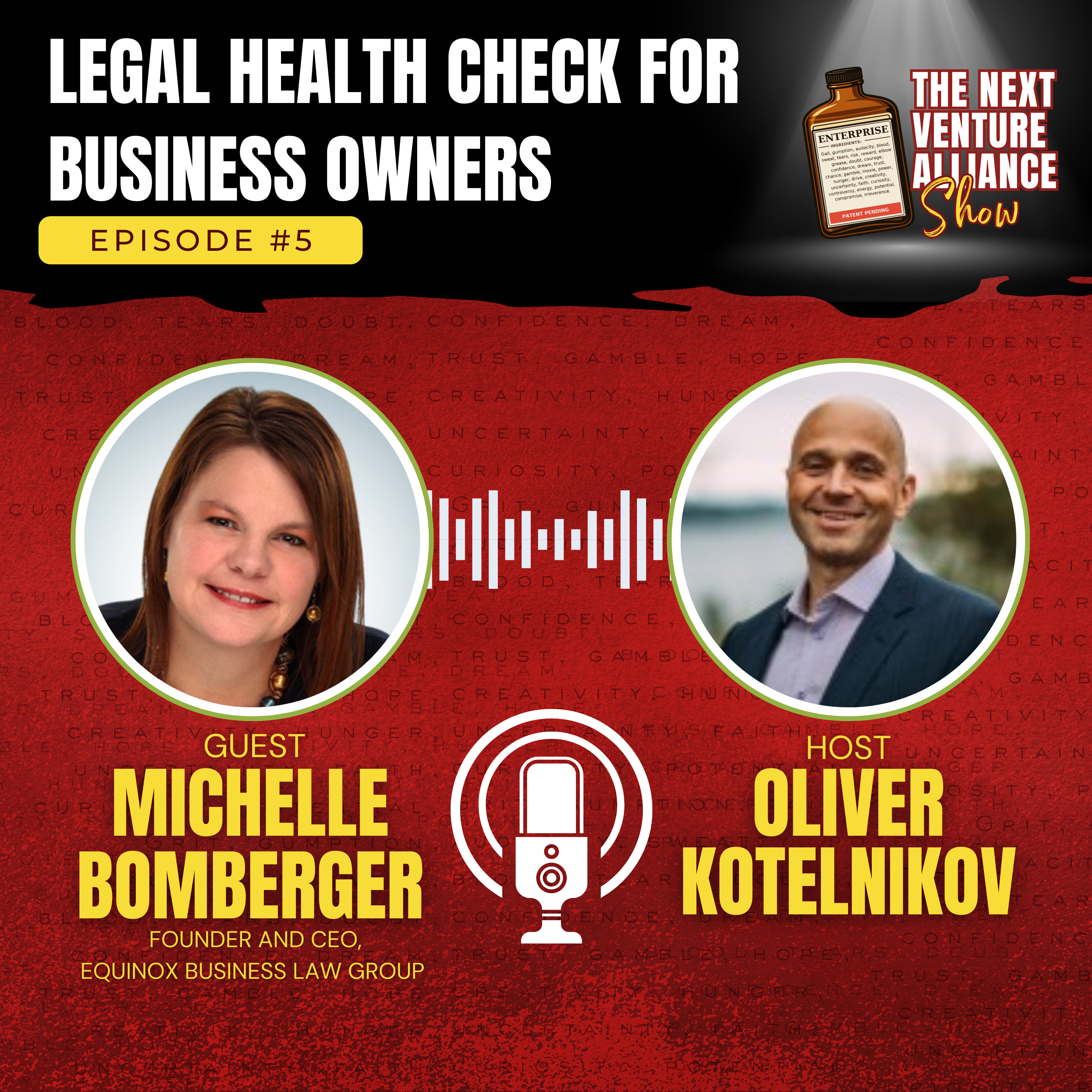
[00:00:34] Speaker B: Good morning and welcome to the next Venture alliance show. My name is Oliver Kotelnikov. I'm an entrepreneur, a storyteller, a mergers and acquisitions advisor, and a business and commercial real estate broker at IBA in Bellevue, Washington. On this show we talk with founders, business owners, self starters, industry leaders and trusted advisors who support them. Together, we explore both the strategic and the human side of entrepreneurship. Our guest today is Michelle Bomberger. Michelle is an award winning attorney, entrepreneur, legal innovator and CEO of Equinox Business Law Group. She pioneered the fractional general counsel model, bringing strategic, forward thinking legal guidance to growing companies that want to scale.
For decades, Michelle has inspired thousands of entrepreneurs to see legal counsel as a catalyst for growth and not just the cost of doing business. Prior to Equinox, Michelle was a consultant to nationally recognized firms such as Ernst and Young and was a member of the internal audit team at Singular Wireless. Michelle earned both her juris Dr. And MBA from Northwestern University and her undergraduate degree in finance and computer applications from the University of Notre Dame. She's been recognized as a Puget Sound Business Journal 40 under 40 honoree and won the award for King County Executives Women Owned Small Business of the Year. Michelle currently serves as president of the Seattle chapter of Entrepreneurs Organization and is a past board member of Bellevue LifeSpring and Youth Theater Northwest. In her free time, Michelle loves to ride horses and enjoys traveling with her family. Michelle, you're a consummate professional and one of the most well rounded humans I know. It's an honor to have you. Thank you for joining.
[00:02:24] Speaker C: Well, thank you. It's a long bio, but I think speaks a lot to the 20 years that I've been kind of in the Seattle market as an entrepreneur.
[00:02:34] Speaker B: Yeah. Did I get that right? Did I get the bio pieces correct?
[00:02:38] Speaker C: Yeah, yeah. Like I said, there was. There was a lot there.
[00:02:41] Speaker B: There's a lot there. Were you surprised yourself?
[00:02:44] Speaker C: I was so.
[00:02:46] Speaker B: Well, I remember we met in about 2019. You came to speak at one of IBA events and I was in the middle of transition, just, you know, making the change to business brokerage and M&A, I just sold my business. And I think this was one of the first professional development events that, you know, as part of the IBA team. And I was both, you know, impressed and intimidated just because the amount of information that you provided just blew me away.
And you know, full disclosure, six, seven years after I took some notes, but I haven't completed my homework so I'm sort of half prepared for this conversation.
[00:03:32] Speaker C: Well, I think IBA does such a great job with bringing its team together to learn and learn not only from whoever's speaking, but from the experiences in the room. And so it was a really fun day I thought as well, because there were, you know, folks who were, you know, involved with kind of traditional seller side. They were kind of buyer side, they were franchise folks. So it was a really diverse room. And if memory serves, we talked about limitations on liability, we talked about indemnification, all those like really sort of sticky areas that make deals slow down, stop, go forward. There's a lot of pressure in that area and so glad you got something out of it.
[00:04:16] Speaker B: Yeah, I got a ton out of it. And obviously those specific things, you know, right off the bat are a lot. And you know, we'll get into the, a little bit of that further in the conversation.
But how about, you know, when did Equinox start and maybe a little bit about your story and how we got to this point today?
[00:04:36] Speaker C: Yeah, of course a lot of the story was in the bio, so we'll keep that part brief.
We are celebrating our 20th anniversary as Equinox and the founding of it was, you know, just me. I was coming out of corporate, hadn't really ever practiced law before, at least not, you know, in a traditional private practice.
And I knew that there was a better way to serve businesses.
Most businesses, even larger ones, but definitely small and mid sized companies don't use legal proactively because it's messy, it's difficult, it's complicated, it's expensive and so they just kind of avoid it. And as we got more and more technology tools available, those are easy sort of defaults and go to's for folks to use. And then I do encourage that with the caveat that the value of legal is in the thinking. The value of legal is in the experience and the ability to connect the dots on what is your business's risk profile and what is your risk tolerance as a leader and putting those together and then making the legal assessment.
And so going into kind of founding this business, it's like how do we take the ticking clock off the table, how do we take the risk aversion and the no off the table and make something that really does work for businesses? And that's kind of the foundation of where Equinox was very business centric fixed price. And we've over the last 10 years really shifted to this fractional general counsel model, which is a fixed price all inclusive, with the goal of being knowledgeable about the business and being able to give a quick, relevant, practical answer without all of those like fees that go along with it. It's a fixed price.
So this journey and how do we package this, how do we build a solution that works?
And that's probably one of the things I'm most proud of in the business.
[00:06:40] Speaker B: And it's very different, right, from a traditional model of legal advisory services. And you know, at the foundation of it is, you know, if I can call it that, preventative care. Right. And you have the term legal health check, which you draw a parallel to, you know, to the medical world, which is very close in that sense, is that, you know, if you're going to the doctor with an acute symptom of something, you know, you need to go to the doctor if you have an acute symptom of something. But preventatively, you know, that can be avoided. Right. If you sort of take care of yourself and are, you use the word proactive and you know, if I look at, you know, your services and this is just a brief rundown, but employment and HR contracts and leases, ownership and succession, trademarks and copyrights, mergers and acquisitions, risk assessments, strategic planning and compliance, data privacy, real estate, you know, at a glance. Yes, these are all services that a business owner might need.
An employment and HR issue doesn't have to happen if you're preventative about it. Right. A data privacy breach need not occur if measures are taken. Succession, planning, you know, planning is the key word. Let's start early, right? I mean, are those some of the building blocks?
[00:07:55] Speaker C: Absolutely. I think, you know, many cases you're not going to stop the thing from happening, but what you will be is confident and prepared that when it happens, you know, you have the infrastructure in place to mitigate the risk quickly or completely. It depends on kind of, again, the nature of the problem. So, you know, you look at employment, right? We can't stop someone from suing you. However, you can have the processes, procedures, policies, documents in place so that when and if that happens, you are ready, you've been doing the things, right. So that claim is not going to go very far. You know, you use the example of the primary care physician, and we actually use that a lot. And yes, there, there's an acute issue. You go to your doctor, but the great thing about your primary care doctor is that they know that you were training for a marathon. They know that you had a back issue last year and were taking some medications. They know these things and so they can connect those dots more readily. And what the industry has taught businesses is that you need a different lawyer for every issue. Right. And if you have a different lawyer for every issue, great. At least you have them. I'm thrilled that you have them.
But if they're not talking to each other, then I don't know that you went and, you know, had a surgery last year. And so it's hard for me to be able to fold that information into the decision making.
So we really look at ourselves as similar to that primary care doctor who's like, okay, yeah, I know the history. I know what you've been working on. I know that these things are your goals and what you've done in the past. So given all of that, here's the prescription for going forward. Here's the policies, here's the procedures, here's the documents, here's how we manage that risk so that you can go forward confidently and safely into those decisions in the next year.
[00:09:52] Speaker B: And you've been seeing the patient for, for some time now. You have their medical history.
You know, again, when you're, much like when you're in the middle of a medical emergency or an issue, you know, legally, it's the same thing. If you have to do, you know, a bunch of intake forms and a bunch of admin, you know, when you're in the middle of an emergency, that's arguably the worst time to do it. Right. You do it. But, but yeah, it's, it's, you know, the parallel is I, you know, I think is going to your primary care provider rather than running to the emergency room every time, which.
[00:10:26] Speaker C: Yeah. And it slows it down. It makes it more expensive as well. Because if I have to sit there for two hours and understand all of the history, then we aren't going to have that cadence to be able to say, okay, quickly, like, let me look at your documents. Here's where we are.
We have a lot of, you know, and if, you know, for. And the council's not gonna be as relevant. I think that's one of the challenges that folks get is what they get is something that's super risk aver because the lawyer has to take that approach. Because they don't know all of the if ands and buts that have happened in the past. And so again, if you have that relationship and relationship with any professional advisor, I would say those people can then provide really relevant, timely guidance because they know again, where that business is and what your risk tolerance is.
[00:11:15] Speaker B: You mentioned, you know, there's a pricing. I mean, how do you price something like that?
And how are services priced? And having a general counsel and essentially an attorney on call. Right. For a variety of issues.
[00:11:28] Speaker C: Yeah.
It's been really interesting to see progress and how this has come together. And what we have found is that tailoring it to the business's needs, knowing that that's going to vary over time, is really the solution that we've taken. So we, we do an interview with the client, we say, what are the projects? Based on our conversation, based on what they came in knowing for sure they had on their plate. What are the projects that you want to tackle over the next six months? It might be, you know, hey, we have a, you know, partner retiring or we haven't looked at our employment documents in five years, or we're going into a new business relationship or expanding our geography, whatever those things are.
And so we'll build out those known projects. And typically a six month period is a pretty reliable planning cycle we found. I mean, yes, things change, there's no question. But in six months we kind of know what we're going to be tackling as a business.
So we build out a plan that includes those known projects. It might be 2, it might be 10, depends on what the business has on their radar.
And then in addition to that, we know that the things are going to come up, the unexpected things are going to come up. And so based on the complexity of the business, based on the owner's sort of risk profile, we then build in those wraparound services so they can call and say, hey, I got this nasty letter, what do I do with it? This employee just came in and said this. Can someone hop on a call and talk with me? We're getting ready to go into this new partnership. Can you review these documents? All those things that are unexpected are also included. And then we do regular check in meetings, we do a quarterly legal update which is, hey, here are the laws that are coming down the pike, federal and state.
Here's how they apply to you. Let's get everything trued up for when they go into effect. So it's our job to make sure that those things are happening proactively and in advance. So all that is packaged up into a six month plan. And then every six months we do the same thing. Maybe we tackle 10 projects in the last six months and there's just, there's not a lot. So it might bump down for six months because hey, we're kind of in maintenance mode and we know that going into, you know, 2027 we're going to have this other, you know, big thing happening and so it just floats over time. And that's worked really well because we kind of just meet where it makes sense. Yeah.
[00:13:57] Speaker B: And, and the model makes a lot of sense.
You know, I like the legislative be so you know, you know you can, you keep an eye on what's coming down kind of the pike and you're able to build that into the next six months because you know, something that's relevant to that particular business or that business owner is going to take effect or something's going to be passed.
And then so you provision for that in the next six months saying hey, we're going to need to look at these legal bills that are coming out that are going to have a pretty big effect on you.
[00:14:27] Speaker C: Yeah. A great example of that was when all of the non compete changes were happening, were happening both at the federal level, which were being challenged, but also Washington State and Oregon State were making changes as well. And so there were things that were happening fairly quickly. And so it's like, hey, we're just going to pull all your documents and we're going to just review them, talk through what those changes look like and get those implemented for you. So they also understand what it is that is changing. It's not just us delivering a document, but hey, you know, here's the difference between a non competent, non solicitation and a non interference. And here's what's allowable, here's what's not allowable.
So that when they go into their next conversation with a new employee or a new contractor, they're able to, you know, understand what it is that they're allowed to agree to or put in writing.
[00:15:14] Speaker B: Yeah. And just even knowing. Right. Same as kind of in tax law, you know, business owner just knowing that something is coming down and is going to be passed or you know, enacted, whether that's tax or legal is half of it. And you know, no matter what business owners that you can commit to, say well I'll just start watching, you know, the legal landscape or the start, you know, keeping an eye on the tax code. It's impossible to keep track of. Right. And again, you just Being ahead of it versus being informed, saying, okay, hey, now this is coming out, whether that's minimum wage, non competes or whatever it is.
[00:15:51] Speaker C: Yeah. We really encourage both our clients and other advisors that we know to, you know, lead in this area. Right. So our clients should be able to rely upon advisors, even advisors, you know, like you all at iba, to be like, hey, here's stuff you need to know. Months, months and months in advance of when you need to do something about.
[00:16:13] Speaker B: It, perhaps, and then some more months.
[00:16:15] Speaker C: Yeah, right. But I think that, you know, so many of these relationships, whether it's, you know, insurance or tax or legal financial planning, like all of them, you know, can be like a once a year thing or a transactional thing rather than something that is, you know, hey, I'm an advisor and I have insights into these things. I want to get those into your hands. And so we encourage folks to kind of reach out a few times a year and say, hey, what do I need to know?
[00:16:43] Speaker B: What do I need to know? Yeah.
And you know, you mentioned you're attorney entrepreneur, so you are a business owner.
Business owners. And you know, I found tremendous value in that for me as a business broker because starting out, you know, I had some mergers and acquisitions experience as, you know, as an operator. But really, you know, what I had was the ability to relate to a business owner in the beginning, you know, and that was most of it, you know, and some years have gone by and I've had some success and I can, you know, now speak to being able to, you know, having some experience on the mergers and acquisitions on the transactional side. But the ability. But that business owner part think still remains the most important overlap that I have with the client. Do you find that it helps you, being a business owner to help business owners, you know, in a legal sense?
[00:17:38] Speaker C: Yeah, I think the relatability is really important.
Right. And I think, you know, even us being a fellow small business is important because entrepreneurs, from my experience, want someone who gets the experience that they're going through.
And when we talk about being strategic rather than transactional, you know, being able to say, I've been through this, I've seen this not only as a observer of other clients, but I've lived this. Right. You know, you get a lawsuit. Yeah, it happens, you know, it's going to happen.
[00:18:18] Speaker B: I have been sued before as a business owner.
[00:18:21] Speaker C: Right, exactly.
And the perspective that we can provide as peers, not just advisors. And so I think pairing those two things together is what stands out to a lot of entrepreneurial Clients is people who can relate to that emotional experience. Not just the financial or just the, you know, ego, but like, this is an emotional roller coaster.
And it's personal. It's not just business.
And one of the things that we talk with our team about is the value of us being advisors is not just the risk and the paper and the documents. I said at the beginning, the value of a lawyer is in the thinking through the process problem.
And the more we understand who we're talking to, the better we're able to do that. So, for example, you can have two identical businesses on paper, identical, and you put a different leadership team on top of it. And it's a totally different business because they make decisions differently, they react to things differently. And so we have clients who won't sign anything until it's fully reviewed and negotiated.
And we have people who sign things left, right and center without even having them in front of us. And neither is right or wrong. It's that us knowing that propensity puts us in a position to be able.
[00:19:48] Speaker B: To advise different meaning knowing that about your client, kind of their position on something arrived, they told me to sign it, I signed it, it looked fine.
[00:19:59] Speaker C: Yep. And so in that case, we might be able to say, hey, any contract you get, we want you to look at these five things, right? And we can begin to educate them and educate the people around them on what is maybe standard for your business, right. What is, what does an indemnity provision mean and what are you looking for when you read it? And if we can provide them with at least those little data points, then they might say, oh, this looks different. Because otherwise they're skipping that whole section because it's boilerplate, right?
[00:20:30] Speaker B: Yeah. It's amazing how much is called boilerplate. I mean, they'll look at it and go, you know, it's all standard stuff. It's boilerplate. And these words get thrown around. You know, it's industry practice. You know, it's all normal. Right. In someone's head.
[00:20:43] Speaker C: But yeah, and the title is the same and all of the words are different and it actually matters. It's one of the most important provisions of a contract. And people don't understand them well enough and they're convoluted. I mean, the number of times I've had to parse them out into like all these little sub bullet points because they're so convoluted that people are like, oh, you know, it's standard.
[00:21:03] Speaker B: Yeah, people love that word, right? It's just standard. Standard industry practice. It's normal. It's, it, let's, let's, let's talk about that. I mean mergers and acquisitions, it's you know, one, you know, areas and it's where we overlap and we can, you know, it's an abyss of a topic. Right. We can probably do, you know, a 12 part television series on it. But you've mentioned, you know, indemnity provisions and so maybe let's kind of peel back the curtain a little bit on the contract stage then the purchase and sale agreement specifically, you know, I know the listeners might say, well you've got, you know, you've got a great legal scholar on your show and you're going to talk about the purchase and sale agreement. We all know what that is. You know, can't you pick something more interesting? To me, I think that's where the disagreement is a lot of the times and the difference between a successful and an unsuccessful deal is a, you know, there needs to be a shared understanding of what a purchase and sale agreement is. So in your opinion, you know, conceptually, what is a purchase and sale agreement and what are its key objectives?
[00:22:11] Speaker C: That's a big question. Yeah, I mean I think clarity certainly. I mean I think that's probably the most important piece is what's on the paper matters, especially at that stage. And I'll go back a step.
My perspective of a letter of intent or an LOI is that it should include all deal killers.
So anything that know that you need in order to move this thing forward should be in there because there's no reason to waste, you know, months of time and then get to the purchase and sale agreement and be like, well I absolutely have to have this asset, this inventory, this person or I can't close. Well we should have started with that months ago and saved ourselves some time because turns out seller won't do that. Right?
So for the loi, everyone's like well it's non binding. Well it does have binding provisions, so let's keep that in mind. But yes, it's not. But it also is the document that everyone goes back to and says well that wasn't in the loi. That wasn't in the loi.
So set the stage. Well at the beginning with the loi and I think that is really important and I a lot of it's not binding so let's just move on. And I think that's a disconnect because that is the expectation that is flowing into that purchase agreement. So those two things are really important. I think the second piece that really drives the purchase agreement is due diligence. And due diligence is the part of the process where the buyer asks hundreds and hundreds of questions. The seller tries to answer them and gets very tired of answering questions, and you create this tension in the process.
So the more prepared the seller can be for those questions, the easier it's going to be and the more confidence the buyer will have. And the reason I mention this is because of the purchase and sale agreement, probably half of it is the seller's representations and warranties. It's the part of the document where the seller promises that all these things are true, that, you know, there's no lawsuits pending, they followed all of the laws, they filed all their taxes properly, and those words matter.
Right?
And you'll see the buyers often, or sellers often want to put, to my knowledge, to the best of my knowledge, and buyers like, no, no, no, no. You either know or you don't know.
[00:24:30] Speaker B: Right.
[00:24:31] Speaker C: Really hard space. So again, if the seller is really prepared and has a very organized, you know, set of documents that they're handing over, the buyer's got a lot more confidence. They're not going to nitpick as much in those representations and warranties.
To me, for the seller, certainly that is the most important part of the document because every single word in there has to be accurate or has to be disclosed as an exception.
And again, the more messy the seller is, the more convoluted and the more caveats the buyer is going to expect.
And then there's the protection. So that gets to the indemnification piece, and that is, if someone did something wrong, the other party gets reimbursed for those costs. And this is particularly a breach of representations and warranties. If the seller said something was true and it turns out that it's not, then the buyer will be able to be compensated in some way.
And those provisions have gotten very, very complex over the last 10 years, in my experience, in my opinion. So, you know, it's clarity, but it feeds from these other parts of the process.
[00:25:39] Speaker B: Yeah, no, and great answer. And I asked you a big question, and there was a lot there in your response. But, you know, I'll say on the LOI and letter of intent, you know, I agree that there's a lot of, hey, it's not binding. Let's just move on. Let's just get it into escrow. Let's just get it off the market. Let's start.
But really, you know, it's a firm handshake and it's a durable Agreement and there are, you know, binding provisions which are, you know, usually what exclusivity and public disclosure. Typically the exclusivity depending on what's in there. But what would you say are, let's say five or six things that need to be in an LOI for you to have a, you know, a good blueprint for, for, for, for purchase and sale agreement?
[00:26:29] Speaker C: I think any, what I would call deal killers but also might be called, you know, conditions to closing are probably the most important.
Right. So if you have a, on the buyer side, you know, a financing condition, right. Like I have to be able to get this financing or I can't close on the, you know, the seller's involvement after closing, for example, you have to be available at this kind of level with these goals, the goals of keeping customers, the goals of training our staff or whatever those things are. So to me that's probably the most important and that those are also kind of exit clauses as well. So under what circumstances can someone walk away? Again, it's non binding. But if there's escrow on the table then, you know, what are the terms.
[00:27:19] Speaker B: Of that, of that escrow, lease contingency, you know, post transition training, any holdbacks? Right. If there any, you know, parts of the purchase price that are being retained in escrow for, to address, you know, post closing liabilities. I mean any of those things non compete probably. Right. If there's a different expectation around that.
[00:27:41] Speaker C: Yeah. What is the role of the seller in the short term, in the long term, in being, being involved? I think also, you know, just the, the, the condition of the financials and the due diligence. What are the assumptions being made? Like we talk about conditions to closing, but what are the assumptions being made on the proposed purchase price?
A lot of times that's not in there. Again, you know, it's subject to due diligence, it's subject to us learning more.
I am a little iffy, ambivalent about, you know, lots of specific time frames. I think there needs to be some timeframes to keep things moving forward and to put some pressure on the parties to move things forward.
But sometimes there's, you know, 30 days here and then 20 days here and then five days here. Like I think sometimes that's too constraining to a business process.
But there should be some timelines in there so that there's kind of pressure that's not just we expect to close by the end of the year because then the last two weeks of the year are just nuts.
Whereas if you Say within, you know, five days of signing this, the request for due diligence will come out. You know, we anticipate to be signing the purchase agreement by this date and then closing by this date. I think it's good to have some guidance around those things to set expectations. And again, I think the biggest job of the LOI is to set expectations.
[00:28:56] Speaker B: Yeah.
[00:28:57] Speaker C: And then.
[00:28:57] Speaker B: And until the purchase and sale agreement is signed, which can take some time. I mean, that is kind of the governing document. That's, in essence, that's all we have at that point. Right. We're negotiating the purchase and sale, which can take time, it can take longer.
The LOI needs to be substantive enough to where we can refer back to it and say, hey, here's what we agreed. We can talk about it. You know, we can talk about a variance, but this is what we agreed to from the outset. So I think issues start when things start becoming wildly different. And you mentioned setting expectations, when we're deviating from those, and somebody saying, wait, this is not what we talked about. And then the credibility issue, right. Of, okay, what else is going to go like this?
If we're just disregarding all prior agreements or forgetting that they happened, you know, it starts deferring to trust very quickly. Right. And parties say, well, this isn't. These people aren't who they say we were. And it gets personal. And so I think the LOI is a detailed enough LOI keeps parties from getting personal. Right. And you can always refer back. There's a not making this up. We agreed to this.
[00:30:06] Speaker C: Right.
You got the ground rules in place.
But you mentioned trust. And I think it's really important, even when it's not personal, there has to be, you know, a foundation of trust and confidence. And that's where I kind of go back to the confidence a seller can put into a buyer based on what they know, what they can deliver, the timeliness of delivery. They're not just like, you know, frantically scraping things together. I'll have those in two weeks after I create it, because it was never created before.
More that trust bond strengthens, and the buyer's like, oh, okay, you know, this person knows their business and I have confidence in what I'm buying.
And I mentioned earlier the tension that exists there and the number of times that I've heard, you know, sellers say, why don't they just trust me? You know, have you created, you know, an environment that promotes trust? Because they. I mean, usually they're doing everything in good faith.
It's just that the buyer is seeing these cracks. Right.
[00:31:08] Speaker B: And so if you can, they're unfamiliar parties oftentimes. Right. That have never met each other, that are all of a sudden brought together in what often is the biggest transaction of both of their lives.
[00:31:19] Speaker C: That's right. That's right. So it's all heard horror stories.
[00:31:23] Speaker B: They will, yeah. They all have these, you know, composites of, you know, sometimes inaccurate and incomplete information that, you know, maybe friends or well meaning advisors have said, you know, oh, well, here's what should happen, here's what you should do. Right. And, and I think this is the.
[00:31:40] Speaker C: You know, a lot of value in, you know, bringing these advisors to the table, especially on the seller side, early. Right. You know, you probably have a similar experience, but oftentimes we're brought in after the LOI is signed and then we're, you know, hitting due diligence. And there's so much that's not, you know, that's not done. There's not a data room prepared. There's not. And oftentimes that happens. Right? Unexpected offer shows up, you know, you're going full speed ahead with an unexpected offer. But on the, you know, ideal side, you know, someone is thinking about this, right.
And I'm sure, you know, I've heard this from, from, you know, your team, other brokers. If I can be in there 18 months in advance, then we can start thinking about what do we need to clean up, what do we need to make sure is pretty, what do we need to shore up for value purposes, not only just for legal purposes or liability purposes, but you can actually increase value if you perhaps get that trademark or you modify your contracts to be more readily assignable or you put in place certain kinds of employment contracts to keep people. There's, there's lots of things that can be done if you have, yeah, reduce.
[00:32:48] Speaker B: Owner dependency, don't be a bottleneck as.
[00:32:51] Speaker C: The owner, you know, it's an easier thing to buy.
And so, you know, how do we help, you know, businesses to think that far ahead? And if you talk to the tax people, they're like, we want to know five years ahead so we can make any changes to the corporate structure that far in advance? Because you have to have a certain Runway on that corporate structure in order to take advantage of it.
You know, how do we help some of these business owners to begin thinking about this process long before they're expecting to do it.
And from our business model standpoint, we've done a number of businesses where they're like, hey, I'm probably going to Sell in the next few years.
Okay, let's start building that data room. Let's start going through a due diligence checklist. What are the things that we can, you know, right now start to put in place that are going to make this business easier to buy? And again, part of our fixed price, it's like we're just going to build it in the background. We're going to do every month, we're going to do a couple of pieces of this and in a year you'll have a full kind of data room ready to go. And there's no reason why a business owner is thinking like that because they've never done this before. Right.
So how do we get in there earlier to be able to help them make this transaction happen more smoothly because they're prepared for something they've never done before?
[00:34:14] Speaker B: Yeah, we, I mean, we advocate for, you know, I call it the gift of time, meaning if you're not selling yet and you have two or three years, this is the perfect time, like you've mentioned, you know, without the pressure is to start attending some, some of these things, gathering information, learning about the process, doing a trial run. Due diligence, in essence. Right. So we, you know, IBA does an evaluation prior to recommending a price or prior to bringing a business to market. That's the dress rehearsal for due diligence because we asked for probably about 80% of what's going to be needed on least on the operational and the financial side of things.
But also at that point, you know, it would be great to have a team in place to where we can say, you know, we can present the evaluation. A CPA can look at it and say, hey, here's your post sale liability under this or post sale tax liability. Here are your estimated proceeds.
I think you would be better off structuring this as a equity sale. Do you think that's going to be a problem that comes back to the broker? If there's an attorney, I can run it by an attorney by, you know, Equinox and say, hey, can we. Do you see an issue with, you know, structuring this as an equity sale or, you know, what do we need to do to optimize everything? Right. And then after the sale is completed, you know, the proceeds may be earmarked for some next, you know, venture or adventure, whatever the case may be. Tax shelter. Right. But trying to sort through all that, as you sometimes see, you know, in, in due diligence when there are already other pressures or we're, you know, Two weeks from closing, and they're saying, well, what my, you know, how much am I going to pay in income tax? Right.
[00:35:57] Speaker C: Yeah. I love the gift of.
[00:36:00] Speaker B: It just ends up being another pressure point at a time when it's absolutely least needed. Right. So that, I mean, I'm with you on time and the team. Right. Time and team. If you have those two, you're probably going to achieve the best achievable outcome.
Not optimal. It's never optimal. Things happen. And, and, but yeah, I, you know, starting early is probably, and it doesn't cost anything to start early. It just requires shifting from planning. And planning is, you know, probably the hardest thing for us as humans to do because especially business owners, they have buyers that they're putting out. Now you're saying, hey, I need you to think about this thing that may or may not happen, happen three years from now. Yeah, it's a tall order.
[00:36:47] Speaker C: But somehow the owner dependency is a big part of it. And so that practice is also really useful. Right. If we can get folks to practice that, you know, okay, who can do these roles for you? How. How do you step into that kind of CEO, you know, on the business rather than in the business leadership role?
[00:37:06] Speaker B: And that's what separates, you know, a business from a very highly paid job.
Yeah, right. And that's how a buyer looks at it, is, okay, am I just stepping into something where I will be well compensated but we'll need to work, or is this an actual something with an advantage of ownership? Because business ownership is risk. Right. There's risk there. And so what are the upsides to it? And oftentimes they're leaving a position, you know, again, try to walk around the table and give the seller the view of the buyer, you know, and they're saying, well, who do you represent? Well, I represent you, but we need to understand the market demand and how it's viewed, how it will be perceived.
Yeah. And the buyers oftentimes leaving a position where they're already working and they're well compensated.
What's the advantage here? Right. Are they just shifting one job to another? So that's the owner dependency piece. But you'd mentioned due diligence. And I think those probably the four things that are sellers or parties are least prepared for are due diligence, the disclosures that then, you know, inform the reps and warranties, and the indemnifications, which are sort of the cures to things. If, you know, if we, we didn't say if, you know, if what we said wasn't accurate. Right. So maybe about those fundamentally, what is a representation and warranty?
What is a disclosure schedule? What is an indemnification?
[00:38:37] Speaker C: Yeah, so the representations and warranties. And again, this is usually a significant part of the document. And so the seller, they always say.
[00:38:46] Speaker B: In that part, I say there are many reasons to hire an attorney, but if they had to pick one, it's this document, purchase and sale agreement, and it's this section.
[00:38:55] Speaker C: Yeah.
What the seller is doing in this section is promising that certain things are true about the business. And this is where the buyer gets confidence in what they're acquiring. Right. So with respect to taxes. Right. All taxes have been paid federal, state, local, fully and completely and accurately in accordance with gaap. Right. Let's just put something like that out there.
So as the seller, seller's counsel, I would say, is all of this true and. Oh, yeah, yeah, we pay our taxes. Okay, let's ask the question.
Did you use gap?
What's gap?
Here's most small businesses don't, and it's become, it's become less of a critical issue in recent years. But it's that level of nuance that matters. In the reps and warranties, it will say all. It will say must versus May. It will say very, very definitive words. And so I, I universally tell sellers, you need to read through this with a fine tooth comb, make sure every word is accurate. And Sometimes this is 30 pages. It can be intense. You know, you've got hazard, environmental, you've got all contracts, you've got tax, you've got employment, which probably has 15 paragraphs in and of itself. It goes on and on. And so you are representing and warranting that those words on the paper are true.
So the schedules or the disclosures are exceptions.
So, for example, you know, there are no threatened or active lawsuits. Right. Well, we had this one complaint three months ago where they threatened litigation. Okay. So that we leave that statement in there, but then in the schedule or the disclosure, we would put those exceptions. Oh, by the way, we had this complaint, and so we want to make sure that anything that is an exception is written down.
And on those exception sheets, a lot of them are blank. A lot of them don't have, you know, don't have any exceptions. But if there are exceptions, they need to be listed there. On the flip side, sometimes it says, you know, list or provide the top 25 contracts. So that would be the schedule would include what is required or what is asked for. But so those can be many pages, and they can take a Lot of time. And it prompts more questions often. And so while you're doing due diligence on one side, you're doing these documents typically in parallel, and one is sort of prompting more questions on the other side. So those two things happen together and it can spiral into bigger things that. So then we get to the indemnification provisions. And so indemnification, again is everyone makes promises under the contract.
If some sort of damage arises because those promises are false, those statements are false, then the party that's harmed gets a remedy, gets some sort of, whether it's termination of a contract, whether it's money damages, whether it's, you know, holdback provisions, whatever those things are.
So if, for example, the business, the seller says, we are properly registered in every jurisdiction where we do business, and it turns out they never registered in Texas, even though they have an employee there. And it turns out some letter comes from Texas and there's some penalties due for not properly registering. Those would be costs and damages that the seller would have to indemnify the buyer for. For. And there may be other penalties. Sometimes you can cancel the contract because it's such a big thing that we can't proceed because we basically have damages that we can't satisfy or get around and continue the business.
I mentioned that, and I'm sure you've seen this. The indemnification provisions have gotten very complex in my experience over the last 10 years or so where it'll say for, you know, these reps and warranties, the indemnification only lasts for two years and it's capped at $50,000 again, depending on the size of the deal. These other ones last forever and don't have a cap.
And these other ones only apply if the damages are more than $10,000. Right. So there's all of these, like, buckets and movements. Because there are things that are basically mission critical that will destroy the business.
I care about those. But I'm not going to nitpick over whether the inventory amount was, you know.
[00:43:36] Speaker B: Like a fundamental rep and warranty, let's say, environmental or tax matters, those live forever or limited by statute or something like that.
[00:43:45] Speaker C: Oftentimes they'd be the statute of limitations on something like that, because once those statute limitations passes, then there's no more risk. And so those will often be. But something like the business was properly set up as a corporation in the state of Washington. It's kind of a problem if it's not right.
[00:44:05] Speaker B: And you should know. Right. It's not so Maybe we can talk about qualifiers and knowledge then. You touched on that. But, you know, some things you should just know. Right. And you should be. And if you're not able to make that statement, then again it prompts further questions.
[00:44:21] Speaker C: That's right.
[00:44:22] Speaker B: What are some of those things that it should just be a flat versus a modified.
[00:44:26] Speaker C: You know, I think, you know, a lot of times Sellers Council wants to qualify everything with, to the best of sellers knowledge.
And I think the way I look at it is, as the owner, is this something you should know? Right.
[00:44:42] Speaker B: Regardless of who you represent? Right.
[00:44:45] Speaker C: Yeah.
[00:44:45] Speaker B: In fairness.
[00:44:46] Speaker C: Correct. And I think the definition of knowledge comes up a lot too. How are we defining knowledge? Is it that you know, me as the owner actually knows this fact, which is a little bit different than me as the owner? I either know this fact or after inquiry or reasonable inquiry of my leadership team knows this fact. Because as an absent owner. Right. Someone who's not in the business every single day, I don't know, I can actually say I didn't know that. Well, that doesn't really help the buyer either. Right. So oftentimes there will be with due inquiry as well. So what should you know?
Because you should know that you paid the taxes, you should know that your business is set up properly in every state.
You should know that you're paying proper wages.
And then a lot of times you'll see something that maybe you don't. So you would say there is no litigation or to the knowledge of the seller, any threatened litigation. Right. Or any pending litigation. Right. So you may not know of every possible person out there who's thinking, oh, I might, I might sue them. Right. Obviously we don't know that. So they can get a little nuanced.
But what I say to folks is I suggest they read this. Is there anything that you're like, I don't know. Okay, let's talk about that.
[00:46:08] Speaker B: Let's talk about that one. And some of them are reason, you know, if there are fines or fees or violations, like a parking ticket is a violation. Do you know that One of your 16 or 17 employees, whether they got one in the last two weeks, should you be tracking that? You know, who knows? Right? But speaking on the employees, I mean, is that a recent development where the owners or the principal's knowledge is kind of commingled or now that the employees or the management team's knowledge becomes the owner's knowledge and they're indemnifying for that?
So in essence, you know, that they should know what the employees know or don't know.
[00:46:52] Speaker C: Well, I think the standard is as the owners of the business who are selling the business, you have a responsibility, a duty of loyalty, a duty of care to the company. Right.
So if you are an absent owner, then if I were the buyer, I would want more of that language around the do inquiry.
Right.
If you, you know, are in the business, then you're going to be that person who's running it. So understanding kind of the role of the person who's selling it. And I think, you know, there's a good faith component here as well. Like, I don't know, I didn't ask, I don't know. Right. Like we also want that, you know, good faith language in there as well that, you know, usually in the rep and warranties section, it specifies that standard of good faith or due inquiry or knowledge or like what are those components that they are promising and what is the detail of that? And again, this is where the legal piece can be really important is kind of reading that with a critical eye on what am I committing to, what am I actually promising here?
And when, you know, the professional advisors are working with their client, they know what that role is. And if we're having the conversation about I actually don't know. Okay, well then we have to be careful about making sure that we're either providing exceptions or disclosing or changing that definition as well. So it is important that, and there's, there's going to be language in the agreement that you are making a representation and warranty to these points and ignorance is not going to be a defense.
[00:48:41] Speaker B: Right. That's really well put. I, you know, it's a, one of the things that you said at one of your recent seminars was that it stuck with me was it was about order of operations and when things happened. And like you mentioned, they run parallel. Right. And oftentimes and that due diligence actually informs these other things. It informs disclosure schedules, it informs how the reps and warranties evolve and change based on what they're finding out. Right. Because the buyer does have the opportunity to look under the hood and conduct full diligence. It's reasonable to believe that some of the things they learn there are different and more detailed than what they learned in discovery. And that's going to change the level of their inquiry and it's going to change this, this rep, for instance, about should, should you not know what your employees know? Because if you're there, it's one thing if they learn that you're absent or you were absent for the past 18 months or maybe didn't know that. That's a different type of. Now that changes the Corresponding Rep.
Yeah, 100%. Yeah. It's a living document. Right. And that's part of the frustration, I think, is that until it's signed, it remains a living document.
And you mentioned, you know, the personal aspect of it and the seller feeling oftentimes is if they're being questioned, attacked.
And as a sell side broker, I, you know, what I say is that this actually protects you. I know that this feels like you're just furnishing information and giving and they're asking for all these things.
But at the end of the day, once it's all said and done, if you've told them everything, then you sleep at night and you're as safe as you can. The more you say, the safer you are, in essence.
[00:50:37] Speaker C: Absolutely.
[00:50:37] Speaker B: You don't want to say the wrong things, but it does protect the seller. Whereas it can feel like they're, you know, running around and sort of taking orders. And I think that's part of the frustration is we already told them this. Why are they asking again? Well, it's based on additional diligence.
[00:50:53] Speaker C: Yeah.
And I think that that is really good advice is that, you know, while this feels like an attack, remember that the more that you give them, the fewer questions or opportunities they can come back and say, I didn't know or I wasn't told. And that's going to fulfills the indemnification, you know, obligation is that they're like, I didn't know this. It wasn't disclosed. And that's again, you know, yes, you might have told them, but does it also need to be written down in the schedule? Right.
Because there's multiple places here and just because you told them, if it's not in the schedule, it telling them may not have been enough.
Right.
And so spending a lot of time on the reps and warranties and the schedules and making sure that they are as complete as you possibly they can will, you know, save the seller in the long run and save the buyer too. I mean, ultimately, you know, a buyer who doesn't do the diligence is also in, you know, trouble. Not because they can sue the seller necessarily, but because they're stuck with something they didn't expect. And so it works well on both sides. And I think all of us as professionals in, in this category, in this industry need to really just prepare clients for what it takes.
Right. Not like, not the document, not the words on the paper. But this is. This is a bit of a roller coaster.
It's. No, it's gonna feel, and you're gonna get deal fatigue. Deal fatigue is a term that's, you know, thrown around a lot. It's real. You know, you get to month five or month six, and you're like, can we just be done already? Right.
And yes.
And that's normal. And setting those expectations, I think, is a big part of our job.
[00:52:25] Speaker B: And I think this is where your model could be of just general general counsel on staff, in essence, could be of great benefit because you have some time to educate ahead of time if you see a transition coming. Because I think one of the things that, you know, that ends up being a challenge is that we're dealing with often, like false comparisons. You know, people don't know what a business transaction is. Very often the closest the proxy is the sale of, you know, residential real estate, which we get compared to a lot in different, you know, in different sort of aspects. But the expectation is that of that contract, oh, I've. I've sold a house. So it's probably similar. Okay, due diligence. I've heard what that is.
But not understanding and then the expectation not being there and saying, gosh, this is really a lot, and feeling like something is going wrong now.
[00:53:22] Speaker C: Yeah.
[00:53:23] Speaker B: Which if the education piece was there, they would know that it's actually pretty standard. Right. Yeah.
[00:53:30] Speaker C: I think the other. The other thing that comes up a lot is this is a small deal.
And, you know, unfortunately, you know, the dollars associated with the transaction don't always drive the complexity. Right. So.
Correct. If you're disorganized, if the seller is completely disorganized, has. Doesn't. Has not done any preparation, it's going to be more expensive. No question. It's going to take longer because you have to dig further and ask more questions. But I think people assume that because it's a smaller deal, it's going to be less complicated and less expensive.
And the fact remains that the work is still essentially the same. And that's somewhat unfortunate because, you know, if you're selling something for $500,000 or, you know, $5 million, like, the work is kind of the same.
The nature of the business being sold definitely changes that and adjusts that. But that percentage of the deal value is.
It does not help the smaller deals so much.
[00:54:35] Speaker B: Yeah, there's more allocated. You know, the costs hit a little harder.
And that goes for brokerage fees and legal and accounting.
[00:54:42] Speaker C: And yeah, the work still has to.
[00:54:45] Speaker B: Be done, but it doesn't. But, but, but legal liability emerging from a small deal isn't any different.
Right. Than it is in a larger deal. You still have to look at it the same way.
[00:54:59] Speaker C: Yeah, yeah. And the moving parts might be fewer, but generally speaking, we can't say, well, it's a, you know, smaller dollar amount and therefore the legal fees will be less because it just doesn't, it, you know, unfortunately doesn't work that way because we still have to do that work, still have to do that. All the pieces still have to happen.
[00:55:14] Speaker B: For the benefit of the clients, for the protection of the clients. 100 who should draft the purchase and sale agreement?
[00:55:20] Speaker C: Which side a common practice is the buyer. Buyer commonly does it. I think there's certainly a benefit to drafting. You get to sort of set those expectations and set the stage from the outset.
So that's what I would tell, you know, anyone in the market is like, you're better off if you get the first cut generally.
And that's not necessarily more expensive also. Right. People think, well, you know, reviewing is going to be less expensive than drafting. It's like, I don't know what we're going to get from the other side.
So it's a known quantity if you draft it, but I would say 75% of the time the buyer is, is in the expectation that they'll drop.
[00:56:02] Speaker B: As an attorney, if you are reviewing, you get the purchase and sale agreement, you look at the loi, you say, I don't know what these two have in common. Do you respond to it or do you send it back and say, these aren't what we agree to?
[00:56:16] Speaker C: I think if it's really different, it's either an email or a phone call that says, hey, you know, here are some significant variances from the loi. Was this something that the parties talked about? And I just wasn't in the loop. I sort of set that because there's a lot of times where the, the seller are having all kinds of conversations and maybe they didn't get written down or maybe they didn't get forwarded to, to me. So I would kind of go with the benefit of the doubt that someone is not intentionally, you know, writing something up that's completely different. I think more likely what you get is something that is like the spirit of the LOI is in there.
But all of sort of those liability provisions are written in a way to benefit one party significantly on the other side of the other. That might be style, that might be risk.
It just depends. And so then you would kind of get into, hey, you know, this feels a lot of balance. Let's talk about these things first. What I would want to do is focus on the things that are, again, deal killers. Rather than redlining an entire, you know, 50 page document, let's get to the stuff that matters and let's talk through that and make sure we're still of a deal.
And a lot of times I'll call the client and be like, hey, you know, here's what this thing says. Is this something you talk to them about? And they might say, oh yeah, yeah, yeah, I had that conversation. And I don't. You flesh it out because it happens and that's okay.
[00:57:32] Speaker B: But you judge the purchase and sale agreement by length. Like if you see a certain type of deal and it's 100 pages, do you go, this is right? Or is there room for that?
[00:57:43] Speaker C: I think there's certainly overkill.
There's no question that, you know, from a buyer's perspective on a small deal and you have a document 100 pages and there's a bunch of reps and warranties that are completely inapplicable to the transaction. Right. You'll see something about inventory and the business doesn't have any inventory, or you'll see something about leased premises and there's no lease premises. And it's like, this was sloppy, right? This is not the work that the work.
[00:58:06] Speaker B: See something from another deal different or.
[00:58:09] Speaker C: You see something from another deal.
And so, you know, then I think it's just the. What is the. What does the client want you to do? Does the client want you to sort of throw it back and say, hey guys, put a little more effort into this? Or do we take that opportunity to the document that, you know, works for us in our response?
But yeah, it's. It'd be tricky. And then this is why I say to, you know, clients, we try to do fixed price whenever we can.
But on the side, if we know if we're getting a document that's three pages and doesn't cover anything, or 100 pages and is overkill and half of it's inapplicable or something right in the middle, we just don't know until we see that document. We kind of wait and see what it looks like before we can kind of provide that estimate or that pricing on it. Because there's just as many of the three pagers and 100 pagers as there are of the. You know, it's a Goldilocks thing, right?
[00:59:02] Speaker B: Yeah, you can start peeling the layers and sometimes I Mean, you often have ancillary documents. You have, you know, employment agreements, you have security agreements to notes, you have personal guarantees. You have all, you know, non competes can, can range in length and size and complexity.
You can have a, and everything that goes with the lease. If they own the real estate, you know, maybe you're leasing it back. So it's, it's sometimes more than just one document, which is another, you know, variance and expectations. It's like we just hired you to draft one document. Right.
[00:59:37] Speaker C: That is really important is depending on the deal structure and the elements of the deal, you know, is this an ongoing employment agreement with the seller or a consulting group with the seller, or is it just built into the deal? Some transition services, Is there a promissory note? Is there, you know, SBA financing? All those things are going to drive what are the components of the deal and what we can control and what we can't control. Right. There are pieces of it that are pretty straightforward. We'll draft it, there'll be a few changes, no problem.
And then there'll be things that are much more substantive in the negotiation.
[01:00:14] Speaker B: Yeah, that's kind of open for discussion or I guess, you know, the range, for instance, you know, back to reps and warranties, you know, there's that, you know, is it 12 months? Is it 18 months? Is it 24 months? Well, we want more on this because of what we learned or standard, you know, how do you, in terms of negotiations, you know, somebody wants 12 months on something, somebody wants 18 months. What are the driving factors there? People are stuck. Like, how do you plan or have, what do you anchor on?
[01:00:43] Speaker C: I think what you're looking for is what, what is the party worried about?
Can we provide more confidence in that issue that's driving them to want that longer indemnity.
And then on the flip side, how confident is, you know, this, how worried is the buyer? What are they worried about? And then on the seller side, how confident are they that there's nothing there?
Right.
You know, oftentimes it's the dollar amount even more than the length of time that's going to be at issue. Right. So if we're capping it or we're putting some sort of a minimum on it, then, you know, what is my potential exposure in this, you know, being a shorter timeline or a longer timeline or higher dollar amount or a lower dollar amount. So really, I think peeling back an understanding of what it is that's driving the concern.
Right. And that's where something like statute limitations is an easy, you know, check the box and not then what are you hiding? Right? Like what do you know that I should know about? If it's not going to just be like what is the legal standard?
So it's not an anchor so much, it's just an understanding of what are the risks to each party in the transaction and how do we understand the fears and build something that minimizes the risk to the extent possible.
[01:02:06] Speaker B: What about commercial Brokers association documents like a CEBA contract? And people say, well, CEBA contract has the statute at X. This is where we're going to keep it. What's your position on that document in general?
[01:02:20] Speaker C: My reluctance in the document in general is that I don't think it fits most business deals well, works quite similarly to a real estate transaction document. And so going back to my comment earlier about like, okay, in seven days this happens or the deal goes away or in five days this happens or.
[01:02:44] Speaker B: The deal by 11pm you know, that.
[01:02:46] Speaker C: Day I just, I like there are so many gotchas in it versus a relationship that we're trying to build between two parties. Right. When you think about a, you know, selling a real estate in general, you sign the documents and you're done. You don't have to deal with each other anymore. In a business deal, this is a much longer process. There's a lot more moving parts, there's a lot more emotion typically.
And so I don't think that it does all of the conditions, the caveats, the what ifs in the same way. And certainly when you look at sort of reps and warranties and things like that, it's, it's more limited in my experience of what, you know, it doesn't deal with. And yes, you can write all those.
[01:03:24] Speaker B: Things in, but it's a little more seller friendly. Would you say that's accurate, the CEBA document? I mean, in the scope of reps and warranties?
[01:03:32] Speaker C: Yeah, certainly from that standpoint. Yeah, yeah. So I mean generally I say let's, let's just the amount of time it's going to take us to make a SEBA document work for this deal, we might as well just draft one.
That's generally my standard because not like that the boilerplate is a bad thing or whatever. But I just don't think that, I think there's so much work that has to be done to build all of the typical business transaction nuances around it. It assumes, you know, inventory, it assumes different types of financing, it assumes, it just makes a lot of assumptions around what the business is that I don't think are practical for.
[01:04:10] Speaker A: Yeah.
[01:04:10] Speaker B: You end up modifying it in something that doesn't necessarily fit from the start.
[01:04:16] Speaker C: Yeah. Then you just basically have like 20 pages of amendments. Yeah. So then like I said, I don't like the 11:59pm timelines. 5 days, 7 days, 6 days. Like it just to me that's. Yeah, it's, it's rigid.
[01:04:31] Speaker B: And if you forget to check one of those boxes, it's all canceled. Everything expires, goodbye.
[01:04:36] Speaker C: Right. Everything's done. Sorry.
So, I mean, I'm sure there are spaces where it serves a purpose, but for the kinds of deals that, that you and I do, it probably doesn't fit those, those very well.
[01:04:49] Speaker B: And yeah, I just see it referenced, you know, as sometimes in the disagreement or in. It's just kind of an arbiter and it's parts of it that could be that have merit to them. But. Yeah, it's not even always an arbiter of taste or legal practice. Right. It's just.
[01:05:07] Speaker C: Yeah. And you didn't just mention. So I think dispute resolution is another provision that is important in these deal documents. So, you know, how if we have a disagreement, how do we work through it?
And there's a lot of different ways to do that.
You know, a common practice is, you know, 30 days of negotiation, 30 days of mediation, and then some sort of binding arbitration is pretty common.
But if it's a financial issue, there's a third party, you know, CPA who performs an audit and makes a financial decision on the facts. And that really plays into some of this indemnity languages. You know, what are the damages, what are the costs, what are the financial piece play out.
And then if you have some sort of an earn out or hold back, how do we calculate those? And so having a provision that really clearly specifies how the financial aspect of a disagreement, which is different than kind of the emotional aspect of the disagreement, like how do we get to some third party arbiter who can say, okay, here's the number and we're all going to agree this is the number. Okay, great. We apply the number, we move on. Which is different than. I think you lied.
It doesn't matter what the number is. Right.
That's a different kind of dispute. Yeah.
[01:06:26] Speaker B: Transacting in trust. Right. Possibly the most kind of fragile, sensitive commodity. Again, it's unknown parties coming together. It's trust but verify. I'm trying to verify something isn't, you know, working. And then trust starts eroding and then the emotional aspect of the deal takes over. Right. And once the flame is burning, it's hard to put out. Right. It's a lot. Kind of an ounce of prevention is a pound of the cure in this case, where you just don't want to get it to a point where parties sometimes through miscommunication, just don't trust each other. Right. It's not that. It's somebody said the wrong or lied. They just forgot they, you know, to send that document when they said they would, somebody was out of town. And now it's we can trust each other, which you really can't move the transaction forward. You have to unwind that, go back to the place of last trust, and then move the transaction forward. I mean, how do you handle those parts in the transaction when it gets that way?
[01:07:34] Speaker C: You know, I think there's a lot of momentum that drives things to move forward, even maybe when they shouldn't. Right. The, you know, making kind of the excuses, the caveats.
I have one deal that comes to mind where, you know, the parties knew each other. You know, it was a industry kind of consolidation deal.
And as we got into the the it became more apparent that the buyer wasn't who the seller thought they were.
And you're so far along in the process that it's hard to walk away. And so I remember in this particular instance, the broker actually said, remember, you don't have to do this.
Right. You weren't looking for this. You don't have to do this.
And I remember that really striking me at the time as such an important thing to say in that moment, because those doubts were creeping in of the fact that it just didn't feel right anymore was creeping in.
And they did end up closing, closing deal.
But that really just struck me as an important thing to be said in that moment in time.
I think it's really, somebody doesn't.
[01:08:53] Speaker B: Can make a decision without feeling forced.
Right. Somebody gives, opens up that door and creates the space around still agency, still choice, still decision, multiple roads. You can. You choose.
[01:09:07] Speaker C: Yep.
[01:09:07] Speaker B: Right. And you can create some of that space.
[01:09:12] Speaker C: Yeah.
I had another deal and then because of that experience that I just shared, had another deal where the seller was staying on in a professional capacity with a significant part of the purchase price being their salary and earn out following the deal. And one of the things that I said to them was, if this doesn't work out, are you still willing to do this deal if you have to give up all that salary because you want the freedom to be able to walk away?
And it allowed them to, but they would have given up, you know, a significant portion of the deal.
And they said, yes, I can do this deal and feel okay if I walk away six months down the road. So I think it's. It's, you know, probing and that the client understands the risk that they're taking in different stages of this. So if this thing feels off, if this thing is not going right, would you be willing to continue this? If.
Right. And if not, do we walk away or do we need to change the deal in order to reflect your risk tolerance and what would be acceptable, both financially, emotionally, and everything else that goes along, that goes along with it.
And so I think it's kind of taking a step back and looking at it from not just the legal and the deal perspective, but like, what is the future look like for this person?
And I'm sure you've had lots of experiences where people have, you know, sellers have stayed on and they're like, I can't be an employee. I can't be an employee of this person, whatever that is. Right.
And being prepared for that is another huge benefit that we can provide an obstacle for a lot of folks.
[01:10:51] Speaker B: Yeah. And the trick there is asking someone to prepare for something. They have no idea what it is. Right. Somebody who's ran the company for 50 years doesn't know what it's like to be an employee, and you can't explain it to them.
[01:11:04] Speaker C: Right.
[01:11:04] Speaker B: So.
[01:11:05] Speaker C: But you can't ask them if you can decide this is not okay for you.
[01:11:09] Speaker B: Yeah.
[01:11:10] Speaker C: Can you. Is this set up in a way that you could walk away or are you stuck? Because financially this is half the.
[01:11:16] Speaker B: Yeah. And I think of helplessness, of being stuck. I think is. Is the one thing that as trusted advisors, we need to figure out a way to ask the right question, to take that away. Because it's almost always take away able. Right. You can, if you don't, like you said, force through the decision and pause at times when the momentum is there. There's a full head of steam and everybody, we're closing, we're moving. You're saying, okay, something has shifted. We need to pause. And you ask the right question because, you know, and this probes the question, what is it to be a trusted advisor? Because oftentimes, you know, they've run it through a million different times, and they come to you to say, I don't understand anymore, Michelle. What should I do?
[01:11:56] Speaker C: Yeah.
[01:11:56] Speaker B: Right. And ultimately, you're not buying or selling the business, but you're in a position, you are now being asked to give that advice and the advice probably needs to be packaged in the form of the right question for them to keep thinking through it.
[01:12:10] Speaker C: Yeah.
[01:12:11] Speaker B: That sound accurate?
[01:12:13] Speaker C: Yeah, I think it really is. You know, having that critical eye and having that experience to say, you know, here's what I'm hearing from you. What are the doubts, what are the concerns, what are the. Okay, so let's take that down the road. Six months, 12 months, 18 months, however long that deal, kind of. Because that relationship, as I mentioned, you know, can go on for years. Especially in situation where, you know, the seller keeps the real estate and rents to the buyer. Right. So the whole thing blows up where the, the seller doesn't want to work there anymore, you know, hates this person, but yet they've got a five year lease of the property with them. Which, you know, you think about all the components of this long term relationship.
And so if this thing, this piece blows up, how does it affect everything around it, if there is anything around it? And so I do think we have a unique perspective having seen these things occur. And going back to one of the first things you mentioned of being a business owner ourselves and being able to say this experience might look like this.
Right. You know, you have been, you know, fostering, you know, building this baby for 50 years and now you're handing it off. This is not an easy thing. And relating to that and then saying now you're going to be put back into it in this other position, you know, and I think even speaking to people who've been in that position is probably another thing. If you have folks who've been through that experience, positive and negative, giving them a potential option to talk to, you know, others could.
[01:13:49] Speaker B: Another voice. Yeah, another voice can be helpful. Yeah, but, but I mean, I think experience is important. There is having gone through it, whether it's advising other clients through difficult times and transition, by definition is change. Right. And it's something new. So, you know, I think saying that we don't have all the answers and we're making, you know, highly educated guesses on from experience and with the information that we have and understanding that some part of it is just we don't know what the relationship of a buyer and seller will be six months from now as they start working together.
[01:14:31] Speaker C: So perspective, it's like I can't tell you what to do because obviously, you know, my temperament, your temperament, you know, the relationship is different, but from experience, here, here, the. And again, I think looking at the big picture of that long term relationship is one of the more important facets that they don't necessarily think about.
[01:14:53] Speaker B: It's a tough, tough. You do you, do you consider it to be a job? Is it a career, is it a calling? What is legal counsel?
Somebody, how do you see yourself?
[01:15:05] Speaker C: You know, I love the kinds of conversations we were just talking about. To me, the strategic, the big picture, the how do I think about this problem is, you know, the part that I always really enjoy and I lead with, you know, the business, I lead with the entrepreneur even more than the side of things. And so I really, really dig into, you know, how do, can I be a resource, a tool set to help you think about this problem differently. And that's where I think, you know, legal counsel fits into business. Right. We are often thought of as the firefighters, as the, you know, the technicians.
But the real value is in helping to think about the risk management and the risk mitigation of the problem. You know, I about, you know, you go through, you know, a whole year of contracts in law school and you don't look at a contract ever. You don't write contracts. You learn how to think about how the law applies and you learn is.
[01:16:10] Speaker B: That by design so that you think you're learn to think along the right lines and don't get distracted by.
[01:16:17] Speaker C: I think the law truly is about thinking through the problem, right.
The, you know, the technical part of writing the documents comes after that.
[01:16:29] Speaker B: You know what to write, right.
[01:16:30] Speaker C: Once you've thought through like, okay, well, what are the issues here? What are the things that could go wrong here? What are the things that we want to protect against? What are the opportunities? What are the roles and responsibilities of each party? And I think this is where, you know, other countries have more of apprenticeship type programs alongside their, their programs. And in the US they've built a lot more of clinical practices. So you have a law clinic, you have an immigration law clinic, you have a juvenile justice law clinic where students can get that hands on experience. Because the legal classroom, the law school classroom doesn't do that. The law school classroom is teaching you the theory and how to apply those. And you know, law school exams is really like, you know, find as many ways to think about this problem and you know, just kitchen sink it. If this were true, then this is legal theory and you kind of go through those and it's not about, you know, who could draft the best contract to reflect the terms of the loi. Like it's not what we do.
And I think that is not the way that people look at lawyers. But if you have that opportunity and you have a relationship with a lawyer who's, who's at that contract, that engagement, that, you know, employment relation, that problem, whatever it is with that lens. It's a risk management tool. Right? That's what it is. And so when we think about the general counsel, the general counsel sits at the table with leadership team to say, great, okay, so if we do this, you know, have we thought about, you know, jurisdictional issues, have we thought about contract issues? Have we thought about IP issues? Have we thought about, you know, whatever those things are that aren't in kind of the purview of the other leaders at the table? Right. And if you don't have that, you're going to go forward without that perspective at the table and you're going to miss something. And that's pretty common because most small businesses don't have that perspective at the table. And it's part of what we want to bring, that's what we try to bring in our fractional general counsel business model is what if you had that, what if you had a regular meeting where you said, hey, here's what we're planning to do in the next six months or three, three years, or whatever it is, what do we need to be thinking about? And what risk mitigation tools can we put in place in advance so that when things go sideways or when we get to that point, we feel really confident, ready to go?
And so that's. It's a different way of looking at it. And I think it's when I talk with our team, understanding what the business is trying to do, what are their goals, and then understanding from that standpoint, what are the right tools to put in place for that business's industry, size, geography, all the tactical things. And then that leadership team, what does that leadership team need and want as far as protection goes? And so there's a big education process and we do. But the folks who want to build those, you know, safe, secure businesses for the future, it's a great, the. Is a wonderful tool.
They just often don't engage with it because of the fact that it is so hard, the norms are so difficult.
[01:19:35] Speaker B: And I think that bit that you're kind of, that depth of knowledge that you're describing is best delivered through an ongoing relationship. It would be very hard for you to come into a new boardroom, sit down and say, listen, guys, here's what we're going to do, and just drop all this knowledge and have them all benefit from it. Right? You're at the table kind of from one session to the next. You're. There's continuity, you're able to build, you're able to kind of grow together, address the needs as things are changing. And that way it's an ongoing conversation that already had a beginning, is somewhere in the middle now. And everybody has context by picking up the phone and saying, okay, here's what we're doing. Can you advise us?
[01:20:17] Speaker C: You know, yeah, six minutes.
[01:20:22] Speaker B: You know, the old six minutes. Right. And I mean, I continue to see value in business model and just being there and having all the existing context before you address something new and building like it's an incremental build, which is of tremendous value to the business owners and to organizations.
[01:20:41] Speaker C: Yeah. Having that history and the perspective on. Here's what we did previously. Here's, you know, we're not recreating the wheel every time either, and we're not having to get up to speed every time either. So, you know, hey, I know last year we did, you know, this contract, this one feels very similar. Let us take a look at that and we'll build from there. And so it is a lot more efficient as well, because you're not, you know, starting from scratch every time the phone rings.
And again, it's for folks who really like to have active advisors. It's a really good model for them to be able to have that voice at the table on their terms. Again, we try to build it based on, you know, what is your budget, what is your, your profile, what is your timeline, what are the projects you need to do, and let's tailor it for that need so that it's not too much or too little, and then shift it over time based on what the business needs.
[01:21:31] Speaker B: And understanding the value of the voice you're bringing is one that nobody in the organization has. It may not be things they like to hear, it may not be things they expect to hear. It's very often things that they don't know exist. If you were just regurgitating things that they already knew, there wouldn't be a ton of value. But you're often. And saying things, you know, from a legal perspective and like, you know, like you said, problem solving, looking at not saying these are the solutions or these problems are going to happen, but here's one through ten of things that could happen. How are we going to respond to those if they do? Because probably two or three of them probably will happen. So are we going to be ready? Right.
[01:22:10] Speaker C: Yeah. And I think it's, you know, understanding, like, what are we tackling right now? Right. What Are our problems right now? What are we tackling right now? And let's, let's sh that up. But came to mind as you were speaking is AI. Right. So we're all embracing AI. We've got, you know, Chat GPT or you've got Copilot and then you've got all these tools that have AI built into them. And, and business leaders aren't thinking about an AI policy for their business.
When you talk to the leader, they either are going to say oh yeah, yeah, yeah, we're really encouraging people to use it or we're just telling people they can't use it.
[01:22:47] Speaker B: Yeah. And what does either one of those things really mean?
[01:22:49] Speaker C: What does that mean? Right. And are you actually protecting the business with that mindset?
Because the more definition you can give people, the more examples you can give people about here's what's expected, the better. Right.
And the average person is using it anyway. Right. Whether you say yes or no, I mean they may not be telling you, but are they, you know, using it in a way that makes sense for your business and is protecting your business? So for example, you know, the, the one is putting confidential information into the public, you know, the domain of the environment.
And you know, I think most people are aware of that at this point, but they may not even know whether they're doing it or not doing it. Right. Because you haven't provided the protocols for that. So what's the concern?
[01:23:37] Speaker B: Give me an example like somebody HR information, employee information, feeding it into Chat GPT and then how can that be kind of misused or, or be harmful?
[01:23:49] Speaker C: Yeah, it's, it's. So let's say I have a client that is doing a joint venture with Dell, big publicly traded company and I have a copy of that contract and I put that contract into Chat GPT and say hey, summarize this for me. The terms of that contract are now out in that domain. And so when someone looks up, you know, Dell joint venture with whatever company, not even the company, but like something more vague than that, this type of information could become, is, is in the public domain. And so you basically violated your confidentiality provisions because those contracts all have confidentiality provisions now.
[01:24:27] Speaker B: So you've now put it, entrusted Chad GPT with it and by that you have put it out in public domain, violating the existing most in confidentiality clauses.
[01:24:37] Speaker C: Correct. Now there's an argument that's like really seriously, like who's going to know?
[01:24:41] Speaker B: Who's going to find it?
[01:24:42] Speaker C: Yeah. There's always the question of who's going to know. But the point is, is technically speaking, you have violated those provisions and we don't know what's that.
[01:24:53] Speaker B: Can someone prove it and trace it back to you?
[01:24:56] Speaker C: I don't know. I mean, again, this is some somewhat new.
Yeah, but I'm not putting any client stuff in there. We use it a lot and we have both a legal tool and we use Copilot.
But I'm very cautious about anything that has names in it.
Even going into our private space, that's one thing. But into any public space, that's another thing. And you can toggle that on and off. I think the bigger issue is, you know, let's say the pressure is not understanding what you're doing, right?
And even, you know, a public company or, you know, a company puts their financials in there for a, an analysis and the financials are out there. Like, I don't know what the likelihood is today in the world for that to become an issue.
[01:25:43] Speaker B: Something out there, you put a profit and loss statement in there. On the top it says Dell, you know, a balance sheet of such and such, tax return of such and such. Now that's out there and somebody says here's, here's learnings for 2025.
[01:25:56] Speaker C: And there's, there's all kinds of nuance around, around that.
So that's, that's kind of one example. I think the other example is what tools people are using. We don't provide any guidance on what tools. Then you could have people using competing tools. You're not building infrastructure in the business for the future of that business's growth.
So for our company, for example, we are trying a few different tools for marketing and creative and we've been doing this over the last couple of years and it's amazing how quickly this has changed. And I guess it's not amazing if you've been using it like you just sort of see how incredibly powerful it's become in the last year.
But if I was, you know, using three tools and then, you know, my marketing manager was using three tools and you know, we have somebody over in client services who's using a couple other tools. Like let's consolidate this so that we're actually building capabilities, not just using the technology.
What are we using it for? What? And is it actually building capability and intention in the business for how we're using AI and that's, you know, a little bigger, but just kind of going back to examples of things that are just not even on people's radars. We can say, you know, A year ago we started talking to people about AI policies and saying, okay, this is something that, you know, people are talking about, people are using every day. Have you thought about what this would look like in your own business?
[01:27:26] Speaker B: And similar to, okay, this is our CRM, you know, this is our QuickBooks software. Here's our AI software that we're all using, right? We're not each using something different and it's not, it's officially kind of part of the company resource and the companies there are.
[01:27:44] Speaker C: And I'm still trying to figure a lot of this out because I'm definitely not the. But you know, I've done, you know, quite a bit around, you know, customer profiling and messaging and this and that. How do I put that in a place that we all can use the same thing, right? So the idea of a, you know, an LLM or a GPT like that is an insular thing that, you know, Microsoft Copilot can go to this folder and pull all this content and it does that somewhat already.
But we want it to be in a place where we all can build on the same tool set rather than each of us having our own chats happening in, you know, six different arenas. And you know, we're not actually building a tool set or efficiency in the organization.
[01:28:29] Speaker B: So yeah, I think part of the challenge there is that technology is moving faster than anything else, right? It's moving faster than you, me, the people in our companies, the computers. You know, every week somebody has a new messenger, new phone, new way of communicating, new CRM, new data room. How do you keep, how do you standardize all of it, you know, with the rate of change and the acceleration, you know, that we'll ever catch up.
[01:28:57] Speaker C: But that's the sort of thing that we do, you know, again, try to help folks stay ahead of and stay aware of. Right. Is the idea that you, you're thinking about it from a business efficiency or from a technology or capability.
Where are the risks? And I did a talk a couple of months ago around, it was an AI conference and the organizer was like, I just want like the fear mongering. I really want this to be about adoption. I want this to be about people getting excited about doing it rather than.
[01:29:32] Speaker B: Being reactive and trying to, you know, hold back progress.
[01:29:35] Speaker C: And yeah, I said, you know, here's the thing. I am all for go forward, go do it, go use it.
And you need to understand from your own business what are the guardrails that you want to put in place?
Where's our exposure? I mean, you look at, you know, just, even the phishing, you know, hacks and the, the, what used to be kind of ransomware, you know, is now like the CEO calls you on the phone and tells you to transfer money and you're, you know, 95% confident that it's a CEO and it turns out that it's not like, and so for us it's about understanding risk and being able to present risk in a way that they wouldn't have necessarily seen that elsewhere, they wouldn't have heard, heard it elsewhere. And it's not, don't do it, do it. And what are the tools we need to put around this in order to make sure your team is aware of what they're doing and they're, you're mitigating the risks appropriately in the business.
And so, you know, AI governance is a thing now that most people haven't even really heard about. Like, what are, what are the, the infrastructure rules that we have around permissions around tools around, you know, whistleblowing, right. So what does that look like?
And you know, small businesses were like, my God, I don't have time for this. Right?
Are the small steps that you might want to take or need to take.
Like for example, our IT company sends us these little, you know, vignettes and quizzes around IT security. And you know, it's silly, but it's a good reminder, right? It's good, like it's good reminder that hey, you know, double check that, that address before you respond or so. So doesn't have to be fear mongering, it's just kind of keeping people aware of risks as they change in the world.
[01:31:31] Speaker B: Well, I think, I mean it, it's transition, right? Where you know, a lot of what we do is transition related and change and we help people through some of the bigger transitional moments in their life. But this is also an example of a growth mindset, right? We need to transition to what's inevitably coming in terms of artificial intelligence and how it fits in. And before we started the conversation, we talked about at some point the question is going to become what's our place in it?
Are we still controlling it? Are we still in charge and deciding, you know, what's going to be kind of the, you know, what we're accepting and adopting or are we one of the. Because it's now being, you know, being questioned. So growth. Yeah, it's, I think we're stopping it. It's more, can you align with it?
[01:32:25] Speaker C: Can you and be realistic about, you know, what its role is? Because it has a role. Right.
You know, I look at, you know, my industry and I say, you know, all of this drafting is going away from a human standpoint. Right. There's no question about that. And as I mentioned, you know, the lawyer's best use is in the thinking is that going away. Probably not in the short term, eventually, maybe, but right now, you know, the best, most important work is in helping business owners to think about, you know, the risks. You know, how are we going to get there? How are we going to get there safely and securely and with a growth mindset so that our business is stronger in the future. And, you know, they're, you know, AI is a piece of that and we'll just need to figure out, you know, how do we put the checks and balances in place so that we can leverage the technology for the things that the technology is good at and leverage the people for the things that the people, people are uniquely good at. And I think that, again, perspective about us being, you know, business owners and peers, being able to show up and say, here's what we're doing. We're also a small business and I am completely paralyzed by some of the stuff. But here's the stuff that, you know, we're working on, and I think that's that.
[01:33:43] Speaker B: And is the legal world and legislature and laws going to be able to keep up with the rate of change of AI and say, you know, is this legal? Right? Do we even know if this is legal or if there's, you know, legal language or statutes around it? Or do we know whether some things are legal or illegal with AI because we don't have laws for them yet?
[01:34:03] Speaker C: Yeah, we were talking about Waymo the other day that's driving cars. And when a Waymo gets pulled over by a police officer, there's no one to ticket.
Right, right. It can call like customer service.
[01:34:19] Speaker B: This is the cab.
[01:34:20] Speaker C: Right, sorry, it did that.
So to your point, there's no law that allows them to ticket Waymo because they can't.
And this isn't the first time that, you know, the law hasn't, is going to be able to keep up.
I think you'll start to see, and you are starting to see individual states putting in place AI regulation.
And so in certain areas for protection, personal identifiable information, you're already seeing, you know, protections around that. You're seeing protections of AI imagery. Those types of things are, are happening more quickly, certainly in progressive states the same way the data privacy occurred. So we don't have a US Data privacy standard every State has its own rules. We're seeing the same thing with, with AI right now. And I think it will be behind. It's not going to be able to keep up, but it is happening and it will be the same sort of patchwork that we see with, with privacy, I think.
[01:35:24] Speaker B: Interesting example with Waymo, when you ticket Waymo, do they request a mitigation hearing and show up and there's no driver's.
[01:35:34] Speaker C: License that they can put into the system, so the police don't have a way of doing it this point, from what I understand.
[01:35:39] Speaker B: And do they have a driving record? Do they have an insurance implication for.
[01:35:45] Speaker C: For way and drives more. It's learning the patterns of the people around it. And so I think it's becoming, you know, more aggressive, more like behaving the average driver on the street, which is not necessarily a good thing.
[01:36:00] Speaker B: That's. That's brand that needs to stop. I think the idea is to be. To go the other direction and be better than we are, but.
[01:36:07] Speaker C: Right, that's what we'd like, I think.
[01:36:09] Speaker B: But if it's taking its cues from us, that's probably a flaw in the system.
Yeah. So what's. What's next for you, Michelle, and for Equinox? What's. I mean, you're, you're. You're doing lots of educational stuff and obviously serving clients and anything coming up in. In 2026 that that should know about.
[01:36:32] Speaker C: I think we are continuing to work on our business model in a way that we can make it more approachable to more businesses.
So, you know, our target client is typically a client that's larger with more moving parts, employees, and they have multiple jurisdictions contracts coming in and out a lot. Or they have a lot of.
Not complexity, but a lot of activity that requires ongoing support.
So one of the things that we're working on is how do we equally serve businesses that have less need and still be that advisor for them when they have that advisor. So we're kind of working on different ways of organizing the solution for that purpose and kind of growing the team with that foundation of can we make sure that we have multiple people who can resolve sort of any kind of issue? We have some kind of core things that are every day for us, every day is corporate governance, that type of thing, contracts, employment, like that stuff that we see day in and day out.
We regularly see real estate. We see leases a lot, but real estate transactions. We see trademarks. My p. Work. We see dispute resolution. We don't do litigation, but we do a lot of like helping people to sort of, you know, get to between owners. And we see M and A. I expect there to be a lot more M and A next year as well. I don't know how you're. How you're feeling, but it's to me that with the white collar professionals being laid off, a lot of boomers trying to exit. It feels like sort of a bit of a match made in heaven for.
[01:38:24] Speaker B: There is that trend. That trend is strong for sure. We will see lots of M and A.
I think you'll be busy on front.
[01:38:34] Speaker C: Yeah. And so we want to make sure that we have the capacity in house to handle the core work as well as that. Some of that exceptional work as well.
And so since the first half of the year, I've been president of the Seattle chapter of Entrepreneurs Organization for last year that wraps up in June, so that'll be a little freeing from that standpoint. But it's been just a great environment for me to grow my own leadership and to be around entrepreneurial peers in kind of a growth.
[01:39:06] Speaker B: Talk about that a little bit. What does the organization do exactly?
[01:39:10] Speaker C: Yeah, so it's. It's organization. It's known as EO. It's a global nonprofit based in the US with about 200 chapters around the world.
And it is about entrepreneurship, the growth of entrepreneurs being able to move the world forward. So collectively we come together in small confidential groups similar to like a mastermind group or a Vistage type.
While we have the common of being entrepreneurs, the focus is really around the 5% of our lives that we don't have anywhere to go with.
So. And ensure you can feel this coming from your entrepreneurial background as well. It's like there are a lot of things that you don't. You can't really share with your friends. You can't. Your family's kind of tired of hearing your employees aren't the right place to go with it. And whether those are like the big victories or whether those are like the devastations or I just can't figure this out.
That's. This is the place for that. And so we do deep dives and we work through that. And a lot of it is about personal growth. It's about why am I showing up this way, how do I show up better? And so it's not necessarily about, I'm trying to figure out a new branding or I'm trying to figure out, you know, how customer acquisition strategy.
It's about how do I be a better leader? So small groups and then within the chapters There are learning events. We had, we had Amanda Knox speak earlier this year.
Really interesting about sort of really incredible speaker. And so some of those speakers are again about business tactics. Like you know, there was one on personal branding for example, which is a hot topic right now, versus something that's really about, you know, leadership development.
And then we have social events, we have a massive holiday party that is just kind of everyone comes and just sort of spends time together with that again that common glue of the 5% of life that we are willing to share with each other, a lot of that. And then beyond the chapter, there are regional events and global events and it's just a fantastic place to grow as a, as a entrepreneur, as a leader.
[01:41:30] Speaker B: Business owners and or aspiring entrepreneurs or.
[01:41:33] Speaker C: Who, who's like so EO qualification for membership is that you are owner controlling of a business of at least $1 million in revenue. And then there's a program that's called the EO Accelerator program which is fantastic. That's where I started.
And it's a lot more hands on tactical. So there's four full days of facilitated learning based on the scaling up methodology, a little bit of eos, but it is much more. How do you scale this business to a million? And so you're in a small group as well as this more formal training and so accelerator, it's a great program, great content and really affordable and so highly recommend that.
And so there's the million dollar kind of component and there's the sub million dollar component as well called the Excel.
[01:42:24] Speaker B: And is it something people can apply for or do you have to be voted in or kind of. What's the, what's the, what's something?
[01:42:32] Speaker C: Yeah, a little bit of both. We do, we do a monthly information session to learn more and then there's a quarterly, what we call our day pass where you get kind of a trial for what the EO forum experience looks like. You get to meet a bunch of members and that if you decide to move forward, there is an interview process as well. So it's mutual interview I would say because it's not for everyone, like not everyone can show up and is willing to go like complete, you know, deep dive into the hardest, the hardest things.
[01:43:03] Speaker B: Yeah, I mean you need to bring something, you need to commit and share something that's meaningful and be vulnerable and.
[01:43:11] Speaker C: Yeah, and that's where I mean that there's a lot of power there. Right? There's a lot of power in that.
But it's not. It's not. It is definitely A place where I have grown so much in, in the years that I've been involved and just built relationships with, with peers that are some of my best friends.
[01:43:30] Speaker B: But that's, that's coming to an end in June.
[01:43:32] Speaker C: You said the presidency is not my, not my membership. Remember? For. I've been a member since accelerator for three years. And then I joined EO in 2020, right before COVID I'll go back to being, being a regular member, a past president at that point.
[01:43:46] Speaker B: So it'll be a load off. I mean, you just, just.
[01:43:50] Speaker C: It's been fun, though.
[01:43:52] Speaker B: Well, I would imagine that it's, you know, it's challenging that it's. These are successful, you know, individuals and entrepreneurs who need to bled or want to be led and want to, you need to bring. I don't think that there's a, there's a session you can phone in.
[01:44:08] Speaker C: Yeah. You know, one of the huge benefits of EO also is the leadership training that they, that they provide of your, your path of leadership. You join the board and then, you know, choose to be president. And then there's regional roles and global roles. I mean, you can kind of take this however you want, but, but the idea, leading peers is a whole different skill set. Right. You know, this, you know, you don't have that actual authority. And so having a board of people who are, you know, equally busy and, you know, they've got their own lives and this is something they're volunteering to do. And we want to provide an incredible year, incredible experience for, for members.
How do we do that? How do we get people involved and excited to have a diversity of, of activities and experiences and, and that's, you know, the training piece.
There's a regional leadership academy which is even kind of deeper around intention and, you know, kind of what kind of, you know, life you want to lead, it's a good time for that. I was actually thinking about kind of revisiting some of those materials as we head into next year as well around intense. So, so it's, it's great for that as well.
[01:45:17] Speaker B: I'm going to revisit the brochure you handed me in 2019 and look through it and make sure that I see how much of it I've, I've actually learned.
[01:45:27] Speaker C: It's great. It's really a great, great place and I've been able to travel quite a lot just being on the board and meeting leaders from other chapters around the world.
[01:45:37] Speaker B: Is it, I mean, is a global, global reach organization. You travel with it and yeah, there's.
[01:45:43] Speaker C: 220 chapters around the world. About 20.
[01:45:46] Speaker B: Because I saw Portland and Seattle. Is that those are the ones that you were mostly involved with?
[01:45:52] Speaker C: Yeah. So I'm, I'm a member of Seattle and I am a, what's called a strategic alliance partner, kind of a sponsor type role in Portland. But there's a chapter in Vancouver, Victoria, there's a chapter in Boise. Like, you know, a lot of, a lot of the four in LA, you know. So Seattle's about 150 members.
No, 150.
[01:46:15] Speaker B: Oh, 150 odds still. That's, that's a lot.
[01:46:19] Speaker C: Yeah, it's, it's a good, you know, good diverse group of, you know, from industry, business size, you know, age of the member tenure, neo of the member time in business. So you get, you know, a lot of diversity of experiences. But some chapters are, you know, I think Atlanta and Nashville are both around 300.
So, you know, some of the chapters are, you know, getting, getting pretty large and they split sometimes. Like I said, LA's got like four.
[01:46:47] Speaker B: Are you still a member of Vistage and Young Presidents Organization, Women Presidents or any. Any of these still on your radar or.
[01:46:54] Speaker C: I'm in Women Presidents. That's wpo.
So I've been doing those two because those. WPO tends to be a little bit more businessy than EO is. EO is a lot more about kind of leadership growth, personal growth.
I stopped doing Vistage when I started EO because I kind of thought those were the same.
[01:47:12] Speaker B: I figured those two. Yeah. Are probably.
[01:47:14] Speaker C: Yeah, yeah.
[01:47:16] Speaker B: They compete or they just.
[01:47:18] Speaker C: They do. Although an insider in both. They're not, they're not this, you know, vistage. I was in a Trusted Advisor group, which is different than a CEO group, although about half the people in the Trust Advisor group were also owners of their business. I said that. I'm like, I'm not really here for referrals. I'm here for like the business work that needs to be done.
And then there is ypo, which is Young Presidents.
[01:47:42] Speaker B: Young Presidents.
[01:47:43] Speaker C: Yeah, on that one.
So, so yeah, those are just eo. WPO are my two.
[01:47:50] Speaker B: All right, well, this has been a great conversation. Michelle is always eye opening and educational and entertaining. I, I love talking to you. Appreciate you coming on.
[01:48:02] Speaker C: Yeah, thanks so much for the invitation. It's not often that we get to just sit down and dig in, so I really appreciate it.
[01:48:08] Speaker B: Yeah. Like I said, we could probably do six or seven more parts to this, the sale agreement, which to me, by the way, constructed correctly like Reads a book like it has a beginning, a middle and an end. It's not this, you know, this sort of a document that doesn't make any. I mean it does actually hold together and each part has its. But I appreciate you breaking it down. I, and I do think needs more that level education before people ever look at it.
[01:48:38] Speaker C: Yeah.
[01:48:39] Speaker B: Just to kind of get the ground, the ground level, what it is and what it's trying to.
[01:48:43] Speaker C: Yeah, I think they're fun documents to work on too. I think they, you know, they're all in their own, their own way happy, happy to dig if that's helpful.
[01:48:52] Speaker B: But you think the drafting of it is going away on behalf of kind of legal counsel with, with AI that they'll eventually.
[01:49:00] Speaker C: I mean, maybe not, you know, maybe not. But certainly if you have, I mean, I can see in the very short term, you have an LOI and you have a standard, you know, purchase and sale agreement from a buyer side or a seller side and you put in some specific criteria, you see of the LOI and then you have maybe some questions and you say, you know, create it, it can do that now. So.
[01:49:25] Speaker B: And it will from your setting. It will be a reasonably well put together document.
[01:49:30] Speaker C: Yeah. Because you're giving it the tools. Right. Like I'm assuming at this point, you know, you've got one or more baseline versions that you want to work off of and then you tell it. Here are the things that I want you to think about based on, you know, maybe the buyer, the seller, the industry, the, you know, the loi. I think with a handful of questions, it's totally doable. No, no, it needs over. It still needs oversight. No, quite. You know, I'm not suggesting that it's done at that point, but you could get, you could get probably.
[01:50:02] Speaker B: I think it's in the same place as self driving cars. Like it's really close. It still needs some oversight to where most people, most drivers probably wouldn't close their eyes and let it do a thing completely. Whereas, you know, like most attorneys probably wouldn't blindly let it draft.
But I, I'm with you that the critical thinking part is, you know, to me it really wants to agree with you still, which, which is a problem. Right. It, it should look at it critically like a fractional general counsel and say good stuff, great ideas, here's how we can improve, you know, and, and here's what you did wrong or you know, have that critical, I think is what it's missing.
[01:50:43] Speaker C: Ask it to do that too. Yeah, right. So you can Say I want you to find, you know, all of, you know, all risks. Or I want you to point out the risks that you see based on something. Right. You've got something to.
Because I think that's part of the problem is, you know, it's not. You can't just say, write me a purchase and sale agreement.
You need to be able to say, you know, here are the conditions. Here are the, you know, here's who. Who you and your job is. Right. And your job might be your opposing counsel.
You know, what are you, you know, what is opposing counsel going to ask? Right. So I think there's a lot of learning in how we as users maximize.
[01:51:26] Speaker B: I think it is. Yeah. I mean, the user was necessary, but then it will say, that's a great idea, Michelle. I can't believe I didn't think of it. Let me let you know, someone told.
[01:51:34] Speaker C: Me that you can change that. So it doesn't do that. Because I do think that's everything I say is a great idea.
[01:51:40] Speaker B: I know to me that's a certain point.
I'm like, I can't be saying everything right. You need to be a little more. I promise I won't shut you down or change, you know, the platform. I'll still be using you, even if you're a little critical of me.
[01:51:58] Speaker C: Well, again, thank you so much for having me. It's.
It was. And keep me posted on when. When it's ready to go live and happy to.
[01:52:07] Speaker B: Happy to share and where can work, you know, to reach out and learn more about you and Equinox.
[01:52:16] Speaker C: Yeah, our website is Equinox Law and on our website we have a contact page.
We also have the Legal Health check that you mentioned earlier.
[01:52:26] Speaker B: Highly recommend it.
[01:52:28] Speaker C: Yeah, it's a, it's about five go through and you get a full kind of report.
That I think is a great tool to use with your leadership team as well as with your advisors.
It. It provides just some on where you might have gaps to. To take a look.
So that is a great tool and we're happy online.
[01:52:52] Speaker B: That's something new on the website. Okay.
[01:52:55] Speaker C: Yep, yep. You just follow the links to the Legal Health check and at the end of that, you are welcome to set up a time to talk us about the results. Any questions you have, like, you're like, hey, I don't even know what this data privacy thing is, or, you know, I'd like to talk more about my employment documents, whatever those things are, we're happy to do a little bit of a deeper dive into that business health check results if that's helpful as well. So and then I'm quite on LinkedIn so feel free to check in with me on LinkedIn and I'd be happy to spend some time talking with you about how we work and your newsletter.
[01:53:30] Speaker B: That'S available people can Click subscribe on LinkedIn and receive it.
[01:53:34] Speaker C: Yeah. So there's a LinkedIn version of the newsletter which is kind of cool and then there's the email version which if you go to our website, I think the bottom where there's subscribe to our newsletter there too. We've been doing it for many, many years. We get marks from people on the fact that it's a kind of executive level business focused tool. So check it out.
[01:53:58] Speaker B: Yeah, very timely, very relevant. Also highly recommended. Michelle Happy New year. Happy Hope. 2026 gets off to a good start and has been roaring. Are you hanging out for a little bit and vacation mode or are you working or.
[01:54:15] Speaker C: I'm. I'm working this week and then I've got a couple weeks of vacation at the end of January, so. So saving it up a bit, but.
[01:54:25] Speaker B: That'S the best time to vacation anyway. That's when the crowds are crowds, you know, and are subsided and service is better, airfare is cheaper.
[01:54:35] Speaker C: You get out of the darkness, you're.
[01:54:37] Speaker B: On your way out.
[01:54:39] Speaker C: So.
Well, I will see you around in the New year. Happy New Year to you as well and thanks again.
[01:54:45] Speaker B: Likewise. Happy 2026. Thank you.
[01:54:47] Speaker A: Thanks for listening to the Next Venture alliance show. We hope today's conversation left you inspired, informed and ready to take bold steps towards your next venture. Don't forget to subscribe and leave a review on Spotify, Apple Podcasts, Amazon Music or wherever you're tuning in. It really helps more entrepreneurs discover the show.
For resources, show notes and more inspiring stories, visit us
[email protected] and stay connected until next time. Keep building, keep growing and keep moving forward.