[00:00:00] Speaker A: What does it really take to build something extraordinary? Behind every thriving business is a powerful mix of grit, creativity, risk, and the relentless drive to keep going when others would stop.
Welcome to the next Venture alliance show. The podcast where entrepreneurs, innovators and trusted advisors come together to uncover the stories and strategies behind remarkable ventures. With your host, Oliver Kotelnikov. Whether you're building, buying, scaling, or selling, this is your space to learn, gain, get inspired, and prepare for your next venture.
[00:00:33] Speaker B: Glad to have you with us today for the next Venture alliance show. My name is Oliver Kotelnikov. I'm an entrepreneur, storyteller, mergers and acquisitions advisor, and a business and commercial real estate broker.
If this is your first time tuning in on the show, we talk to founders, business owners, self starters, industry leaders, and trusted advisors who support them. Together, we explore both the strategic and the human side of entrepreneurship.
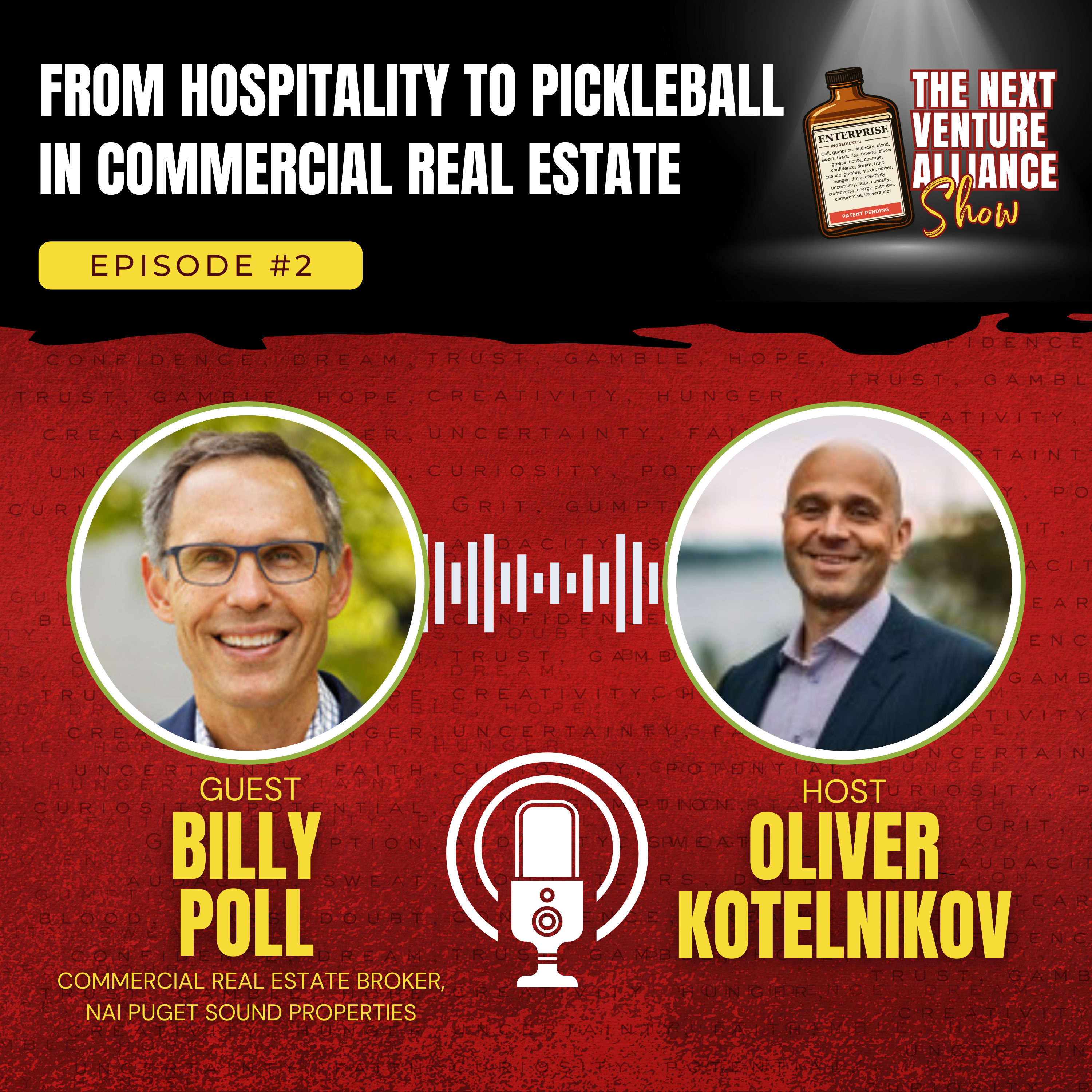
On today's episode, I'm joined by the man, the myth, the legend, and sometimes a commercial real estate broker at nai.
[00:01:13] Speaker A: Billy Pol.
Hi there.
Thank you for that intro, Oliver. I love it.
[00:01:19] Speaker B: Well, a little more intro. I mean, you know, Billy, you've been a commercial real estate broker since 2003. $500 million in transacted history, 4 million square feet, 400 sales and leasing transactions.
You know, I could just say I'm sorry that this commercial real estate thing hasn't worked out for you.
[00:01:45] Speaker A: It's sounds like it's been. It's been very enjoyable. It's been a. It's been a great ride. I've been really fortunate. I've got into this business at a good time. I learned from some great mentors.
I've worked with just really fantastic people in this industry, both on the client side and on the brokerage side and the ownership side. And, you know, you and I have had many conversations in the past about kind of what I do in the business. And it's a little different than a lot of people because I'm a generalist in the business.
I do kind of a hodgepodge of things. That's not an industry term per se, but it's techie. Yeah, the hodgepodger. Yeah, I'm your hodgepodge real estate broker. But I've just really enjoyed it. I've just enjoyed it from the day I started, which was in the beginning of 2003, to now, you know, 2025. I still just really enjoy what I do for a living.
[00:02:48] Speaker B: So, you know, I think that was one of the things that stuck with me, you know, in this conversation.
It's an important one for Me in many different ways. One, I just enjoy our conversations and we've had many over the years. Two, you are one of the first people in this industry that I spoke with, and I see you as being instrumental in sort of guiding me and pointing me in the right direction into business brokerage and mergers and acquisitions.
[00:03:19] Speaker A: Yeah, well, that was. That was a fortunate meeting, I think, for both of us. Not only for us to establish, you know, a long term relationship with each other, but I felt like listening to you and, and with your breath of business background and whatnot, I just thought, God, here's a guy that has so much experience. I think that experience would maybe be better suited on the business brokerage side than just the straight commercial leasing and sales side.
You're. I mean, I was going to make the joke. You're one of the few people that have listened to me, but I just felt like, God, everything you told me and when you were thinking about getting into commercial real estate and this and that, I was like, God, I just think, Oliver, you're just such a natural for it.
And it's nice for me when I meet people and, you know, you just get that gut feeling, right? A lot of what we do in commercial real estate is art and science, right? There's a lot of science to it, the numbers and whatnot. But there's the art part and the feeling part and then just your intuition part. And when we first met, one, I knew you were a great guy, right? And I'd heard that before I met you. But two, I just felt like, God, you know, you've got so much business experience and you're very relatable and you can analyze things well.
I'm just glad that it's worked out to be a good fit for you because at the end of the day, that's what we're all looking for in our respective careers is finding a good fit and then giving the best guidance and wisdom and knowledge and service that we can to our clients. And you've done an exceptional job at that, and I'm proud of you, my man.
[00:04:58] Speaker B: Hey, I appreciate it. You know, and it's not an easy business, right? Neither one of our sectors are an easy one to make it in because we bet on ourselves. And whatever the swings, you know, regional economic industry swings, we absorb them, right? And there are no excuses. At the end of the day, we don't have the too big or too small to fail. If you fail, you fail.
[00:05:18] Speaker A: But my God, that's very true.
[00:05:21] Speaker B: But one of the.
That first meeting that we had.
I.
You told me about your industry, which I didn't know enough about to fully understand what you were saying. And then you told me about why I would be better fitted for something for a different industry, which I sort of got. Yeah, that makes sense. But what I think the reason that I listen to you is because of your attitude, and you seem to be well grounded and having a good time and having a.
Just kind of a straightforward, easygoing attitude about what I saw to be a fairly complex business.
[00:05:59] Speaker A: Right.
[00:06:00] Speaker B: And so seeing somebody being able to enjoy it is what made it attractive to me. And really the reason that I listened to you and I did go talk to Gregory, which turned out to be, you know, another very important meeting. And. But it's that initial sort of conversation that you and I had, and it was your demeanor more than the content, because I, at the time, didn't have the knowledge and the experience to absorb all the data points. And one of the things you said to me was what you just touched on. And I tried to figure out, like, what is it that you do? And you said, some days I really don't know what exactly we do. I was like, man, this guy's 20 plus years in. He's successful. He's telling me he doesn't know what he does.
[00:06:47] Speaker A: I could do that.
[00:06:47] Speaker B: I could sort of wing it and be successful a lot of that. We were encouraging data points at the time, even if I'm kind of an intuitive level.
[00:06:56] Speaker A: So that's so funny. You're like, if this guy can figure out how to make a living doing this, with everything he's told me, I'm sure I can make a living doing whatever he's suggesting I do.
[00:07:08] Speaker B: How do you value this building that we're in? This is a commercial building. And you went into like, hey, this is.
You probably heard all the metrics and all the numbers and all the statistics, but it's part metrics, part art. Right? There is.
And so when you.
When you put forth an opinion of value, it really is an opinion of value based on what numbers, but also your experience, your lens, how you view it and what you bring to the business. Right. You don't value things the same way as probably anybody else in the industry.
[00:07:40] Speaker A: Right. And, you know, it's such a simple. Again, back to your point. This business gets incredibly complicated, but it gets incredibly complicated because of personalities. When you simplify it and you peel all the layers of anything, it. It does come down to some simple, simple kinds of things. And when you're talking about Value of a property. A property is only valued at what somebody else is willing to pay for it.
[00:08:08] Speaker B: Free market economy. Willing by willing seller. Right?
[00:08:11] Speaker A: Exactly. And so people. And exactly. Hopefully you transact because the opinion that you think that your property is worth somebody else is in at least full agreement or close agreement to that. Right. That's the only way things transact. But people just get caught up in all these different things sometimes. And it's like, look, we can. I can price things and put it out there, whatever you want. And I'm happy to do that until it gets to the point of ridiculousness because then the market's telling you what some things actually worse worth based on what somebody's willing to pay for it. So I've always tried to just take things and just get to the bottom line and try to get to it fairly quickly because I think that is in the best interest of all parties to do that. And it's just a good form of communication and, and connecting with other people.
That's just kind of been my philosophy. And the other thing is when I was talking about God, some days I don't know what I'm doing, right? Because I don't know how the days ev.
And every day is different. And some days I look at my calendar and I think like, gosh, you know, I only have two meetings today and I think, is it going to be a fairly quiet day? And then all of a sudden the day just explodes into all this stuff and I'm running from one property and the next thing you know, I'm scheduling different things. So my, my overall big picture philosophy in this business and, and business in general is that the one thing that I know is that I never know.
And I just tried to kind of live by that and never ever be completely surprised when I come across something that I've never seen before. Because it seems to happen almost every.
[00:10:00] Speaker B: Day, literally, which is what keeps it exciting.
[00:10:04] Speaker A: Exactly.
[00:10:05] Speaker B: How do you handle that conversation as a professional with a client? Right. Let's take a doctor. If a client comes to a doctor and says, this is my ailment, and the doctor says, I've never come across this, but let me problem solve it, Right? That could be trouble. So, yeah.
How do you address that?
[00:10:27] Speaker A: Like a doctor? Look, doctors. I have a lot of respect for doctors and I'm friends and my, I'm. I have a family full of doctors. Doctors are practicing medicine. They're not perfecting it.
They're in the journey to try to seek more perfection, but they're practicing Medicine, same way in real estate and business brokerage. We're practicing in this. We're not practicing for like the major performance. We're practicing because that's what we do. We're not perfectionists. We haven't seen everything that's possibly going to happen. We can't think of every single scenario out there because that's just not how life works. But the hope is you do something long enough, you're surrounded by enough good people that you've seen enough, been through enough, have enough experience to help your clients and the people you're working with make good, intelligent, long term decisions. That's what it comes down to more than anything.
[00:11:21] Speaker B: And we put it in a range or I do, right? I say here's the fair market value. It's between these goalposts and I caveat that with the market will true it up. Right.
[00:11:32] Speaker A: So exactly. We're not smarter than the market.
Right. We don't make the market, we work in the market.
And, and it's. I have to remind people that all the time, the past couple of years have been especially challenging. The market is so hit or miss in the commercial market, you know, in the Northwest that when you hit, you hit. Meaning like you take, you, you take a property, you put it on the market, hopefully you priced it, you know, where you think that you can sell it or maybe a little bit more just to have room for negotiat, then you get a lot of interest on it. There's been other times, and I will tell you, I don't need to go into all the examples, but there's been times when I have great property development sites in Seattle, Capitol Hill, where I've done a ton of work over the years. And I, we put, we took one property to market there and literally did not have an interested party for over a year.
[00:12:30] Speaker B: And you thought it was a home run.
[00:12:32] Speaker A: When we got that listing, I was so excited. I was like, this is just another opportunity when you can do it. Potentially a call for offers because there's going to be excess demand for it. We didn't price it that way, we didn't do it. But none of that. I mean, but again that's getting in tune with what the market's doing now versus what the market was doing, let's say four or five years ago or.
[00:12:58] Speaker B: What you thought it's going to do.
[00:13:00] Speaker A: Yeah, just because it's not doing that or because I'm a Seattle light, I know that corner extremely well. Then buy it 1500 times and thinking, oh my God, this is just a dynamite development site. It's going to fly off the shelf and then next thing you know, you know, nothing happens when you fall flat on your face. These things happen and these things happen to people that have been doing this for a long time.
[00:13:25] Speaker B: So because of the complexity, right. And the complexity of the market, the complexity of the uncertainty, you know, you have the human factor, you have the economics, you have sort of the, you know, these are very consequential decisions oftentimes. Right. For people. So, you know, they think they're aligned and they want to move forward, then something changes. And you know, how many times have you had that conversation of you're now no longer a real estate broker, you are a psychologist, you are a retirement planner, you're caveating stuff saying, I'm not a tax strategist.
[00:14:08] Speaker A: But you know, know, it's exactly. Yeah. I mean, this industry have those difficult.
[00:14:13] Speaker B: Conversations that, where they look to you as an advisor and you need to sometimes make a decision.
[00:14:20] Speaker A: Yeah. I mean, it's hard. I mean, it's hard wearing a lot of different hats and knowing which hat to wear at any given time is important to know that.
Right. But I do feel like this job, this career is oftentimes more psychologist than it is economist or knowing how to crunch all the numbers and look at the spreadsheets and evaluate things from a business perspective. It's oftentimes way more psychology than that.
And again, I mean, I think part of being a trusted advisor is just knowing that you're going to give the best, most honest service possible to people and they expect that in return.
And for me, that's why this career has been so rewarding is I feel like I can just be that trusted advisor for people and I don't have to think like, do they trust the information I'm giving them? Because they know that I'm giving it to a. From a place of I care about them.
And it's nice, it's just great to have that, that special connected advisory rapport with people. And, and that was one of the reasons I got into the business in the very beginning because I'd been in other industries and I just never felt like, God, I want to develop long term relationships where you can continually work with people on a variety of projects. Right. It's not just, you know, you, you handle a transaction for someone and it's one and done and you send them a holiday card for the next 10 years and you're kind of like this forgotten person. I've been fortunate because I've worked with a lot of people in different areas where it's a lot of ongoing decision making, advising, doing, and you become great friends and you feel like you're a family member. And it's just that I was looking for that in this career and I was fortunate that, you know, I was looking for it in a career and I was fortunate that, I mean, I.
[00:16:34] Speaker B: Found the same element. You know, I've stayed at clients, houses, I've been invited to their vacation homes after projects complete. Sometimes I'm sitting there going, is this quote unquote appropriate? Is this with an agency?
[00:16:45] Speaker A: Right, exactly.
[00:16:47] Speaker B: Should this be happening? But, but ultimately it all kind of runs together and people say, well, this is a people business, is a people business.
And ultimately where you trend, the reason people call you back and come back to you is because we transact in knowledge and experience. But probably trust first and foremost, you know, because if you're not trusted, you can't be in the room to help make that type of, or that magnitude of a decision, no matter how much you know.
[00:17:15] Speaker A: Right, exactly. Trust is everything. I mean, you know, we have the benefit of looking back from a lot of years of experience in the working world and then you realize, gosh, when I was my 25 year old self and I was seriously thinking about going to business school and doing all that stuff, and I never did go to business school because I got involved in different businesses, but thinking like, what would I have learned and what would I teach to people? And if I was teaching people in business school, the most fundamental element is how to develop trust with people. Because that's the basis of every successful relationship, whether it's in business or personal or business and personal. And I'm saying that, but I don't know as a step by step process of how to develop trust. I think part of that is just, you know, you have to, you have to want it and you have to show it.
[00:18:10] Speaker B: I, I don't think you can sequence or strategize trust, impart it somehow to maybe the first meeting. And if it's there, it's there. But I've had meetings where I sense that, and I've had to bring this up, is that you need to work with people you like and trust. If you're not trusting my opinion in this, if you just want someone to do busy work and run numbers, that's not me. Nor should you hire anybody for that reason for this type of project.
[00:18:41] Speaker A: Right?
[00:18:41] Speaker B: So continue looking for someone that you trust. If that's not me for Whatever reason, then. Then this isn't a good partnership.
[00:18:50] Speaker A: Exactly. Amen to that, for sure.
[00:18:54] Speaker B: You mentioned the perspective of time and having. Having that sort of ability to look back. And you've been in the Pacific Northwest, not only the commercial real estate industry, but. But this specific sector and in this corner of the country and the world. How have things changed that? We can talk about Seattle specifically, or Washington or the areas that you've covered.
[00:19:18] Speaker A: Yeah, I mean, in some ways it's changed a lot, and in other ways it hasn't changed. So, you know that expression, the more things change, the more they stay the same. Yeah, yeah.
I still maintain. I mean, I can get into a couple of examples, but I still maintain that Seattle is one of the biggest small towns in the United States of America.
[00:19:41] Speaker B: Interesting.
[00:19:42] Speaker A: I think.
[00:19:42] Speaker B: I think it's been overtaken by Boise in my mind now, but. Really?
[00:19:47] Speaker A: Yeah, yeah.
[00:19:48] Speaker B: It's kind of that. Yeah, yeah.
[00:19:51] Speaker A: Okay. But I just feel like, you know, I mean, I'm from here. I spent my whole life in Washington, except for eight years of my life when I lived. I went to school in Colorado and then I spent four years living in Colorado working and skiing and doing a bunch of stuff.
I mean, Seattle, you know, our business is basically both sides of Lake Washington. Right. So we do King County, Seattle, and the east side. And it's obviously grown a tremendous amount over the past, you know, 25, 30 years I've been in the business now, what, 23 years. Going on my 23rd year.
Grown a lot. You've seen kind of the entrepreneurial spirit, the.
I mean, that's the engine that just keeps this area growing. I mean, you've got.
[00:20:38] Speaker B: I mean, you were in Seattle, you were in the business and in Seattle before it became tech and the prices, sort of totally the big town thing, right?
[00:20:46] Speaker A: Yeah.
I mean, I grew up here. Right. And so, you know, when I was growing up, the biggest companies, you know, this is pretty.
Microsoft, Pre Costco. I mean, the big businesses when I was growing up was, you know, Nordstrom, Boeing Warehouser, you know, those were kind of like the big three growing up. And you, you. I mean, tech was starting to kind of show its tentacles a little bit. You had the University of Washington and biotech and. And so, I mean, biotechnology was like a huge sector in the 80s and 90s and it still is, but it gets overshadowed sometimes by primogenetics and kind of genetics, Immunex. I mean, I was fortunate enough to have a friend that I grew up with. His dad was one of the co founders of Immunex, which was later purchased by Amgen. You have. You had. You had all these different biotechnology companies growing here, so science and technology and research and all that stuff was going on here. And then it was kind of like you had, you know, the Jiffy Pop that you can buy in the store, and you put it on the burner. It was like it had all the kernels in it. And then somebody just put it on a really hot stove. And then a Jiffy popped and exploded into this huge thing.
[00:22:08] Speaker B: Popcorn.
[00:22:09] Speaker A: Totally. The popcorn just started flying everywhere. And then from each of those pieces of popcorn, if you see in the.
[00:22:16] Speaker B: Movie theater, in the concession.
[00:22:18] Speaker A: Exactly. It's just exploding, and it's just like, holy moly. Like, oh, my God. And then you had, like, all the housing and, you know, Issaquah, like, when I was growing up, Issaquah was basically this little city that once you went through it, you feel like, okay, we're about halfway or maybe a little further towards getting this n to go skiing.
[00:22:39] Speaker B: Yeah.
[00:22:40] Speaker A: And then now you look at how Issaquan, Samamish and the plateaus and all that stuff have.
[00:22:46] Speaker B: Have grown up right after that. Right. I mean, that's a whole new city that just appeared.
[00:22:51] Speaker A: Totally. Yeah.
[00:22:53] Speaker B: That's a municipality that just grew up by, you know, that just grew near Snoqualmie Falls. Like, the falls was like, expedition to go to.
[00:23:02] Speaker A: Exactly, exactly. And so it's like, I just experienced, like, this hyper growth of an area, and I think it's so exciting to see that. And, you know, I mean, I remember when I went to school in Colorado, people would ask questions about Seattle, and literally, they would ask you questions, and they were like, do you guys. Like, do you guys have cars there, or do you drive around in canoes? Yeah, you know, like, we're some, you know, Native American, you know, natural land, like Alaska or something, and people just didn't really know. And now, I mean, you know, Seattle really wasn't on the map, per se, and now it's so on the map, and it got hip. And then in the early, you know, late 80s, early 90s grunge, you know, music took a huge explosion. And I remember living through that and going and seeing all the bands and this and that. And then Seattle was just on the map. Like, you have the music scene, you have the technology scene. You had, like, the corporate scene. You just had all this stuff popping out of the popcorn.
[00:24:09] Speaker B: I actually think in that exact order, it was music, and then it was probably kind of corporate. It got corporate and Corporate and tech kind of went hand in hand. But. But music is the first time that anything other than rain came up in conversation about Seattle, which, by the way, still comes up, you get into play. People have never, you know, like, how long is that gonna stick around, the whole rain thing? But.
[00:24:35] Speaker A: Oh, my God. I mean, people that don't live here think it rains every single day, and so they really do. And then you. It's funny, I mean, I've never looked it up, but I think it rains actually more in Florida than it does in Seattle. Because when it rains in Florida, I mean, you get sometimes 3, 4 inches of rain versus, if you looked at the overall quantity of rain. I probably just chat GPT and look it up. But there's a lot of places that rain way more than.
[00:25:04] Speaker B: Way more than.
[00:25:05] Speaker A: But they're probably on that many places other than like, San Francisco and London that are as overcast as Seattle. Right. I mean, and that, for me sometimes is the frustrating part is I just look at the weather here and I like that it's a pretty, you know, mild climate here, that it doesn't get too warm and it doesn't get too cold, you know, but when it's 46 degrees and gray, that for me is just kind of like what I get tired of looking.
[00:25:38] Speaker B: Yeah. And sometimes for six months straight. Right. It's 46 and gray. And that's the tough part.
It was 46 and gray seasonally in the fall.
[00:25:47] Speaker A: Exactly.
[00:25:48] Speaker B: That's okay. But then, so, you know, I'm with you. The mild climate, I. I get a little nutty, like February, early March. I just need some sun. Doesn't matter.
[00:26:01] Speaker A: Me too.
[00:26:01] Speaker B: Yeah.
[00:26:02] Speaker A: And all. And my remedy over the years, Oliver, has just been like, at least twice during the winter, I just get out of Seattle.
[00:26:09] Speaker B: Yeah.
[00:26:09] Speaker A: I'm fortunate now, you know, my kid, I have one daughter in college and one out of school working in Chicago. But I just. We just get out of Seattle for a week or two during the winter, you know, just somewhere.
Yeah. Somewhere where I just know that I can wear shorts and a T shirt and just know that it's not going to be drizzly or gray.
[00:26:30] Speaker B: That's my little pickleball, maybe.
[00:26:33] Speaker A: Oh, yeah. Yeah.
[00:26:35] Speaker B: Is that kind of overtaken the.
[00:26:37] Speaker A: Are you baiting me on this, Oliver? Did somebody tell you to, like, ask me about pickleball?
[00:26:42] Speaker B: Because you told me about it.
[00:26:44] Speaker A: Yeah, I.
You know, pickleball is definitely, like, a serious passion of mine. Okay. And the funny thing is, you look at pickleball, pickleball has Gotten huge over the past, like, let's call it the past seven to 10 years.
[00:27:01] Speaker B: Hey, I'll go back to the popcorn analogy. Like, I cannot exactly, you know, Covid, right. I mean, it's just started blowing up and it was.
[00:27:10] Speaker A: Covid was.
[00:27:12] Speaker B: Or something or.
[00:27:12] Speaker A: Yeah, Started on Bainbridge. What people don't realize is pickleball has Been around since 1965, right? It's been around for 60 years.
1965. It's been around for 60 Years. I was fortunate enough to get exposed to pickleball when I was young. I mean, I'm a tennis player. Played tennis growing up, Played tennis in college. Have played tennis for, you know, going on 50 years. And I played pickleball the first time. I was probably 10 years old. I'm 57 now.
So you look back, I played some form of pickleball for about 47 years, but got really into pickleball about 10 years ago. I felt like pre Covid, there were all these people, like, pouring little things of gasoline around, you know, little. Little pickleball gasoline going around. And then right before COVID or right when covet happened, somebody just threw matches on it and it just.
[00:28:10] Speaker B: It just caught fire. Yeah, it did. And.
[00:28:13] Speaker A: But I can see why, right? I mean, it makes so much sense that the game finally kind of got its. Its. You know, it's like grunge music, right? It, like, you know, you have these bands playing, and all of a sudden it's like the hottest thing. And pickleball is that, like, people now look at, like, the Northwest and even Seattle, they're like, yeah, it's the pickleball capital of, you know, the world. Because this is where it started. I mean, there are places where more people play pickleball, you know, per capita, than here, because they have better temperature. I mean, they have better climates, right? You can play year round there. But yeah, I've gotten really into it, and I love it. It was. It was. Not only do I feel like it's so fun to play, but I wasn't looking for, like a outside, you know, new social group of people. I felt like, God, I know a lot of people in Seattle, and I have met so many diverse, different people from playing pickleball that my friends sometimes ask me, they're like, do you like playing pickleball because you like playing pickleball, or do you like it just because you meet so many more people? And I think the answer is yes to both of it.
It's fun and everybody can play it. You don't have to Be a super, you know, athletic person to be a pretty decent pickleball player.
[00:29:34] Speaker B: Yeah. Well, that's a low barrier to entry. I just.
[00:29:37] Speaker A: It is. It's easy to learn. It's a really easy game to learn.
It's a easy game to learn. It's a hard game to master. Right. So.
And I'm not trying to necessarily master it. I mean, I can play at a pretty, you know, decently high level and play, you know, like, tournament people and this and that. I just think it's so fun how many people have enjoyed playing the game. It's kind of like I knew how fun it was, you know, 40 some years ago, and now everybody knows how fun it is.
[00:30:07] Speaker B: You know, it's interesting you said tennis, right? But you get like those racket sports that are different. Like the way that the pickleball racket impacts the ball, the way the ball travels. You got pickleball, you have like, Batman, which is, you know, a whole different thing. You got, you know, ping pong. So all those little parallels, but they're completely different sports. And I've played pickleball, and it's not easy to kind of really understand the dynamic of it. I mean, maybe like racquetball, maybe like, you know, squash. They're all different, right?
[00:30:40] Speaker A: But they're all different, and they all have, like, kind of their own merits, I think.
You know, I actually was a squash player before I was a.
[00:30:50] Speaker B: You were.
[00:30:51] Speaker A: That was my first record.
[00:30:52] Speaker B: Did you play at the Seattle Athletic Club? Were you part of the that gang?
[00:30:56] Speaker A: Yeah, that. Where I originally learned how to play. But I was like 9 years old and my dad was a squash player. And then, you know, we had a tennis court. I grew up Mount Baker, and so there was a couple public tennis courts. And, you know, I would see friends go down there. So that's when I got into tennis and I met one of my best friends on the tennis court there, and we started playing a bunch. But I mean, I love them all. Like some people now there's this huge divide between tennis players and pickleball players, Right.
[00:31:26] Speaker B: Isn't it a separation?
[00:31:27] Speaker A: Oh, my God. Like. Well, because pickleball tennis players get fed up with pickleball players because, let's say.
[00:31:33] Speaker B: The same court, they have to share the court.
[00:31:35] Speaker A: Exactly. And here's what's unfair about the two. Pickleball takes over tennis courts, right? But tennis doesn't ever take over pickleball courts. Right. You'll never see, like, a facility where there's pickleball courts and then all Of a sudden, they're. They, you know, resurface it and they put tennis courts. It's exact opposite because, you know, you can have tennis courts that sit there and are never used, and you put pickleball lines on them, and it'll be one of the most packed facilities around. Right, because more people can play pickleball. And so I see, you know. Yeah, and I see. But I'm kind of like the. Can't we all get along?
You know, that's how I feel about it.
[00:32:16] Speaker B: And the answer, it sounds like, is no. Between the pickleballers and the.
[00:32:19] Speaker A: It's kind of tough. I mean, tennis players, you know, maybe tennis players are a little snobby and. Look, the reality, though, is tennis is just a harder game to learn and get good at than pickleball. It is. I mean, I. I think you just. It just takes more coordination. It's a bigger court, it's a faster ball. You know, you have strings versus a paddle. You have a softball that spins and the different things you can do with it. So, I mean, we could talk about this all. All day. But it's really.
It's really interesting kind of how pickleball's grown.
[00:32:56] Speaker B: How does it. How does it tie into what you do professionally? Because I've seen facilities, you know, big gyms and large sort of retail facilities transition into, you know, often athletic facilities, but specifically pickleball courts. And there are some interesting examples. But I mean, are there big, dedicated pickleball facilities springing up? And are you having. Are you seeing that demand in commercial real estate?
[00:33:24] Speaker A: I mean, I've been involved in it from the front line.
I can tell you that. I was working with a pickleball group last year that two people that were not necessarily tied to the sport, but were really interested in doing a facility. So another partner of mine here in the company, he introduced me to this group because of my love for pickleball. I said, yeah, I'd like to help you, like, find the facility to do this. We actually found we were successful at locating two different facilities that unfortunately, the people were working with just for different reasons, couldn't make the commitment to it. But both of those now have become pickleball facilities. The two one's up in Lynwood, it's called Pickleball Kingdom. Okay, Bath and Beyond. So it was a repurposed.
[00:34:11] Speaker B: There you go.
Bed, Bath and Beyond.
[00:34:14] Speaker A: So big box store, high ceilings, air conditioning, great conversion. And that was one of the first properties I showed this group. And so they couldn't make you handle.
[00:34:23] Speaker B: The transaction as a broker to.
[00:34:26] Speaker A: Unfortunately, no. Okay. This is one of my sad consulting.
[00:34:29] Speaker B: On the pickleball side, at least.
[00:34:31] Speaker A: I mean, it's. It's kind of sad because I wanted to feel like from the beginning I could help one of the pickleball groups do this. And my friends, both of the brokers on the listing side and the brokerage side, handle pickleball Kingdom. And then another one just became available or just now opened for business about two months ago. And it's called Side out Tsunami, which is off Rayner Avenue. You've probably passed this. You know where Lowe's is on Rainier Avenue?
[00:34:58] Speaker B: Yeah, I do.
[00:34:59] Speaker A: The old Pepsi bottling plant. I grew up eight blocks away from this, so I know the area really well. It was the Pepsi bottling plant, which was purchased by Prologis, which is a huge industrial reit. They have, you know, a couple hundred thousand square feet there. And they converted a hundred thousand feet, one of the big buildings there into the biggest indoor pickleball facility in Seattle. It's 26 indoor pickleball courts. It's called Tsunami and it is fantastic.
[00:35:32] Speaker B: Do you go play there? I mean.
[00:35:33] Speaker A: Yeah, yeah, I go play there. I make the joke. It's going to be my retirement home because it is so fun. It's. They've done a phenomenal job.
[00:35:44] Speaker B: 26 courts and they're just kind of one next to it. One big.
[00:35:49] Speaker A: Yeah, they. I mean, it's a huge, you know, industrial building that has.
It's pretty much either 20 or 24 foot clear height. The columns are really spread out. So you don't have to worry about that. Some of the courts are at different positions. You have some that are north, south and others that are east, west. But they've done a really effective job just putting in all these courts. There's fences around each court.
[00:36:13] Speaker B: What's the square footage, approximately? What's the footprint?
[00:36:16] Speaker A: Honestly, I think their total footprint there is between 95 and 100,000.
They've got kind of a couple lounge areas.
[00:36:26] Speaker B: They've got like a two acre facility, essentially.
[00:36:30] Speaker A: Yeah. And they've got a ton of parking. I mean, you know, with 26 courts, you know, if you have 26 courts and most people play doubles pickleball, that's 26 times four. So you're what, 104 people and then people waiting and this and that. I mean, they have great parking. I mean, they just, they. I. I think they were so smart in landing that location because it's, you know, close to i90.
It's supposed to get i5. So it's close for eastside people, and it's close for west side Seattle people. And I love it.
[00:37:04] Speaker B: I mean, I have a pickleball conversion zone. I mean, that's where that's. That's the go to right now.
[00:37:09] Speaker A: It's huge. But then here's the other thing. So you're talking about how it applies to the. To the business. You know, I'm always paying attention to who's doing what not only for pickleball, but repurposing buildings.
And in Bellevue, like off Bellevue Way, Bellevue Way and Main street is the old sports authority, and that recently was converted into a new pickleball facility. They just opened up two days ago called Bellevue Pickleball. And that's 13 quarts. Indoor pickleball courts. So we went from an underserved market for several years with indoor pickleball to one where all of a sudden we have great things for pickleball players. So we've got the one in Linwood, there's one in Mukilteo, there's one in Seattle, there's one in Bellevue. There's another one. The Theo's Chocolate Factory in Fremont.
[00:38:04] Speaker B: Yeah, near. Near the canal. Right?
[00:38:06] Speaker A: Yeah, exactly. Yep. That's coming. That's.
[00:38:09] Speaker B: These buildings all used to be something else, and now they're.
And now they're housing this latest most popular activity.
[00:38:17] Speaker A: Right. And people are trying to figure out, too. I mean, I get asked this question, you know, is it going to be like frozen yogurt? Is it going to be like, is.
[00:38:29] Speaker B: It going to be over in five years?
[00:38:30] Speaker A: Right, exactly. And again, I don't know. Yeah, I. I mean, I do think, you know, with any mass proliferation of concept, there's going to be good operators and bad operators.
So at some point there will be some sort of consolidation with these different businesses because not everyone will be able to survive. But I do think this is not a trend. I do think this is a lifestyle that is.
That will be around for a long time. I just don't see pickleball dying like, you know, frozen yogurt places. I just think there will be a couple that are probably built and not operated properly, and it will get either consolidated or maybe a few closed down. But I think it's here to stay. That's my gut. And, you know, only time will tell.
[00:39:23] Speaker B: I mean, I think business wise, it's strategically smart because it captures a wider demographic. So you. You can't play tennis if you used to play tennis, basketball, soccer, any of those types of Sports, you can't really, you know, I won't advise it. And people are typically get injured. I mean, I'm an injured soccer basketball player, and I still play occasionally, but I wouldn't want to keep playing it at 50, 60.
You can still go out there and play pickleball and find community and get exercise and who cares if you're great at it or not or, you know, whatever it is.
It's not a competition. It's about being out there and being active and.
[00:40:04] Speaker A: Exactly.
[00:40:05] Speaker B: Doing something new for a lot of people. Right. They can pick it up fairly quickly. And I'm sure there are different levels.
[00:40:11] Speaker A: Absolutely. And, and, and these places, you know, these, like Tsunami, for instance, I mean, are really good about, you know, getting people, you know, they have the open play. You can show up, you can put your paddles, stack paddles with people and play with different people. And they divide it, you know, beginner, intermediate, advanced, elite. So they really work hard to try to get, like, abilities together.
And, you know, if you're an advanced player and you want to play with some of your friends that aren't as good, you can do that too. And it's just. Yeah. I think the accessibility of this sport is different than almost any sport I've ever seen.
You know, really, anybody can play it at any age.
[00:40:56] Speaker B: Which is what it. Yeah. Which is what it really should be. Which is more than can be said for tennis or golf, for instance. Right, Exactly. Yeah.
[00:41:04] Speaker A: Yeah. I mean, I play pickleball with. I mean, I. I literally have played pickleball for people that age from 10 to 94. Yeah.
[00:41:14] Speaker B: And you can do it quickly. You can go out and have a great 45 minute pickleball outing. Right?
[00:41:19] Speaker A: Absolutely.
And, I mean, I'm fortunate because I'm a certified coach in pickleball. I just.
[00:41:26] Speaker B: They are. Okay.
[00:41:27] Speaker A: All right. I went and did that because I want to do some things long term with pickleball. I want to help people. I want to help underserved or underprivileged people get exposed to the sport. And I also want to help kids with disabilities. You know, maybe they're somewhere on the autism spectrum. I want to teach that, and I feel like I'm gonna. I. I feel like pickleball really hits something kind of like real estate with that connection with people that I want to do more of it in the future.
[00:42:01] Speaker B: So something tells me you're gonna build connections and meet people. No matter what you do, it's not about pickleball or real estate. That is probably who you are.
[00:42:11] Speaker A: Yeah, at your core.
[00:42:13] Speaker B: And the activity is just a vehicle.
[00:42:15] Speaker A: It's fun. So we'll see.
[00:42:17] Speaker B: Meeting people over an activity. Right. It's different than, let's take a professional networking event which we all attend and which are part of the industry. But there's a little bit of, I don't want to say forced, but we are kind of all here under a premise and we need to find something to talk about. We know what it's about. You know, we have a range of topics. But it's different than playing a great game of something or playing or, you know, connecting with somebody over this activity that happens naturally, organically.
[00:42:47] Speaker A: Exactly.
[00:42:48] Speaker B: It's a different sort of level of connection, I think.
What's the business model of a pickleball facility? I mean, is it like a gym? Is it per hour, is it per month?
[00:43:00] Speaker A: It's a great question. And I think, you know, again, in the infancy stage, which we are, for intents and purposes, I think they're trying to figure that out.
The ones that I've seen are really a subscription model. So you do a monthly, you know, like a gym, you pay monthly.
Like the tsunami that I joined, I paid for the whole year. And then I have essentially unlimited. All you can eat, all you can play pickleball.
But I think most are doing the subscription monthly model. And then if you're not a member, you can pay a certain fee to go in and play like in the open play sections of the day.
So on average, you know, most people are charging somewhere in the kind of that 20 to $30 for a couple hours to play.
And you know, I looked at, when we were working with this pickleball group, I looked at how the model is and like the revenue model and yeah, I mean, you have to have a fair amount of members to make it worth doing because let's face it, these are big facilities.
Seattle, you know, whether in Seattle or east side, the rents are not cheap.
And you know, the question mark that I always have about any of the pickleball models is whether, you know, are these truly year end numbers that your year to year numbers you're looking at or are they.
Gosh, it's great in the winter, it's great from October, middle of October to May 1. But then are people gonna then go play outside and not play indoors? And.
And I think we'll only know that, you know, when the time comes. So I think that's the trick for these places. Get enough revenue that they can sustain themselves over a seven or eight month period rather than 12 months.
[00:44:55] Speaker B: So I'm gonna make, you know, probably a seasonal business model isn't going to work.
Figure out a way to fill these gyms. An operator, an entrepreneur needs to figure out a way to keep people in there year round. I mean, you're not gonna.
[00:45:09] Speaker A: Yeah, it may be that they do well year round because the sport has grown so fast that even if you know that you're a member of an indoor facility and even if you want to play outdoors, but if that outdoor facility is packed in the summer and you know, you can reserve a court and play indoors, I think people probably might play more indoor pickleball than they would usually do because they have that membership.
So. So we'll see. I think that that's going to be very telling in the next couple of years.
[00:45:44] Speaker B: And they're developing the business like any business. Right. They're seeing what works. It's a little bit of sort of trial and error and with anything new.
Yeah, yeah.
[00:45:53] Speaker A: Hey, but it's exciting. It's exciting. I'm just glad that a lot of people are, are, you know, jumping in the water and doing this because clearly there's a market for it. I mean, just, just from a membership soon. So set out Tsunami sold out their memberships in three weeks.
[00:46:13] Speaker B: Is this the Bellevue one or this.
[00:46:15] Speaker A: Is the Seattle one, the Radar Offer Avenue. They sold their memberships.
[00:46:20] Speaker B: So it's a limited capacity of people that can be in there. And they sold out in three weeks for, for a year.
For.
[00:46:28] Speaker A: Yeah, so they're sold out now and then they have a waiting list. So if, you know, some people decide to bow out of their membership, they have a waiting list. But I don't know how many they've sold. You know, but it's, I mean that I.
[00:46:41] Speaker B: So if we get a basketball team in Seattle, what's going to be the hotter ticket?
Season tickets to the new Sonics or, or, or, or Tsunam Ball?
What's gonna have a longer waiting list?
They're probably in the same league.
[00:46:58] Speaker A: Seriously. That is hilarious. I hope that it's basketball. I hope that the demand still is for so many people to want to go see basketball. But yeah, gosh, whenever that time is, pickleball just keeps growing.
[00:47:12] Speaker B: We'll.
[00:47:12] Speaker A: We'll see.
[00:47:13] Speaker B: I mean, what sort of play and confidence are, you know, the operators showing? What sort of lease do they sign a 10 year lease on? 100,000. A 20 year lease like that? Because that's telling what kind of play they're making.
[00:47:27] Speaker A: You know, I wouldn't want to Speak out of turn just because I wasn't involved in that. My guess, with the amount of tenant improvements that they put into the big one in Seattle, my guess is they probably signed a ten year lease.
[00:47:42] Speaker B: Ten year, okay.
[00:47:43] Speaker A: Yeah. But what's interesting in Bellevue where they did that one, that is that whole property is slated for redevelopment and so that was purchased by Canadian developer. Well, a well financed Canadian developer that's done several other projects in Bellevue. So they went in on that one knowing that they might only be there for a couple of years.
So that model is very different than the one in Seattle. I mean that, that could be a two or three year existence for the Bellevue one versus long long for the one in Seattle.
[00:48:19] Speaker B: But if it works over that two to three years, they're going to be looking to relocate somewhere. It's kind of a proof of concept or a test of concept, right?
[00:48:27] Speaker A: Totally. I think it's absolutely that Oliver. I mean, I think if they, I mean they'll have a dedicated customer list that will follow them anywhere. Right. I mean, I think, you know, you could probably do another long term facility in Bellevue and probably sell that out, be fine. Yeah.
[00:48:48] Speaker B: I mean look at rock climbing or climbing gyms, right? There was, you know, there how many of the, you know, for a while there was Stone Gardens and you know, maybe the bouldering project. But it's like pizza places. Like when you just when you think that the market is saturated, you find out that there's room for a thousand more as long as there's interest.
[00:49:08] Speaker A: Exactly. I mean, amazing what, what consumer demand can do. Well, and let's not forget when we were talking about businesses in Seattle that have had a major impact. I mean look at Starbucks, right? And look at coffee. I mean I've been fortunate enough to work with some great coffee clients.
Mercury's being one, Katana being another. I work with blazing bagels. I mean I do site selection work for all three of those companies. And you know, it's so interesting, people ask the question, I mean, how many coffee places can you have in one geographic area? And the answer is a lot.
[00:49:47] Speaker B: You know, again, we don't know. Right? We don't know the answer. We don't think the ceiling and it, every time it's higher and higher.
[00:49:55] Speaker A: Like it's, it's, it's to me, you know, but again, that's been a really, for me that's been a great front seat ride to those types of businesses. I've, I've just seen how they can grow and the whole category grows. As well as just like with the population growth.
[00:50:17] Speaker B: I mean, isn't it amazing how something brand new can come in and take up this massive segment of the market? Like, who would have thought. Pickleball, Right.
[00:50:26] Speaker A: I know.
[00:50:27] Speaker B: However many years ago. You know, like you said, the game is however many decades old, but it sat dormant until it just detonated over something. It went viral. And all of a sudden, we can't find enough space, you know, in the great state of Washington.
[00:50:43] Speaker A: I know.
[00:50:44] Speaker B: We can't build them fast enough. Right.
[00:50:46] Speaker A: And it makes you think, like, okay, so what was going on during all this time before?
[00:50:51] Speaker B: Yeah. And what were these people doing for exactly.
[00:50:55] Speaker A: Well, I know. Like, I should take you, Oliver. I should take you over to Tsunami. Just. So, yeah, I'd love to join you over there. I'll get. Hell, I'll give you a pickleball lesson if you want. I'm.
[00:51:06] Speaker B: I'm athletic enough to where I can fix it quickly.
[00:51:08] Speaker A: So we'll get Stephen Cohen out there and, you know, another friend.
[00:51:12] Speaker B: You know, now you're pushing it. But I.
[00:51:14] Speaker A: But we.
But it makes you think, like, what creates that tipping point?
Right. Pickleball. Pickleball could have gotten big 30 years ago, but it didn't. It got big in the past five to seven years. And what caused that?
[00:51:33] Speaker B: And no one could have predicted it.
[00:51:36] Speaker A: No. Yeah. I mean, I think we'll put it.
[00:51:39] Speaker B: In that category that we don't know. Right. We just don't know.
[00:51:44] Speaker A: I mean, I was in the beverage alcohol business before I got into real estate and did this. I mean, I was in the beer importing business right back. We'll talk about that a little bit.
[00:51:54] Speaker B: What is that chapter of your life before we get into the story? How.
[00:51:58] Speaker A: Yeah, so I grew up working in the restaurant business.
I grew. I mean, I worked for.
Exactly. Schwartz Brothers restaurants. Good memory.
I worked for them for 10 years of my life. And from the time that I was basically 14, I started washing dishes for them. And then I worked at different.
Different of the different jobs in different restaurants until I got to Kachina Kachina, which was their big Italian.
Yeah. So Kachina Kachina on South Lake Union. That was their first Kachina Kachina. And I worked there for two summers while I was going to college. And then after college, I worked full time night manager. And then I did that for a year. And I realized the best job in the restaurant was actually being a server rather than a manager. And so I went back to that because I was playing a lot of tennis and doing athletic stuff and did that. And then I was kind of looking like to parlay that experience that I had because I ran a fish and chip stand called Benji's Fish and Chips. And I was kind of trying to figure out what do I do with this restaurant experience. And then it turned out you own.
[00:53:10] Speaker B: You own the fish and chips place.
[00:53:12] Speaker A: I didn't. I wish I did.
The Schwarz Brothers owned it and I helped manage that along Lindsay Schwartz, who now is the CEO of Schwartz Brothers. He did a lot better in the restaurant business than me.
He and I were the managers of Benji's Fish and Chips. And, and I mean looking back on it, gosh, I wish I bought Danny Schwartz. What's that was it.
[00:53:35] Speaker B: Danny Schwartz was his brother.
[00:53:37] Speaker A: Danny is Lindsay's stepmother. Yeah. And so anyway, so I worked for Schwartz Brothers and then I was looking to do something different and a friend of mine, friend of mine got into the, took over the operations for a company called Merchant Duven, which is a beer importing company that imported like Samuel Smith's and beers from Belgium and England and Germany and some different areas. And he needed somebody to help him with operations. And so I did that for a couple years. I quit that job because I wanted to move out and ski in Colorado. I did that for a winter and then he hired me back to run a five state territory out based in Colorado. So I did that for two years and then had every intention of going to business school.
And then my father got sick at the time and my friends started this new Internet company and they needed help in sales and just one thing led to another. I moved back to Seattle. I helped them with that company. That company was called Goto Net, which was an Internet. You know, we own different.
[00:54:44] Speaker B: One of many. Early stage Internet.
[00:54:46] Speaker A: Yeah, the providers, you know, again had no clue when I got into that that Internet was going to be some big thing. I just thought, hey, I need a job. And my friend started this company and they, they made a help and so I was like, yeah, I'll do that. And then did that for gosh, three and a half years. You know, it was small company when I started it was like 20 of us and then it grew to like 700 and then we merged with Infospace and then it was like a 2000 person company. And I just didn't want to be a part of a company that big. I just have always liked a smaller, intimate type of environment. And I got out of that. I did a quick stint with Intercom Seattle with the radio conglomerate. I worked for the mountain radio station and did, you know, advertising programs for them? Because I was selling Internet advertising at Go to Net. And then I transitioned over to a more proven model which was radio advertising. And I was just a little disenchanted with that business. It wasn't quite what I was looking for after some of the other work experience. And then I just, I kind of all roads led me to commercial real estate and I started that shortly thereafter. So that's, that's, I got into commercial real estate. The very non linear route. You know, the, like the, the. But you know, having business experience and operations experience and obviously dealing with people and negotiating and all that, it just kind of all seemed like I was mixing all these ingredients to kind of finally actually make the.
[00:56:24] Speaker B: And how long did it take you to get going successfully? I mean it's no secret that these businesses, I mean they are sort of like we entrepreneurs solopress. Essentially you're sort of building your customer base, your book of business, your product, your service, if you will. And it can take a while to get started and to really build, you know, critical velocity to where you're generating income and can support yourself. And maybe that was different in the early stages or years back. But how was your start in it? And did you ever doubt it? Did you kind of.
[00:56:59] Speaker A: Oh man.
How long does it take? How have I been in this business? 23 years.
[00:57:04] Speaker B: It's taking me about 25 quarter century.
[00:57:06] Speaker A: It's taking me about 24 years. No, I'm kidding.
I, you know, I think even when we met and I was talking to you about like getting started, I mean 2017, you and I met 2017, wow. Eight years ago. Crazy.
It took me. Well, I mean that first year I remember it was really hard, brutal because it, you know, I, I, I mean I know a lot of people in Seattle, but I didn't have any experience and it's, it's catch 22, right? Like I would go to people and just say look, I'll work on anything. I just want experience.
I mean good, the bad, the ugly. I took on listings that probably nowadays I would not do it just because the chances of being successful with that. I know how to evaluate it now. And back then I didn't, I just needed, I needed to have my signup somewhere and I needed to see if.
[00:58:03] Speaker B: People would call your name on it.
[00:58:05] Speaker A: Exactly. And you're building up a name, you're building up a reputation, you're, you're going to get this knowledge. And you know, I mean my wife and I, I Mean, she knows better than anybody. I mean, I made way more money as a waiter at Kachina Kachina, and I did in my first year in commercial real estate. I mean, that's how long in your.
[00:58:25] Speaker B: Commercial real estate career before she starts making overtures about going back to serving. Saying, Billy, about.
[00:58:32] Speaker A: About 24 years.
He still says, your fallback. You're a great waiter. You can still always do that, you know. No, I.
[00:58:41] Speaker B: You were a guy when she met you. You were a guy with cash in your pocket every night.
[00:58:45] Speaker A: Then you go, you talk about the.
[00:58:46] Speaker B: Mythical check you're gonna get three months from now.
[00:58:49] Speaker A: Like, she's like, where's the check? I've checked all your pockets, and I've also checked the checking account and I don't see anything. You know, this is not what I do.
[00:58:58] Speaker B: Volunteering.
[00:58:59] Speaker A: Tell me.
So, no, I think, you know, I think again, you're building a rolling out this snowball, right? And the snowflakes that turn into, you know, particles that turn into rolling it. I think it took me probably three or four years before I felt like I was kind of getting the ball rolling and having some success for my clients where it was turning into like, hey, we've done this one location and like, let's do something else. Or I worked on a piece of property and they liked what happened. And so I. I felt like I was. So that was 2003.
So it was kind of. I was kind of grooving in for about four years. And then, you know, 2008, the market really changed and we went into a really down market. But I, at point I built up clients. And so then we got through that two or three year period and then it was like a really great period until basically Covid. Right.
So I would say, you know, four years, and it was a weird kind of two, three years and then a long run after that. But I always caution people like, hey, if you're looking to. I mean, I had a friend that ended up working, you know, with you guys or through another business broker with iba. I really encouraged him to purchase a business rather than. He really was gung ho. He wanted to get into commercial real estate. You know, probably the right personality. He just wanted to get from point A to Z quicker than I felt. Yeah. Then I think his realistic. I like, look, I'm going to be quite honest with you. You can't make a good living in this business until you've gone through the school of hard knocks and been in the trenches for probably three or four years. And I, that's accurate. I mean, I think for people getting this business. Look, this is a fantastic business, Oliver. I, I, I mean, I could stand on a soapbox and anybody that listened to me, I would tell you that it's a fantastic way to make a living. But it is really hard to get the ball rolling. It's, it's, it's, there's not a lot of barriers to entry. You know, to get a license isn't that difficult. Right. As you know, and I know you take the practice test, you get the license, and then you have a license and you have no experience, you have no client base. You have, you have your name, but that's established in other industries, but nobody knows, like, do you know how to negotiate a real estate deal? Do you have like, do you have any sense of like, how to put this together? And you don't even know if you have that right because you haven't done it.
And I just encourage people, if you're long term thinkers, especially if you're young and you're young enough that you have the support at home, you know, whether that's financial support or just the mental support of knowing that it's going to be lean for a little while. I mean, that's important to have. I mean, that's an important conversation if you're married or in a serious relationship. It's going to be hard in the beginning.
[01:02:10] Speaker B: But do you, I mean, are you approached a lot? Are you mentoring people? Are people asking you? You know, because obviously it's easy to look at, you know, you and 25 years in and you're, you're pickleball and you look great and you're feeling good and your name's out there and everybody knows who you are and people are calling you, right?
Oh, God, I want to be like Billy. I mean, that's what I felt.
[01:02:33] Speaker A: Well, exactly. I mean, like, I, like some of the young guys here, I'm like, don't do what I'm doing. Like, they'll hear me come in the office and I'm talking to, you know, a couple friends and planning a trip and doing this and that. But what they don't see is, you know, the 70 hours of work that I was putting in when I had a, you know, new marriage, young family.
You know, I'm working all day, I'm having dinner, I'm working at night. You know, I'm up all night thinking about deals. I'm stressed. You know, it's, it's, it's different. I mean, I Try never to forget that. And I do get approached to people. I'm kind of like one of those people when people like, like want to suggest somebody to have an informational interview, my name comes up because I've done several different things and, and I'm happy to give my advice to people, you know, and sit down. I mean I'll talk to anybody for an hour, hour and a half. It's just I am, I'm not, I'm not the most efficient person with my time or probably other people's time. But I'll always just tell you everything I know because I feel like, you know, that's kind of, that's a way of giving back.
[01:03:42] Speaker B: Right. There's some responsibility that comes with success. And people can give back in different ways. Some people volunteer, some people donate money.
But having those open and honest conversations and I find that you're kind of like Gregory in many ways. I mean you guys are peers in your, you know, in your industries in terms of just experience, stature, success, but also in terms of your open door policy.
Because I'm amazed at your, like Gregory Stu's like, I'll talk to anybody. I'm like, where do you find the time? You've got 20 plus brokers, you got a mentor, you got, you know, your own deals, you have networking, you have all these things spinning. Yeah, he'll, he'll, to somebody who's just, just wants to talk to him about business, brokerage, he'll meet him for coffee, he'll go have lunch. Totally. Where do you have the time?
[01:04:28] Speaker A: Well, Gregory is exceptional too in that, you know, he's so knowledgeable and that, you know, I've had a great relationship with Iba and Gregory and a lot of you guys for a long time. And he's so exceptional because he is a super busy guy. But you never feel like he's too busy for you.
Right? So like you can 10 different things on his plate. Yeah. All going on. But like you call him or you stop by and see him and it's just like, oh my God. Like I know this guy's super busy, but he always has the time for people and it's, it's a great quality in him.
[01:05:03] Speaker B: And I think you're similar in that way. And I've had that same kind of dynamic with them on the phone or in a meeting where like my phone will be buzzing or I'll, I'll have something happening in my head. I'm like, I, there's no way that I'm Gregory's Talking, there's no way that I'm busier than him. Right. So I know, you know, professionally speaking. So yeah, making that time, I think is critical in terms of giving back. That's one of the biggest things you can give back is these conversations.
[01:05:31] Speaker A: Yeah. I mean, I just hope that look, when it's again, peel the onion and you take out layers.
I've had really great mentors in my life.
[01:05:43] Speaker B: Who some of them, I mean, who were your mentors?
[01:05:45] Speaker A: I mean, I can name like I, I almost name them by sector when, you know, like the different industries. So when I was, you know, John and Bill Schwartz, especially John Schwartz because he was more the day to day. John Schwartz was a huge mentor of mine. Right.
Segment, like, in which segment of like restaurant business. When I was in the beer importing business, Tom Levitt and Charlie Finkel at Merchant Event. When I was at Goto Net, you know, I worked with John Keister and Steve Rosen and they were huge, you know, influences on me. And then when I got into commercial real estate, I worked with Morris P. Ha and was an unbelievable mentor for me. He was also my father in law and he taught me, you know, the most important thing and that is just always do the right thing and just always take care of people and you know, don't, don't dollar sign on your head. Just take care of people because they're people and they have needs and realizing that even if you're working on a small deal, it's a big deal for the people you're helping. Right. And he was just an exceptional, as far as just the way he could communicate with people and his influence with people. And I just feel like, you know, those are, you know, those are four, like business mentors. I felt like I had great parents. You know, I mean, I've had really. I mean, I've been blessed with a lot of great friendships in my life and I'm constantly being, you know, taught life lessons by good friends. And I just feel like, hey, if I've been able to be a sponge and absorb all this, I want somebody to like take the sponge and squeeze it out of me and give it back to people and you know, again, pay forward.
[01:07:34] Speaker B: Yeah, yeah.
[01:07:35] Speaker A: And I feel like, you know, serving others and helping others. I kind of feel like, you know, we get a limited time on this earth to, to things and I feel like, you know, the more you can help people and the more, you know, you can just, even if it's just little subtle things to help brighten a person's day or help them in their life. I, I feel like that's kind of why we're here.
[01:07:58] Speaker B: So I think if you love what you do, and I can hear that with you, you have a really vivid memory of almost every early stages of almost every step. Right. And that helps you relate to that person. Because when you're sharing knowledge and experience as a mentor and you're coming at it from, I'm this great, successful xyz, you're just starting out, that doesn't inspire really anybody. Right. It's when you have and you've done the journey, yet you can recount every moment of it and you can like, you know, I was in the restaurant industry for a long time.
[01:08:32] Speaker A: I know.
[01:08:33] Speaker B: And it was, you know, it grew up, grew to be a large business and exited it when it, you know, became what I thought too large.
But at no point did I not know or did I not do every job in the restaurant. At some point.
I could always talk to the dishwasher or to somebody just coming in, doing something for the first time, because I remember it right. I remember it, and I could relate to them. I can't manage somebody coming out of, you know, with an mba, having never run a restaurant. I can't manage, you know, I can't be a man. So I, I, you kind of carrying that love of the industry and you do makes it relatable and it makes that those lessons stick.
[01:09:22] Speaker A: I hope so. I mean, again, I've just enjoyed the journey. Right. I mean, I've had jobs, I mean, our parts of jobs. I mean, I still have things in, even commercial real estate. I mean, I love doing all the, you know, you know, entering in data and this and that. But it's, it's, I mean, for me, if you filter it down, it's always been about the people and the relationships and just feeling like that that's, that's the foundation, Right. I mean, it's been a huge, huge part of my life.
[01:09:53] Speaker B: I mean, it has to start there. Like I said, everything is a people business because it is, we're, we're dealing with people and it's conversations and understanding people's stories. They're coming to you with the project.
But if you don't know, if you don't have the context and you're just trying to do that, you're just being transactional.
You're not going to be successful in this business or probably any other business.
[01:10:20] Speaker A: Exactly. I agree. That's why, Oliver, you have to write your life philosophy book, because the things that we're talking about now, you know that like, those are great nuggets to just have for. To reinforce people and. And behavior of what you're talking about. So.
[01:10:39] Speaker B: Yeah. And that's why we're having these conversations and. And some of this stuff is hard to pull up on command. I have to talk to somebody like yourself and hear you, and you're inspiring me. So it starts to flow, right?
[01:10:52] Speaker A: Yeah.
[01:10:52] Speaker B: And so there's a. That conversational piece of it. But, you know, what keeps coming up is Seattle and restaurant industry. And we both share that background. Obviously, that's a different landscape. So I, you know, I exited 2018, I had six locations, you know, close to 70 employees. Retail location, sort of a production facility. So really a scale, you know, hospitality, food service, food and beverage operation.
[01:11:20] Speaker A: Yeah.
[01:11:20] Speaker B: But some of the things that came about after Covid and that ultimately changed the landscape. I mean, I saw some of those things coming even before COVID happened. Right. And I don't know if they would have brought about the type of change that we're seeing now.
But to me, when I, you know, kind of what's happening now, let's say in downtown Seattle, is honestly devastating. Like, I.
It's a place that I recognize and in, you know, some of that ties into kind of my question is, what's happening in the commercial real estate space and the occupancy and are people. Because people aren't returning. Is it. Is it, I guess ultimately, is it ever coming back? I mean, are we getting our city back to the way it was? Or is the new normal something else that we're not even knowing yet what it is?
[01:12:15] Speaker A: Well, that's a fantastic question of which I wish I had the answer. You know, I kind of look at both sides of my brain and like the optimist, Seattleite, entrepreneurial, love the city, always feel connect, connection. Like Seattle's always going to come back. Right. It's because, you know, geographically how it is between water and mountains, you know, it's. There's finite amount of area and, you know, there's a lot of different ways to look at that. And I think the optimist in me says, yes, it will come back. The pessimist in me says we're about 40% vacant.
[01:12:56] Speaker B: 40. So that's a kind of a baseline statistic. 40% vacancy.
[01:13:01] Speaker A: Yeah. Yeah. I mean, I think you can read any statistics from the major houses that were somewhere between 35 and 45% vacancy in downtown Seattle. And that has such a ripple effect on retail and auxiliary businesses that Feed into that.
How do you repurpose some of those office buildings? You know, there's always the talk about, you know, multifamily and converting them into condos for people to live in. I, I don't know. I mean, I know some really smart people that are betting on Seattle and making very opportunistic real estate purchases right now, betting that Seattle will accelerate again and fill some of that vacancy and be vibrant again. And I know some really smart people that are like, hey, I'm never ever buy property in Seattle and I'm getting out of it and I don't care how much I get for it. I just rather get something, nothing and somewhere right in between. Right. Knowing that, you know, there's. The pendulum goes both ways and the mindset goes both ways. But I don't know. I mean, I think politically we're dealing with some serious challenges in Seattle. And I'm not a Seattle resident. I mean, I live on Mershaw island, so I don't vote in Seattle. And I, we don't have to get into a political discussion, but, but I just feel like, I hope that the leaders in Seattle that are elected are looking forward enough to make the changes that are necessary to, to, to have fact in the future. That that's, I think, I mean, if.
[01:14:44] Speaker B: You were a city official, what are the changes that are necessary? We're 40% vacant. That's 40% of those people that aren't coming down for lunch and buying goods and services that, you know, it's a base. Right. That's missing all of a sudden. What would you do if you were from, as a, from like, as a business oriented, business, business politician, what would you do?
[01:15:06] Speaker A: I mean, the easiest challenge to try to tackle for me is the homelessness issue because you got to make Seattle so it's not scary.
Right. And so, and I have again, a solution. There's a good reason I'm not in politics. One, I, I won't collect it. And two, I don't want to do that.
I mean, maybe if, you know, you're.
[01:15:31] Speaker B: On a pickleball platform, I mean, I'm.
[01:15:34] Speaker A: Gonna turn all the office buildings in Seattle the pickleball facilities.
[01:15:37] Speaker B: Correct?
[01:15:38] Speaker A: Yeah, right. But I just feel like it's gotta feel safe. People have got to walk around the CBD in Seattle and not feel like there are places to avoid.
And, and I, I, it's that you have people setting up, you know, where they live in Seattle, on the street, close to like major things in the city like the Paramount Theater or fifth Avenue or, you know, where people go and. And do things. And I feel horrible for people that are dealing with these issues, but I feel like we have to come to a greater good and figure out a way to help these people, but help them help the. The greater. Right.
[01:16:27] Speaker B: So, you know, in, in bringing the city back, Right?
[01:16:31] Speaker A: Yeah.
[01:16:32] Speaker B: The, the purpose and the goal of a city, of a municipality, of a downtown.
[01:16:38] Speaker A: Right.
[01:16:38] Speaker B: Right now we have, like you mentioned, I mean, these sort of disjointed pockets where you're trying to go from point A to point B.
[01:16:44] Speaker A: Right.
[01:16:45] Speaker B: Nobody wants to walk this route. You kind of have to go that route between such and such hours and sort of avoid this. And then you can kind of go a little bit to the left over here, but not to the right. Right. That's a kind of a pedestrian sort of.
[01:17:00] Speaker A: No, people can feel safe and then.
[01:17:02] Speaker B: They have to feel excited, start about something. Something. Right. We're really far off about.
[01:17:06] Speaker A: We're not. We're city. The size of Chicago. Right.
Chicago obviously has parts where due to different ethnicities, you're not going to go to different parts, but the core of it, right. If you walk around downtown Chicago, you feel pretty darn safe.
And I feel like I'm just Chicago as an example, because my daughter is a nurse there, but I feel like we could have what Chicago has. Right. And that is to feel.
[01:17:35] Speaker B: How many blocks of Chicago would you say are walkable? Like, because Seattle has areas of two to three blocks and then it ends. Right.
[01:17:42] Speaker A: Right now Chicago is. God, I don't even. That's a great question. I mean, certainly as long as Michigan.
[01:17:49] Speaker B: Avenue is commercial realist, how many contiguous blocks of walkable.
[01:17:55] Speaker A: I mean, you should be able, like downtown. The problem with downtown is once you get to 3rd Avenue, you're at a jam, right? Because nobody wants to go to 3rd Avenue. Right. So you're looking at from 4th on up to like 9th or 10th or getting up on Capitol Hill.
[01:18:11] Speaker B: People don't want to cross it like it's a picket line. Right. They just.
[01:18:14] Speaker A: Exactly. Yeah. I don't want to do it. And I'm from here and I will do it. You know, if I'm going to Wild Ginger and, you know, I park three blocks away, I'll do it, but you can't have that. And certainly when we've taken tourists that have come to the city and they notice it and they're like, holy moly. You know, I was walking up from, you know, First Avenue and I was going towards, you know, one of the restaurants on 4th or 5th or 6th, you know, what in the world is going on there? You just can't that.
[01:18:47] Speaker B: And oftentimes, these are people that have visited you in Seattle 10 years ago. Right. So they have a reference point.
[01:18:53] Speaker A: Exactly.
[01:18:54] Speaker B: Is this even the same place? Right.
[01:18:56] Speaker A: Yeah. And Seattle feels so different than the city I grew up in. And again, I grew up in South Seattle. I mean, I'm not afraid of rough areas. Right. I grew up Mount Baker. Mount Baker. A very divided area. You have a couple night. As you get close to the water, you have a couple, you know, some. Some varying streets. As you get closer to Rayner Avenue, it gets a little rougher. And I'm okay with that. Right. I. I understand that, but not to the point where I felt, like, so unsafe. I felt like I was gonna get mugged or harmed or I wouldn't want to have my family there. You know, I never felt that way growing up, and I didn't feel that way in Seattle up until maybe like you said, about 10, 12 years ago. And it's just.
It makes me sad, you know, when I see, like, the tents and all the things that have been erected in the city throughout.
Just makes me feel like, wow, that's not the city I grew up in. And I don't like that feeling. And I want to feel like this is the city that I take a lot of pride in telling people around the country that we don't drive in canoes, driving cars, and we care about each other, and I want that.
That to more around the city, and I don't. And even though I live on the east side, I live, you know, East Seattle, which is Mercer Island. I just. I'm hopeful at some point, we get that safe, caring feeling back in the city.
And again, I. I don't know what the easy answer is, because there is no easy answer, but there's got to be more than what we're doing.
[01:20:36] Speaker B: Well, and I'm asking difficult questions.
[01:20:39] Speaker A: Really hard question. Oliver, Ask me a couple, like, layup, easy questions. But. But tell us.
[01:20:44] Speaker B: So give me this.
[01:20:45] Speaker A: So.
[01:20:45] Speaker B: So you mentioned this. And you hear these plans for. And I'll get. I'll give you a couple layups. But. But on the.
I felt pickleball was the layup, right?
[01:20:53] Speaker A: It was the easiest. You want to go. Let's talk more about pickleball. Let's talk about Padel. No.
[01:20:58] Speaker B: Anyway, so to finish this, you know, these ideas, the solutions that sort of propose a restructuring of everything, right? Repurposing commercial buildings into condos into flex Spaces into. Is it possible, is it realistic from a kind of industry real estate standpoint? Is it possible to take, you know, a 50 story building and really make it into something fundamentally different? Or is it in that sense a special use, special purpose building that's meant to house that sector of the economy? Can we really do something with it?
[01:21:40] Speaker A: Honestly? I mean the way that those floor plates are constructed with the plumbing. If you take a 50 story office building and try to make condominiums out of it. I'm not a developer, but I work with several developers who are a lot smarter than me. It seems like you'd almost be better off taking that building down and restarting it and, and rebuilding it to fit the specs that you need in order to make it multi family. Because it's really expensive to, to repurpose stuff like that. So, and there may, I mean maybe when in this new age of how things are changing, maybe, maybe they just have to take down some of these office buildings. I, I don't think so far out of the question to do that in the future and then use it for something, something else.
[01:22:32] Speaker B: Because this isn't the highest and best use of the land anymore given.
[01:22:37] Speaker A: Exactly. It's not if the highest and best use isn't office and it's multi family or if it's, you know, something else. The one thing is in a capitalistic society people get very creative. And so I think there are going to be things that happen in the future that nobody even thought of with some of this real estate. Right. And I mean, who would have ever thought a Bed bath and beyond 10 years ago would be a pickleball facility or the Pepsi bottling plant on Rainier Avenue, or I'm working with a padel with a mix between almost like racquetball and pickleball that we're looking at a facility in Ballard that's an old, like, like it was used in the fishing industry.
Right. And so who would have ever thought that it could be that kind of use? And there's probably, you know, gonna be some stories that come out of this is whoever, who would ever thought a 50 story office building could be whatever it turns into. So that part can be exciting too. I mean, and it is.
[01:23:34] Speaker B: I have a new exciting chapter ahead of us. And so I mean, if you were making a bet a long time commercial real estate, what would you be investing in? You said you're not a developer. What are you building in 2024?
What are you putting money in? You know, let's say capital Is Yeah. Not a question.
Long term play for the next.
[01:23:55] Speaker A: However, honestly, I mean the way I've kind of done things is I like multi family.
As for an investor, I also like suburban retail and office. I think people aren't going to go unless especially in Seattle, you can't make that commercial core an attractive area to go. I would put my money on outlying areas both on the retail level. I mean we're seeing how retail has tightened up so much because people aren't going to these commercial business districts. They're working at home or going and visiting all these different businesses closer to their homes. Well, you and I talked about like.
[01:24:35] Speaker B: Rent and landing was an interest where they built the, the new Sounders facility. Right?
[01:24:40] Speaker A: Yeah, things like that I think are. Are better long term bets. Yeah.
[01:24:45] Speaker B: What's the World cup going to do next year?
[01:24:48] Speaker A: I think Seattle. I mean again, I'm hoping that we can kind of really clean things up because Seattle has the opportunity to shine like it never has.
Right. I mean bigger. I mean that six week period is going to be bigger. I mean if you look at the volume of people, that's bigger than a World's Fair, that's bigger than, I mean World's Fair overall had more people, but it's going to be huge.
[01:25:14] Speaker B: I think is bigger than the World Cup.
[01:25:18] Speaker A: So you've been. I haven't been, but you know, and I'm talking. Actually my next call today at 4 o' clock is with an outdoor advertising company to help one of my clients because we're looking at possibly doing something related to the World cup on one of his buildings. And the, the amount of advertisers and dollars that are gonna roll into Seattle is astronomical. I think Seattle, again, take the Jiffy Pop analogy. It would be like jiffy pop times 10.
Right. And I think our work cut out.
[01:25:52] Speaker B: For us right between now it's not that far away.
[01:25:55] Speaker A: Well, they better figure out the light rail, you know, because they're going to need it. I mean that has to be operating like having the light rail go across I90. I mean that has to be done for next year because we don't have the parking infrastructure to get all these people where they need to go. People are going to have to take light rail. But I'm super excited and for my clients, you know, and family and people that have businesses in Seattle, I mean that's our time to shine. And if I was the mayor, which I'm not and far from it, but if she, she's got to be, you know, pounding and ringing the bell of like, guys, this is our time. Like, there's never a better time to promote Seattle than right now. And I just hope that, you know, she and the city council and everybody can just be on board with that. It's going to be. I, I'm super excited. I haven't bought tickets and I'm a soccer fan. I mean, I love the Sounders, but I, but we get closer, I'm going to figure out a way to at least go to one or two games.
So I.
[01:27:02] Speaker B: Do yourself a favor. I mean anything you can do to go and catch and it doesn't really matter even what the game is.
[01:27:08] Speaker A: It's.
[01:27:09] Speaker B: It's really the energy, you know that it's in the stadium.
[01:27:12] Speaker A: Yeah.
[01:27:13] Speaker B: Everybody wants to see the pedigree, you know, the marquee games, but.
[01:27:16] Speaker A: Right.
[01:27:17] Speaker B: And it can be, you know, even the smallest, most unknown teams.
[01:27:23] Speaker A: It's just, it's just they're so cool because it is the most popular sport in the world.
Right. And so.
And that goes with. It is unbelievable. And I, I love it. Yeah. My, my short answer, which is never a short answer is it's.
[01:27:44] Speaker B: This is why we have the long form conversation.
[01:27:46] Speaker A: Exactly. So I'm super pumped for it and.
[01:27:49] Speaker B: I know you got to run. Do we have a few more minutes or you got to.
[01:27:51] Speaker A: Yeah, no, I've got. I mean I basically have. I mean I've just got a roll from this call to the next one. So call it like 10 or 15 more minutes.
[01:27:59] Speaker B: Awesome. Awesome. Well, it's the real estate and kind of the industry.
What are you, I mean, pickleball. Any sort of life advice, Things what are you doing? Are you.
Things you're reading, things you're listening to. I mean, what's catching you? I know you're always.
[01:28:16] Speaker A: Yeah.
[01:28:17] Speaker B: Some new. And you have some new ideas. So where are they coming from these days?
[01:28:20] Speaker A: So.
So things one. You know, with both of our daughters out of the house, my wife and I are traveling more, which has been great. I mean we've always loved to travel and. But now we're like more extensive traveling. We've been doing like some back road bike trips, trips, you know, which are. You're basically biking or they have these multi sport trips where you do biking, hiking and kayaking. We've done four of those since our youngest daughter went to college last year. She's now a sophomore.
The other thing for me that's super fun is skiing is still a passion of mine. And my younger, my youngest daughter, she's at the University of Utah. So we rented a house in February and we spent the whole month in February in Salt Lake City and had friends come stay with us the whole month. And I ski 21 out of 28 days in park City or where we. I ski.
I do the Icon pass. And so that gets you which pass? Yeah, I do Icon and my two favorite, I'll tell you my three favorite. Snowbird, Alta, and Snow Basin are my three favorite on the Icon.
But I, I ski all of them. Right? It's Snowbird, Alta, Solitude, Brighton, Deer Valley, Snow Basin. Deer Valley.
[01:29:36] Speaker B: Okay.
[01:29:36] Speaker A: Deer Valley just expanded. My working at Deer Valley this, this winter and she's been going through the training and they just expanded. They just opened up 2,000 more acres. And so there are a total of close to 5,000 acres now and doing just a crazy amount of expansion there.
[01:29:54] Speaker B: It's phenomenal terrain and the snow is, is, it's a different kind of snow almost.
[01:29:59] Speaker A: You know, it is. So you, you, you know, Oliver, because I mean, I was a total Colorado snob before, right? Eight years of my life.
[01:30:10] Speaker B: Colorado is a high bar.
[01:30:11] Speaker A: Colorado's phenomenal. But I will say, and I've gone on several ski trips to Utah. Utah has the best snow in the country. I mean, from my experience and just time after time again and from this past February, there's nothing like skiing Utah snow. It's easy to ski, it's easy to move, it's light. It's just, there's something about it. It's a little kind of squeeze it for you.
[01:30:35] Speaker B: I mean, I was in Park City.
[01:30:36] Speaker A: A couple years ago and it's just, it's, it's phenomenal. So I'm excited. I'm gonna go back down there in February this year.
So the traveling has been a passion.
You know, just seeing friends, you know, and, and just doing fun things with friends. Been great, you know, as far as reading and business.
I have been listening. There's a podcast out there called Acquired.
[01:31:03] Speaker B: You've probably.
[01:31:04] Speaker A: Yeah, familiar. Yeah. So it's David and Ben who actually worked with one of my cousins in venture capital and I really like their podcasts a lot. So I just recently listened to the Trader Joe's podcast that they did.
[01:31:20] Speaker B: I haven't heard, but they're kind of long. They take a while to produce episodes.
[01:31:24] Speaker A: But they're long podcasts. They're anywhere from three to four hours. So, you know, give yourself a few days to listen to it. But I, I really love kind of their in depth research into companies and I always love like Listening to one of their podcasts and then going like they did one on Costco and Trader Joe's. And you know, it's fun to listen their podcast and then go back to the retailer and just, you know, see it through that they were talking about. And they do a phenomenal job at that. And yeah, I'm trying to read more. I still play guitar. I'm trying to do that, you know, almost every day. I like to play guitar and kind of do that music outlet and just, just trying to stay healthy, my man. You know, that's important. I mean especially my biggest mantra in life has been your health is your wealth.
And you know, I can't live my life to the full extent for me and other people unless I'm feeling healthy. And so I really, if I'm in town, I just, I start off every day at the club and just make that a part of my routine.
Most important meeting I have in, in the day for myself is, is that one.
[01:32:32] Speaker B: What time, what time do you get going?
[01:32:34] Speaker A: 7:30. I'm at the 30. Yep, 7:30. And you know, I either center group fitness or swim or you know, occasionally I play pickleball over there. But most of the time it's just working on serious fitness.
[01:32:46] Speaker B: How important to, I mean, you mentioned obviously important, but just to disconnect in this business and, and be fresh and kind of have that fresh perspective and maybe a little bit of beginner's eyes.
[01:32:56] Speaker A: And huge, you know, I mean the stress that you are under in this business that you're not even aware of, it's important to have an outlet. You know, everybody has to have an outlet or several outlets. And for me, exercise is a big part of that. I'm not a big drinker. You know, I don't do drugs and exercise. Like for me and Dean Alteros, my business partner, I mean for many years we would work, you know, in the morning, you know, work from 7:30 to mid midday, around noon, do a class at the Bellevue Club, like a spin class, you know, get a good sweat, kind of break up the day, clear the mind and then go on and, and work all afternoon. And I, I, you know, whatever it is, it's morning, midday, afternoon, you got to have that outlet. You got to clear the head.
So it's important.
[01:33:45] Speaker B: What's your, what's your, what's your relationship with your phone? Like do you weekends, evenings in the gym or do you disconnect? Do you make an effort to turn it off, to not look at it?
[01:33:57] Speaker A: Yeah, I, I have always, if I'm at the club. My. My phone's locked up in the gym. It's locked up in my locker.
[01:34:04] Speaker B: So you got that discipline. You're not.
[01:34:06] Speaker A: Yeah, I. I will not, you know, there from. Well, now, I mean, I'm working less hours than I did, you know, back then, but I will put it in the locker from 9:30 or from 7:30 to 9:30. I'm not checking it.
And. And at home, you know, if I'm at dinner, my phone is off, you know, being charged and I'm not checking it and.
[01:34:27] Speaker B: Because it wants to invade.
[01:34:29] Speaker A: Totally. And it's a space invader and I just refuse to let it do that. But I also am accessible to people. I mean, and if, you know, I try to gauge according to what I'm working on and. And what else is going on in life. But. Yeah, you got to compartmentalize that phone and the computer and I mean, we just get bombarded and with communication outlets.
Yeah.
[01:34:54] Speaker B: Important than otherwise. Right. And compartmentalize me. Put it in a compartment with a lock and lock it up.
[01:35:01] Speaker A: Totally, totally. Because it, you know, to constantly want your attention and.
And you just have to figure out a way to put it aside, so. That's good advice, Billy.
[01:35:15] Speaker B: I really appreciate the time. I know you gotta run. It's been a great conversation. I.
More than the conversation, I appreciate your. And your mentorship and everything taught me over the years and getting me my start in this business. I've. You know, I can't always.
I don't always say that. And we sometimes, you know, talk enough. But I want you to know that, you know, I. I remember it and appreciate it.
[01:35:39] Speaker A: You know what? My pleasure, my man. I'm. I'm super proud of you and what you're doing. And when I. When I hear great things about you, Oliver, it just makes me smile, you know, I'm like, I knew Oliver would be great at this and, and you are. And. And keep paying forward, my man.
[01:35:54] Speaker B: I try to, you know, I try to and. And be available to people. And more importantly, you know, like you said, be healthy and kind of keep your head fresh so that when you need it for someone else.
[01:36:06] Speaker A: Yep.
[01:36:08] Speaker B: You kind of. You're. You're there for it.
[01:36:10] Speaker A: Yep, exactly.
So, my friend, happy holidays. Have a great Thanksgiving and we'll be in touch. We'll see each other hopefully soon.
[01:36:21] Speaker B: Happy Thanksgiving. And we're gonna. Are we doing the pickleball outing?
[01:36:25] Speaker A: Dude, let's do that. Yeah. Offline.
Let's set something up for December. Just text me and I'll get you over to Tsunami for sure. Perfect.
[01:36:34] Speaker B: I love it.
[01:36:35] Speaker A: Okay, awesome, bud. Talk to you later. See you. Bye. Bye. Thanks for listening to the next Venture alliance show. We hope today's conversation left you inspired, informed, and ready to take bold steps towards your next venture. Don't forget to subscribe and leave a review on Spotify, Apple Podcasts, Amazon Music, or wherever you're tuning in. It really helps more entrepreneurs discover the show. For resources, show notes, and more inspiring stories, visit us
[email protected] and stay connected until next time. Keep building, keep growing, and keep moving forward.