[00:00:00] Speaker A: What does it really take to build something extraordinary? Behind every thriving business is a powerful mix of grit, creativity, risk, and the relentless drive to keep going when others would stop.
Welcome to the Next Venture alliance show. The podcast where entrepreneurs, innovators and trusted advisors come together to uncover the stories and strategies behind remarkable ventures with your host, Oliver Kotelnikov. Whether you're building, buying, scaling or selling, this is your space to learn, get inspired and prepare for your next venture.
[00:00:37] Speaker B: Hello everyone, and glad to have you with us today for another episode of the Next Venture Alliance Show. My name is Oliver Kotelnikov. I'm an entrepreneur, a storyteller, mergers and acquisitions advisor, and a business and commercial real estate broker.
On this show, we talk with founders, business owners, self starters, industry leaders, and the trusted advisors who support them. Together, we explore both the strategic and the human side of entrepreneurship.
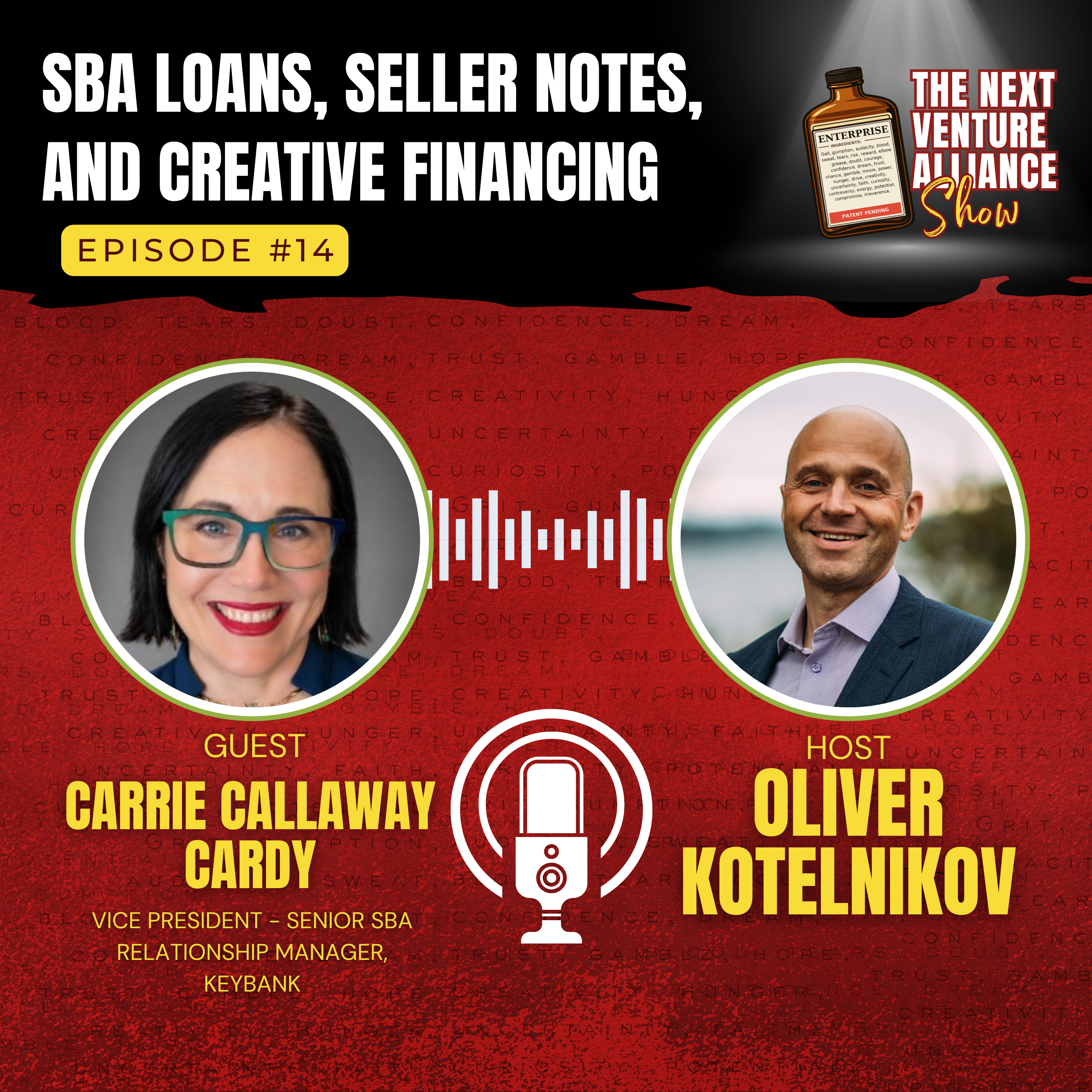
Our guest today is Carrie Calloway Carty. Carrie is a Vice president and senior SBA relationship manager at KeyBank who specializes in financing business acquisitions.
With two decades of experience in small business lending, she works at the intersection of buyers, sellers and business brokers, helping structure deals that close.
Her expertise spans SBA financing for acquisitions, expansions and commercial real estate. And she brings a practical, hands on approach to guiding clients through underwriting, deal structure and lender expectations. Carrie is also a frequent workshop instructor and mentor to entrepreneurs, supporting the next generation of business owners through education and access to capital.
Now, I've known Carrie for many years and she's a longtime colleague and a dear friend and just happens to be one of my favorite bankers to work with. She's a wellspring of knowledge and experience and whether you're a first time buyer or an experienced operator looking to grow by acquisition, you're in for a treat. So Carrie, good to see you. Welcome to the show.
[00:02:15] Speaker C: Thank you. I mean, that is quite the introduction. Thank you. Yeah, I appreciate it.
Yeah, I mean, it's been over a decade working together, so thanks so much for the invite. It's always fun to do new and exciting projects with you. So thanks for the invite.
[00:02:29] Speaker B: I appreciate it. I appreciate the partnership and for the listeners, if you haven't been through an SBA loan process, it can be an arduous process.
If, if you have been through an SBA process, you know, it can get complicated and you need trusted guides. So I think one thing I've always appreciated about you and I think you're different in this regard is that, you know, you're a problem solver and you know, working in a, I would say fairly constrained you know, highly regulated environment. There's not always a ton of leeway. You know, things. It's a government program. At the end of the day, you find room to operate and find, find solutions and you're creative and, you know, on more than one occasion, I've resorted to kind of your knowledge and experience to get deals done. So I appreciate it. And maybe you can give us a little bit of backstory and sort of history and how you came to be the SBA lending wizard that you are today.
[00:03:40] Speaker C: I think like most people who are passionate about what they do, I came through like a very meandering, different try all the things background. I actually went to university in England in and I did international business. That was my degree originally and ended up in public policy for grad school, entrepreneurship and community development. So that's my passion. Place is access to capital, as you mentioned, generational wealth building the legacy that comes with business ownership change too. He grew up in a family where my dad started his business out of a walk in closet when I was in sixth grade and my brother now owns it and owns a lot of locations and is thriving. And it's just a really fun story, but I was, you know, working in dad's business, doing the checkbook ledger back in the day, like entering it in, like, that's how I paid for gas when I was in school. And what's the business?
What was the. It's a financial planning firm. Yeah.
[00:04:37] Speaker B: Okay.
[00:04:38] Speaker C: Financial planning firm. Like a franchise, actually, originally, so.
But yes, a lot of. And a lot of my finance, like, math stuff came from working with dad when I was a teenager. So kind of funny how I ended up.
[00:04:52] Speaker B: And you get kind of a practical angle to it. I mean, I can tell you, I mean, you started out working with real people and with their real money, so you can't be too theoretical or, you know, or too kind of, you know, out there. I mean, this is. These are real dollars of real people. So I definitely see that in your practice.
[00:05:13] Speaker C: Yeah, I mean, I think the biggest thing, you know, for me on the background side is I kind of said, you know, how do I meet the economic needs of my family and also feed the passion I have around this topic? And I didn't want to still live in Alaska. I love Alaska. My husband works for the Navy here in Bremerton and my whole family's in Alaska. But. But I wanted to travel more. And so that was part of the motivation that led me on the meandering path to where I landed today. It's A great mix of the two things.
[00:05:40] Speaker B: Okay. And then you spent some time, I think, on the conventional side of lending before you came to SBA or mortgage?
[00:05:48] Speaker C: Actually, I did residential lending for about a decade. Yeah. Yeah. Before I came into SBA and met a mentor, a woman who kind of of took me under her wing and said, hey, you should try this. I think you be a good mix of your skills.
And, yeah, went into SBA lending not knowing anything about commercial finance or commercial math, as it were, right on the back end, but a lot about how to make complicated projects work.
I did specialty programs in mortgage, so it was a good fit. Learned a lot, and it's really the passion of the business owners that keeps me here. It's what I love about what we do.
[00:06:23] Speaker B: So it's kind of a Rubik's Cube world that we're in. You know, I mean, the colors are the same, but every transaction, every situation, you get handed kind of a different configuration. Right. And the true test is like, can you put it back together from anywhere? Right. Not just the thing you worked on last time. Right. Not the one thing.
Here's Blind Scramble. Here you go. And like, after, you know, I can imagine, I don't know how many deals, but countless, countless deals of different shapes and sizes, we're still handed a different Rubik's Cube every time.
[00:07:02] Speaker C: It's actually my favorite thing about what we do. It's that everything's a little different, that everyone's story is different. It keeps it fresh. It makes you want to do it consistently. I get bored easily, so those people don't know me. I don't like being bored. It's not my thing. I love a puzzle, both physical puzzles and work puzzles.
And it's kind of what I've gotten known for is taking a look at things that maybe don't quite fit the box and finding a way to either say, here's how we get to the box today, or we can't get to the box today, but here's how you get to the box in six months or next year.
Yeah. And there's a lot of satisfaction in finding ways to get things done that maybe are overlooked in other ways by other people.
[00:07:42] Speaker B: Yeah. Certainly keeps it fresh.
But, you know, one of the things that I see is, I mean, we just throw around terms, right?
Purchase and sale agreement and financing and, you know, various terms. And SBA is one of those terms people just throw around sba, and I think we all have a good idea of what it is. But what is, let's Start in the beginning. I mean, what is sba? What is its history and philosophy? And are we using it the way it's intended today?
[00:08:17] Speaker C: I think at the customer, he's heard about sba, but I think a lot of people don't really know what it is right at its inception. It's designed as a jobs program. That's really the spirit of the program. It's designed to allow banks to finance things they wouldn't finance without a federal guarantee. So think about it a lot like if you've done an FHA loan on a house or a VA loan, if you're a veteran, like, that's, that's kind of how to think about sba.
[00:08:43] Speaker B: So FHA loan, incentivizing homeownership, gives it some support. More people can now own homes.
[00:08:50] Speaker C: Sba, same idea. Yeah. Lower down payment with the federal guarantee. Different underwriting criteria because of the federal guarantee. And historically, you know, banks would not do, you know, 10% down. They wouldn't do no collateral. They'd want to know you have something they can touch in case the deal didn't work or something happened or you got in trouble.
And SBA allows banks to lend without collateral or limited collateral. It's a very, it's, it, it's just a very different program in that way, really. Designed around fostering that American dream component where it's like, hey, I have this idea, I want to grow this business, I want my employees to buy this business, I want my kid, I want my neighbor, whatever that is.
Historically, banks couldn't finance that. It was a lot of seller carry, it was a lot of wealthy people only. And it really made that transition and what entrepreneurs do from startup to transition, accessible to everybody, instead of just to people who have family knowledge or money or other resources.
[00:09:56] Speaker B: Because it used to be that I think you kind of needed to already have the money to be able to borrow it, or where you needed to have something that equaled the value of what you try, which kind of defeats the purpose a little bit.
And it does limit it to the people that already have money and are just using the system versus actually incentivizing first time business ownership.
[00:10:23] Speaker C: Well, I think the big difference is as our economy has evolved, we're largely a service economy, especially here in Washington. And service businesses don't typically have something I can pick up and go sell. Yeah, right. It's people, it's knowledge, it's intellectual property. Like what used to be manufacturing collateral. Right. Things I can touch is now intellectual or people or a business. And So I think it's nice that the program has evolved in that way to allow lending with 10% down most of the time. For most projects like that, it makes it way more accessible, which is great.
[00:11:00] Speaker B: How does.
What's the connection between. Because we hear SBA and then there's the bank. Like, what is the connection between the. Because the government doesn't actually lend. Right. The government guarantees and contracts with banks who lend and then use that guarantee to make it work on their end. But oftentimes when people borrow, they don't, you know, they feel like they're borrowing from the government and the decision making process throughout the loan too do. It's, you know, SBA requires this. SBA requires that. What is SBA and what. And how does it connect to the framework of the banks regionally, nationally, locally?
[00:11:40] Speaker C: Yeah, I think it's really important to understand that SBA has what's called an sop. Let's throw around more acronyms. Right?
[00:11:46] Speaker B: Let's throw them out. Let's see what they are. So what is SOP?
[00:11:48] Speaker C: Standard operating procedure. It's like 500 pages and half my life is looking things up and making sure I know it, I swear. But that document is what governs what lenders are allowed to do. It's what makes it eligible for the program.
So the way to think about it is it's like our underwriting rules. If we want to use the program, it's the guidelines, the minimum. Most banks are more conservative than that, which is why when you hear people say, oh, my bank said they don't do startups, but another bank might.
That's because that bank has chosen to participate in startups by using the SBA program.
But that other bank said it's too risky. We're not comfortable with startups. So banks can be more risky or more stringent. Sorry, not more risky. More stringent than the SBA rules. But they can't. But they have to, at the minimum, meet SBA guidelines. And that's where it gets confusing, I think, for people, because you talk to one lender and they say, hey, it's 10% down. Another lender may say, hey, I want a seller carry, and 10% down.
Another lender may have a viewpoint on experience that's different. At the end of the day, SBA has this really fun sentence which basically is called, you know, they want us to document that we have been prudent lenders. That's literally what it's called.
[00:12:59] Speaker B: Lenders. Wow.
[00:13:01] Speaker C: Every lender seems to have a little bit of a Different appetite or viewpoint on what a prudent lending is for their bank and their model. And that's okay. But that's why if you find you get an answer you don't love, but it seems like it might be within the program, go talk to another banker. Like I'm like all about that. There's no reason not to do that.
Go talk to somebody else. Because the answer isn't necessarily no. It might just not be a good fit for that bank. But that's what makes SBA a little confusing, is because the minimum rules are how it applies. The money still comes from the bank. So at the end of the day, the bank has to make that decision for their risk appetite. Very weird. But that's, yeah, that's why you should work with a specialist. It gets very confusing.
[00:13:43] Speaker B: Well, well, and that, and that's constantly the line throughout the loan process too is who's making this decision? Like in this case, is it key bank or is it sba? And, and, and, and I find, you know, some banks have more sort of agency, it feels like in the process than, than others who, you know, just defer to the sba.
You know, we, more acronyms. There's, you know, preferred Lending provider. Right. And so they just throw that out there, which I think means that you have some decision making ability on your local level. Is that correct?
[00:14:16] Speaker C: Right. So more acronyms. That's really what we're going to do today is lots of acronyms.
Lending provider. Right, exactly. Like Oliver said, it basically means we have the authority, we have done enough loans and demonstrated we can follow the rules and do the reporting and do the audit and everything that goes along with that. So SBA says, okay, you can underwrite on behalf of SBA for a guarantee and we're going to spot check that you met eligibility and that you are prudent lenders. So that's why to Oliver, to add more adventure to it, sometimes the appetite or the risk profile changes because sba, when they audit will change. Whether that's the leader of the sba, the current administration, whether it's the particular audit group you got, whatever. You may see some shift around even within a bank because of that.
I know, clear as mud, but that's how it works.
[00:15:10] Speaker B: But it's good to have an understanding again because people go into it thinking, oh, it's an SBA loan, right. And this is big umbrella, but, but here are all these, you know, moving pieces underneath it. I think it really helps to understand the process, the nature, the goals of the organizations. Their mandate and really what they can and can't do for you. And so on that note, I mean, what are some of the kind of more common financial products that the SBA offers to fit different acquisition needs?
[00:15:46] Speaker C: Yeah, I think, I mean, at the core there's three main products that people run into the Most. One is SBA Express, so that's typically under 500,000.
I don't see as many of those in the larger acquisitions. A lot of those are self financed or they're financed through Community Development Financial Institutions. Another acronym, cdfis. Right.
[00:16:06] Speaker B: Which is another bank, Community Development Financial. We're going to put all that in the show notes, by the way.
[00:16:11] Speaker C: We're just going to be like, hey, yeah.
Or they're financed through. We see a lot of credit unions participate in express or micro lending.
We definitely participate too.
But at the. Typically, again, a lot of what we work on is kind of over that price range when people put their projects together. But that program has a little bit less strict rules as far as underwriting goes. Again, depending on the lender. But usually it's more streamlined, which is nice.
And different lenders required different rules with that program. It just makes it a little easier. But most people are going to run into is what you and I run into pretty much all the time, which is the SBA 7A program. So again, more, you know, letters.
The 7A program is really, when people say SBA, that's what almost everybody thinks about. And so that's the one that you want to do a startup 10 year, 10 down. That's the minimum for that program. You want to buy a business, you know, there's ways to do a Little less down, 10 down, 10 year term, largely. Right. So it's very like, it's the kind of meat and potatoes, the everyday loan that most people will do.
The other loan, which you and I have done a couple of projects like this before. Right. Is a combination of products, which happens
[00:17:25] Speaker B: a lot actually, because you and I can do anything too simple. We have to, we have to have some blend.
[00:17:31] Speaker C: Right.
A lot of the combination products are going to be, hey, I'm going to buy the business, but I'm also getting the opportunity to buy the building, which I think is great. It helps the math in general because real estate's a longer payment, which is nice.
But then we use a lot of times what's called the SBA 504 program.
Again, no acronym, just numbers this time. But the 504 program is for real estate and durable equipment. So for example, I have clients who are getting a drill. They do contract like work they're doing on the 504 program.
[00:18:07] Speaker B: Like a drill rig, something that.
[00:18:10] Speaker C: Yeah, yeah, yeah. And so they're doing it on the 504 program and that's a 10 year product.
Most of what we run into, most of what you may run into on an acquisition would be on the real estate side. But one of the interesting ways that you can get better rates and longer term options with equipment is to utilize the 504 if the business you're buying has durable equipment. So we again, more acronyms. Renee, Remaining useful life of 10 years or longer. Right. So like it's this whole adventure but you know, the more and more we talk about this again, we'll get into the nuance as well. But every deal is different, every project is different, which is what I love about what I do. But also what can sometimes make this process intimidating, especially to a first time buyer.
And if we haven't said it before, like, having an advisor is super important. Working with a lender, talking to multiple lenders or specialists is super important. If you're buying a business, making sure the business is being listed by a reputable broker and that the information you're getting is good and accurate. Super important too. So just reiterate like it's a lot of acronyms, but at the end of
[00:19:15] Speaker B: the day, as long as you define them and explain them, it's all good stuff. So.
[00:19:20] Speaker C: Right.
[00:19:20] Speaker B: Yeah, yeah.
[00:19:22] Speaker C: Yep, yep.
[00:19:23] Speaker B: Okay. So, so we have 7A, we have 504.
What's the best way to understand for a buyer, you know, whether first time or expanding, what program they should be targeting, you know, kind of early stage, should they be talking to a banker? Should they be having some stuff outlined of what they're wanting to buy? I mean, where, where does somebody start to understand, you know, what they're after or what they qualify for?
[00:19:55] Speaker C: Yeah, I think at the end of the day for most people it's less about seeking the product and making more about making sure that the business you want to buy will cash flow alone, that's going to work for the bank you're working with. So you know, I always, I always say start earlier rather than later. So even if you're not quite ready to buy the business, but you've got some money saved up or you want to utilize, you know, other down payment programs, etc. Take a look, talk to a lender, talk about what may be out there. Unless you're buying a building or significant equipment that like is going to last for a decade or more, you're going to be using the 7A program.
I think that's just the easiest way for most people to think about it.
But, but I do think, you know, it can be intimidating making that first phone call or talking to the lender. I will tell you just when you walk into a bank, most people sitting in your bank branch are great at the everyday transaction, but they're usually not the specialists you need to talk to about acquisition financing. So step one, talk to an SBA specialist. Whether it's your current bank, another bank or a few people, I think it always makes sense to do that. And I think one of the things that I love to do is if you're looking at businesses and you're like, hey, I saw a great one on bizbuysell.com or I saw a listing from a broker from IBA, for example.
I always tell people, I know we're looking, send me your listing, send me the information that's in the sheet that's listed. Because we can have a great conversation about what questions do I have?
What should you ask that the bank would want to know? And does the math work for you? Because not every business, the math is going to work either for the listing price or loan because you may not have enough down payment to meet that difference or you may just not. It may just not be a good fit because it wouldn't give a salary level that you need to get to based on the math for the business. Not every business is a great fit for everyone, and that's okay.
[00:21:51] Speaker B: And I think that's a give, you know, very sound advice. One is make sure you're talking to the right person. Right. I mean, often, oftentimes it's, you know, just like in the medical or legal field. I mean, you want to be talking to a specialist in that field, but people don't know where to start. So they'll walk into a branch and they'll say, you know, I've always done business at X Bank.
You know, I'm going to buy a business through them. May not, may not be a great fit. And I think the other thing for buyers to keep in mind is that banks are actually a great ally for you because, you know, they're sort of, they're not representing you, but they're really looking at things very, very closely. You know, that to make sure that it works for them.
And it's sort of that arduous underwriting process. I mean, you're kind of underwriting it you're essentially doing the due diligence for the buyer.
You're making the deal, make sure the deal works for you. But if it works for the bank, it probably financially is going to work for the buyer. So I think just understanding who's who in this equation and that working with the right banker, that they're an ally in the process, certainly on the buy side, they help the seller and the transaction because they deliver funding, but they're sort of on the buy side mostly
[00:23:14] Speaker C: as far as, well, and to clarify over, we really are on the buy side like. So from a confidentially, like confidentiality perspective, your banker works for you as a buyer. And so at the end of the day, if you give me permission to like, Oliver and I are working on a project and he's the listing broker, I have to ask your permission to have conversations that are detailed about your project, where you're at, whatever's going on outside of asking for additional information, etc. So that confidentiality does exist. I do think that's a really important comment because at the end of the day, the, the bank wants you to succeed because candidly, that's how the bank gets repaid, right?
[00:23:50] Speaker B: Yes.
[00:23:51] Speaker C: And so if they don't think you're going to get, you're going to be able to repay, they're not going to say, yes, it's in your best interest to be able to repay too.
You know, one of the things I like about the program, even though everyone hates a lot of paperwork and rules, is for the most part the due diligence and the strictness around some of the program helps us make sure we're making loans that make sense for you and that that's a universal situation.
Whether you're working with somebody like me, has 20 years of experience or someone who has a couple of years of experience in the program. Those guardrails help to make sure that you're getting a loan that makes sense for you and will be able to be repaid. Like that's part of the goal. I like that part of the program.
[00:24:33] Speaker B: Yeah. No, I mean it has to be a win win. And nobody wants to see anybody fail. Right. And then the bottom line is that your team and you know, the bank's team are professionals. They're professional underwriters. They look at it with, with a set of eyes that unless the buyer is, you know, a professional in the field themselves, I mean, they're just not going to see certain things.
And not only are they obtaining financing by working with a quality banker, they're also getting a very detailed, diligent second set of eyes on the opportunity where I mean, you can tell pretty quickly, like you said, from a listing like, you know, either this is overpriced or this is outside of your price range or any of those things. I mean, shooting from the hip, you can probably generate, you know, some good feedback. And it's, you know, you look at the business and the other side of is you look at the borrower. Right. And are, and then ultimately are, is the business and the borrower, are they a good team in essence?
[00:25:35] Speaker C: Absolutely.
So yeah, and I think that's a really good point. Right.
Oh, sorry, go ahead.
[00:25:41] Speaker B: No, no, no. Well, I just wanted to, just finishing that, you know, the question is like, what else?
You know, buyers are focused on the business and they say, hey, once I find the right business, then I will, you know, deal with the rest of it. But really it's the package, it's there. They're about 50% of this, you know, rough numbers of this acquisition. So, you know, when should they be looking at how good a fit are they for this business? Not is, does the business fit them?
[00:26:10] Speaker C: I think, I think it depends a little bit about industry too. Right. So one of the things that we look at is going to, is really going to be your experience. That was my first question.
When someone says, I found a business, so that's great. Tell me why this is a great business for you. That's always my first.
Because at the end of the day, some businesses related skills are fine. Right. I'm buying a retail business. I have experience working in tech where I manage teams, I've managed people, I've managed budgets. I'm buying a retail business. Okay. Relatable skills, no problem.
On the flip side, you know, hey, I want to buy a restaurant, but I've never managed or run a restaurant before.
Most banks are going to say no to that.
So industries where specialty knowledge is really important, construction, restaurant, hotels, that kind of stuff, that's where there's going to be more concern or scrutiny put upon you as a buyer is like their experience. That's where that piece is really important. That's that fit you're talking about. That's part of that.
And there's creative ways to get there. Right. We can have a minority owner with some experience. We can have an employee who joins the ownership team that adds that experience. There's a lot of ways to get there. But you're not wrong. That's a big part of it. The other big thing that I think Isn't talked about enough on the banker side is what do you need to make money wise to make your world work? Because if you're exiting a $400,000 tech job and you're buying a business that historically has paid the operator $100,000 a year, how are you going to manage that gap? Or is there an expectation that this business needs to be able to give you that same 400,000? Those are the kinds of questions that I ask, and I ask those really early, often before they even find the right business. We talk about what kind of salary makes the world work for you. And I go through the numbers with them also.
What kind of business are you looking for? What does your experience look like? And we talk about specialty businesses and whether that's a good fit or not. And the third thing we talk about, Oliver, is down payment. Do you have money available for down payment? We can talk about lots of options to get there, but at the end of the day, do you have down payment and do you have some reserves as a cushion to make sure your world still works in transition?
Those are the three biggest things that I look at on the buyer side. That's that other half that that married up with that business component for us.
[00:28:29] Speaker B: Yeah. And you know, that's fantastic insight because I can almost guarantee that that many people aren't thinking about the global outlook. Matter of fact, you use a financial term, global cash flow. Right. Meaning kind of what, what's, what's the business generating? How much are you needing? And you can get into, you know, kind of their family arrangements, how, you know, how many is it, is it a married couple? How much is the spouse making? How much do they need together versus what this business generates? Because you can fund, you know, maybe a lower cash flowing business if their overall financial situation is stronger and vice versa. Right. I mean, that's why you look at personal financial statements. You look at the overall financial picture and all of that kind of informs, the deal structure and max lending, in essence.
[00:29:21] Speaker C: Yeah. And that's one way people get ready. Oftentimes I see, right. Is they say, hey, I know I want to exit my employer in the next year, I want to go buy a business.
They pay off debt. A lot of times they put together some savings, they manage their budget differently. Maybe that last year before they're telling their company that they're done, they're out of corporate world and want to go buy business.
But that's a great point. That global. And that again, a bank term. Right. That global cash flow. We look at is really business cash flow left to pay the loan plus a cushion, plus your personal life if you need it from that. How does that all mix together? Together.
And you don't have to remember all of that. Like your lender can go over what that math looks like and say, hey, say you want to make 300.
Your personal math says 150 works. Are you good with that? Until the business ramps up, how do you feel about it?
What's realistic and all of that. And those are all conversations to have with your lending advisor, for sure.
[00:30:15] Speaker B: Yeah. And it can get a little personal. People can feel like it's invasive and it's like why do you care where my spouse works and how much they make or what my vacation, vacation home is worth or you know, all of these, you know, kinds of things. But, but it is, it's kind of an all in process. Like you are committing to something that is really all encompassing and, and you know, you look at all, all facets, which is what I'm trying to open up here is kind of the whole, the whole picture.
And, but to me that approach creates options. I mean that's where you were able to be flexible is because you're looking in the nooks and crannies and places where somebody else may not look for resources and say, and you've done this, you know, on my deals multiple times where like I didn't know what the solution was. Right. I just brought you a problem and you solved it. So the goal, to me that's, that's it can feel invasive, but to me that's flexible. That's what opens up flexibility is that we're not and you know, same thing for us as brokers. We're not there to audit the business.
You know, we're there to evaluate it and to understand it and to deliver maximum set of best options for in our case, exit. In your case it's financing options and getting somebody into a business. But we do need to have those deeper level conversations.
[00:31:45] Speaker C: Yeah, I think that's a good point. The one thing I would say too is just be honest with whoever you're talking to a lot of people who will leave stuff out and we'll find out later that nothing derails a project worse than like lack of disclosure to your, to your financial person.
But with that too, you know, when I get the whole picture, as you mentioned, there's other ways to get there. Whether it's, you know, programs for down payment or home equity or whatever else. There's a lot of ways to get there, the whole picture is the best way to understand.
I think that's a great way to put it. Thank you.
[00:32:19] Speaker B: Now, the second piece, and we skimmed over this, but talk more about experience. And you know, we have direct experience, we have, you know, relevant experience. We have different shades of experience that we can, you know, sort of draw on to make things work. But, but really that's, that's an important part that makes again, you know, business lending different from home lending. Like, you know, when you're buying a home, what's your experience?
What experience have you? Do you know how to live in the house and do you have a job that supports the payment? In this case, the question of, hey, you need to tell us how you're going to run this business successfully. And to me, that's been probably, you know, one of the more highly scrutinized sort of points of underwriting is they're looking deeper and deeper into experience and trying to understand, no, you know, yes, you worked in construction, you were a general contractor, but this is a painting business. Right. Tell us how you, you know, how much have you actually painted? Right. And they're just digging and digging and digging, trying to understand. So I mean, talk about shades of experience and why that's important and, and, and how you can solve that.
[00:33:31] Speaker C: I mean, I think the why that's important thing is really a number thing that matters to buyers and to sellers because they want their buyers to be successful. Successful. Right. One of the number one reasons we see default is because of mismatch experience
[00:33:45] Speaker B: is that the number one default reason for loans is lack of it.
[00:33:49] Speaker C: There's one and two. One is seller exits and does not transition as expected, which good contracts, good lawyers, good brokers solve for a lot of that. Right. But one and two, I don't remember what order they're in. But the other one is mismatch of experience.
[00:34:02] Speaker B: But it's up there.
[00:34:04] Speaker C: It is, yeah. Cannot remember which one's one and two, but yeah, those are the two big ones. And I think part of it is that people get into a business that's running smoothly and they have the employees and the change management that goes with that transition doesn't always go as well as people expect. And that's where those hiccups can come in without experience in the field, without that credibility that goes with that.
But again, it depends on if it's related. So let's talk about shades, like you said, right? So if you're like, hey, I want to by an H Vac company and the Owner is the estimator.
You better be able to estimate or have an owner who is going to be on your loan with you who can.
Because that business can't operate effectively without an experienced person being able to do estimates for the jobs. You just can't right now. One thing to talk about with experience too, right. Is let's say I have an employee who does that.
A lot of times SBA is not okay with that anymore because there's no teeth in employment contracts anymore. Really. And so they're going to want to see that that person's part of your ownership group if you want to count their experience to solve for that issue. We do that a lot actually.
But again, it's a shades of experience thing. I'm going to buy a tech company. I did something else in tech.
Sure. As long as you can tell me how it's related and how your experience is appropriate, no problem. I want to buy a retail company like I mentioned and I run any other sort of business or I've been like managed people or projects or whatever, a lot of project managers in this kind of retail space, etc, that's all fine too.
The easiest way to think about, I think about it is this. If you need a specific license, if you need a specific set of like credentials or bonding that goes with it, with the exception of restaurant and hospitality, which are the other two, I guess in that space. But like for the most part, those are the direct experience. Experience once restaurant, hospitality.
[00:35:58] Speaker B: So professional, like licensure, where there's licensure, that's. You need direct.
[00:36:03] Speaker C: I think so, yeah. So there might be some exceptions with some lenders. But the way that we look at it is if you need to have a license that's very specific to do it, you need to have that credential or someone in your ownership group has to, because here's why it matters.
Let's say I buy a daycare business and I don't have the credentials and my director leaves and they're the only one that the credentials are hanging on.
There's rules about how fast I have to get spun up to not have my center closed.
Yeah, like that's a big deal. It's the same, same thing as we look at, hey, you know, if it's really anything where it's like if that person exit, your business is not kind of in trouble, your business is super in trouble. That's really the way to look at it.
[00:36:49] Speaker B: And so, and then digging deeper into experience, if you're an estimator for an H VAC company and you're exiting as the owner and the incoming owner has to take that role. Then, you know, what does the estimator have to do? Well, they have to have working knowledge of however many products they're selling. Right. You know, furnaces, ventilation systems, you know, AC units.
You're going out there to talk to them. Right. And maybe you're not selling quite yet, but you're going to be asked questions. Right. All of a sudden, if you show up as the new owner and you're, you know, looking in your, you know, SOP book versus being able to answer it, then you're not going to get those jobs. Right. So in essence, you can't estimate. Right. Or it's.
I mean, if you really dig deep, I can make sense. I can kind of understand why this is so important because it's easy to say I estimated, you know, car parts.
You know, I can estimate furnaces. Well, not. Well, not really because the competition is so high and people are kind of judging you and on your knowledge and experience. And if you're not fluid, if you're not knowledgeable, if you're not professional and you can't sell and recommend persuasively, you're just not going to get the jobs and your income will suffer.
[00:38:15] Speaker C: Yeah. And I think too, right. Like, if you've worked in the industry, but you haven't been the guy who's estimating or is estimating the projects. That's a different issue, Right. Hey, I've already licensed. I already do all this stuff. I just haven't been that person. We're going to be fine with that. That's a transferable change.
So just let me just for context, it's not for us anyway. We're not getting further there. But it's really about can that transition happen in a reasonable way in a short period of time? And how do we document that if we get audited? That's how the bank has to look at.
Yeah.
[00:38:50] Speaker B: On the third part, you said down payment. So you know that 10% number, I mean, that's the one that everybody is, you know, running around with that. That's what we all run with, everybody. 10% temperature. So where did that come from? How realistic is it? And what moves the needle up or down from it?
[00:39:10] Speaker C: Sure.
So I usually tell people they need 10% down and another 5% as reserves. It's not perfect, but life gets more expensive than we expect. Having some sort of cushion helps underwriting be comfortable. So I just want to put that out there. Don't be wrong if you're doing a $5 million acquisition, okay, maybe another 5% reserves is not the appropriate number. But for most projects that I work on, which are kind of in that under 3 million space, it's pretty close to kind of how underwriting is going to look at having some reserves in case things aren't perfect.
So to your point, 10% down if you have experience and the business is what I say, solid. Right. So the business cash flow is fine, everybody's good, no major challenges, financials look stable. We're not talking about major spikes and declines, etc. A lot of times lenders will get comfortable with 10% down without any type of talk about another acronym or comment. Right. Seller carry. So additional, the seller taking on part of the debt without that, that straight 10% down option.
For most businesses, we're able to do that.
Where it gets to more down comes in two forms. One, you love the business. You see why it's priced the way it is. You want to buy it. But max lending doesn't meet the purchase price. You got a bigger gap.
[00:40:30] Speaker B: Max lending. So those max lending, what? What?
[00:40:33] Speaker C: Yeah. So from a lender's perspective, I can't comment on price. We don't set price. That's not my job. I don't have those licenses. That's what Oliver does. Right. For me, I can say based on the math I see, here's the maximum loan amount I can do.
And sometimes the business is the right opportunity. It is priced appropriate for the way the business is structured. But banks can only look backwards. They can't look forward.
So you may say I'm going to buy this business anyway, but instead of it being 10% down, because max lending plus 10% does not equal my purchase price, maybe I'm putting 20% down or 25% down because it's worth it for me.
Maybe I'm acquiring it for my existing business.
Maybe I have a ton of experience.
Maybe you have a pretty passive owner. We've talked about that before, right. Who's like ready to retire and hasn't really like modernized the world. And there's some easy ways to do that.
There's a lot of great reasons to do a purchase price more than max lending. They're not the same thing.
But that difference has to come from somewhere. And usually it's extra down payment or some sort of seller carry and creative adventure.
[00:41:46] Speaker B: Well, and that's a great distinction because oftentimes, especially novice buyers will conflate what they can afford with 10% down.
They will directly equate that to fair market value of the business and they'll say, well, the business is overpriced, which really means I can't get it funded with 10% down and everything else that the bank requires for liquidity reserves. And so that translates to the business is overpriced. But if it's the right opportunity, again, there are many places where liquidity can come in handy.
But one, if you find the right opportunity, maybe you need to put more down if other things. As a broker that I can think of, if we're reassigning a lease and it's a, you know, arm's length lease and a commercial landlord, I can guarantee you they don't want you arriving with nothing in the bank and saying, you know, I'm the guarantor on this lease, you know, you need some signature power and you need some, you know, you need some funds on your balance sheet and you know, the list goes on and on why you need extra liquidity. But I think what I'm trying to make the case for is pricing the opportunity correctly. And if you're a first time buyer, get into a smaller business first that you can afford and maybe learn the ropes versus trying to get to that, you know, those higher registers and punch above your weight and end up somewhere where you're, you know, maybe out of your depth a little bit financially sometimes experience wise. I what do you see for sort of buyer selection and I guess a case for starter businesses. Maybe they're not perfect, but they fit in some of these other ways that
[00:43:41] Speaker C: it depends on what your goals are as a buyer. Right. So if your goal as a buyer is I don't want to work in corporate life, I want to replace my job, the smaller businesses are great. Maybe you're buying a franchise location that's been up and running for a few years. Maybe you're buying, you know, a small restaurant in your community. Maybe you're buying the consignment shop down the street. For me, like there's a lot of great reasons, maybe it's a passion project of yours. All those are great reasons to do kind of the smaller side businesses.
I have a client who got into a small one and they're continuing to buy basically the same type of business over and over again with the proceeds from now having ramped up and like really improved the, the math on this on the first one they bought, which is great, it's such a great model for that.
On the flip side, if your goal is I have a ton of experience in, you know, corporate management. I've done a bunch of things with big GLS and big projects and all of that.
I'm seeing a lot of people I know we're getting in the weeds a minute for come out of tech with significant retirement and rather than pulling retirement, they can utilize. Here comes another ackerman, the Robs program, which is rollover business startup.
Used to be for startups that isn't anymore. It's very fun and acronym world over here. But what that basically means is there's a program and I'm not licensed for it. So I'm going to give you the basics. Right? There's a program which allows you to create a C corp and your own 401k plan and roll that 401k over so that your 401k funds invest in your own corp. Why that matters is it doesn't have the tax penalties or the early withdrawal rules.
It's a way to use your retirement in order to get into that bigger business to punch above your weight. Like you're talking about Oliver.
And I think as we're seeing more and more tech layoffs in our community and we're seeing significant retirement assets for a lot of our tech workers in our community, it's a really interesting time to see this program utilized more as a way to really buy those bigger businesses as we're seeing that generational turnover as well. It's a really interesting way to get there. And some of them do smaller ones and just pay cash by doing it that way too, which is interesting.
[00:45:51] Speaker B: And have you seen an uptick in Robs?
Does it correlate to development of AI and tech jobs going? I mean, are those things connected?
[00:46:00] Speaker C: Yeah. So I've just started seeing it in the last probably six months where we're seeing.
I'm getting a lot more questions about hey, is there a way to use my retimer for this?
And there's a couple of vendors that we use that do like info sessions. So I'll be like, go talk to them. I'm not licensed for this, but they have great info about it.
But I. But I will tell you, it's an interesting option. C Corps have all of their own. Talk to your CPA legal. That's my disclaimer. Right.
[00:46:25] Speaker B: About C Corps and the mine too, believe me.
[00:46:28] Speaker A: Right.
[00:46:28] Speaker C: And unwinding that where you go to sell is a different thing, as Oliver knows too. But sometimes it can be really great. You know, we see very large retirement accounts coming out of tech and the opportunity to Then kind of level up or buy that next big project has been really interesting to look at. A lot of them are doing investor cash groups, too, which has been interesting.
[00:46:53] Speaker B: No, and I mean. And that's.
I mean, I started seeing that, but certainly not. I haven't seen it in the quantities that.
That you're describing, but it absolutely sounds like a viable avenue for someone with significant retirement set aside and maybe before retirement age. Right. I mean, these could be.
[00:47:17] Speaker C: Yeah, most of them are right. And it doesn't even have to be huge. I have a client who just did it with a hundred thousand dollars. They bought their employer's business, but they needed the down payment, and they did. $100,000 from the retirement from their previous company can't be your active one. So it was quite interesting.
[00:47:33] Speaker B: Okay. Okay. Yeah. See, I mean, we're.
I think if there's a thread here, it's. There are just so many steps and options, you know, if it. And it takes some time to kind of get to know the landscape, but if you zoom out, there's many, many ways to acquisition.
And so just understanding what the options are, I think, and taking some time to just explore and talk to knowledgeable people can set you in the right direction.
How does a lender look at. Let's say there's an issue with relevant experience or they got turned down for relevant experience.
Again, getting into a smaller business. Let's say you buy something smaller, you know, does a lender look at the borrower differently if they are an existing operator now? Right. Say they've ran the smaller business for a couple years.
They've shown that they're doing it successfully.
I mean, talk about maybe some of the issues that. That can mitigate and maybe how long that protracted entry can take.
[00:48:45] Speaker C: Oliver, you don't know this, but it is. Right.
[00:48:48] Speaker B: See, I opened the Pandora's box. I knew there was one.
[00:48:51] Speaker C: No. For what? Here's why. Two reasons. One, yes, we totally look at it differently. And once you have two years of operating experience and show the profitability and the business is doing well, whether you start up something small or you acquire something small, you can then acquire your next business, assuming it's healthy and your company's healthy, potentially with zero down because it's considered an expansion.
This is my favorite topic right now because.
[00:49:18] Speaker B: So two years, Carrie. Two, you need two. Two tax returns or you just need
[00:49:22] Speaker C: two calendar tax returns? Yeah.
[00:49:24] Speaker B: Okay. Okay.
[00:49:24] Speaker C: Every lender's a little different. That's how we do it. We want to see two tax returns.
[00:49:28] Speaker B: That sounds Reasonable. I mean, if you've generated two good years and have two sets of documents. Okay.
[00:49:34] Speaker C: Yeah. And so it's fun because you could buy your competitor, you could like, like whatever, however you want to do. The zero down program works if you're buying something that's in the exact same industry. So it's the NAICS code, more acronyms.
[00:49:46] Speaker B: Give us an example, like at a restaurant or electrical company. Like, you know, pick something that.
[00:49:52] Speaker C: Yeah, so I actually am working on. Right. One right now.
It's a restaurant. In this case, they've operated it for about two and a half years and someone in the same type of restaurant that they met through their organization wanted to sell the. To sell their business and they're going to buy that restaurant with zero down because it's the exact same type of business.
I did one last year where there were.
They're basically a electrical engineering company and they bought a competitor out. The competitor was ready to retire. We did that with zero down for them, too. They'd been in business for several years. And so whether you're an existing business operator or you wait for a couple of years and now are an existing business operator, like that acquisition of the same.
Same exact ownership, same, exact type of business is how it works. But you can do zero down, which is really interesting.
[00:50:42] Speaker B: And what. And is it. Is it the industry code that defines same?
[00:50:46] Speaker C: Yeah.
[00:50:46] Speaker B: Is there a geographical. There's like a distance between.
[00:50:52] Speaker C: Yeah, so NAICS code. Right. So let's add more acronyms to the world. Right. North American Industry Classification System.
[00:50:58] Speaker B: Nice. And then there's the SIC code. Right?
[00:51:02] Speaker C: Yeah, there's that one too. The SBA looks at the NAICS code. So it's a six digit one.
It has to be the same six digits and the ownership has to be exactly the same. To do zero down, geography has to make sense. So let's say your ownership group is you and your brother. And your brother lives in Oregon and you live in Washington and now you're going to buy another one, but it's in Oregon where your brother lives. Cool. No problem. Totally makes sense. Hey, I'm going to buy one in dc. But the business physically needs somebody there operating it. Probably not going to work so much. Right. With the zero down, they're considered that higher risk. Right, Right.
Has to make sense. But yeah, it's something that.
[00:51:41] Speaker B: Where the owner can keep an eye on both reasonably. The same owner.
[00:51:47] Speaker C: Yeah, yeah. I've done exceptions where, like I have one where we did one on the east coast and his daughter lives out there. She graduated school and finished the degree. That's the same degree he had.
And so that was another engineering firm. So they bought an engineering company as an acquisition on the east coast and she's an employee. But it's still that like. So it's just a. She'll own it eventually. But that's like, that was how they did there. So that makes it just if it makes sense.
[00:52:17] Speaker B: So I mean that's. If you're past your first business, you have at least one and you, you've operated for a couple years. There's. And then you like the industry.
I mean that's, that's quite the avenue for growth.
[00:52:31] Speaker C: It's pretty great. Yeah.
And we can finance working capital too, which is even more fun. So it's like a nice, it's just a really easy way to do that. There's a few ways to do zero down acquisition or more limited down acquisition, which again, we get in the weeds on that some other day probably. But the acquisition in this way, this expansion option I think is probably.
I expect us to see a lot more of that as we're seeing more and more of this, kind of got this gap between generation of business owners right now. And so I think we'll see some more on the, on the more established end retire and some of the ones who've been in business, you know, two, three, five, seven years being able to acquire those. That's my hope anyway.
[00:53:16] Speaker B: So zero down. And maybe this can get us into a next.
Not an acronym, but a term of debt service. Right. And maybe that relates. You said you don't set the purchase price, you set max lending.
How does the bank look at the value of the business and you know, make it pencil or not. How does the bank determine if you're not setting it, what is debt service? What's important?
What should buyers know, you know, and zero down. Like how does that work? Because you're not, you know, how does that make debt service work? Because you're not delivering the initial influx.
[00:53:56] Speaker C: Yeah. So DSCR stands for Debt Service Coverage Ratio, as Ella mentioned. So yet another acronym. That's my world.
The easiest way to look at it is it's the business break even plus whatever percent the bank needs to feel comfortable approving it. So for Most banks with SBA, it's a 1.25. That's what most people talk about.
Which. What does that mean? Right. So let's say, for example, My business makes $100,000 in net income.
My total debt payment annually is 50,000.
Well now I've got a two debt service coverage ratio. So I have 100% more than my payment in extra profits. That's that way like it's like that. That's how it works.
[00:54:43] Speaker B: And, and, and a bank would like that.
[00:54:45] Speaker C: Yeah, that'd be awesome. Like I don't. I've seen things over two like maybe 10, 10 times in 20 years.
It's not common. Mostly because people reinvest in the company or they do other things. Right? Absolutely.
Two things to know that are really important. This is after you pay yourself. Remember that global cash flow comment from earlier?
The amount that is going to make the bank comfortable that you can cover your world.
Another acronym for mortgage life. Right. DTI Debt to income ratio is another one. But that's the personal side.
Most banks want to see that you have 50% or less debt to income. So it's the flip again more acronym. Best way to think about it is if my mortgage payment is $5,000 a month the bank's going to want to know that I make at least 10,000 months gross. That's the only payment I have.
They want to know that your income growth is twice what your debt on your credit report is going to say.
[00:55:44] Speaker B: So the bank wants you to make enough money to pay debt service, cover your life expenses and have a little cushion on top of it for life's little surprises.
And how big or a little of a cushion depends on the risk acceptance of the bank. And that can.
That can vary we right.
[00:56:04] Speaker C: Very.
[00:56:04] Speaker B: 125 is that benchmark. But most businesses land somewhere between 125 and 1 5.
[00:56:12] Speaker C: Yeah, most businesses do.
Depends. Right. Because again if there's value built into the price that isn't reflected in cash flow. So cash flow is that money left over to pay for debt after we pay taxes all our expenses, all of and ourselves. Right. So that's that what's left over number.
If that cash flow doesn't always marry up to price as far as what the price would look like and what I mean by that is let's say the business is listed for a million and I say max lending based on cash flow is 700,000.
There may be a great reason for that business to be listed a million based on the properties of that business. But that gap then would come from our buyer in some format or a combination of buyer, seller, debt combination. There's ways to get there. But I think when you think about debt service to your point right. It's really about can the business pay the debt and you have a cushion in case things aren't perfect, that's really what the bank. That's the easiest way to think about it. It's like, hey, after everything's said and done, can I pay the loan, pay myself and have a cushion in case things go sideways?
That's what we're looking for.
[00:57:25] Speaker B: So in essence, that is the bank's opinion of value, right? What they are sort of willing to, to go on the line for. So in a situation, and this can happen in competitive environments, you know, the price of the business, maybe at the evaluation stage, it's at reasonable fair market value, there's lots of demand, price gets pushed up.
You know, everybody is, everybody's happy at the time of the agreement. And then it goes into underwriting and the bank looks at it and says, you know, we're very happy that you're both happy with this deal, but here's what we're willing to pay for it, right? And there's a gap. So, you know, and on one, you know, buyer liquidity can help out here. Seller note can help out. You know, willingness of the parties to bring the deal together, is it paramount. But, like, what are some of the ways to mitigate that gap from the lender's standpoint?
[00:58:25] Speaker C: So one of the ways that we mitigate, obviously more money is always easy, right? If you have extra liquidity and you want to put it down, everybody's happy. That's the simplest way. It's not always the only, like most of the time, that's not what I see. What I see. And where we've gotten creative, I think on several deals in the last year or so, has been on the seller carry side.
SBA changed their rules, and we'll talk about rule changes later a little bit, but SBA changed their rules. Where they used to call it standby debt, it doesn't really exist in the same way it used to. So sba, if you're going to count the seller note, meaning how much of the project the seller is going to finance, if you want to count that as interest only payments, it can't just be the first two years. The minimum payment has to be for the life of the loan at interest only to get that lower payment to help us get a bigger number overall. And so what I mean by that, for example, and I'm going to make up numbers. This is not the right math.
[00:59:18] Speaker B: Yeah, round numbers.
[00:59:19] Speaker C: Yeah, right. But, but let's say we talk about $1 million deal and we're back at that 700,000 number. And let's say my buyer has 200,000. So I've got a $100,000 gap. We kind of got to figure out what we can do. Sometimes we can say, hey, seller, like, would you be willing to do a little bit more than the gap, meaning that the lender money will come down because the lender loan is often more expensive than interest only on the seller side.
Let's say, hey, seller, will you come in with 150,000 as the seller carry and do interest only with bank permission to pay you off early after typically five years? That's what we like to see.
So assuming the business is doing fine, they can choose to pay it back back early. They just get bank permission, no problem.
The reason it's a little bit more than the gap is because the lender loan will then come down typically by that amount, that difference at 50,000, because the payment for the seller interest only is cheaper than the lender. So you kind of do the math backwards to try to get to a number that's the same.
Yeah, my overall payment, like debt service wise, where I have to get to is I make up stuff, right. $5,000 a month.
The combination of the seller carry interest only, plus the lender loan has to be 5k. And how do we make the math work to get to that number and still get as much cash into the deal overall as everybody wants? That's, that's, that's the adventure.
[01:00:46] Speaker B: Yeah. And you know, sellers, unless they're prepared ahead of time, you know, obviously want to maximize cash at closing and as that are not always fair fans of the seller note.
Because depending, I think, on the size of the debt, these are unfamiliar parties. Right. They're starting to act as the bank they're committing to, acting as the bank to someone that they've just recently met. In kind of a contractual sense.
They're typically subordinated. No bank's going to be in second position. So they're saying, you know, if something happens, if the business fails, basically a subordination agreement says you are going to be the absolute last in line to get anything.
So that, you know, but, but on the flip side, you know, it is more common, I think, than sellers assume, especially in the 10 to 20% range.
You know, I think if we're talking more than that, then we need to have the discussion of kind of overall trust and then bigger picture questions.
But a seller note can also sort of solidify and collateralize the deal in a sense that it prices the seller, not prices in, but it gives them some skin in the game. Right. You mentioned seller's not sort of honoring maybe the transition plans or, or assistance agreements, but if you have a little bit of money on it, you, you know, you want the business to succeed.
I mean, does bank look at it from that standpoint as well? Because seller no doesn't always cover a cash flow shortage. Right. It can cover, you know, other concerns.
[01:02:30] Speaker C: Yeah. And I think bigger projects oftentimes will see some seller carry maybe 5 or 10% of the purchase price just to give that reassurance to underwriting and it helps to lower risk.
And so as I mentioned before, kind of those two reasons for default, that, that was what I was alluding to. Deals without seller carry have a higher default rate on average than deals with seller carry. But largely when we don't have like. And that's a statistical understanding, it's just, it's a statistic. Right, Exactly. Yeah, yeah. And so, yeah, and so we'll see lenders oftentimes for bigger projects, or if the experience is clear, close but not quite, or if the cash flows had a lot of variability or if the owner has a lot of transition to do, like client introductions, those kinds of things where the plan is really robust. Often you'll see lenders say, hey, look, no problem, deal looks good, we'll do 80%. Why are you put in 10% seller? We want to see a 10% seller carry.
[01:03:31] Speaker B: We'll put a handcuff on you. They'll dissolve in three years, you know.
[01:03:36] Speaker C: Right, yeah. And those can still have permission from the bank to pay off early too. And so that's, I think what a lot of people don't know in that space is you can say, hey, I'm going to do it on a five year term. I'm going to do it with regular principal and interest payments and with permission from the bank. At the end of five years, it's paid in full or paid off early with bank permission.
If businesses do well and the sellers are even more incentivized to make sure they go great, that first couple of years, they get paid off early if they have extra cash. And that's really nice too.
[01:04:07] Speaker B: And you know, and this is an instance where I often advocate, again, working with the team and being proactive. The fact is, like, the seller may not need all the money, you know, at closing and may actually benefit in the tax sense from deferring part of the income. You know, the initial reaction's always give me cash at closing. But you may be pushed into a higher tax bracket. You may be, you know, taxed At a custom, as a one time liquidity event that, you know, it may make sense to defer those things. So again, looking at it comprehensively and you know, does it make sense to kind of extend a seller note and exit and then put it in good hands and steward the buyer to, you know, and watch your business succeed, or is it just, no, I'm not doing it. And so, and that's a conversation that we, you know, as brokers sometimes struggle with, especially when these concepts are kind of introduced as news flashes later. You know, all kind of in the last mile delivery. Right. We're almost there and then the seller ends up, you know, carrying 10, 20%. So we, we try to really have that conversation ahead of time and say, hey, this is normal. This is commonplace. This is pretty standard market practice, you know, in business acquisitions. And we'll try to get maximum cash at closing. But the reality is that especially in an SBA loan, it's pretty common.
[01:05:39] Speaker C: It is, yeah. You know, I would say for bigger projects I work on 70% of them
[01:05:45] Speaker B: have some sort of 70% have a seller now in what range of the purchase price?
[01:05:52] Speaker C: 750 to 5 million. Like 750 enough. Like it's really like if I get over 500,000 on a purchase price is what I'm going to see it. And usually it's between 5 and 10% of the purchase price. I'm not seeing a lot.
[01:06:03] Speaker B: Well, that's, that's what I'm asking. So five to ten. Okay.
[01:06:05] Speaker C: Yeah, yeah.
[01:06:07] Speaker B: And over what, five years?
[01:06:09] Speaker C: Over five years structured as five year terms with permission from the bank to pay off. Yeah, okay. Yeah.
[01:06:16] Speaker B: And you kind of briefly mentioned standby. I mean, that can also impact, you know, the appetite for a note. That's a pretty important concept. What is standby? How often do they come in?
[01:06:28] Speaker C: Yeah, so we see standby a lot if we have parties who really share a vision. Right. So we say, hey, like the purchase price, is this because maybe an owner has been ill or something else has been going on, but like they really have a shared passion for whatever the business is.
They want to get to that purchase price. But they can't quite get there on the math with the bank.
Standby can be useful in that space. And what that means is no payments are allowed on that loan until the SBA is paid off.
And so we see with family a lot, actually, that's probably the number one place I see it.
[01:07:00] Speaker B: So that could be 10 years, right? In the 7A.
[01:07:02] Speaker C: Yeah, it would be 10 years. Yeah, we See, with family a lot, we see it with employees purchasing a lot.
But we do also see it when it's a passion project. Hey, this is the right buyer who gets my mission, gets what I built.
And I want to. I want this person to buy my business.
Okay. The bank can't quite get to my number. I really want that number. How do we get there? Standby can do some of that. It just like, that's where that conversation comes in, like you mentioned before.
[01:07:30] Speaker B: Yeah. And then. And it does typically require trust of some form, whether that's people that have built great rapport, whether they share great vision. I mean, sometimes it's a, you know, it's a security agreement, and sometimes it's a, you know, it's a tax advantage. They're very practical concerns that can sometimes, you know, bring people to. Yes, but.
But did you say that there's less standby now or that they're going away or does.
[01:07:55] Speaker C: Yeah, there's less standby. The SBA rules changed. So before you could do standby notes, to have essentially zero down on acquisitions, in some cases with 100% standby from a seller, SBA was like, Nope. Those had higher default rates. Unsurprisingly, when people don't have their own money into the pricing project, there is an option for that with half down from our buyer and half. There's a lot of rules. There's a way to get there. Half standby, half buyer, down payment. But I haven't done one since the rule change happened. So, yeah, I haven't done a standby since the rule change, except for I had one passion project where it was just like the right fit for the right. And they just had to be each other. They were like two peas in a pot. It was so much fun to watch. But they. They did. They did a standby agreement because in this case, the. The owner had had some family stuff happen, and so the business had. The numbers had fallen off, but weren't really.
It would have picked back up with active involvement very easily. But the bank can't look forward. So that's how they met that difference.
[01:08:58] Speaker B: Yeah, I like that. The bank can't look forward. I, you know, we. We want to. We want to kind of flip more than one page. You can maybe flip one page, Right. But you can't flip, Right? Yeah. Yeah.
[01:09:11] Speaker C: So, yeah, hey, like, oh, you know, your uncle works there, but doesn't work there. I can add that back, right? Or I'm going to hire this person to replace these two people. We can have a Little forward in that way.
[01:09:22] Speaker B: But yeah, it's be a little forward looking. But mostly yeah, we're, we're looking at historical and what happened and trying to use that to, to predict, engage what the future will be. Right. But, but we can't push it too far past what we can support. You know, then we can't push the narrative too far past what we can support with.
[01:09:46] Speaker C: Part of the reason for that is that SBA requires a business valuation, a cash flow based valuation which is done by a third party. And so what they're going to look at is all the businesses that, that have sold in similar, similar types of businesses all over the country and in the area and they basically say hey, like does the cash flow align? Does it make sense? What does it look like?
What's the value of the business? And max lending for us for Most projects is 90% of the valuation or the purchase price, whichever is less.
90% we added working capital. That doesn't count. But like for the business price itself.
[01:10:25] Speaker B: Well, we've mentioned rule changes a few times and we mentioned SOP several times. So what are the changes in the SOP as of late or what's coming down the pike?
[01:10:35] Speaker C: I mean it changes all the time.
I joke with my clients, don't use ChatGPT to find an answer because it's probably pulling like four versions ago of an answer. It's been a whole thing, big changes. One happened earlier this year in February. And I know, you know, I've talked about it a little bit largely because of the area we live in here in Western Washington.
The SBA requires 100% of all ownership to be full US citizens.
And that probably had the biggest impact. Candidly. I've, I've, I've.
[01:11:06] Speaker B: That's massive.
[01:11:07] Speaker C: It's such a huge deal where we live because it used to be green card holders were allowed. It used to be even more available than that. So the rules have, have changed dramatically in the last year.
For context, I probably do 100 projects a year total. Like overall, all kinds of different things.
In February I like we people who aren't quite ready, but we're almost ready or looking or whatever. 20, 20 different people I told they couldn't move forward. 20 in February. Gosh.
[01:11:39] Speaker B: And you know, immigrants and ethnic groups, I mean they're just such a massive, they're so entrepreneurial. Right. It's such a big part of what built this country.
[01:11:47] Speaker C: And Seattle too.
[01:11:49] Speaker B: Right.
[01:11:50] Speaker C: Washington especially. Right.
And actually eastern Washington. All of Washington. Yeah.
[01:11:56] Speaker B: So you so based. So that's the line in the sand. You have to have a U.S. passport. Anything short of that, you don't qualify for SBA.
[01:12:03] Speaker C: I mean, you don't have to have a passport, you have to be a citizen. Yes. And there's no exceptions at all. So, for example, I have an owner I was looking to. They were acquiring another business.
She owned a half a percent of the business that was doing the acquiring. She lives in another country.
She was ineligible, but she was the patent holder, so she had to digest up her company in order for them to get lending.
[01:12:34] Speaker B: So she exited, exit the company
[01:12:38] Speaker C: in order to get SBA loaning. That's what they chose to do. They're going to do a agreement that flips back our ownership when the SBA loan is paid off. And that's how we've gotten creative.
Not me, because I'm not a lawyer. Right. But that's how people have gotten creative is they do have a US Citizen who is part of the ownership group who want, like, who can be that person, and they can then go acquire the business, etc. Once the loan is paid off, they'll do ownership changes, end at the. At that time, and write it into their structure.
Yeah, it's not. It's had a major impact, especially with the tech layoffs, because we have a lot of tech. Tech and tech people who have green cards in our community, and so lots of cash, but no SBA lending on that side. So it's been an interesting.
It's been an interesting six months.
[01:13:25] Speaker B: Yeah, I mean, interesting is an interesting word for, like, it's just such a.
It's. It just shoots, you know, the, Just the. I mean, it hampers the economy for sure. It doesn't stop it. But, I mean, how many people aren't. You know, that would have been, like you mentioned, job creation is the, you know, the original goal.
I, you know, I think they're going against their own ethos and philosophy here with. With this policy change.
Because you're definitely limiting job creation.
[01:13:56] Speaker C: Yeah. And I think that's especially true, again, when we're talking about the cash investment component that goes into it.
You know, in. In my experience, I've been so fortunate to work with such a diverse buyer group and entrepreneurial group in general.
And a lot of the wealth building has been help, you know, helped a family member buy it at that point or work together and bought it together or whatever. It's been a lot of community work within that space, which is so fun.
But that's where we're seeing the gap is A lot of the funds may be held with someone who has a green card. So do they become an investor without ownership and what does that look like? It's just definitely a different.
Different climate.
No, but it means, it means we have to get creative and find a way around it, or we have to see if we can find a lender who maybe can do something that isn't sba. But largely those are smaller projects, are usually under a million.
[01:14:52] Speaker B: Are you finding ways to kind of get creative and work around that, or is there.
Is it kind of a hard stop?
[01:15:00] Speaker C: Some acquisition is harder because a lot of times my person with experience is my green card holder.
And so that's really where that becomes more challenging.
[01:15:12] Speaker B: Okay, so we're now on the. Okay, experience ties into it. And the.
[01:15:16] Speaker C: Yeah. So if my person with experience who's doing the acquisition with the investor group, the person who has experience as a green card holder, they can't be on the loan when I need them on the loan because they have experience. So it's a tough.
[01:15:29] Speaker B: I'm sure that's a conversation you've had many times now. People say, look, the person doesn't need to be on the loan, do they? And you're saying they do.
[01:15:37] Speaker C: And every lender may be a little different, but for us, especially if it's a specialty related, they do. Right, because they need to be on the hook for the.
Because the personal guarantee component that goes with that for the most part is tied to their ability to operate the business. That's a lot of that. So, yeah, I'm hopeful we're going to see some changes. We'll see. I haven't heard anything yet, but I think that's probably the biggest one. The other big win. There's a win, which is nice. That one's not a win.
[01:16:07] Speaker B: Well, yeah, let's talk about something positive, something nice.
[01:16:10] Speaker C: Right.
There's been a lot of like, noise about, hey, you can do $10 million with SBA now, sort of the answer sort of is still restricted to 5 million maximum.
If you have 3 million in 504, you still can only have 2 million in 7A. And so 5 or 4 is the secondary portion. So 3 program doesn't matter. But the short version is like, talk to your lender. But here's where it gets fun.
So this is where it matters for our acquisition projects.
Let's say I want to do a $4 million, 7 a loan to buy business, and I want to do a million dollar 504 for the equipment and I want to do a $5 million project for the building.
As long as the lender approves the 4 million 7A first, you can do both of the 504s and you can continue to do real estate acquisition or equipment acquisition or whatever.
[01:17:06] Speaker B: In that way, you just can get to the 10 million. But there's kind of an extra step.
[01:17:11] Speaker C: Yeah. You just can't get it to me on 7A, which is what we care about largely Right. On the acquisition side, because 7A is usually acquisition.
But I do want to talk about one other change that I think gets overlooked. And it happened.
[01:17:23] Speaker B: You seem excited about it. Let's hear it.
[01:17:25] Speaker C: This is my favorite one. We use this for one of your clients. You don't know this, so we did.
If the business is in a different NAICS code, first three digits this time, not six.
[01:17:37] Speaker B: Okay.
[01:17:38] Speaker C: You get another. You get access to another $5 million on the 7A program. So let's say, for example, I own cafes and I want to buy bakery.
You can use a different NAICS code. Right. Because bakery is a different NAICS code
[01:17:55] Speaker B: then, Kevin, this sounds vaguely familiar to me, but I, I don't know where I heard it.
[01:17:59] Speaker C: I could talk about it. And so. But basically the, the idea really behind it, right. Is that if you own a consulting firm, again, different industry. Right. Can't be consulting in the same first three digits of the key. And you want to buy a Jimmy John's. I'm making up stuff. Right. Whatever franchise brand you decide you want to do, you can do both. And you. It's not the same pool of money. Each different business type has access to that 5 million again.
And that's an overlooked thing. People will tell them no. And lenders who don't know or remember this rule will tell people, oh, you've already used your 5 million in eligibility for 7A. We can't do any more lending in this way.
Not true. If the first three digits are different. And there's a lot of related industries where those first three digits.
[01:18:49] Speaker B: So they're related, but I mean, they can be really close and people can think that they're the same, but they're not.
[01:18:54] Speaker C: Yeah. It's the first three digits of those that code. Right. So again, like, hey, if I was wholesaling on one side and I was installing on the other side, depending on the industry, the first three digits might be different.
[01:19:06] Speaker B: You get a brand new, you get a fresh start.
[01:19:09] Speaker C: Yeah. And so I have some customers I worked with who bought four or five businesses that way, where they largely have said, hey, you Know, I want to buy this type of business and they'll go do that and then they'll go buy the next type of business and then they'll be related, but not exactly kind of fun.
[01:19:29] Speaker B: Hospitality certainly has that. Right. I mean you have different sectors. You have, I, I think Nick says different sectors for accommodation, quick. Yeah, all that kind of thing.
[01:19:39] Speaker C: So. Yeah, but like limited service, restaurant and full service have the same first three digits. Right?
[01:19:44] Speaker B: So that they do. Okay.
[01:19:45] Speaker C: But, but I think not have the same digits as a restaurant. So like it's like
[01:19:53] Speaker B: so that, that can, you know, in an owner's mind how they, I mean, I think the lesson is here, how you think of your business may not be how government classifies it, which can be a resource if you think of them, if you happen to think of them differently.
[01:20:09] Speaker C: Well, and I look at what's on the business license that you have for in this case Washington state. Right. I go look and say, hey, what's the code that's listed oftentimes one on your tax return doesn't match that. So I'm going to go based off of how your license, not how, how your accountant put it in 15 years ago when you were a little bit different than what you were.
[01:20:25] Speaker B: Okay, okay. And you've seen, you've caught that as like that's that, that can be a miss and an error sometimes.
[01:20:33] Speaker C: Oh, probably 50% of the time the numbers do not match.
[01:20:37] Speaker B: Wow. Okay, I'll have to, I'll have to change because I look on the tax return. I mean that's where, that's where I go to.
[01:20:44] Speaker C: Oh yes. Pro tip business license number like has the NAICS code. That is the official classification code for that business for the state, federal or
[01:20:52] Speaker B: so you're saying, state.
[01:20:54] Speaker C: So it's how the business is licensed. And I basically have their CPA do an amendment not to the tax return, but like a letter that goes with it that says this is to convert.
[01:21:02] Speaker B: But are you talking about like the federal license or the state, like that lists the ubi.
[01:21:07] Speaker C: Yeah. So not on the UBI side, but on the Department of Revenue site they have to put in a code. Wholesale bakery, retail bakery, full service restaurant, whatever. And there's a code listed on their license.
[01:21:21] Speaker B: I'm learning, I'm learning.
[01:21:23] Speaker C: Right.
[01:21:23] Speaker B: But it really does for sure.
[01:21:25] Speaker C: If that means that I can get to $5 million products done for the same person in related businesses and sometimes for the same seller who's selling two different pieces of a business, it could be really fun.
I know I'm a nerd.
[01:21:40] Speaker B: It can definitely. And it's easy to miss.
Yeah, it's easy to miss, right? You can just write yourself off and say, you know, I've maxed out the cap like you said, or I don't qualify.
Why do good deals fail in financing, Harry? If you were to just kind of summarize the financing piece of it, everything's great, checks the boxes for some reason, right? I mean, why do they fall off the rails? Is it rapport? Is it poorly priced? Is it slow document collection? Is it
[01:22:23] Speaker C: that? The number one reason that acquisitions fall off the rails is when sellers are not ready for the fact that banks will ask for updated financial information and to have that available and cleaned up for the bank, including comparison statements.
I will tell you I have lost more deals because their CPA did the year ends and now we're in April and I need an updated number for some reason, like we didn't close, got delayed, lawyers, whatever. Things happen.
And now I get those financials and the CPA did an amazing job. Everything beautiful, organized, cleaned up for year end. But I get internal numbers and they're a mess. The quality of the financial statement matters.
So that's probably one of the big reasons I'll see. It's probably the biggest.
[01:23:11] Speaker B: Minutes, 60 days.
[01:23:13] Speaker C: So financial statement 90.
[01:23:16] Speaker B: 90. Okay.
[01:23:18] Speaker C: Unless an underwriter is concerned about like seasonality or something, in which case they may spot check it.
But quality of financial statements is the number one derailer for me, outside of just candidly, somebody who listed it, not knowing how to list it, which I don't run into a lot. But sometimes, like the numbers just don't make sense. But aside from that, the number one reason that deals do not work even though they look like they should on paper, is the quality of the financial statements. Cleaning up books, good records, being able to answer questions.
A seller who's organized in that space will have so much more success and the buyer will as well. As a result, it makes a huge difference.
[01:23:59] Speaker B: And buyers get them. Because you need both sets of finance. I mean, you need updates from the buyers as well, right? So you have parties are often busy doing different things. You've got the buyer who may start be working the job. You got the seller who was running the business. They're saying, yes, yes, we'll get to it. Whereas, you know, the urgency is, is there to get it as quickly as possible to keep moving things, moving forward.
[01:24:21] Speaker C: And with that, there's two things that happen all the time. Not all the time, but often. Which is why I always tell everybody, like not to do this. Right. Number one on the seller side. Pretty please, just keep your foot on the gas. Like I know you've got a contract but don't stop.
Like it still needs to look pretty. If something gets slowed down and I need updated financials, the buyer still needs a pipeline or whatever is going on or a work in progress group or whatever is going on. Right. I've seen that happen. I've had deals fall off because of that. We get updated financials in April and the numbers are off a cliff. Like they don't work at all.
And that's no fun. I declined one for that last year.
And then the flip side of that is on the buyer. They're all excited about the new business. They go quit their job when they didn't say when they said they were going to retain their job to the underwriter. That's happened a bunch. I talk about that a lot.
[01:25:11] Speaker B: Or they buy a house or they go looking for that cabin, they buy
[01:25:15] Speaker C: a car like so my comment is like, look, if you're going to have your credit pulled or make a major financial decision, just call me first. It's probably fine, but let's make sure.
So yeah, that's, that's, that's a big one. I had, I had someone spend half their liquidity on a down payment and bought a house and didn't tell us that was the plan and their liquidity was their reserves that underready needed for their approval.
[01:25:45] Speaker B: Yeah. And I mean we certainly see our, you know, share of adventures on, you know, on the keeping the foot on the gas part. And I always say just own this business until the day that you don't anymore. Right. Own it like you always have and things will be fine. But yeah, we, I mean that last mile delivery, I think we've both found some interesting adventures there to varying results. But that's great advice. I mean I, I would agree that in financing those are the things that, that, that derail.
Well, I want to shift gears a bit and touch on your kind of business development and the education portion of what you do. I mean I mentioned in the intro you're very generous with your time and you give back. I know that you're, you know, you're from Alaska and you do a lot of educating there and not only do you educate, but you travel to do it.
But maybe to start out, you know, how do you work with brokers and professional advisors?
[01:26:47] Speaker C: Sure.
[01:26:49] Speaker B: What's that process to work with you for either buy side, sell side, broker if an accountant has a client, if an attorney has a client. Well, I mean, any of that.
[01:26:58] Speaker C: Yeah. And I think it's kind of twofold. There's kind of two steps in what I like to do. Right. One is, you know, I like to do a lot of education on the broker side. Attorney, cpa, et cetera. You know, this is what I do every day. Most people, I mean, obviously you do it regularly, but most people who are in my sphere and I run into, in this work, this isn't what they do every day. They, they just don't know what they don't know. And so sometimes there'll be presentations at CPA offices, sometimes we. Presentations with broker teams.
Sometimes it's just a coffee. Hey, what are you seeing? Like, let's talk about it. Okay, how can I help to support, like what your goals are with what you're doing?
It's very synergistic in our industry. Right. Like, it's a lot of, a lot of what we have to do is work together to be successful. And so that part I really enjoy, you know, on the, on the buyer side and really. So I teach classes too, which you alluded to. So I teach for score.org which is a non profit that offers free mentoring, which is great. It's funded in part by the SBA and by private grants and funding. And I teach for, in Alaska for the Small Business Development center, another acronym, sbdc.
And I teach for them and they provide.
We have it here in Washington too. They provide free technical assistance. So business planning, financial projections, all of that.
[01:28:16] Speaker B: Fantastic resources, both of those, by the way, and they're free to buyers.
[01:28:20] Speaker C: Free is great, right? Yeah. SBDC in Washington is a partnership between Washington State University and the sba. So it's great. It's all paid for, so use it, please.
It's good too, for people who are buying while they're in the process of going through the loan. I think the SBC is a great tool too, to get to go through projections and planning and see, like, do I really understand the math? Like, do I understand where I'm going? Do I have a plan for going forward? I think it's a cool tool for that.
And that's a class I teach for SCORE is formal business planning too. So I teach it once a quarter.
But you know, on the individual level, most of the coaching I do is on individual or small group level, and I really like it that way. I think it's more fun, candidly than classes.
And so sometimes it's, you know, hey, I'VE got a broker who has a handful of clients that want to buy but maybe don't know how to get there or aren't ready.
You know, sometimes it'll be a review listings before they list and sometimes and say, hey, you know, here's the questions. I do it a lot with newer brokers too, where I'm like, hey, like, just send me it. I'll tell you how the bank would look at it. I'll tell you the questions we would ask so that they can be better prepared for their listings.
But now, on the buyer side, a lot of it is just talking early. Like, if there's one piece of advice I could give anybody, even if you don't know what business you want yet, find somebody that you can connect with either mentorship with score, SBDC said, if you have an idea there, but also on the banking side too, make sure your house is in order so that when you find the right business, you can be successful. And I coach a lot in that space. We talk a lot about, like, what does it take to get lender ready? I do a lot of lender ready kind of classes.
[01:30:02] Speaker B: Yeah. And I think where people end up when things fall through the crack is people feel like it's too early. Right. It's too early to reach out once I find something, once I get something. And it's too early until it's too late. So I mean, is there such a thing as too early to reach out to you, to run a business opportunity by you, whether it's a buy or sell side?
[01:30:23] Speaker C: I don't think so. I mean, everybody has a different approach. Right. So my background is in economic development. Like, my passion is around job creation and generational wealth building. Like, that's my happy place. And so I would rather have, and I do 50 buyers who are looking at things on and off and have been the longest one I've been working with for like seven years.
Hey, what do you think about this one? Hey, no, this doesn't make any sense. Like, ask these five questions or I've already looked at this business and obviously I can't say that exactly. I can say like specific questions or concerns, but a lot of times it's, yeah, this is great. Here's how it align. Do you have experience with xyz? So those are coming to me pretty consistently, which is great because then people know if they're ready because it's competitive. For the great businesses and them being
[01:31:12] Speaker B: incredibly competitive, there are such a big difference.
[01:31:17] Speaker C: I feel like it's getting more competitive Lately it's been very interesting. So I do write lender interest letters for potential buyers too. So if I know they have the experience, the financial wherewithal as well, and especially if I've reviewed a packet or a listing where I have the basic financial data and add backs and stuff, I'll write them a formal lender interest letter that basically just says hey, like based on what I see on the prospectus and based on, you know, the health of our buyer and you know, just say that I verified financials, which I usually have, I've done all that before I send the letter. You know, I don't see any issues or roadblocks. And you know, I hope that what that does is add credibility for a buyer making an offer. Right. That's what the goal of that is. It gives them more confidence to, to make that, make that offer because they know we've looked at it.
A lot of my coaching is done in that way where it's hey, like have you thought about this?
What about that? Do you have experience or on the broker side, you know, hey, you're gonna list that. Great. Here's three things that I see you might want to ask the seller before you put it up because every lender is going to want to know.
[01:32:21] Speaker B: So the letter of interest from a lender and it does carry a lot of weight and goes a long way.
I can tell you, as you know, somebody who represents on the sell side that some of them, I mean, depending on kind of level of detail, are very generic. But, but generally when a lender writes something meaningful, meaning they've reviewed, you know, they've looked at the buyer, they, like you said, you know, you understand their relevant experience, their financial position and you say hey, you're qualified for X.
Obviously we need to look at the business and this isn't a final decision to lend but, but it is, you know, it probably puts you ahead of 90% of buyers out there that, that are looking at businesses if you come, if your offer is supported by a letter like that.
[01:33:11] Speaker C: So no, and that's, I think part of the reason we do that is for that reason. Part of it is also to make them make sure we've talked about the important things before they go into the LOI process if they're going to get there. Right. I think it's a combination of two. 1 Comment I do want to say is lenders shouldn't be putting a dollar amount people are qualified for is my like pet peeve issue. Because an acquisition, the business they do
[01:33:33] Speaker B: all the Time though. I mean, you know that they do.
[01:33:35] Speaker C: I don't know how you do that. Like what, what math does that come from? Right.
[01:33:40] Speaker B: So, so, so, Carrie, if it has a, if it has a number in there, it's a BS letter.
[01:33:45] Speaker C: It depends on how detailed your listing prospectus is. So if the listing has a lot of great detail, I could see a number like for the most part, yours do, for example. They really do. They have a lot of great information. They have add backs, they have comments.
I don't really have issues doing a number in that way.
But if there's no significant numbers and there's a number on your letter of interest, that doesn't make any sense unless the person has that much cash, which great, good for them.
[01:34:16] Speaker B: And usually the rest of it is too. It's so general and so generic that you have a hard time believing that any lender, certainly underwriter or credit actually looked at it. Right. It's, it's something that's.
[01:34:31] Speaker C: And those won't have credit look at them either. I think that's important to know like at the beginning because we don't have full tax return data. We have like listing information. Not every brokerage firm is created equal. There's my like, you know, two comments about that. But sometimes you get great listings and they have great detail and they have add backs and comments and good detail about the business. And sometimes you get them and the numbers are not aligning with the tax returns when they get the tax returns. And that's one way that deals derail too past loi.
But that's what I'm saying. So it just depends on how healthy the listing is as well, right? How detailed? I don't know.
[01:35:12] Speaker B: Yeah, no, I mean, how much can you actually, what can you tell from the prospectus about the listing and how much is, you know, tip of the iceberg versus what's underwater. Right. What, what portion are you able to see and, and that's why you're issuing.
[01:35:30] Speaker C: That's why I always recommend, you know, when you're looking at listings, making sure that you understand who the broker is, that's on the other side of it. And can you get good detail? Do they have a good, it sounds weird to say good reputation, but at the end of the day, like that's a lot of what expertise and advice is coming from.
You get to know people in the industry, your bank gets to know people.
You as a buyer get to know people. Like at the end of the day, like that credibility, I think matters. I'd love to say like it's all like completely like non judgmental in any way. But we're all people too. And knowing that someone does good work makes me more likely to find a way to figure it out than if I've had challenges with data quality in the past.
[01:36:13] Speaker B: Yeah, no, I mean track record. We're all leaving footprints out there and they're creating a reputation. And today more than ever, I mean it's.
Everything's online more or less. Right. Anybody can be looked up now. It does matter where it comes from and who is who. Right.
Credibility makes a difference.
What's. Do you have a prediction for interest rates last 12 to 18 months? I mean we're hearing they're probably going to stand still through the end of the year. Maybe. Maybe. I mean, what are you thinking?
[01:36:53] Speaker C: I think it'll stand still through the end of the year. You know, I was hoping we'd see decrease in 26. Obviously that hasn't happened. I think is unlikely to happen.
I wish I had a crystal ball. I don't.
I'm hopeful we see stability through the end of the year. So there can be consistency of some sort. Like that's really from the bankruptcy, like that consistency is helpful if we start seeing rates rise. Makes underwriting less comfortable. They build in more cushion. Affects how we do the math.
[01:37:23] Speaker B: Yeah, No, I mean it changes essentially the affordability, you know, max lending and in essence the price of the business. Right. It, it and sometimes, I mean, and you've been through this many times where, you know, there are times where it changed six times in one year, I think, which, you know, that means that a deal, that an interest rate can change, you know, two or three times in the course of one deal. I mean that's such a roller coaster.
[01:37:46] Speaker C: Like it's a lot and it can, it can affect like you said, max lending and viability of a project too. I'm hoping we see stability in their rate and hopefully we see some improvements next year.
I don't know.
I used to feel like I had some sort of pulse on it.
I don't know right now.
[01:38:08] Speaker B: I love and trust people who say I don't know. Especially the really knowledgeable ones.
If you know everything and you always have an answer, I don't trust you in an environment like this out.
[01:38:22] Speaker C: Right. I don't know. Let me go find out this one. There's no finding out. I just don't know.
[01:38:27] Speaker B: Yeah, yeah, there is no finding out.
What are some of your favorite resources out there that you could recommend to prospective buyers? I Mean, short of calling a banker.
You mentioned score, you mentioned sbdc.
And this could be, you know, books, podcasts, websites, publications, anything.
[01:38:48] Speaker C: I mean, I, for me, I like score.org's website because it's continuously updated with content from the whole country and it's classes that are recorded and it's podcasts and it's all kinds.
[01:38:58] Speaker B: Which website?
[01:38:59] Speaker C: Scores.score.org oh, score website.
[01:39:02] Speaker B: Okay.
[01:39:02] Speaker C: Yeah, yeah. And the main reason I go there is I'm always, I'm a little bit paranoid about data quality and accurate information and SCORE vets data that goes on there within what we do. Like my realm of the world. There's a lot of really great stuff on Insta that I enjoy following. But would I recommend it as far as like accuracy and good data? I don't know. It always makes me a little bit nervous to go that space. But SCORE does continue to update and it's updating on a national level with people like me or other professionals, plus other people who are putting in podcasts or videos. And most of it's free. I'm a big fan of that too. So that, that's a resource I always recommend.
Otherwise you're going to laugh. But your other big resource in getting ready to buy a business is your financial planner.
Because at the end of the day, it's a major life decision. It might be the biggest decision you ever make.
Do you have a plan for taxation? Do you have a plan for savings? Do you have a plan for retirement? If you're not getting a traditional 401k through a regular employer anymore, are you going to start a 401k? How are you going to handle your employees and like understanding, like what's important to you and what matters both in the math of your personal financials and kind of the tools that need to go into place if you acquire business. Again, depending on size, it'll be all a little different.
But I'm always a big, I'm always a big proponent for that. If you're going to take a big chunk of money out of your investments, like, what's the impact on your other long term plans?
[01:40:32] Speaker B: It's going to impact everything.
[01:40:34] Speaker C: Yeah, it does. And so your financial planner is probably the number one place I would start if you're looking at buying a business.
[01:40:45] Speaker B: Yeah, I mean, I always encourage, and this is, you know, philosophy at this point and an ethos that selling a business and buying is really should be a part of your overall comprehensive financial plan because it will impact taxes, it will impact, you know, charitable giving and you know, things that you want to do again, that you have to look at it in a global sense because there won't be a single thing that will be untouched when you buy or sell a business. Everything will. Right. So. So you have to talk to a. Well, you know, to your financial planner, to a cpa, to an attorney. And all of that stuff, by the way, is best done outside the pressures of the deal room or competitive, you know, business shopping environment. Like you.
[01:41:32] Speaker C: Yeah.
[01:41:32] Speaker B: You're thinking of buying something in the next two years. You can actually have those conversations now in a calm setting.
[01:41:38] Speaker C: And I think it's great too, because you can make changes to plan to be even more ready than you are today. But usually that too, it affects, like, what's your succession plan if you're buying by yourself, like, do you want your spouse to inherit it? Do they want to inherit it? If not, like, what's the plan then,
[01:41:53] Speaker B: like, you want to have a conversation with your spouse about whether
[01:41:59] Speaker A: I don't
[01:42:00] Speaker B: want you to adhere to what.
[01:42:01] Speaker C: Yeah, right. Or like, if you have a partnership and your spouse is your primary beneficiary, like they now own the business with your partner. If something happens to you, like, do you have a plan for that? Like, what is all of these things matter? And so that financial plan on wealth advisor, CPA attorney kind of space. I think I always like to start with a financial planner. I'm biased too. Right. Like I said, I grew up with a family that does that for a living, so it's like ingrained in my head. But I think it's super important. Planning. Planning is what makes things calm. When you make decisions, and I'm a big fan of that.
[01:42:34] Speaker B: Yeah. And you make a better decision ultimately, you know, with the benefit of time and information.
[01:42:40] Speaker C: Yeah.
[01:42:40] Speaker B: And we both know that a live transaction is not an environment of calm or, or comfort of any sort. So it's exhilarating and it's emotional, but it can be a pressure cooker. I'm just saying some decisions are better made outside of that context.
[01:43:04] Speaker C: Yeah. And essentially, if you have that context and you go in to look at a business, maybe that business isn't the right fit for you with the context of your bigger plan. And that's important to know too.
[01:43:15] Speaker B: And your bigger plan can actually change your entire context of what's a good business for you. Right. Because if you just look at that and then you look at, well, here's what it did do all these other things, you know, I don't know if it's a Good fit, you know, all things considered. Now that you've considered them. Right. So consider them ahead of time. But personally or professionally, what have you changed your mind about in the last year?
[01:43:45] Speaker C: I, I'm not great at setting boundaries about working too much if I'm really honest, like it's the thing I struggle with. I work a lot, you know, you can emails for me at crazy hours.
So in the last year I set a pretty rigid schedule. I no longer like, I work a million hours, but I don't work Fridays anymore. So I'm still working, you know, 50
[01:44:06] Speaker B: hours a week, like non negotiable. You're, you're not working Friday?
[01:44:09] Speaker C: No, I don't work Fridays anymore. At the end of the day I can't sit. Solve anything on a Friday anyway. Right. We can answer questions, whatever, but most people, one, don't want to talk to me on a Friday, so I set an email. It gets ignored until Monday anyway.
And two, I, unless there's a closing, there's exceptions, right? But unless there's a closing, like I can't solve anything on a Friday because people take time off, people are unavailable, the decision maker isn't available till Monday, whatever. So yeah, it's been my like line in the sand. That's my big change this year, which took a lot of getting used to, to be perfectly honest, because I, I'm a little bit of a workaholic by personality.
[01:44:47] Speaker B: But do you love it now that you adopted it?
[01:44:50] Speaker C: Yeah. So I've been doing it for three months and it's been great for my family. I have a 12 year old and a lovely husband and yeah, it's been really great for my family and my health, to be perfectly honest too. I think that's the big thing is, that's the big change for me personally. Right. Is just really focusing a little bit more.
[01:45:09] Speaker B: I might steal that one. I've just, I've struggled with Fridays recently. I just, I've noticed that like few, very few good things happen. Like you could just let it be like it's, it's, it's always some like damper on the end of the week. Like I wish I just didn't even open up this can of worms. Still, like why, you know.
[01:45:30] Speaker C: Yeah. I want to think sometimes you, like you, you try to get something done and part of the party isn't there, so you're spinning on it and not solving. And sometimes people over the weekend, this is the other reason I did it, to be honest, is I find that if there's a Stressed item. A cooler head is needed. A professional step in, like advisor is needed. The over the weekend time, surprisingly like that little extra time solves a lot of problems.
People take a step back, they take the weekend. They don't get that email on a Friday afternoon that they feel like they need to address.
It's kind of bizarre. I thought it was going to have a major impact on how clients saw things or service or anything else. And at least so far I haven't had any significant negative feedback and it's been great for my health and for my family. So that's the big change for me this year.
[01:46:20] Speaker B: I love it. I love it. And that's very sage advice.
And, you know, I don't like the term work life balance, but. But there is some balance in there that. That needs to be achieved. And we're probably always doing both a little bit. But certainly stepping back is. Is a good policy. So I really appreciate you sharing that.
[01:46:42] Speaker C: Yeah. Lots more time in my kayak too, which has been great.
[01:46:46] Speaker B: Kayak?
[01:46:46] Speaker C: Yeah.
[01:46:48] Speaker B: Yeah. Where do you kayak?
[01:46:49] Speaker C: There's a motorless lake by my house. I live in Kitsap county in Bremerton. And so there's a lake called Wildcat Lake, which is amazing and beautiful, and eagles nests and ducks and lee pads and. Yeah, it's lovely. My son comes with me. We have.
[01:47:04] Speaker B: Leave the phone behind.
[01:47:06] Speaker C: Yeah, well, it's in the bag. Off. Like in case there's an emergency because I have a 12 year old with me. Yes.
[01:47:13] Speaker B: As long as it's off.
[01:47:15] Speaker C: And yes, no phone on
[01:47:20] Speaker B: World Cup. Carrie. Who's gonna win it? We're close.
[01:47:23] Speaker C: Oh, my gosh. I went to that match. The USA went on that Monday.
[01:47:27] Speaker B: We both did.
And we both deserved a better experience.
[01:47:30] Speaker C: We did. I'm so glad I went. It was the only match I went to the whole time. I bought tickets way before the US And I still had a lovely experience, but I did get a little grumpy. So I. I joke about it like, there's the logical pick and there's the emotional pick. So the logical pick. I think Spain. I think Spain's gonna win.
But as I mentioned before, I went to university in England. That's actually where I got my degree from within England. And so I have a hard time
[01:47:55] Speaker B: betting on the lions. Your heart is betting on the lions, right?
[01:48:00] Speaker C: I love watching England.
It doesn't matter what they do. I don't know why. It's just, you know, I didn't. I wasn't into soccer until I lived in London and My mentor is a Tottenham hot spurs fan and so a Spurs fan. And so that's how I got in to football originally when I lived there and so that in England. So that's what I did at university and so it's, it's stuck.
[01:48:24] Speaker B: So you're, yeah, no, I mean it's, they're definitely a dark horse and an underdog in this thing and you know, now that Spain got past France, I mean that's their, their heavy favorite.
But I think the one thing every, you know, every team needs, a triumphant moment, you know, that becomes a champion, that happens before. That's kind of my theory. And England beat Mexico in Azteca, you know, which is impossible stadium to win in. Like the record there of teams going in there is atrocious. And England came out of that match and they, they came out bloody, they came out bruised, but they came out winners and they are, they feel invincible. I mean you saw it in their next game like so I, I mean I think they have that. Yeah, I mean they're not afraid of anyone.
[01:49:19] Speaker C: So. No, their, their attitude's definitely different since that. That was a crazy match to watch too. Like I would love to see.
[01:49:25] Speaker B: Did you see that game?
[01:49:27] Speaker C: Well, not in first class.
[01:49:29] Speaker B: Yeah, my cousin was in town. We drove by Georgian Dragon on an off chance that we could get in and the crowds were like on the street.
Oh, spilling out, spilling out. Yeah, it was wild. So we went to, went to a Central American place instead and had a
[01:49:47] Speaker C: great meal and lovely cheer.
[01:49:50] Speaker B: Good environment, very cool. Yeah, the COVID What's that?
[01:49:56] Speaker C: I said the World Cup's just been a fun experience. My kid's old enough.
[01:49:59] Speaker B: Oh, I, I, man, I'm, I'm gonna miss it. I'm gonna have a hangover. I can already tell.
I, I, you know, I did, I did, I rooted for the U.S. i, you know, I bought in.
But it, you know, it was the better team won there and I think they're all since learned and, but, but we did, I think deserve to see a better, better final game. I just, it was just such a, such a beat down. But
[01:50:30] Speaker C: yeah.
[01:50:31] Speaker B: Yep, yep. Well, hey, we've covered a ton of ground. Appreciate the conversation. I think this is a good time to stop. I think we talked about part two at some point. Yeah, we'll see.
You know, with, at the rate that things are changing and we might have a ton of new material to cover soon.
[01:50:53] Speaker C: Yeah, we'll know more as we get closer to fiscal year change. So I'll keep you posted.
[01:50:57] Speaker B: Is there stuff coming I mean, what are you expecting as we get closer? What else?
[01:51:01] Speaker C: There's lots of rumors and nothing confirmed. And so we will see what that looks like. Usually we see something towards the end of July with like a hey, by the way, here's what's coming.
Hasn't been that way this year. So, like, as far as updates, so we'll, we'll see what happens. I think we'll see some changes. I think we'll see a little bit of tightening in, in restrictions. So like, as far as, like, underwriting from the SBA side, but we'll see.
I don't know yet.
[01:51:28] Speaker B: Well, keep us posted.
Thanks for having me posted on what's happening.
[01:51:34] Speaker C: I will.
[01:51:35] Speaker B: All right, Carrie, thanks so much. Oliver, thanks for jumping on. I enjoyed the conversation. Good seeing you.
[01:51:40] Speaker C: You as well. Take care.
[01:51:41] Speaker B: Talk to you soon. Bye.
[01:51:43] Speaker A: Thanks for listening to the next Venture alliance show. We hope today's conversation left you inspired, informed, and ready to take bold steps towards your next venture. Don't forget to subscribe and leave a review on Spotify, Apple Podcasts, Amazon Music, or wherever you're tuning in. It really helps more entrepreneurs discover the show. For resources, show notes, and more inspiring stories, visit us
[email protected] and stay connected until next time. Keep building, keep growing, and keep moving forward.