[00:00:00] Speaker A: What does it really take to build something extraordinary? Behind every thriving business is a powerful mix of grit, creativity, risk, and the relentless drive to keep going when others would stop.
Welcome to the Next Venture alliance show. The podcast where entrepreneurs, innovators and trusted advisors come together to uncover the stories and strategies behind remarkable ventures with your host, Oliver Kotelnikov. Whether you're building, buying, scaling or selling, this is your space to learn, gain, get inspired and prepare for your next venture.
[00:00:35] Speaker B: Hello everyone, and welcome to the next Venture Alliance Show.
I'm your host, Oliver Kotelnikov and I'm an entrepreneur, a storyteller, mergers and acquisitions advisor, and a business and commercial real estate broker.
On the show, we sit down with founders, business owners, industry leaders, and the trusted advisors who support them.
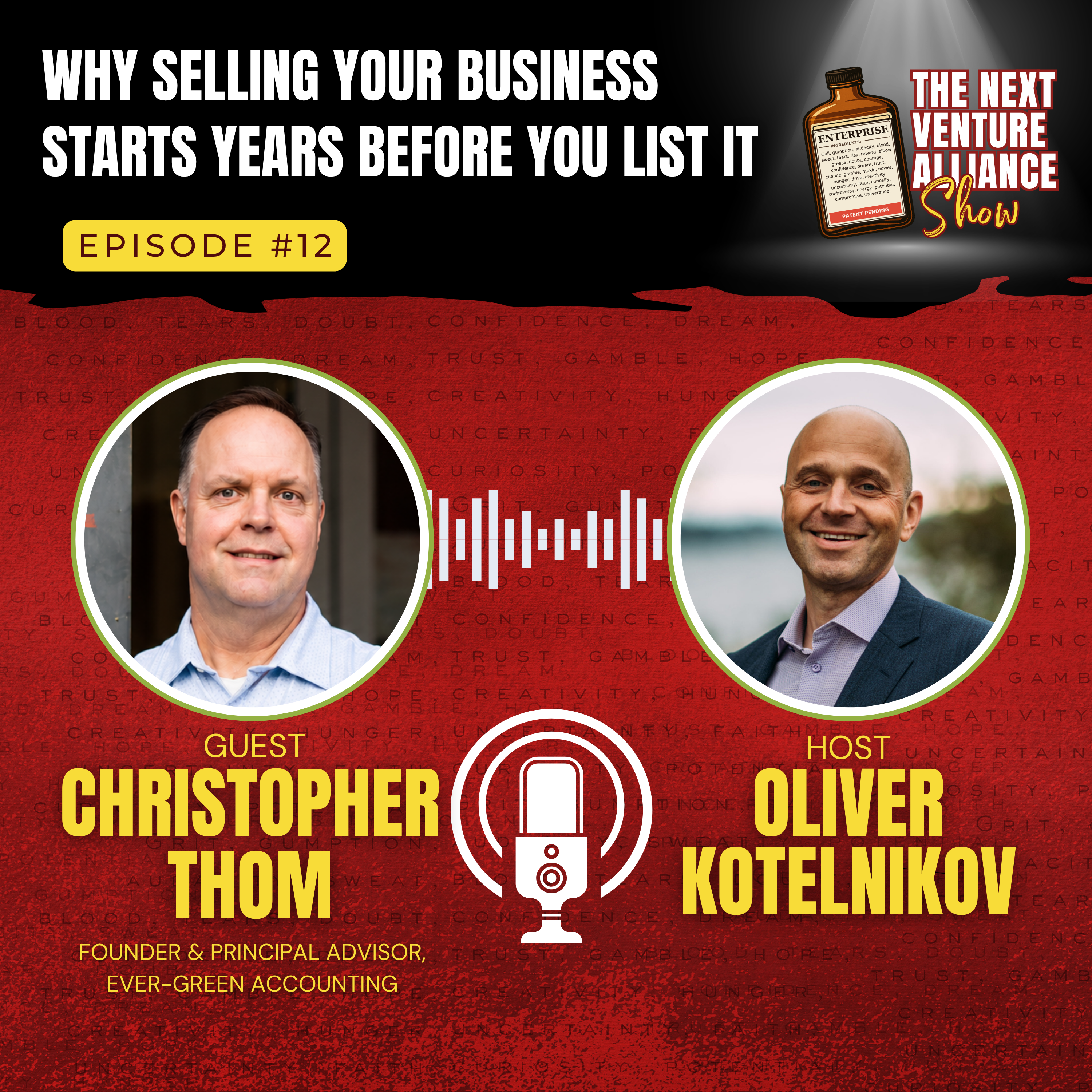
And together we explore both strategic and human sides of entrepreneurship. Our guest today is Christopher Tom, CPA and owner of Evergreen Accounting. Chris and his team specialize in tax preparation, strategic tax planning and advisory services for individuals and business owners. Their work goes well beyond filing tax returns, helping clients make informed financial decisions year round through proactive planning, retirement strategies, business tax optimization, and guidance on complex financial and tax matters. Chris earned his undergraduate degree from University of Colorado and graduated magna cum laude with a Master's in accounting from the University of Notre Dame.
His professional experience includes leadership roles with such well known firms as Paccar, Moss Adams and HKP Advisors.
He's also a veteran of the United States Army.
Veteran of the United States Army. And in addition to his work in accounting and tax planning, Chris has spent years advising business owners through mergers, acquisitions, succession planning and ownership transitions.
He's seen firsthand what separates smooth transactions from difficult ones and what business owners can do years in advance to improve their outcomes.
So today we'll be discussing the role of a CPA in the sale of a business.
Common deal pitfalls, tax planning opportunities, valuation expectations, and why Successful exits often come down to two things, planning and preparation and working with a qualified team of advisors to execute on the exit strategy. Chris, great to have you here. Welcome to the show.
[00:02:48] Speaker C: Thank you so much. It's nice to be involved and glad to give a little bit of background on me and help out in any way I can.
[00:03:00] Speaker B: Yeah. So yeah, I mean you've had a, you're kind of a man of many interests and have had, you know, having an interesting background and biography. I mean, tell us how you, how you got to one to be a CPA and start Evergreen Accounting and what led us to this conversation here.
[00:03:20] Speaker C: Yeah, sure. It certainly was not linear. I grew up in Seattle in the Seattle area and out of high school, didn't really know what I wanted to do and so joined the army and in hopes to sort of grow up quick and was stationed there in Germany for most of my time. Tour left the army after four years, became a government contractor and worked as a mechanic on M1A1 Abrams tanks and worked on Humvees and 5 tons and Wrecker 10 ton wreckers and stuff as a diesel mechanic in Fort Carson, Colorado Springs, where I started going to night school and you know, eventually night school leads to four year college and you know, you end up with, you know, degree. I chose accounting.
I'm interested in numbers, I'm interested in puzzles, but ultimately really just wanted to help what. And what I discovered even later was really loved helping the people that don't enjoy doing certain things. And so, you know, nobody loves taxes. And I found myself helping to solve tax issues and complexities and, and synthesize it down to a conversation that can be understandable.
So got a degree in accounting and I wasn't going to go to get my master's degree originally I had a professor that that was great and talked me into going to grad school.
Got into Notre Dame, still kind of quite sure how, but got into Notre Dame to get a master's degree and then started my career after Notre Dame at Deloitte Tax in Seattle, back kind of coming back home from South Bend, Indiana. So I was at Deloitte for about 4 years working on all kinds of transactions and 10k and stuff for publicly traded companies, very high net worth individuals and so on and got burnt out pretty quick.
You know, after that fourth year it was like, you know, time to kind of rebalance work and life.
And so went to paccar as in Bellevue, Washington as one of their assistant tax managers and did that for a couple of years that got, that was like the opposite spectrum. Whereas, you know, Deloitte is very robust and dynamic and nothing against paccar. It was a wonderful experience but at
[00:06:06] Speaker B: the end of the day ended up
[00:06:07] Speaker C: being kind of routine day in and day out, 8 to 5 and same sort of accruals and you know, issues and stuff that you were tackling from day to day. And I just found myself wanting more and also wanting to help more people, you know, kind of one to one. And so ended up over at Moss Adams doing just that, working small business and being a small business advisor and working with families and such. And then I got into M and A through my experience at Moss Adams and I I spent a great deal of time working with both buyers and sellers, learning what private equity acquisitions were.
Was involved with a company that bought themselves back from their private equity. Knew they, we helped them sell the business to the private equity. And then we were still working with them. And then we actually, it didn't go well. And so we actually helped them buy themselves back from that private equity.
Fascinating, but wonderful group and set of owners. And I still continue and today, and we're about to go potentially into another transaction where they're looking to retire. And they've been, they've owned the business for a good 15 years at this point and, and they'll be looking to sell here in the next probably 24 to 18 months or 18 to 24 months. They'll be looking to sell their.
So, which is really. So then I started Evergreen Accounting. I spent a little bit of time at a company called HKP as a partner about four and a half years. And then I thought, you know, I can do this in a more advanced, innovative way, kind of bring a new light to the accounting profession in hope to be more streamlined and more in depth or have a depth, in depth relationship with my clients. And so I thought, you know, I can do this on my own as a, as a new firm. And so I created Evergreen Accounting about six months ago, seven months ago at this point to do just that.
[00:08:17] Speaker B: So.
[00:08:18] Speaker C: And it's going really well.
[00:08:22] Speaker B: Awesome. Well, thanks, thanks for the, for the overview. It looks like things have kind of come full circle and then you're off to a pretty new exciting chapter. And you know, I know we kind of crossed paths with iba, which is how we met. And I think we share similar philosophy and maybe see the same thing from clients and business owners in that there's a tendency to spend years, sometimes decades building the business, starting the business, building the business and giving it all this time and energy. And then when it comes time to exit, it can kind of get treated as, as an afterthought and say, well, now we're done. We're just gonna list in the spring. And you know, and, and, and, and maybe try to rush through that process. Whereas we try to encourage business owners to look at the process of sale as kind of a comprehensive process. And, and a, you know, it's one part of a larger, make it a plan, you know, one part of a larger financial plan. Include the sale of the business in your overall sort of scheme of things.
And so, you know, to me, that's the difference between a sale which is just transactional. You're selling A car, selling a boat, maybe you're selling a piece of property. Let me just sell the business versus a transition of a business, which is what an asset like this requires in your mind, what differentiates, you know, a simple sale of a business from succession planning and you know, exit strategy.
[00:10:12] Speaker C: There's so much, I think it difference in. And really it's not maybe not necessarily about the numbers which we can get into and we can talk numbers and there's no emotion in numbers. It's just the number.
When you're talking about a sale of a business, it really has to, you know, it's more to do with that business. To the seller, that's their baby in a way. Right. They've built a life around it and they've put time, sweat and energy, tears, successes and all of that emotion in history comes along with it. And so when a seller is selling that and you know, and there's also interpersonal relationships with the team that they've have in the company. And so you want to hand that off and trust that the buyer is going to do right by the company, by its customers, by its employees.
And you don't, as a seller, I would imagine you don't have that level of trust yet.
And so to the buyer it's the number like how much do we have to pay for this company? But to the sellers, they're everything.
And so it's, it's more than.
Yeah.
[00:11:26] Speaker B: And it's, and there can be that gap where, you know, the seller, somebody's selling their life's work in essence or transitioning it and trying to put it in good hands.
And sometimes on the other side, you know, it can be met with numbers, you know, sort of a pragmatic approach and really an investment and a money making widget which can derail as you know, negotiations pretty quickly. And we need to build trust before we start talking about the numbers. I don't think any seller is denying the fact that we need to discuss the numbers objectively, but there is a trust factor here that's probably larger than just about any other type of transaction or transition.
[00:12:19] Speaker C: Yeah. And I think the hope for a seller is to sell it to a strategic buyer. So somebody in their industry that wants to continue to operate and, and keep enough capital in the business for its own internal growth and to support the employees, you know, as compared to like a private equity or a venture capital purchaser that, you know, is looking to have a turn on their investment and to realize appreciation and return on asset, return on investment to their Investors. So there's a different motivation and therefore a different level of trust between the seller and the buyer, in my, in my opinion.
[00:13:01] Speaker B: So it's, it's. What is the role of an accountant or a cpa?
Oh, sorry.
[00:13:08] Speaker C: Yeah, no worries.
[00:13:11] Speaker B: The role, what is the role of an accountant or a CPA in a transaction? Yeah, I, I know we're talking about a team and building a transactional team and you know, they're different. You can have the broker and, and an attorney and there's, you know, lenders and wealth advisors. And what, what is, what does a CPA do in, in a transaction?
[00:13:34] Speaker C: Yeah, so I, I think that the seller needs, you know, from a sailor seller's point of view, they're relying on their CP to help sort of translate the deal into what are, what am I getting? What and what's the number after tax?
And then to help guide them and guide the broker and guide the legal department or the lawyer along with what are the, what are the numbers? What are the risks behind the numbers? So that you can help coach really what, what are they looking at as far as the, after the after tax proceeds? So they know what they're going to be living on after the sale.
So, you know, what, you know, understanding them, translating, you know, helping to translate the, the deal into what, what it is they're selling, how is it going to be taxed? How much am I going to keep?
There are surprises. There's, there are any things in here that, you know, methods of accounting. Are there anything that we, we should do now to prepare the company to sell? And so I think that really the earlier a CPA can get involved with the sale, you know, the better they, a seller can even have their current, you know, CPA firm working the deal. But if that CPA is essentially a tax preparer and not necessarily a tax consultant with M and A experience, they may not, they miss, they may miss things or not know that, oh, well, we can set you up from a tax methods position so that we're able to defer tax, minimize tax, look at the jurisdictions, look at some of the filing positions to make sure that everything is safe so that we're not reducing or diminishing value at the sale. So I think that the CPA's role is multifold, but it really comes down to helping structure, plan and then almost be the middle person between legal and the broker. So that, because we sort of are the pivotal point or pivotal contact between both and to the, to the seller.
Yeah.
[00:15:56] Speaker B: And you know, you touched on an Interesting topic there is.
It's the tendency is always to focus on the money coming in. Right. What's the number again we're back to the numbers. What's the purchase price? What's the number that I'm getting? But the proceeds after tax, you know, are, can, can put a dent in that. So it's kind of a penny saved is a penny earned.
What are some of the things that a seller may not be thinking of that will impact their walking away?
[00:16:30] Speaker C: Number structure. Business structure is one component that we often see having pre selling reorganizations and working with legal to put together a structure that would allow the sale of the same company's operations to help minimize or defer tax.
That, that certainly helps and that can take time.
The other piece too is sellers oftentimes may be say charitably motivated. I had a client a few years ago that tithe 10% of all of their income and we were able to help knowing ahead of time that they were ready to sell.
We were able to help structure an ability for them to tithe their S corporation stock prior to the sale closing so that they were able to get the value of the sale on that stock as a charitable donation without having to pick up capital gain in their taxes for the sale of that portion of their stock. So you know, it saved them, you know, well over a million dollars based on that ultimate sale price. But they were, it saved them well over a million dollars in capital gains results of that churn. That's a,
[00:18:03] Speaker B: I mean that's a tangible number, right? You saved seven figures.
It didn't come from the buyer, it came from how. From tax treatment, correct?
[00:18:14] Speaker C: Yeah. And being knowledgeable ahead of time. I'm working with a seller now and they have had years of, of losses and they've got, you know, everything passes through because it's a, it's an S corp. Everything passes through to them. But they have years of accumulated loss carry forwards on their personal returns. And so helping navigate through structure and purchase price allocation, which is something we haven't talked about yet, but through that, helping them understand what the taxes are and if there's any planning opportunities prior to them, their exit, paying off debt, things like that, you know, getting into working capital and that helps with purchase price allocation. There are lots of little concepts that can help on that end.
[00:19:07] Speaker B: And again it all comes down to planning. And we can get into terminology here shortly and some key concepts, but some of these things that you're discussing, they're difficult to problem solve under the pressures of a live Transaction in the deal room, when the seller is introduced to some of these advanced tax concepts down the line, when they're, you know, trying to negotiate a purchase and sale agreement and learning about this in the process, that can be a lot to handle.
There is really no need to, I mean, all of that can be done in advance.
I mean, we don't even need to have the business listed.
You know, oftentimes we work with sellers, we start with an evaluation, which is a detailed document outlining the, you know, the fair market value of the business, you know, based on that document, even if it's in a range, you know, you could model tax outcomes prior to listing the business, helping the seller based on that evaluation, model their exit proceeds, their retirement investments, et cetera.
And again, all of that is much better accomplished, you know, without the pressures of a live transaction.
[00:20:36] Speaker C: You're, you're absolutely right. And, and in. On top of that, when you're in the middle of the transaction, there's a lot of hurry up and wait.
But if you're ahead of time, you can, you can adjust and you can plan for, you can set expectations.
And then, you know, then as a advisor, then, you know, it really helps because you're able to meet those expectations. You know, nobody likes, no seller likes a surprise at the last second that, hey, if we would have structured this differently, you would have saved a couple hundred thousand, you know, a meaningful number of money. So, you know, there's certainly opportunity to get in front of things when you're not in the middle of a transaction. When a seller wants to, you know, wants to make sure that they have everything checked off and that everything's there. But a buyer wants to get the keys to the car.
And so there's a lot of, you know, hurry up and, you know, let's get this thing closed so that we can take over.
Seller wants to make sure they've got all of their ducks in a row so they're not leaving money on the table.
[00:21:46] Speaker B: Yeah. And, you know, I would say tax planning especially is one of those items that really benefits from early stage planning.
Because if you don't understand something, you have the time to, you know, to ask for advice and learn about it and make sure that you do understand it without there being a deadline for X, Y and Z, which a transaction is always a series of deadlines, Right. That sometimes they can be extended, but it creates pressure. So how early should a CPA be involved? How early should a business owner be talking to their cpa? If a thought of succession, planning and transition and selling the business has entered their mind. When's a good time to talk to your cpa?
[00:22:38] Speaker C: You know, I've, you know, the standard is right as early as possible. But realistically, a good CPA and a good advisor should be having that conversation and checking in annually. They should be, they should, sorry, they should be getting in front of their client and having that as they check in throughout the year or, or at least, like I said, at least annually to every year and a half.
If it's a new relationship, you know, I would say that, you know, with not less than a year, you know, you want to be in the middle of the transaction or, or saying, hey, how do we do? Like how do we close? How do we do? Like you don't want to be having it then like, you know, so I would say 12 months to 18 months prior to a transaction. If your CPA hasn't brought it up and asked you what your planned exit is, then you know, if you're starting to contemplate an exit a year to a year and a half prior to, so that you have one ability, one planning period to adjust if you can structure and methods of accounting, you can adjust for that one filing period before you actually have that potential exit is really helpful if you can get like a method change from, for example, if you're, you know, an accrual method of accounting and it would be better for you to be cash method or vice versa, having one year behind you to say I've, I've made that transition and now I'm filing under this method. You know, oftentimes a buyer wants consistency and so in a sale, so buyer is going to say through their deal and the documents, they're going to say, okay, you know, you're going to treat your taxes and you're going to treat your accounting in a consistent method that you know, we put the LOI to you, you know, under. So that could change the, the economics of the deal if you're not able to do company level planning because you know now you're in the middle of the transaction. So
[00:24:49] Speaker B: yeah, and some of those changes again we're back to time. And then planning and preparation can take a long time to implement and to take effect and, and to be of benefit. Right. Sometimes we can come to under, like you said, we can come to understand a deal term or a concept, but all it does is create frustration if it says, well I'm glad you understand it. But if you understood it two years ago and did something about it, that would have actually saved you money for now. We got to move on. Right? That's a, that's a frustrating bit of news to, to receive. I mean, it almost doesn't help you.
[00:25:24] Speaker C: Absolutely. You know, the best, the best situation is I had a.
Several years ago, I had a very large doctor practice with multiple offices.
They came to our firm and said, we're looking at selling 100-year-old doctor's practice. We're looking at selling, and we think we're going to close in two years.
And by the way, we have three possible buyers. And so they looked at our tax team and said, can you help model? Here's three, Lois. It was like the best graduate school level, like, project ever. It was. Here are three buyers. Here's three, Lois. With three different terms under the loi. Can you please let us know what each of our owners, you know, we're talking about a hundred owners, what each of our owners can expect to receive on their final paychecks and on the final sale of the company, and to be able to take that model of that for them, come back to them with, you know, buyers 1, 2, and 3. And by the way, we're also going to look at some methods and we're going to look at slowing down depreciation so there's less recapture these little things.
We were able to carry that out all the way through and help them with the sale of the company and then filing final tax returns. We filed their final bonus W2s and, and then all the way through an IRS examination and with, you know, fortunately, you know, no adjustment by the IRS agent that reviewed that transaction. And so I look at that as like the ultimate success from an accountant's perspective. That's like, to be able to go from an evaluation of a, of a buyer from a seller's point of view and then carry that all the way through to two and a half, three years later to say, okay, we've concluded that final audit from the irs, and there's been no adjustment on a, a deal that was about $125 million. I mean, that's, it was significant and it was meaningful to each of those owners.
And, and to be able to take that, you know, and see sort of your, the, the, the resolution, the completion of that all the way through to the end was really remarkable.
[00:27:42] Speaker B: Yeah, and you're right, that, that is a perfect case study that illustrates exactly what we're talking about here.
But one thing I'd like to touch on and something I do, you know, as part of this podcast Is education and education in terms of.
We assume that everybody knows what terms mean and everybody has the same understanding of them. But so often even professionals don't. Or they're coming, you know, they're kind of wearing a different hat. And so in terms of accounting, you mentioned tax allocation. And I'll just ask him in a very rudimentary way, what is tax allocation and why is it important?
[00:28:25] Speaker C: Yeah, tax allocation is a concept where you're taking the purchase price of the, of the company that end final price, and you're carving it up into what the buyer actually bought.
So if I looked at it like, in terms of, you know, if I go in and I.
If I go to, you know, Nordstrom Rack and I buy, like, clothing, I bought shirts, I bought shoes, I bought pants. Purchase price allocation is similar. I bought accounts receivable. What are my assets? Right. I bought accounts receivable. I bought some trucks, I bought computers and equipment.
I might have taken over their leasehold improvements.
There's various things on their, on the seller's balance sheet that I have to carve up because I might have paid $10 million for the business, but $3 million of that was my purchase of accounts receivable, which leaves $7 million left to go. Okay, well, what else did I buy? I bought, you know, I bought trucks and forklifts and, you know, manufacturing equipment.
If I'm a, you know, if I'm buying a restaurant, I bought kitchen equipment, you know, so I look at all of that and I go, what is the value of the items that I purchased? Inventory is another one that, you know. And a buyer is going to come in and say, it, well, depends on the motivation of the buyer. But the buyer may come in and say, we want to value inventory at the price that you have. And the seller's going, well, but I intended to sell this for more than I paid for it. And I put my inventory in my books at cost.
A seller or buyers might say, well, we want to show that we're really profitable from the get because we're a PE firm. And so we want to have ratios that show that we're really profitable and that the return on our purchase, it was, was great out of the gate. So you have a differently motivated buyer than somebody going, I want to explain
[00:30:25] Speaker B: what the difference is behind, like, what motivates them differently. What's the difference between a hundred thousand dollars, a million dollars, or $500,000 of goodwill versus a million dollars of equipment?
Why, why does that matter to me as a seller?
[00:30:42] Speaker C: Seller is if the seller sells their inventory at a higher value than their cost, then that's ordinary income at ordinary income rates. So anything allocated to their ordinary income bucket, it, it may have a higher tax bracket than, than buying goodwill or selling goodwill because goodwill has, you know, oftentimes long term capital gain rates and long term capital gain rates, you know, can be 20% at the high bracket. Currently you can get into whether or not there's you know, other taxes on that like net investment income tax. But 20% flat is the long term capital gain rates. Now we live in interesting times in Washington state. So Washington state has its own capital gain on long term capital gains. So you know, you may, they may be paying 20% at the federal level but oh boy, there's a, no, potentially a 9.9% rate.
[00:31:47] Speaker B: That's. Yeah.
[00:31:49] Speaker C: So maybe it is beneficial now in new times to sell inventory at a higher profit at you know, 37% or whatever because of qualified business income deductions and stuff. I'll just say like call your CPA because they're going to run the numbers and they're going to say, well what's more beneficial? You know what, it's actually going to be more strategic and beneficial from a tax perspective to have higher profit in your inventory because the net impact of selling inventory could be 30% after net or after the qualified business deduction versus a, you know, call it 30, 30 point or whatever, 9 I guess would be 29.9% what have you if you're adding carry forwards and stuff like that in there. So it's no big, no deal is one size fits all. But those motivations, the CPA is going to be able to carve out and say it's going to be more beneficial whether it's long term capital gains or ordinary income bucket.
[00:32:51] Speaker B: Because those tax, because those buckets where we put the, the, the purchase price dollars are all taxed differently. Right. If we have $10 million and putting 2.5 million in each of the four buckets is going to result a different net proceeds than putting 75 in one and 25 in another.
[00:33:12] Speaker C: And you don't ever know there's no deal that's one size fits all. And this year's answer is going to very well be different than last year's answer or next year's answer. So just because of tax carry forward basis adjustments, there's, you know, different jurisdictions, you know, maybe you were never in California and now you are.
So you know, there's just different things that you have to think about.
When it comes to, you know, the sale of a company. So, and you know, and we haven't, you know, then there's also. That's a purchase price allocation is a, is a asset purchase, asset sale concepts. But if you're selling the company's equity, you know, if you're an S corp or a C corporation, you're selling the company's stock, then purchase price allocation is sort of not even relevant because you're just selling stock at the basic thing of that. So it's not going to even be relevant from a, from that aspect.
[00:34:13] Speaker B: And we can touch on the asset versus stock sale here shortly. But you know, one other thing in allocation that can impact things in deal environments is kind of the legislative environment. What tax laws are being passed like, you know, on tax allocation as of late, buyers are just clamoring to allocate things, to allocate as much as possible to equipment because of certain accelerated depreciation benefits. Right. That's the bucket that allows them to.
And that's, it's been contentious lately. You know, we need to allocate a fair market value to equipment and vehicles.
But a buyer in this tax environment wants to put more in that bucket because they get a write off. So, you know, knowing that, knowing somebody's motivations, you know, and the intent behind the ask somebody saying, look, we want to put this outside, you want to put this on inventory, we want to put it on, you know, vehicles, furniture, fixtures, equipment and vehicles. E. You know, why is that? And oftentimes it's dictated by, you know, absolutely.
[00:35:28] Speaker C: And you know, and buyers can get, you know, they can forget that. If you're buying equipment, you know, you got to remember that, you know, in Washington, you know, we're, you know, often 10, you know, almost 11% sales tax. So if I'm buying equipment, I got to pay sales tax to Washington state on that. So does it make sense as a buyer to, you know, add 10% on the cost that's not going to the seller. It's going up to, you know, Washington for sales tax.
So all of those factors get factored in and structuring can help.
Often it can help a buyer if a seller is, you know, selling, you know, things that are legally an equity sale, but for tax purposes, a stock sale or an asset sale, you know, then Washington may say, well, this is a purchase of an intangible and so it's not subject to sales tax. So there's, there's benefits to structuring, not just the seller, but there's benefits to structuring the company. So that impacts the, you know, reduced tax from a buyer's perspective for to save on sales tax and still get the benefit of step up in the basis and purchase price of equipment and stuff without worrying about sales tax.
[00:36:44] Speaker B: I mean, so both sides are doing the tax math in addition to, you know, again the tendencies to focus on the purchase price and the doll dollars being spent in the versus dollars coming in. But what happens to them afterwards? Right. They both have to report that sale identically to the IRS and that they both have to agree to that tax allocation schedule. How will those numbers be taxed, depreciated, et cetera is a first order consideration.
[00:37:14] Speaker C: Yeah. And in a nutshell, right, A seller generally, up until Washington introduced capital gains tax, the seller would generally want to sell its, its equity. They want to sell their stock, whereas a buyer wants to buy assets. So they get a step up in basis and be able to deduct depreciation and stuff like that on and including goodwill. You know, if it's a stock sale, a seller, you know, they're getting capital gain treatment but the, the buyer doesn't get to depreciate any of the goodwill or intangibles.
But if it's an asset sale, then whatever goodwill is allocated in the deal, they get to take at least a 15 year recovery on their allocation to intellectual property.
[00:38:00] Speaker B: So we're onto the kind of that next topic of asset versus stock sale which is another one that comes up all the time. Right. And sometimes doesn't get discussed early enough or often enough and is, is then introduced into deals by parties that haven't consulted their tax professionals saying you know, we'd actually, we'd like, actually like to change the deal structure because we've learned X, Y and Z.
You know, that information was, you know, probably available the whole time if they wanted to do some early digging. But talk about the difference between stock and asset sales. What is the main difference between those two deal structures?
[00:38:42] Speaker C: The key difference is the diff, you know, the difference between capital gains and ordinary income through allocation of assets, the purchase price to assets. So that's, you know, that piece alone is the key significant difference.
You know, you might say that the stock transaction or equity transaction has some legal baggage to it. You know, if a buyer is buying the company's equity, they're buying all of the legal issues.
So diligence can be really can be
[00:39:23] Speaker B: delayed or which gently shifts it to the legal. Right. You know, you have the whole tax issue here and then there's the liability issue between stock and asset sale. But they're sort of different. But both equally important.
[00:39:38] Speaker C: Yeah, I mean, yeah, exactly. A stock deal, the buyer is buying all of the history and so whatever statutes are behind it, they're adopting and so reps and warranties and all these things on the legal side become applicable.
The benefit of it though is that things like contracts and ein, like numbers and stuff like that. And I deal a lot with the aerospace industry and the FAA can take aerospace manufacturers and say, you know this, they want to have an existing company with their, with their filers. And so, you know, if you're dealing in aerospace manufacturing, retention of the EIN is significantly significant.
[00:40:22] Speaker B: And what is define ein?
[00:40:24] Speaker C: EIN is your employment identification number. So it's your employer number. It's the Social Security number for the business, essentially.
[00:40:34] Speaker B: Good way to put it.
So everything that's. So in this case, in the stock sale, if they inherit the ein, everything that's attached to it, lucrative contracts, talent, employees, agreements with vendors, all of those sorts of things transfer with that EIN number. If you're doing an asset sale, the company is essentially buying the assets of the company, but not the entity and everything that came with it. So they would have to restart all those.
[00:41:08] Speaker C: Yeah, exactly, exactly.
So it can be, you can know, that can be a good thing, you know, but the benefit to a buyer is that step up in basis. And there are hybrid deals that allow for, you know, restructuring so that you can, you can set it up that way so it's treated like an asset sale, but not for legal purposes. It's still an equity deal, but vanilla.
When you're buying assets, I, I start up my own new company with my own new ein, and I go to the seller and I say, I'm going to buy your equipment and I'm going to buy your workforce and I'm going to buy your AR and so on. But each of those things have a price that I'm paying for and then whatever's left is goodwill.
[00:42:00] Speaker B: Talk about basis. So what is basis and depreciation and why is that important?
[00:42:07] Speaker C: Basis in a nutshell is the after tax dollars that you have in the business that you can recover when you're figuring out your gain.
So if I, I look at it like if I bought my house for 500,000 and then I sell my house for 600,000, my basis is 500,000 because that's what I paid for it.
And then my profit is the difference between my sales price and what I bought the company or model.
[00:42:35] Speaker B: If none of it has been depreciated.
Right. Assuming that it just stayed.
[00:42:40] Speaker C: Exactly. If I depreciate my purchase, then I'm reducing my basis. I'm reducing the purchase price because I'm able to then benefit from the deduction of the cost as I'm recognizing depreciation over the period of time that's been allocated to that asset.
So if it's a. If it's commercial building, I have 39 years that I can depreciate my building for.
And so whatever's left, If I'm, say 20 years into that building, I've got half of my basis remaining. If I bought it for, you know, essentially a million, then I've got $500,000 left that I can recover when I sell it. But the difference between what I originally paid for it and what I have left to recover, that gets recouped or recaptured. It fills the bucket back up to my original purchase price at essentially, we'll say ordinary rates. It's. Real estate's a little different, but essentially you have to recoup that because you took a deduction for it over the years.
I have to fill the bucket back up at the tax rate, the ordinary tax rate that I benefited from it before I start recognizing capital gains on top of that.
[00:43:53] Speaker A: That.
[00:43:56] Speaker B: So some in. In a deal, you know, setting aside some advanced deal structures that sort of shift the deal from one to the other for tax purposes, the benefit of an asset sale is that the. That the buyer buys the assets, gets the new basis, essentially what they paid for it again, and then gets to take that write off over 10 years or a shorter depreciation schedule, whatever the law.
[00:44:26] Speaker C: Yeah, well, in the buyer right now, in this legal regime, as you mentioned earlier, they get to take an immediate recovery of all of the equipment.
You know, everything up until and including, potentially including the lethal improvements, they just get to write it off. So if I buy a business and all of my purchase price is allocated to the equipment, I might have paid $2 million for my equipment, but the buyer gets to take that $2 million and just expense it, essentially, kind of
[00:44:55] Speaker B: like an immediate 179. You just. You just write it off.
[00:44:58] Speaker C: Exactly.
[00:45:00] Speaker B: So, yeah, so that's the. I mean, so there's, there's great motivation there to allocate the purchase price to areas that create the most tax benefit and knowing what the law allows
[00:45:18] Speaker C: at
[00:45:18] Speaker B: the time of the transaction.
[00:45:19] Speaker C: Yep, that's exactly right.
[00:45:22] Speaker B: Yeah.
So some other concepts that are sort of in and out of deals a lot and become prevalent and sometimes contentious Working capital.
You know, my experience has been that working capital started somewhere in the middle market and above, you know, a few years ago and, or has always been there and then has slowly trickled down to smaller and smaller deals where it's sort of borderline, not applicable or not applicable at all sometimes. But. But what is working capital? And why is it part of a conversation when a company's being bought and sold?
[00:46:04] Speaker C: Yeah, you know, working capital is. It's confusing even for people that do transactions all the time because it's defined as a part of the deal, as what it is. And so deal number one is going to have a different concept of working capital than deal number two.
Ultimately, I think the textbook definition of working capital is the amount of fuel in the tank of the company that you bought before it's asked. Because you're buying assets, you're buying something. You know, an asset is something that's going to generate a future benefit. And so, you know, you want as a, as a buyer to know how much, how quickly that asset you're buying is going to turn itself into a benefit, into cash.
And so it's the fuel in the tank that will allow the company to operate because the payables, the debts and bills and purchases of inventory are happening. And you're buying the business, whether it's an asset sale or a stock sale, you're buying a company that's operating. And so now you can just shut everything off and say, okay, we're going to collect all of our cash and we're going to pay all of our bills and then we're going to start,
[00:47:23] Speaker B: take all our receivables.
[00:47:25] Speaker C: And so you want to make sure that you have enough fuel in the tank to allow the company to operate and not have to, as a, as a buyer, not have to inject new cash into the company so that it can pay its own obligations. You want the company you just bought to be able to turn its inventory and receivables, convert that into cash so that you can pay your utility bill and your employees and the various payroll taxes and the rent, everything else they bought. So, you know, the, I think the textbook definition is like current assets that are, you know, current assets, less current liabilities is the working capital.
And essentially the deal says that I, I put a letter of intent out there an loi. I put that out there to the seller, and I say, I intend to buy your business for an amount.
But it's assumed that within that amount is enough capital in the company, enough cash and current assets to cover its liabilities until the next dollar after that amount, whatever that is usually called the peg or the target, is to say that the next dollar is now earned on the assets that I bought as the buyer. And so there. It's contentious because so many times the smaller market, they don't keep their books on what we call an accounting accrual method. They don't keep it on accrual, where you're recognizing receivables and payables and debt on lease obligation and right to use assets. You don't think about those concepts as a small business, usually your cash and disbursements accounting. And so when you get the cash, that's when you recognize income, and when you pay the bill, that's when you recognize the expense.
But the buyer is coming in going, well, but we have purchase orders on the books. We know that we're selling this much. And so we need to recognize that maybe as a receivable, but we also know that, you know, the utility bill is due from last month, and so that's a payable, and they need to know what that number is. And so because it's not tracked, it can be really contentious on what the target peg is, and then it can be contentious on what those numbers are on the day, because everything's estimated.
Transaction using, you know, older balance sheets and income statements. Everything's sort of estimated, and then there's a closing date.
And so then that gets sort of locked down to say, like, here's. Here's what the number is.
I always think of it, and then I'll. I'll stop talking about it. I always think about it as if I'm.
If I'm a buyer and I'm going out to purchase, you know, car, there's some assumptions I've made and I've gone out and I've looked at, you know, Kelley Blue Book or whatever. I'm like, okay. Like, I know that, you know, I assume that I'm buying a motor and seats and a steering wheel and tires. I am assuming that. But those are the tangible assets. I'm also necessarily. I'm assuming that the tires are inflated. I'm assuming that if I'm buying a car that there's wiper fluid and that there's transmission fluid and there's a full fuel tank. But if my seller that I bought this from delivered the car and the tires are flat and, you know, the. The fuel tank that we agreed to, like, hey, I agree that in this car, it's going to have a full fuel tank and it comes to me empty, then I have to go put my own money in to go to the gas station and fill the fuel tank. And so I'm going to adjust my purchase price because I assumed this you, you kind of represented that you were going to sell me it with full fuel tank and I don't have to inject my own money to go fill it.
And, and so I'm going to adjust the purchase price to that peg because the delivery of that asset to me as the buyer is different than my assumed or my agreed upon understanding
[00:51:26] Speaker B: is would a rental car analogy in the gas gauge when they say you're going to work as, as a sort of a true up mechanism to say you're going to, you know, we're going to give you this much gas in this car when you rent it and you need to bring it back with the same amount of gas.
[00:51:45] Speaker C: You know, it's, it's. I think it's good. On the rental car analogy, the only caveat is that if you receive the rental car with half a tank and that's what you're agreeing to bring it back on. But then me as I can't guess how much fuel I'm going to have to target or peg that half a tank, I might have filled it and brought it back with a full tank of gas. You know, oftentimes the rental car company is not going to go, oh, you filled it and we gave it to you with half a tank. We're going to pay you the difference in a working capital analogy or metaphor that it works the other direction. We, you know, if a seller sells a company with a peg that set. But the reality is that there was more receivable and there was more cash on the, on hand at the date of the acquisition than the peg.
The buyer gets an adjustment in their favor. The buyer gets to take a little more back.
And so, you know, it, it.
Yeah, sorry, the seller gets more back after the, the adjustment.
So it works really well because it's, it's fair to both sides.
It works out. Right?
[00:53:02] Speaker B: Yeah. No, and it's, and we're talking about it because it seems really simple. But, but, but you know that in every deal, you know, everybody interprets it. People understand the deaf, you know, what, what it means. But there's, it's interpreted differently and sometimes depends on which side of the transaction the advisors are on.
You know, they're kind of wearing that hat and, and as they should being fiercely protective of their clients.
But it's really, you know, it's how much money needs to stay in the business to keep it operating at the profitability and kind of operational stability that we've agreed to. You know, in the evaluation and the contracts how much money needs to stay in it without me bringing additional capital into it on top of the purchase price.
Is that sort of the philosophical view on it is that a buyer deserves that to be included in the purchase?
[00:54:08] Speaker C: Yeah, I think that if that's what the agreement has been, that the built on the LOI is that they've agreed to have this amount left in the company so that it can run on its own fuel without the buyer putting more money in.
Where I see the biggest heartburn in my experience are longer term contracts where customers provide a deposit.
Because a deposit oftentimes in the cash method that became revenue, that became income when it was received.
But maybe the work still needs to be performed.
And so if a, if a, you've got a longer term contract construction is often that way. So if you're buying or you know, selling a construction company and your, your customer's giving you 50% down for a custom home, then you know that's a liability to the company technically under normal methods of accounting. And so the seller can go well I got that cash. That's cash to me. It's not part of the peg.
But the buyer is going to say well this is a liability. So yes, you got the cash but I have to go and perform the work as the buyer. And so there's a grub. Just because cash in hand is to a seller is going to be worth more than the liability.
And you're also assuming as the, the, as the seller, you're assuming well you're not going to run the company as efficiently as I was able to run the company because you're new to this company and so you're putting more liability on the deferred revenue side than I give you credit for. And so that can become an argument.
[00:55:51] Speaker B: So I've seen that as well. And, and it's good that we're defining this is, is, is that sometimes the seller can they have the deposit. They're saying hey I'm giving them these deposits.
This should be some kind of credit to me. I'm handing over cash.
But really it's just a deposit. No work has been performed. It's actually a liability.
They have this cash but they owe performance. They owe the deposit was given to purchase materials secure some maybe labor ahead of time, some administrative overhead associated with like let's keep, stay with the Construction, but site visits and planning, utility locations, et cetera, those types of things.
None of that has been done yet. I already have the money I owe this performance.
So really what you're handing over is, yes, you're giving them the, the cash, but, but you're handing over a liability. So understanding which side of the fence, what the assets and the life, what you're transferring falls on, is it an asset or is it a liability? So, you know, defining those in the working capital, and we're getting kind of into the, maybe the work in progress a little bit and how that's calculated, but again, we're back to definitions because there can be just, hey, I'm giving you cash and it's like, no, you're giving me responsibility and liability.
You know, who owes who here.
[00:57:27] Speaker C: Yeah. And, and you know, often that can be negotiated. And, and there's oftentimes, as you've seen, I'm sure there's a adjustment period. And so you can say, well, what do we actually realize? What was the actual profitability of the deposit after the work was performed?
And so oftentimes, if the deal closes and then 90 days later or something, there's an adjustment where we can reflect back on that closing date and what the true assets and liabilities were and adjust accordingly so that everyone's treated fairly.
[00:58:05] Speaker B: So let's talk through that. We said the peg and the kind of the initial agreements are based on assumptions, largely. Right. We've made assumptions that we believe to be in the range, but we do have a Runway in the process for testing those assumptions and make sure that assumptions are, you know, ultimately turned into facts. So when does that happen?
You know, what is a true up and how does it work?
[00:58:36] Speaker C: Yeah. So so much of the deal is built around that working capital peg, which has many assumptions and estimates in it because the world is moving all the time. And, and so the. You come up with that estimated peg, the peg is agreed on and you. That usually doesn't move the peg is. It's exactly that. It's how much the buyer assumed needed to be in the tank. And you guys agreed as buyer and seller, it's part of your deal. And that was the, the, the peg.
[00:59:09] Speaker B: So let's say a purchase price of a service company of $3 million. And we're saying $400,000 of working capital needs to be included.
[00:59:24] Speaker C: Yep. And so. Right.
[00:59:26] Speaker B: So something like that, just to put numbers on it. So we've agreed it's going to take us 400,000.
[00:59:31] Speaker C: So let's just let's just say, and we'll just use very.
Keeping with being simple, like, and so if that 400,000 of working capital is receivables and there's no debts that you've assumed, we'll just say that there's a receivable on there. You're going to collect 400,000 within whatever certain amount of time at the date, but as of the date of close.
So that might be based on some estimate of a number of a list of various customers that owe the company money.
Well, possibly. Right. One of those receivables came in, and part of a deal, typically is that the seller will flush cash. They'll pull all the cash out of the business.
And so usually it's like they call it cash free, debt free. And so cash gets stripped from the business the day of close or the day before close.
And then unbeknownst to anyone, well, before the deal, one of those payments came in.
And so one of your distributions was on one of those receivables. So you had 400,000, but one of your customers happened to pay the day of close. And you, as part of that flushing out, you pulled that money out. So you might have pulled out, say, 50,000 that you received in deposits.
So now your adjustment, or when you look at it backwards and you're like, you know, it's all spelled out in the agreement. It can be 60 days, 30 days, 90 days, it doesn't matter. But when you look at that adjustment,
[01:01:05] Speaker B: that's the true update. That's the time after closing that we agreed to revisit.
[01:01:09] Speaker C: Exactly. You revisited it and you went, okay, well, I looked at the receivable, and buyer was supposed to get credit for 400,000.
The day before close, 50,000 of it was paid. So the receivable was actually 350,000.
You took that 50,000 out of the company at close.
[01:01:32] Speaker B: So by when you swept cash, that
[01:01:35] Speaker C: 50,000 that you stripped, because we were supposed to have that as fuel in the tank to pay our bills.
And so that adjustment period happens. And then in this case, right. Seller would pay that back to the buyer.
And that's very common. That can happen.
You know, flip side, you could end up having a sale like, you know, last half of the month. You had a great month the month before the sale. And what it allows for is the seller to not be motivated by slowing down sales.
[01:02:15] Speaker B: Right.
[01:02:15] Speaker C: To not go, oh, we're going to slow down collections or whatever, you know, and we'll, you know. So it allows comfort to a buyer to say, Continue to operate the business as you always would and don't accelerate or decelerate bills or payments or collection or anything.
[01:02:34] Speaker B: Right. Business as usuals all across.
[01:02:37] Speaker C: Exactly. And, and so it allows for that, that ability to be stable and not be hinky with the, you know, with the operations of the company up to, up leading up to the sale and the closing date
[01:02:54] Speaker B: because of, you know, under, you know, understanding deal mechanics, you know, and having both sides, you know, act in good faith and, and as they normally would without trying to, you know, manipulate some of these closing mechanisms that, that, you know, you did mention cash versus accrual and, and kind of recognizing revenue and when things are, you know, when money is collected versus when it hits the books. I mean, all of that can, can really skew numbers depending on how you reported. I mean, talk about the difference in another concept of cash versus accrual and why that's important.
[01:03:40] Speaker C: Well, you know, cash versus accrual, you know, in the, typically there's, if you're a seller or a small taxpayer getting away from just selling a business a little bit, there's a simplicity to cash method of accounting. Because I'm paying the tax that I would pay as I, as it follows the cash I collect, I deduct the expenses as I pay those expenses.
So it's not necessarily based on when I earned the income, it's based on when I collected the income and it's not based on when I.
[01:04:22] Speaker B: So when you get the cash or when you get the bill or when you pay it cash in, you record it, cash out, you record it. That's what it is.
[01:04:33] Speaker C: Exactly. But it doesn't recognize the receivable, the amounts that I've billed my customer and I'm waiting for payment because the bill is when I earned it usually. So if I'm billing my customer, you know, typically it's when I've earned that
[01:04:54] Speaker B: revenue and so the job is completed, I've finished everything.
You know, you have the project, the deck, the house, you know, whatever it is, the backyard.
[01:05:06] Speaker C: Yep, exactly.
[01:05:08] Speaker B: That balance is now owed, but exactly.
[01:05:12] Speaker C: And so that's what I can expect to collect. So if I'm an accrual method accounting business, then when I have built, say my customer and I've earned, the project's done often right as we get from, you know, going to the doctor, whatever, I, I get a bill and the bill is going to say you owe us in 30 days.
And so if I'm, if I'm accrual, when I sent the invoice out, I'm going to recognize that as revenue, and I'm going to put a receivable on my books. If I'm a cash method, I don't put a receivable on my books. And when my customer finally pays me within 30 days, hopefully I collect the cash and then I recognize the income.
Same thing. If I, if I get a bill from the utility company and it says, you owe us in 30 days, you know, for the, you know, utilities that you consumed, you know, last month, then I would recognize that as a payable and I would recognize the expense. If I'm accrual, if I'm a cash method, then I don't recognize the expense until I pay it.
If, if I'm a buyer, I don't know if I, if I didn't do any checking and I just look at your balance sheet. I don't know what's coming in. I don't know what you've built. I don't know what you're. What to expect in terms.
[01:06:40] Speaker B: You won't know about it until it comes in. Right. You don't know that there is this other job, essentially, that, that you completed and the revenue is due to come in.
[01:06:51] Speaker C: Yep, yep. Exactly.
[01:06:53] Speaker B: When it hits the mailbox, that's when,
[01:06:55] Speaker C: you know, and I guess, you know, in one sense, if I'm buying, it can be more simple, like if I'm depending on the industry. Right. If I'm. If I'm buying a restaurant, you know, the cash collected that day is typically what you received that day. And so cash or accrual, there's probably very little difference in a cash.
[01:07:17] Speaker B: And your inventory is essentially your working capital. Right. In that setting, in a retail setting, there's probably not a large payable or a large receivable.
[01:07:29] Speaker C: Exactly.
[01:07:30] Speaker B: It's. It's a business.
Business model, you know, business model specifics kind of dictate, you know, what, what accounting methods are appropriate?
[01:07:43] Speaker C: I think so. Yeah. I think so. And if I'm. If I'm retail, if I'm, you know.
[01:07:47] Speaker B: Yeah.
[01:07:48] Speaker C: Restaurant, you know, I, what I collect that day is my revenue, and I don't have a lot of receivables on my books. If I'm in construction or if I'm. I might have a lot of deposits on my books. And so those, like, as we talked about, those are liabilities.
I got a bunch of cash, but I have a bunch of liability. And if I'm, if I'm cash, then maybe I'm not recognizing the liability. And I've recognized The income.
And so there can be a big difference depending on the industry. Manufacturers are that way.
Manufacturers sit on a lot of inventory, raw materials, finished goods and stuff. And so, you know, is that inventory expensed? Are they supplies that you've expensed? Because if you remember as you before a sale, typically a seller is going to be motivated by deductions. And so they're going to go, I want this inventory. But I, because I'm a small business, I can expense my inventory.
And so you might not, you might not have, you know, as we've talked about, basis of that inventory because you've expensed it already.
And so, you know, cash and accrual can be significant to a seller in knowing what they're selling and then what the buckets are that you're putting the allocation of the purchase price. It all kind of fits together.
[01:08:59] Speaker B: It's a, that's why I like what ties together.
Yeah.
You know, and oftentimes it's accounting standards that sort of dictate how, how the reporting takes place. So we often see the term gap accounting. And that's probably, that's another thing that, you know, another term that can enter a deal, a smaller deal. And then the reality is that, you know, up to a certain size, the accounting is, you know, it may be QuickBooks, it may be on the up and up, it may be all legal, but it's more in line with how it works best for the owner and for the business and for the customers. And, you know, historical practices versus here's the standard of compliance that we all adhere to. What is GAAP accounting and when does it really enter the equation?
[01:09:55] Speaker C: Yeah, GAAP accounting is the terminology used by our industry in general accounting to, to simplify it down, you know, you can say it's the, what is the standard accepted accounting principles? So it's generally accepted.
[01:10:14] Speaker B: Okay.
[01:10:14] Speaker C: There's different accounting principles throughout the world, so there's international accounting standards as well. But for us, it's, it's basically the US's definition of what company, what we've all agreed as an industry are the proper accounting to represent the balance sheet and the income statement. And, and so it allows for different businesses, no matter what industry, to agree that these are the accounting principles, these are the representative numbers that are accurate.
Doesn't matter what industry you're in, that a receivable and a, you know, liability, they all have the same sort of definition. Now, there's different rules within that. But essentially it's, it puts commonality, you know, puts trust and calm common Terminology across businesses and spans across whatever you're looking at. You can say, okay, I know what that is in the, in my payable, I know what that is in my inventory.
There are different standards with it.
[01:11:19] Speaker B: Is there a size threshold like for a business that should adhere to GAAP versus Unfortunately no.
[01:11:26] Speaker C: You know, it's going to be dictated typically by your stakeholders. So usually the investors or the bank are going to require GAAP accounting. Where it comes to light in an acquisition is that's the speak that we all understand and that the lawyers understand and they use. And so typically a seller in a small business, even a medium sized business, is maybe to not be generally accepted accounting principles. That GAAP standard, they're going to be something other than that. Cash method of accounting, as we've talked about throughout this conversation, is not GAAP accounting. It's accrual accounting is GAAP accounting. And so.
[01:12:08] Speaker B: Okay, that's an important distinction. So GAAP gap account accrual. GAAP accounting is accrual accounting essentially.
[01:12:15] Speaker C: Yeah, even. And then some.
[01:12:16] Speaker B: But yes, and then, and then some on top of it.
[01:12:20] Speaker C: Yeah, exactly.
[01:12:20] Speaker B: So, but there is no cash gap accounting.
[01:12:25] Speaker C: There is no cash cap accounting. That is correct, yes. Yeah. Okay. So that, that cash accounting comes to light because it's tax, it's tax motivated. And so, and it aligns cash receipts and disbursements with the amount of tax that you're paying at the end of the day.
So it, it's more streamlined, it's easier to look at a bank reconciliation and go cash in, cash out. That's your accounting. But it's not gaap and it's not telling of the future benefit of the assets that somebody's buying or the future obligations of the company in the short term.
So buyers are going to look to gap accounting and that's where some of the complexity in the transaction and some of the maybe potential discontent and we're really support, you know, being supported by good accountants and good brokers and good lawyers can help to define that and bring a seller up to speed on what the gap is. And then oftentimes we'll then help set up maybe even a second set of books so that you still are operating Cash method. But you do have a good understanding of what your accrual method of accounting is.
Because I've not, I've, I've not. I mean it happens, but I've not seen a lot of deal, final deal documents that don't refer back to GAAP accounting. Sometimes they'll say deviations from GAAP and they'll put a list of things where deviations. So they're deviation.
[01:13:55] Speaker B: Okay.
[01:13:56] Speaker C: So basically we're going to do gaap, but we're going to deviate from the standards in these specific accounts.
[01:14:03] Speaker B: Got it? Yeah, but it's important to pick up on and again, we're kind of going between legal and accounting advisory. But if you're looking at a purchase and sale agreement that says all financial statements will be, you know, GAAP compliant, if they're not, we need to discuss that and we need to inform, you know, the buyer and that, that we really don't, that, you know, the books are in good shape. We believe them to be accurate, but they're not going to be GAAP compliant. And maybe, you know, if there's a slight difference, maybe we can add in a deviation caveat. But if you're really not running GAAP at all, it's going to be pretty difficult for deal purposes to convert to it, especially historical books.
[01:14:50] Speaker C: Timely or it's time time consuming and it can be, if you're doing it in a very short window, you know, it can be pricey. Right. To go to professionals and they can then getting the buyers, accountants to look at the gap accounting because they don't have comparative financials to go back to. So they're going to do a lot of scrutiny on the GAAP accounting.
So knowing and being prepared earlier than that is helpful.
[01:15:28] Speaker B: Ken. And this is kind of a next deal term introduction here in a segue to it. But can a quality of earnings report help?
And it's something that, you know, has been prevalent in deals as of late, again permeating down to smaller and smaller deals. But if we can't fully, you know, maybe agree on accounting terminology, if you know, what we're looking at on the books that you've provided has, you know, no pun intended, some gaps.
Can we do, can we do, you know, an extended report, an investigation of sorts and what can you say about quality of earning reports and do they have a place in deals of all sizes?
[01:16:18] Speaker C: Yeah, quality of earnings report is even more. They're important, but they're even more important when it's not a GAAP financial, I think that it's telling and informing the seller and the buyer that you have a well run operating business with, you know, cash flow history and earnings history, you know, over the last 18 months, over the last three years, whatever the span is.
But if you're a cash method taxpayer, cash method reporter, you know, quality earnings reporter is going to be really helpful just to know that you're not leaving money on the table. If I'm a seller, I would want to have a quality earnings report so that, you know, I've sort of done an inspection of my, my company and I know that I'm not leaving money on the table and I'm not demanding more than I should.
[01:17:14] Speaker B: So you're, you're saying proactively it can benefit the seller because typically it's a buy side request.
You know, it can make sense for a seller to lead and do a quality of earnings report maybe in the evaluation stage and, and have it ready just so that they can understand, you know, their own inner workings and, and like you said, aren't leaving money on the table. Does it make sense to do a proactive quality of earning reports for the seller considering a selling.
[01:17:45] Speaker C: If I was, yeah, if I was coaching a seller, I would, I would request a quality earnings report there, you know, and you know, they can vary in scope and depth, but I would, I would do when, if I was selling my practice, my business to have that done the most successful, least contentious deals that I have worked on. The seller had proactively done a quality. Or
[01:18:16] Speaker B: does it simplify due diligence?
I mean, is it, does it cut down on.
[01:18:22] Speaker C: It's part of due diligence that.
But a buyer is going to still, I would hope, do an inspection and due diligence, but it does help sort of guide and maybe help in structure and maybe even help with efficiencies and focus points so that you know that they're not using a shotgun approach to diligence. Um, but you know, really just it helps, it helps a broker, I think, know and understand the business a little bit better to have that quality of earnings report done, you know. And you know, when you talk diligence, doing a sell side diligence project can help know where the cobwebs are so you can kind of clean them up.
All of those things. Whatever you can do to prepare from a seller's perspective before you, you know, put, put a business up on, you know, to the market, I think is incredibly helpful. You know, I look at, if I sell my house, you know, I might, I might take a look around if I don't, you know, if I don't look underneath, you know, in the crawl space, like I don't know what's underneath there. And so doing all of these inspections really helps me be informed of the things that I may not know and the thing, you know, good and bad, but it really helps sort of Clean things up and put some curb appeal to the business.
[01:19:48] Speaker B: Yeah, we, you know, we do an extensive business evaluation prior to, certainly prior to listing the business, but prior to, you know, even signing a listing agreement or, or asking for a listing agreement or any kind of financial or contractual commitment simply because, you know, we want to understand, you know, what the business is worth. We want to understand the, you know, areas of improvement, what's driving the value positively or negatively, what we can get ahead of.
Because if we can get ahead of the issues and fix them before we list, you know, we're assuming that the marketplace and the buyer will pick up on through diligence or quality of earnings or any of these other investigative, you know, procedures.
It's a lot easier to either be aware of the issue, you know, if it's not fixable, or be aware of it and then fix it to the extent possible again ahead of time. Back to planning and preparation.
[01:21:06] Speaker C: Can I ask you a question on that point? And then, and it's, yeah, little off, little off topic. But, but in terms of setting up from a, you know, it's all about, especially on the broker side, I would imagine it's all about how do we find value to the seller and opportunities to increase value.
And so I can imagine sell side diligence would help and quality earnings report would help. Where in the point of the process do you look at the multiple and how do you figure out something like a multiple? And I know that's not tax and talking structure, but I'm just, I'm curious about the multiple and how that comes to play.
[01:21:47] Speaker B: Yeah, so the multiple is essentially risk adjusted rate of return.
So what is the appropriate rate of return for this particular.
Well, on a larger lens, asset class. What's the asset class? Privately owned company.
What's the, what are the risk factors?
You know, a single location retail business is different than, you know, a large manufacturing company with, you know, a distribution network and sort of a more predictable revenue cycle.
We're looking at longevity, we're looking at historical recent performance.
We're certainly looking at businesses, you know, in the same industry and in recent comparative sales.
But you know, if you're looking at industries, for instance, you know, hospitality after Covid is viewed as riskier than, let's say, manufacturing or home and commercial services. Right. And in Covid, H Vac and home services businesses took off. Retail restaurants for the large, for the most part suffered.
[01:23:07] Speaker C: Right.
[01:23:07] Speaker B: So people were willing to pay barely any multiple for a single location restaurant. And maybe, you know, you've seen them but, but these absurd, astronomical 7, 10, 12x multiples for H vac businesses. Right, because one was viewed as very risky and one was, and so, and you know, and one was essentially viewed as recurring revenue and risk free. So, so, you know, it's, it's back to a risk adjusted rate of return. So you know, 2x is a 50% return, 3x is, you know, a 33% return for multiple.
Right. We're expecting a 25% ROI, 5, 20% and so on. And you can take that all the way down to commercial real estate, which let's say, you know, a warehouse property in Seattle or Pierce King in Snohomish county can transact at a 5% cap. Well, what does that mean? That means that a buyer is willing to wait 20 years, right. Essentially to get their money back. So that's a 20x multiple. Why?
Because it's viewed as very low risk. It's essentially a government bond, right. At that, you know, at that point. And so, so that's how multiples often times are determined. I mean, if we're, you know, let's say risk in, in a retail setting, we can look at, you know, if you have, if it's a franchise opportunity, right. Let's say a well known franchise that's doing well and, and it's four or five locations, maybe some of them are doing a little better, some are doing a little worse.
You're still risk diversified. That would command a higher multiple than a single location restaurant, you know, car washes that involve a essential service, you know, and, and then real estate, much higher multiple.
So it's more, more on those kind of merits that, that, that they're determined is how quickly does the buyer want to get their money back.
And how quickly they want to get their money back is determined by how risky it is and how scared buyers are of that industry. You know, so that's.
[01:25:36] Speaker C: How do you, I'm curious, how do you coach a seller? Yeah, where they're in an industry where it's their personal reputation, what we call personal goodwill, figuring out the value of what they're trying to sell. But then you're realizing that as they're trying to get out of an industry, you know, if they're like a doctor's practice and they might have multiple doctors that are maybe in their practice, but everyone's going to see them.
And so if they get out.
[01:26:07] Speaker B: Yeah. So that's a risk factor, right? That is, that is a big transition risk factor. And you get into this, you know what, at this point Is kind of a, you know, a trend.
A trendy word that's trending is owner dependence. Right? You get the owner dependence. And owner dependence, you know, is how much is this an independent business and how much of this is dependent on the owner? When they leave, what's left?
That increases the risk of transition tremendously. And it, and it decreases the multiple because.
And then it creates all kinds of, you know, hedging mechanisms and deals with holdbacks and, you know, tied to customer attrition rates with clawback, you know, provisions with, you know, seller financing, long transition periods, you know, long horizon exits, you know, three years kind of three year transition periods and more sometimes where the seller stays on and essentially stewards this business to a place where the buyer now feels safe and the owner can be gently sort of removed from that environment without any damage to the business. But it's a problem. It's a problem because the owner is the bottleneck. And essentially in the worst cases, without the owner, there is no business, no matter how profitable.
You know, if you're a movie star, if you're George Clooney, can you sell your movie star career?
No, because you are the product.
So if you run, you know, if you run a franchise of Chick Fil A's or Seven Elevens, I, you know, I dare any buyer to name the owner of a fast food restaurant that they frequently, or how many there are or, or, or who owns the gas station or a convenience store, you know, or whatever, you know. But then it's. Then there's degrees to it, right? Then you go to the neighborhood restaurant, super popular, and people go, yeah, I know the owner. You know, I go in there in my birthday and he plays the piano and I take my family in there. That's important, right? All of a sudden, would they not go completely if he wasn't there? Probably not. Maybe some people wouldn't go.
But then you get into those degrees of, yes, people know who the owner is, but they still go there because the food is good and the environment's great and they like the price point and sort of all those normal considerations. So you have to look at the transferable economic benefit. Risk adjusted. Transferable economic benefit. Right. Can I transition this to somebody else? And we evaluate risk in, in our evaluation models and say, this is going to be high risk, this is going to be low risk, and the higher the risk, the lower the multiple. That's really the.
[01:29:17] Speaker C: So I can imagine then that in that industry and in the professional services, sort of high amount of owner involvement, you're being involved on a possible future sale earlier than not. So you can help coach them sort of to help replace themselves earlier would be the deal.
[01:29:42] Speaker B: Yeah, I mean 1, 100%. And there's some things I mentioned, I think briefly that there's some things that aren't fixable. You know, like if you just had a terrible year in, you know, 20, 25 or, or it, you know, it's going to take a few years to leave that tax return in the rear view, you know, there's nothing we can do. We need to own it. We need to put context around it and say, you know, this was a difficult year. This is kind of the nature of this business model. It has ups and downs and this was a difficult year. There's not much we can do in let's say project based construction businesses, right? They have ups and downs, they're tied to interest rates, they're tied to the housing market. They're, you know, all of those things that if, you know, building stops, their business goes up and down.
But things like owner dependence, that is a factor that very often can be fixed through leadership development, through the owner recognizing that their bottleneck. Because it can be a point of pride, hey, when they run it, I am the business. Without me, this business doesn't run. Now play the tape forward for a buyer, there's no worse thing to hear. Like, you know, as good as it, as much of an ego stroke as it is for you when you run the business and you're the face of it, it's, it's, it, it hurts the sale prospects. So you know, maybe there are people in the company that, that need to be given some agency. Maybe the owner actively needs to start separating themselves from the business. Oftentimes it's, you know, it's things like protocols and procedures, you know, when, when the, I'll call it the market. But individual buyers, when they look at a business, they'll say, well, how do you do this? How do you hire? What is your onboarding procedure? Like what software do you use for estimating, what's your client outreach, what's marketing like?
You know, what's the company culture like? You know, how do we communicate with staff throughout, you know, the workday?
And if there aren't those systems and it all lives, as they say, in the owner's head, you can spend, you know, 12 to 18 months and kind of start writing it down, start making manuals, start putting in processes and procedures and protocols and testing them.
You know, here's this new manual. You don't need to call me every time a customer asks this. Here are our responses. I'm just giving kind of examples of building a book.
But that makes it transferable.
If it lives in the owner's head and he or she is approving how many decisions do you have to make every day for the business to run, the closer that number is to zero, the better. So you kind of need to work backwards.
But, but that is very, very fixable provided the owner understands the value of it and is willing to do the work.
[01:32:52] Speaker C: Well said.
Yeah.
[01:32:56] Speaker B: Yeah.
Good detour. No, I like it. I mean, is that something that you kind of encounter with, with, with clients and.
[01:33:04] Speaker C: Well, you know, I often, I've been curious when I'm working with, you know, a, a broker is like, how do they set the price? And, and you know, I understand multiple and I understand, but I never have understood how to set it and what you're, what you're looking at and does it help?
You know, because when we're looking at, as an accountants, we're looking at what are the adjustments that are made to, to, you know, before the multiple. You know, things like, you know, getting, you know, getting personally used assets out of the business. You know, stuff that can happen prior to a sale so that a buyer is going, okay, this is the, these are the business assets I'm buying. And there's not, it's not commingled with, you know, the home office. It's not, it's not commingled with company car that, you know, buyer put in that they just wanted the depreciation write off to, you know, reduce taxes and things like that.
So looking at things like underpayment or overpayment of wages to ownership family members that don't really do a ton, but they're getting compensated. You know, we're looking at those things, right? And we're going, yeah, we can earmark and help work with the broker and help work with the, the owner to clean up the P and L and clean up the balance sheet. But then at the end of the day, whatever that adjusted number is going, okay, you know, you think about like if you're paying a nephew a hundred thousand dollars and they're just coming in part time and not doing a lot, well, if I could take their pay off the books or adjust for it, you know, and the multiple is 5x, well that's $500,000 of adjusted value.
So recognizing where those things are is key. And working alongside the broker to know what the, what the multiple might be and then we can communicate back to the seller to say, look, it's going to be worth it 5x this number to clean that portion up. Nephew might not like to hear that, but
[01:35:18] Speaker B: they may not like it. Yeah, but we have a document called the adjusted cash flow statement, which in essence makes those adjustments and recasts some of those assumptions.
And in the evaluation models, one of the things we adjust for is not what the owner pays them or pays family members, but what is the true replacement cost of that ownership. That's what we factor out of the multiple, essentially, or out of the revenue, the profitability number, the multiply.
There's the multiple and the multiplier. So we're multiplying a number times revenue essentially, or profitability.
So before we can do that, the multiple is not applied to the job portion of the business. So if I'm working and my labor is worth $100,000 as an owner, a buyer doesn't want to pay 3x for the work that they have to do. They will pay 3x for the additional 400,000 of owner benefit that it generates. But we're going to factor out their fair market labor cost.
So we're not taking straight profitability and saying, okay, this business is making 700,000 a year, going to say it's a four multiple, just round numbers, you know, the business is worth 2.8.
What if there are four owners and they're all working full time?
That's a different 700,000 than somebody managing the business executively, remotely, and the business running itself.
Right. That labor contribution of ownership is very different. So we have to look at the principles, who is doing what, not only what the business is generating, but what is the owner doing for that? Because again, their labor, they either have to work in it or they have to pay somebody to do their work. Either way, that's factored. That's not. Nobody's going to pay a multiple for that portion. And so for some of the smaller businesses, I mean, they're buy a job. Business as an owner may be making $200,000, but they're working out 80 hours a week.
There is no multiple or very little because there's, there's no money that the business is generating beyond the labor contribution of ownership.
It's a job.
So, so we have to look at all those things. And that's, and that's part of what we dig into in the evaluation is, you know, who are the owners? What do they do? What does your weekday month look like in the business?
[01:37:57] Speaker C: Yeah, Mr.
[01:37:58] Speaker B: Owner.
And sometimes you Know, they, they don't think about it. It's, you know, oh, I don't work at all except, you know, I'll do the books real quick on Tuesday and I'll go to this meeting on Wednesday and I'll meet with the accountant on Thursday. And. But they're not, they're not thinking of that as work. But you know, in the process of sale, we have to look at it as, you know, that's probably one full time equivalent of, you know, a qualified somebody who has an office management skill set. Right. How much is that worth? In wherever the business is located in King county, it's probably 80,000, you know, 90,000, a hundred thousand, you know, depending.
And then, and then. So it's not what the owner pays for them. Same thing with, for instance, like if they own the real estate and it's seller occupied real estate and they pay rent. Right. They have a landholding entity and an operating company and one pays the other rent.
Oftentimes they'll just assign a rent number.
Right. And they'll say, well, here's what I'm paying. Is it fair market rent? Right. Because a business has to pay fair market rent, we have to adjust for it. Because whether they're selling the real estate or they're staying on as the landlord, if they're 50% below market, the conversation with the owner is, are you willing to lease it at an arm's length?
You know, lease to a buyer at 50% below market. Do you want to own a real estate asset that's 50% below market?
Well, no, I don't. Okay, well then we have to increase the rent. Guess what? That's going to reduce the profitability because you were operating at an artificially low occupancy cost. Right. So we have to make that adjustment. So the same thing with what they're paying themselves, it almost doesn't. I mean, typically they're close, but the IRS kind of wants it to be reasonable, but sometimes it'll be way over. They're not working in the business and collecting, you know, quarter million dollars or they're working in it and taking nothing.
[01:40:06] Speaker C: So yeah, it happens quite often. There's.
Yeah, yeah, they're trying to save on whatever it might be, motivation wise. Right. They're trying to save on payroll taxes, so they pay themselves below market waivers or they're trying to be cash flow neutral on a, they own the building on a separate company and they're paying themselves rent, as you've said. But they're just like, we're just Going to be cash flow neutral. So the building might have a mortgage on it and some property taxes and they'll over triple net. So the business pays all of the expenses and we're just cash flow neutral.
[01:40:40] Speaker B: And all of this may be the result of a well meaning accountant 20 years ago. Right. And they haven't revisited since then. You know, laws have changed and there's all kinds of things, things that could need to be adjusted. So we're adjusting for today and with the understanding that the buyer is looking at it. They're very happy that the business has been great to the seller. Historical sort of financials look great, but what are they buying? Right. What's the business of the future which you get into things like where in the cycle is the owner selling? They very often they'll decide to sell when, you know, maybe the business isn't going well, maybe performance is down, maybe they're kind of at the trough of the cycle. Maybe an employee left, they go, you know, this is the time to retire. I'm done. Well, that's when it's least attractive. Right. And that, you know, we can't, we can talk about the glory days and that they're coming back, but that's not what the documents are showing now. What they're showing now is the closest representation of what the buyer under, you know, understandably and fairly assumes that they're buying, they're buying, you know, what, what's happening now. That's the closest sort of data set to an indication.
[01:42:06] Speaker C: Well, I found sometimes sellers wait a little too long to get out and they're burned out and they're older and they want to be one foot out the door and retired and go to see grandkids and you know, live their lives and they sort of waited too long and so they continue to be there, but they're reducing value by being, yeah, I get on top.
[01:42:31] Speaker B: But you get, you get the best time to sell. And this is the most difficult thing to do. You got to sell when things are going well and getting better. Right. Because that's when it's most attractive to whoever's coming in, you know, and then the, the logical argument to that is, you know, why would I sell? I'm well staffed, things are going great, I'm making money, I'm not.
You wait and then it will cycle back and then, and then, you know, things aren't as rosy and you go, you know what, throw it on your pen, I'm done. I, I just, yeah, naturally, right.
[01:43:03] Speaker C: You're selling and you're frustrated business isn't going as well as it used to be, you become a little more burned out, a little more upset and jaded about it. And so you waited too long.
[01:43:13] Speaker B: Yeah, yeah, yeah.
So, yeah, I mean, we, we deal with some of the same, certainly some of the same dynamics. And I'm very, I'm empathetic. I, I, I completely understand. I've been a business owner and I've sold a business.
But, but I try to counsel from a position of knowledge and experience and say this is really counterintuitive, but you need to plan in advance. And the most important metric for valuation is not what the market is doing, it's not what the interest rates are doing. It's what your business is doing right now.
Right. What is recent and current financials and, and, and not just financials, you know, operational stability, employees, all of those things is, is you need to sell when those things are kind of like a, you know, a jet, jet airplane. You're on the Runway, you're about to take off and start gaining altitude. That's when it's exciting.
[01:44:23] Speaker C: So I'm curious.
[01:44:24] Speaker B: Yeah, so we talked a lot about
[01:44:26] Speaker C: like, you know, people have different roles in, you know, as your client comes to you, business owner comes to you, and they're ready to sell.
And you know, usually they're going to have an accountant. They're going to have, maybe they don't even have a lawyer at that point.
But think oftentimes they don't.
[01:44:46] Speaker B: At least not a transactional lawyer. No, not a.
[01:44:48] Speaker C: So when do you say, hey, this is a team approach. We need to build your benchmark?
Because I look at it as like we all have our own sort of expertise in our professions and not like, not all accountants or transactional accountants on all lawyers.
Lawyers are like, where are your intellectual property? Lawyer, where your property, where your, you know, real estate or employment, you know, transactions might not be what they do. So as you're building your expectation with the client, but then building the, the bench, at what point do you educate the seller saying, hey, okay, we need to start connecting the dots with the right professionals and the right, in the right expertise.
And then is it a hard conversation then to say your accountants sounds like maybe you just ask, is your accountant a transactional accountant? Are they just a tax preparer? Do they do a, do they do your books or do you do it them yourselves or internally?
How does that work?
[01:45:53] Speaker B: Yeah, no, great, great question. And certainly, you know, my approach is time and team are the two most important things. So give yourself Time, prepare and build a team. So I, you know, like you'd mentioned in the beginning of the conversation, as early as possible.
Strategically, you know, the, because oftentimes we don't have a long standing, some relationship with the seller and we may be referred by, you know, a wealth advisor or another professional advisor.
So I, you know, I, I don't come in with, with my own team recommendations, but once I complete the evaluation, which at that point, you know, we've, we've spent some time together, I've requested, you know, the evaluation is based on a thorough document set.
And so once I've learned about the business and we've reviewed the evaluation with the seller, there's usually, you know, a time period where they absorb kind of the findings and the recommendations. And sometimes it could be around price, it could be around timeline, it could be around any, their timeline, any number of things.
You know, I often recommend that they run the evaluation by their CPA or ask them if, you know, if they have a CPA who kind of what their relationship is if they're just doing the taxes or their actual advisor.
And then I say, you know, run the evaluation by your attorney, by your cpa, by your financial planner and see what questions they have. I'm available to answer any questions if there's anything here that wasn't clear because the evaluation is a substantive document and it can, you know, it can, it can take take some time and kind of knowledge to really fully understand, you know, everything that's in there.
And also at that same time point, you know, I'll, I'll have the conversation of, this is your, I've given you a price range for what the business will likely transition for in the next three to 12 months. This isn't, these aren't your proceeds. There are factors here that can really impact how much money you walk away with. I don't know your, you know, overall financial plan. I don't know the rest of your tax situation.
I don't necessarily know what your long term goals are. Right. Are there things here that we should be planning for?
Should we be, is there a 1031? Are you, you know, should we be earmarking proceeds for tax deferral for future investments, et cetera. And I'll be very transparent that that isn't my area of expertise and that there are accountants and CPAs who I can introduce. So at that point, usually at the evaluation stage, I will make a, either make a recommendation for a CPA or at least recommend that they talk to
[01:49:08] Speaker C: a
[01:49:10] Speaker B: CPA who is well versed in deal dynamics and sort of transactional issues.
[01:49:16] Speaker C: That makes sense.
[01:49:18] Speaker B: Yeah. Yeah. And so.
And, you know, one of the recent transactions I did came from a wealth advisor and then went, you know, through an attorney, a cpa. We completed the sale and went back to the wealth advisor for reinvestment. So that's kind of the. The full cycle. Yeah. And then we knew that from the start. And. And just like you said, you had these perfect case studies. That would be my perfect transaction to where.
And I didn't recommend the CPA on that. They already had it. But I recommended the attorney.
And we typically recommend, you know, several different professionals so that they can, you know, have a choice. And then people kind of connect differently. And sometimes, you know, it's important that people are communicating well, so they talk to a couple different people and say, yes, this is. This is good. We're going to work with Chris or.
[01:50:21] Speaker C: Yeah, yeah.
[01:50:22] Speaker B: So. But. But no, I. I'm a big fan of.
Of team building and working with the team. And I.
I think one of the. And I've seen this in deals is the biggest surprises is, is the understanding the taxation and. And the net proceeds. When they look at the evaluation and understanding them ahead of time versus when we're in the middle of. When we're, you know, in the middle of a transaction and we're looking at tax allocation and they're looking at tax rates and how things will be taxed. And it's like, wait a minute. I'm paying how much in taxes?
Let's talk about it now. You know, let's talk about whether this is better an asset sale or a stock sale.
Let's talk about how we position this in the marketplace so that we're setting expectations oftentimes in the listing phase, working capital. Right. Another great item to wrap your head around ahead of time is let's not wait until the buyer proposes it. Let's understand what it is ahead of time and what we should be including. So long and winded answer. But I try to bring in the CPA as early as possible.
[01:51:45] Speaker C: Yeah, yeah, that makes sense.
[01:51:47] Speaker B: Yeah.
You got a few more minutes?
[01:51:51] Speaker C: Couple.
[01:51:52] Speaker B: Yeah, yeah, couple. All right, quick, quick question. So what when deals become contentious, you know, it's buyer and seller starting the same page. Started out on the same page. They both. Buyer wants to. Buyer wants to buy, seller wants to sell. They have a common goal.
Why do deals go off the rails? Where do you see, what are, you know, a couple bullets that you are, you know, where you see friction in
[01:52:18] Speaker C: deals Friction is more, you know, often it's, it's a seller has an expectation of a certain amount or that a deal is going to run, you know, a certain way or be in a certain timeline.
And so when those things are not met, you know, sellers can get frustrated because they're, they've got an expectation in mind, whether that's money or timing or both. And so it can go, you know, off the rails that way.
And, you know, seller. Buyers want to have guardrails. You know, they, they don't know the business, they don't know its history. They might know the industry, but they don't necessarily know that that business. And so they want to have guardrails around it. And sellers, of course, always feel like their business is worth more than maybe it is because it is their baby. So, you know, they're looking at it.
Just gotta reset expectations, realign what's important to the seller, kind of coach them a little bit. But, you know, I, I tend to go, there are.
I can provide the numbers and I can be that counselor if needed.
But you rely on the team and you rely on sort of your own soft skills to reevaluate or help coach and then realize if you're not going to get there, where's the line?
What's important?
Where's the line in the sand that you're not willing to cross? And then let a seller know that it's never too late to just say, you know what, this isn't your deal, even all the way up until close. But you never want that to happen.
But you know, it can.
[01:54:01] Speaker B: Yeah, kind of like you don't have to do this right if you don't want to. But yeah, hey, money, time and emotions, you know, is what I heard. And oftentimes those are the ones that, in their large categories, but they can really send things off the rails.
[01:54:21] Speaker C: Yeah, well, it's setting good expectations, having good communication, knowing, letting your seller, letting your client know ahead of time that here, yes, here's your deal and we've put this together.
I'm going to put myself in the buyer's shoes and here are the points that they may have issue with. And so I want to, we'll talk about it, we'll put guardrails around it and you know, and then we'll see where it takes us. Sometimes they never even bring it up, but, you know, often, sometimes they do, but at least you're prepared.
[01:54:54] Speaker B: How important is having the right evaluation for a business from the start? I mean, having the right jumping off point yeah, that's.
[01:55:02] Speaker C: I mean, it's so key to setting good expectations. You know, you don't want to set an expectation that's wrong, and then you got to go back and reel it in.
You know, if you say the business is, you know, we think that you're going to get, you know, 8 to 10 million, and then buyer comes in and says, I'll give you four, you know.
[01:55:22] Speaker B: Yeah, yeah, that, you know, that, that can, that can create some friction in the middle of the deal that should have been.
Should have been discussed before, right?
Yeah.
What would you say is one thing every owner should do today, tomorrow, in the next couple weeks? What should they get started on from an accounting standpoint if they're selling in the near future?
[01:55:50] Speaker C: You know, I would just say evaluate what, what it is that they want to do next and then have a plan to get them there. So if that's. Retire, if that's. Transition the company to one of their kids, to a family member, to a friend, to a coworker, maybe they have a great operations manager and they want that. Operations manager wants the business someday.
Start doing that now. Evaluate what is your exit?
You know, we're not here to, you know, live to work.
[01:56:20] Speaker B: Right.
[01:56:20] Speaker C: You know, so let's not do that. Let's actually look at and evaluate what do we want to do? You know, what do I want to do when I grow up and, and.
And plan for that? And so it's just maybe having that internal discussion and having that discussion with family, with spouses and. And family to say, yeah, we're doing this now, but what's next for me? And how do I.
[01:56:43] Speaker B: How.
[01:56:44] Speaker C: How do I build a road to that so that it's organized and I'm prepared and that owning a business or not owning a business, I mean, if I'm manager of Starbucks, like, you know, what am I doing next and how do I get myself there?
[01:56:59] Speaker B: Yeah, it's just general.
General best practice. Right. Just plan a little. You know, any resources that, that you're a fan of. I mean, this could be websites, books, podcasts, shows, anything. Your articles.
Yeah.
[01:57:19] Speaker C: You know, there's a lot. Right. Art of the Deal. And there's a lot of books out there that are great. You know, there's asp, has some valuation resources.
There's a lot of IRS sources.
Your source, you know, can be your team. So if you have an, you know, business owner has accounting, you know, accountant, team, tax preparer, advisor, you know, connect with them and say, hey, there's what I'm. You Know they're your resource. So you trust them. I would hope so. You know, reach out and just, hey, this is what I'm planning for. And so do you have resources for me to get comfortable with, ask for? We all have a great network. You have a great network of accountants, of legal teams that, you know, and you might say, oh, I recognize that this is your personality as an owner and everyone's different. And so being able to sort of help navigate and filter your network to your clients so that they have the right team for them.
You know, letting a business owner use their resources that they know and have, and so their CPA is going to be a resource to say, you know, for me personally, I work with a ton of business advisors, brokerage firms, including iba.
[01:58:36] Speaker B: Right.
[01:58:36] Speaker C: And financial planners, estate attorneys, a banker, tons of relationship manager bankers, and wealth advisors through Morgan Stanley and Merrill lynch and. And you know, Hoheimer Wealth Advisors that you guys work with quite a bit. You know, I just. There's. There's just a ton of really great resources and there's a ton of really not great resources and so help you in your team that you do trust to say, you know, I'm looking to sell the business. Who do I need in place that can help me get there? You know, there's certainly Books Built to Sell is a great book. Finish Big is a great book, you know, in terms of, of, you know, part of the deal. Like there's. There's some great books out there that people can read. You know, they just have to Google it or whatever.
[01:59:27] Speaker B: Yeah, books and stuff.
[01:59:30] Speaker C: But I do like Built to Sell, that's John Harwell, I think, or Harlow. Um, okay, we'll make note.
Finished Big is a good book.
[01:59:41] Speaker B: It's a, I mean, stuff that's operating with the end in mind. Right. I. I mean, that's sort of the overarching theme to a lot of successful exit strategies is, is they're not accidental.
[01:59:55] Speaker C: Well, we're all headed somewhere. Don't make that somewhere be an accident.
[02:00:00] Speaker B: Okay, well put. Well, well put.
What. What do you want people to know about Evergreen Accounting? Where can they find you?
Who's your client? Are you accepting new clients?
[02:00:12] Speaker C: Yeah, I'm accepting new clients. I'm@evergreen accounting.com, physically located south of Everett, north of Seattle, in Mill Creek, Washington.
And I try to be approachable. I, you know, in terms of how I serve clients, you know, at this firm, you know, knowledgeable, approachable, responsive.
I'm not one of those accountants that you email, you know, and then Two weeks later you'll get a response that
[02:00:46] Speaker B: accountants, I mean, I gotta say I know many, I know many great ones, but notoriously unreachable sometimes, especially around tax times. I mean it's not my great. But that's what clients will say is hey, I can't reach them or I
[02:00:59] Speaker C: only can get them once a year and then they take a summer off or whatever.
[02:01:02] Speaker B: Right?
[02:01:03] Speaker C: Yeah. No, you're not wrong. We've, we've built a reputation of, of not really being that responsive, which is unfortunate. You know, there's factors, I think to that, you know, there's not a lot of, there's less and less going into accounting now. I think that there's been a turning of the industry.
But a lot of the students that were fulfilled by accounting and puzzling and everything, a lot of them went into computer programming and computer science.
AI has caused a shift in opportunity in that job market.
See not feel as valuable or as, as straightforward as it used to feel in the recent past. And so I think people are coming back to accounting.
We've gotten a bad reputation of work life balance issues and stuff, which has been pretty deserved I think in some of our bigger firms. And so I have taken approach that I embrace technology, I embrace, you know, automation and AI.
Not because I want to do things through AI, for example, or automated ways, but really to see how do we become efficient so that I can focus on what's important and that's serving clients and answering questions and being responsive so that when a client emails me a question or calls me, I pick up the phone and I'll get back to them, you know, hopefully by the end of that day at the latest, if not by the end of the next day.
[02:02:42] Speaker B: I mean, you've been incredibly responsive with me. I certainly appreciate your service oriented approach to your practice because I think a lot of times when people have an accounting question, not all of them, but oftentimes it feels like a medical emergency, I just realized I'm going to pay an extra six figures in taxes. People want to kind of, they want some answers and at any rate, I mean it's.
[02:03:15] Speaker C: Well, they're thinking about it can be
[02:03:16] Speaker B: a long time to wait for a response.
[02:03:19] Speaker C: So there's, you know, there's one aspect right where a client is thinking about it in that moment. And so if you get back to them a week later, A, it may not be relevant but B, they might even remember why they asked the question.
And so getting back to them right away is helpful, like getting back to them a Couple weeks later, it might not even be a relevant answer any longer, or they had to go somewhere else to find the answer.
But, you know, it's, it's meaningful. It is helpful if a question comes across, if they just, if they say, hey, you know, you don't have to get back to me, you know, today, but, you know, sometime next week, if you could just touch base or whatever.
I'm thinking about this for next year. You know, stuff like that is helpful just because I do treat all questions kind of like through a medical emergency.
And really it's because I'm putting myself in my client's shoes and saying if it's important enough for them to reach out and ask, then it should be important enough for me to get back to them.
[02:04:19] Speaker B: I think it comes down to the definition of what is a professional advisor, and that is expressed through how you approach your practice and treat clients. And, I mean, I like your definition of it.
That's certainly what I would want from, from a professional advisor, whether it's, you know, a cpa, an attorney, or a wealth advisor, or a lender or insurance. Right. I, I look for that same quality of responsiveness and professionalism, and. Which is why I think that AI will, Will not make it obsolete. I don't know your take on it, but.
[02:05:03] Speaker C: Well, it'll help us be efficient. It'll help me in my case. Right. It helps answer a question in more depth. And then I can filter the question for its accuracy. I can filter it for its relevance and for just having that real person feel to, you know, to the. To the answer. But it does help, you know, be current in a lot of ways. You know, there's a lot of questions that have come out with the big beautiful bill last year and all the tax rule changes. It's helped with Washington Millionaires Tax and all that conversation to synthesize all of the noise that is out there and all the fake news and stuff around different things. And so it's helped me be efficient again so that I can be relevant and quicker in response to clients that have real questions and don't have the depth of knowledge. And they're relying on, you know, they're relying on their professionals, whether it's myself or their financial planner or their lawyer.
We all know what bad customer service looks like. And so I, I don't want to be that. And yeah, yeah.
[02:06:14] Speaker B: And sometimes it's just being available. I mean, you mentioned information. You know, you read seven different things about the same law or bill in different sources. Is it real? Is it fake just being able to call and say, hey, Chris, I read about something that supporters call the millionaires tax.
Is it true?
Yeah.
Starting 2027, you're probably going to pay an extra 10% in Washington state in capital gains, right?
Yeah.
[02:06:46] Speaker C: Well, and the big one is, should I move?
[02:06:47] Speaker B: Right.
[02:06:48] Speaker C: Yeah. I mean, I'm heading to Tennessee. Right. I mean, again, Tennessee, I'm heading to Texas. I'm getting that quite a bit. I'm headed to Florida.
You know, no one says Nevada, which I'm surprised by. But, you know, you're sticking around, though.
[02:07:08] Speaker B: Are you taking your own advice or are you sticking around?
[02:07:11] Speaker C: No, I'm sticking around. And I've only had one client in dozens of conversations about residency. I've only had one client where it made sense for them to strive to change residency. And it was the first time here in the last 12 months. It was the first time ever that I had recommended changing the residency to California.
They already owned a house there. They were just thorough. Washington resident. But it was the only reason.
[02:07:37] Speaker B: I remember we talked about it. Yeah, no, that scenario made some sense. But again, you'd have to, you'd have to understand it pretty deeply to be able to make a recommendation as part of connecting with clients and saying, you know, it's kind of like our question, you know, oftentimes, you know, what's my multiple. How's the market right now? Should I sell?
There is no short answer. Right. We. We kind of have to sit down and have a few chats, you know, and then look at some documents and, and really give it some time and give it the time and effort that it deserves.
[02:08:10] Speaker C: Yep. Yep.
Awesome.
[02:08:13] Speaker B: Well, hey, it's been a great conversation. I appreciate you joining. I know we opened up some cans of worms and then touched on a lot of important topics.
I hope the listeners will reach out to you for expanded answers on what caught their ear. And like I said, there's a lot there. Your wealth of knowledge.
And thanks for coming on.
[02:08:41] Speaker C: You're very welcome. It was nice. Nice conversation.
[02:08:43] Speaker B: Yeah.
[02:08:44] Speaker C: My first podcast. No, like, this is different. This is cool.
[02:08:49] Speaker B: Yeah, no, this is. It's laid back, so I'm gonna. It's laid back, but no, no, no. Less informative because of it. That's how I like to look at it.
[02:08:57] Speaker C: It very cool.
[02:08:59] Speaker B: We're going to stop recording, hang out for. For just a minute after this so we can kind of wrap up some. Some housekeeping.
[02:09:07] Speaker C: We'll do.
[02:09:07] Speaker A: Thanks for listening to the next Venture alliance show. We hope today's conversation left you inspired, informed and ready to take bold steps towards your next venture. Don't forget to subscribe and leave a review on Spotify, Apple Podcasts, Amazon Music, or wherever you're tuning in. It really helps more entrepreneurs discover the show. For resources, show notes and more inspiring stories, visit us
[email protected] and stay connected until next time. Keep building, keep growing and keep moving forward.