[00:00:00] Speaker A: What does it really take to build something extraordinary? Behind every thriving business is a powerful mix of grit, creativity, risk and the relentless drive to keep going when others would stop.
Welcome to the Next Venture alliance show. The podcast where entrepreneurs, innovators and trusted advisors come together to uncover the stories and strategies behind remarkable ventures with your host, Oliver Kotelnikov. Whether you're building, buying, scaling or selling, this is your space to learn, gain, get inspired and prepare for your next venture.
[00:00:33] Speaker B: Good morning.
Glad to have you with us today for the Next Venture Alliance Show. My name is Oliver Kotelnikov. I am an entrepreneur, a storyteller, a mergers and acquisitions advisor and a business and commercial real estate broker at IBA in Bellevue, Washington.
On this show we talk with founders, business owners, self starters, industry leaders and trusted advisors who support them.
Together, we'll explore both the strategic and the human side of entrepreneurship. Every conversation will be a look behind the scenes. We'll pull back the curtain on the stories behind the people and the people behind the stories.
[00:01:16] Speaker C: You didn't have that you're my neighbor in there. As you're like, that's not one of the credibility factors that will be there.
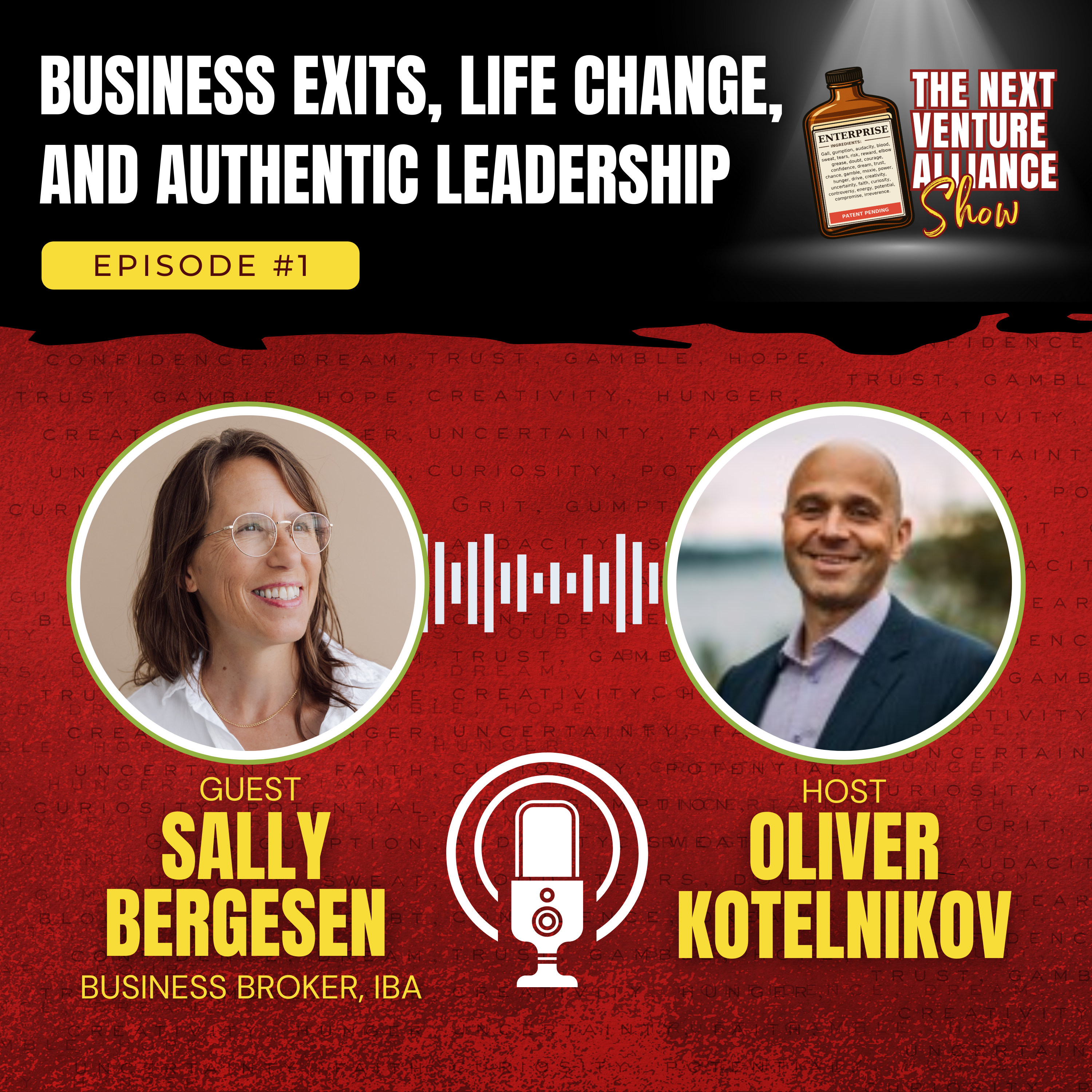
[00:01:24] Speaker B: But yeah. On today's episode I'm joined by a friend and a fellow business broker and a neighbor and a fellow business broker here at iba. Sally Bergeson. Sally is a recovering founder and CEO who now helps business owners achieve their best exit. She has spent her career building and growing companies and she understands firsthand how complex and emotional it can be to sell a business.
After founding and leading and exiting two companies, Wayward, a brand consultancy and Wazelle women's sports apparel brand, Sally transitioned into business brokerage to help owners navigate one of the most consequential decisions of their entrepreneurial career.
And as a middle market intermediary and transition advisor, Sally has completed transactions across professional and home services, construction and consumer product sectors. Her work includes valuation, market preparation, buyer selection, negotiation and guiding clients from offer to close as part of the IBA team. IBA is a premier full service business brokerage with 10 offices across the Pacific Northwest.
For 50 years, IBA has represented owners of family businesses and privately held companies successfully complete completing more than 4, 400 transactions in a wide spectrum of industries.
Originally from California College in Oregon, Seattle, with her beautiful family and in my personal opinion is an all around rock star. Sally, welcome to the show.
[00:03:06] Speaker C: Oh my gosh, thank you Oliver. I'm so excited to be here and that was a big intro. Hopefully I can live up to just a little bit of that. So thank you.
[00:03:15] Speaker B: You're living it now. I really appreciate you joining and we'll have a great conversation. I'm sure there'll be no shortage of things to talk about. But let's begin maybe the beginning, which I don't entirely know where that is. So we can begin maybe with. With us being neighbors and how we met and what an interesting story just that all in itself is.
[00:03:39] Speaker C: I was hoping we would touch on that because I think it goes to show how. Well, I don't know if you're a fate person, you believe life is pre destined or if you're were more just random reactions to the universe.
[00:03:55] Speaker B: Well, not all, but higher intelligence for sure.
[00:03:57] Speaker C: Whichever path you're on. I think meeting you was one of those moments where you meet somebody and just the trajectory of your life changes. And it was so random on the one hand, but not so random because we literally live across the street from each other. But I'll never forget being out on my sidewalk and we had just done some work on our house and our yard and I was like kicking the dirt and I was actually in a really weird place in my life of just transition of having sold my business and not knowing what I wanted to do when I grew up in my early 50s by the way.
[00:04:31] Speaker B: It's a great place to be and you get a blessing of beginners eyes.
[00:04:35] Speaker C: It was.
And my beginner's eyes saw you and we ran into each other on the sidewalk and one thing led to another. But I just started asking you about your world and your job and that's when you told me about your path and being part of iba. And I don't know, my mind was just blown and I just remember just feeling like something inside me clicked and I. One thing led to another and now here we are two and a half. We're in our third. I'm in my third year at iba so. So do Oliver. You changed my life.
I.
[00:05:07] Speaker B: You know, you know, up to the. The higher intelligence. Like I had nothing to do with. With that meeting other than walking by your house as I've done probably a thousand times before. But it just, you know, there were. I think you just had new addition in your backyard. You had a boom. I think. Yeah. For.
And. And I was asking questions about that and. And started talking and how well I summarized in that one meeting what, what brokerage is, what I do.
[00:05:40] Speaker C: And I did.
I think I got your phone.
So that's, that's me. I'm. I'm getting contact info and then I was like, okay, we got it. We gotta have coffee.
[00:05:51] Speaker B: We have to do this. Yeah. And it must have been you mentioned, I mean, you sort of in an intersection or an interesting place in your life for you to be open to that type of a conversation.
You have to be in a certain headspace. You have to be looking, you have to be in a transition mode, you know, that and what had you kind of in place and, and maybe you know, how you get there from, from beginning, you know, entrepreneurial history.
[00:06:18] Speaker C: Yeah. I'm just, you know, that moment again. I had, you know, a company in 2007.
Company. And it was a ride of my life, you know, journey of, you know, idea to building something, you know, and being 13 million in revenue by the time I left the company. And you know, many, many chapters between.
Yeah.
And but kicked my ass, you know, pardon. But Covid, you know, friends and you know, business. No changed. Passed away in 2022. And he had been sort of this very central figure for me.
My parents, when I was really young and he was kind of my. So anyway, all I, I, I did business and I, I, I got mattered me most at the time was basically my freedom and the ability to have kind of a new life. So it really was a, it was hard for me because I was kind of processing kind of like a, I don't know, death, a divorce, a start, you know, like all things wrapped up into one. So.
[00:07:22] Speaker B: And, and you know, I mean, all those things are part of my entrepreneurial history as well. Right. I mean, I founded or was part of a family business and you know, founded all the kind of the growth of it. But it was in my bloodline, it was in my sort of bones and you know, divorce, change, I mean, all of those things happened and, and they couldn't at a certain point, it just can't all stay the same. Right. Change and transition is needed and then.
And happens then to the business owner's identity.
[00:08:01] Speaker C: Yeah.
[00:08:02] Speaker B: And find out, you know, how your work is. You're sort of, that is really you. And how do you identify with and what is left of you after you take a work which sometimes isn't a whole lot when you give it.
[00:08:17] Speaker C: I know you're just a dried husk.
True.
When I'm going through the exit and the divorce and the death and the newness and the rebirth and et cetera. I read this book called Bittersweet by Sarah Kane, I think it is.
And I can just, you know, summarize a couple sentences, which is basically that when we lost in our lives Or. Or you know, it's kind of been really.
It's all the things. But a lot of times it's kind of the precursor to like a massive. So.
So it's like learning to kind of embrace that.
[00:08:51] Speaker B: The whole idea when. When. When you're confused and you're asking the most questions. That's. That's a thing with. Right. You've had a lot of times that's hard to accept. But it's that mindset. Yeah.
[00:09:02] Speaker C: Yeah, totally. Yeah. You know, in the entrepreneur. The entrepreneur is very much a heart on your sleeve kind of person. You know, like into the world and. And. And be. And do take risks and you know, and that. That's can super painful sometimes and a lot of joy can happen, but a lot of pain too. And I. I will read your story and I didn't realize that Proski. Proski was your. Your. Your. Is that right? And. And you kind of grew up before you took over.
[00:09:33] Speaker B: Yeah. So I had two. Two chapters. I mean we started as a family in 1992 and family. Literally the four of us, you know, my.
My parents, my sister and I. Yeah. And that was kind of a long chapter, you know, where just the true family business and we all worked in it and there was, you know, maybe a few more but it was really a true business. And then. And left and wanted something else and.
And try to different things and back early 2000s just because I really did love it and I. I knew well and there was a point in my life and kind of my earlier and I'd gone to community college and taken classes and I'd gone to school at one point in California and I traveled.
[00:10:26] Speaker C: I love that I didn't know about the music school. That's cool.
[00:10:29] Speaker B: Yeah. Yeah. Guitar player. So.
But there was nothing that I knew or understood as well as I did baking.
And I learned a lot of it from my dad. And then I kind of added knowledge through obviously working in a real business setting and then, you know, reading and experimenting. But you know, but it was maybe 22, 23. I had an. Kind of an encyclopedic knowledge of you know, practical knowledge of baking. And there's nothing that I knew as well as I did that and then. And set us up for. For. For girl, you know, married and had kids. And that's when, you know, Olga grew the business and it sort of looks like you know, turned into, you know, piroshki. But I had sort of chapters even within piroshki because I was 25 year stretch so long Enough to have growth and some change. But I had kind of exits even within that chapter and transitions and some of that was dictated by personal growth and some of it was, you know, business. Yeah, it was so separating that from all that is a. Like yeah, whatever.
[00:11:45] Speaker C: Yeah. I think on that sort of like family and family love is this idea of kind of doing love and how you, you can turn something that you love doing into a business and into a job. And I think that there's kind of pros into that.
And personally I found. So my business was running apparel, running community. And that's because running kind of saved at one point. You know, I was.
And then I was found and running was a part of that being found and But I. There were ultimately by the end I was like, I have too much of my life wrapped up in this hobby, this I love to do. I've turned it into my job, my friendships, my, you know, what I do when I travel, my religion, my. No, it is like literally I'm, you know, I stay sane in the world. And so, and so I it had wrestle with that notion of that if you do something you love, you know, in a day in your life and I'm kind of like, I don't know about that.
[00:12:48] Speaker B: There are those things that get thrown at them. People will. Haven't you heard? It's like. Yeah, no, I've heard it. It's not entirely true, but.
[00:12:58] Speaker C: A different.
[00:12:58] Speaker B: Lens on that context.
[00:13:00] Speaker C: Yeah.
[00:13:01] Speaker B: Personal tangent. Right.
[00:13:02] Speaker C: Yeah. So. But back to your point of like what's left when you add. And so I, I think with that. But you know, the. Is that there's like you've got a big void to fill. Right. Like and you can kind of. You kind of with something different. And I think for me that's what I've always loved about the entrepreneurial spirit is that it can be constantly redefined whether that's, you know, I don't want to start another business. I feel like I, I've done that. I've, you know, walked. But I think you can take the entrepreneurs like curiosity and desire to learn and you know, kind of world to a lot different things. And so I'm a big believer in career chapters and this IBA business brokering is my fifth career chapter.
And that's.
Yeah, it's so that's you know, a.
[00:13:49] Speaker B: Lot of what attracted me. I mean that not wanting to own a business, you know, like, you know, I had while to even arrive at at now that I I to move on to owning another business at least at this time. Right. But then the other side of it is, you know, it's knowledge about business ownership and entrepreneurship to not use it in some capacity. So the another thing that I. And sometimes it's the process of elimination. Right. The other thing that I don't want to do is just throw that away.
[00:14:21] Speaker C: Yeah.
[00:14:22] Speaker B: So what's. I don't want to own another business right now. I don't want to throw away all the knowledge that I have. And you know, how is. I mean having successfully for some time now, you know, we be able to relate to business so many levels. Right?
[00:14:38] Speaker C: Yeah.
[00:14:38] Speaker B: You know, business metrics and sort of the M and A of it. It's just one aspect of it. Right. And it's an important one. But.
But the other is being able to relate to moments like this, you know, somebody who understand, you know why. And sometimes there's the compassion required.
[00:14:55] Speaker C: Yeah.
[00:14:56] Speaker B: Needed in the space more than anything else.
[00:15:00] Speaker C: And that's why I love this space that we're in of basically helping the 1 million to 20 million. You know, size businesses are still very, very human. They're very, they're family owned, held, you know, the, the human. There's not like layers of management and you know, you know, bodies, buckets of money. It's. It's very human. And just this past couple met with a business owner who basically inherited that his mother founded. It's been in business for 40 years and she's now been passed away for seven years. And he's kind of at this point, you know, he. He knows he sold in order for it to continue. But like it was such an amazing story to like about her. Like she has a troop like starting the business that she had 40 years ago. It kind of in alternative area and, and then another cut with a husband and wife. You know, I heard about super interesting kind of home services. That's an area that you and I have both worked in. You know, met at their table and then they just looked at me and they said well we're getting a divorce. And you know, so it's like they were just wanted to kind of, you know, move through, you know, efficient away as you know, these are very bright that we sort of get to be a part of.
[00:16:16] Speaker B: And sometimes you're, you know, you trusted what on a second notice. Right.
From a customer expecting one conversation from a client. But you get something entirely different. Right. And then we, you know, we often talk common reasons for exit but some of them are, you know, distress, health.
And so we need to be able to absorb Those as not an M and a advisor but a role. Right. Maybe maybe a psychiatrist, maybe therapist.
[00:16:51] Speaker C: I bet you've been a therapist, right? Yeah.
[00:16:53] Speaker B: Sometimes you know there's where the click out with that. You know they'll say this is going to be a therapy session but I need to say X. Yeah, yeah, yeah.
[00:17:03] Speaker C: Sometimes there's. There could be clients, you know start, you know because it's almost like they've lifted the lid on thoughts and ideas that they have kept tamped down. Right. Because as business owners we know you have to like keep a lot. You'll be the boss, you have to be in control, you have to know what to do, you have to make decisions.
[00:17:20] Speaker B: And so that was part of your stress right as being a business owner. I I think is. Is having to you put on the right and you know strength and winning and that all the time.
But that's not always the story.
Right. And and so they will do it and understanding that that's not only some form of. That is part of a person's story and part of every business.
[00:17:46] Speaker C: Yeah.
[00:17:46] Speaker B: And especially in a family like the family aspect will first, you know in one form or another, you know we need a portion of it.
[00:17:57] Speaker C: Yeah, yeah.
It's really enjoyable for the most part. I will say. I'll tell you a short story about a massage therapist that I had. She worked on athletes primarily. She was a really good sort of like body work person that you know major muscle groups and etc.
She was so quirky though and you kind of had to warn be referred to people to her because she had this method where she'd be like working on you and you'd hit like a bot in your body where you had like knotted muscles or something and all of a sudden she would just go.
[00:18:28] Speaker B: She was the method actor of massage.
[00:18:30] Speaker C: Therapy and she would just make these crazy noises and anyway this. She was so good at what she did though. But the story was she was like, you know, I didn't use the energy of my clients and I was starting to get really sick. So it was basically this. It was a little woo woo, I get it. But she was absorbing the tension and the person's, you know, essence basically and was going into her and she wasn't able to release it. And so now her method was basically to just like. So I literally would like what my stress sounded exiting my body, exiting her. Sometimes I felt that I'm like, you know it's kind of recognized that we a lot you know in terms of different turmoil on we're we're helping people problems. It's very, you know, we're very. We also need to find ways to release that somehow or just, you know sure that we're, you know, taking profile.
[00:19:22] Speaker B: So now I mean you mentioned running use those words and I can, you know, safely assume that that pressure release valve for you.
I mean how does. That's a, that's a.
I, I, I have but I don't.
[00:19:37] Speaker C: I can't make that didn't save you.
[00:19:39] Speaker B: It helps.
[00:19:40] Speaker C: It's nice but that's well, things cold okay. So that is crazy. We can. Although I was thinking this Thanksgiving I wanted to maybe cold plunge. I'm so, I'm. I'm trying, I'm trying to to possibilities with the plunging but no, I, I think I to My, My childhood was just very, you know, rocky. My parents was really young. My, my dad raised my eye. My mom was in the picture but kind of not really and just had, you know, kind of a. Just kind of, you know, like there was not much structure and that's not really great for kids. I think kids actually need structure.
And so by the time college I was just like, ah, I'm just so lost. I don't know who I want to be, where I want to go. I'm doing things that are unhealthy. I'm drinking, I'm smoking pot. I'm, you know, just can't. And when I actually ran a little bit in high school, but when I started running again at the end of college, it just clicked. It was like all of a sudden I just, my head cleared, my body felt stronger. I had a, A rhythm to my life that, you know, I literally needed to be on a. Running didn't tell me it was going to be in life, but it helped me sort of get in the Asking the right questions and kind of following paths that more productive than the ones that I had been on. So it is, it is a boon. I think people have different things, right? Some people are really into yoga or walking or hiking or birding or cold plunges or you know, whatever your thing. It's, it's that it's kind of centered.
[00:21:07] Speaker B: Well, what about it? And what's different from. Can't you get the same thing from crocheting?
[00:21:13] Speaker C: Okay. Now that I'm in mid-50s, I'm like knitting is starting.
[00:21:17] Speaker B: I'm not going to give you ideas. Good.
[00:21:22] Speaker C: Well, I mean science around what running does with the body, right? Because so it's, it's the endorphins, the type two fun if you're into type one and type two fun discussions.
[00:21:35] Speaker B: Explain it, please.
[00:21:37] Speaker C: Type two fun is the. It's. So type one is kind of just like, you know, 100% pleasure but, you know, enjoyable.
Hedonic. Exactly.
And do fun is. Actually requires some effort. You know, it's like you maybe sweat a little, do something hard or lift some things or.
But the. The reward is. Is special and you. That could be like connection with other people. It could be maybe seeing a vista. It could be like kind of that clarity kind of just in nature you fun.
It has more with kind of the balance between and reward. And so yeah, I gotta find out about those. Those could be fun.
[00:22:19] Speaker B: First few are fine. I'm just looking for.
[00:22:21] Speaker C: Maybe I'm looking for a little more unique. I like you, Oliver. You just always a seeker. You just, you know, want to get next level.
[00:22:28] Speaker B: I'll tell you. I'll tell you. Cold water is. It's not just the plunge, right? I mean, to me, that idea of, you know, the fat portion, that's.
[00:22:36] Speaker C: Yeah.
[00:22:36] Speaker B: Kind of taken over now my little tub, I sit there for three minutes and I put on music and all of that. You know, there's some cool. But there's still a lot of constructs in there that, you know, fundamentally, you know, like, it's transformational. It. It could be. It could be. It could be the sound or. Or it could just, you know, a quote cult.
It's. It does bring about me an immediate shift, like a deep foundational change. I.
Maybe momentarily, maybe for an hour, but I. I literally transcend to sort of a different.
Something that I cannot achieve. You know, with maybe the versions of fun and type 2 fun and with some other activities. Right. Or, you know, you kind of get a mind, a flow state. And why cold water does that? I don't know. There's scientific and kind of physiological.
[00:23:30] Speaker C: Yeah, I've read about that. Like it resets the system, doesn't.
[00:23:34] Speaker B: It don't know enough of it. And honestly I'm. I'm kind of.
I'm. I look at one experiment. So I kind of. I try. And if. And if it's good, I'm probably not gonna get why. Right? If it doesn't work, I'll drop it.
[00:23:49] Speaker C: Yeah, well, exactly. And that's a point in and of itself. Like we don't need to science of it all the time. You know what I mean? Like, I feel like one. Like I. I differ from.
Okay, well, no, back in the days when I was racing a lot and training and running marathons and stuff. I like to geek out on some data, like how fast I was going, you know, how long I went, my times, my splits, my, you know, all of that very much. And I think you probably trend this way with the cold plunging too. It's, it's like we need a place get away from technology to get away from data, to get away from all these inputs. And you know, I might ask me about my running watch. I have a fancy Garmin running watch which does all the bajillion things. Right. And she was like mom, I kind of need a running watch. You know, could, you know, using you was like, I'm just in a place in my life. I'm like take it. Like I, I don't, I need to.
[00:24:42] Speaker B: Know it's ultimate value. I don't know what it is, but it's pretty low. Like I won't. Right. And, and I, I like a. You're kind of the way you're. And I think fundamentally it's an understanding that we have a deeper intelligence and a deeper understanding things right inside of us. Right. And the more gadgetry and data.
[00:25:03] Speaker C: Yeah.
[00:25:04] Speaker B: We surround ourselves with less. We inherently trust it. I love, you know, we need on a data driven device right now talking and this isn't like wholesale dismissing all technology data but we do need to recenter and listen to ourselves. And you know, for me like in cold water there are lots of different, you know, I see people kinds of different things. And sauna is the same thing.
[00:25:29] Speaker C: Right.
[00:25:29] Speaker B: And people say, well I have to go in and I'm doing this and it's three minutes and then at three minutes my temperature, like it's this, that and the other and music like I don't like, I don't want to experience this very thing. The fact that it's you know, unpleasant or cold or like that's, that's fine. But you know, that's so I don't want to get away from the experience. I'm there for the experience. So I don't need music in my ears for that. Right.
[00:25:57] Speaker C: Yeah.
[00:25:57] Speaker B: So that's kind of where now when I, I do want music, I'm just like, oh man. Like how much I like how much longer I'm tired. There's a person in front of me, I'm trying to catch up their fabric.
Green lake.
[00:26:14] Speaker C: Like I'm with it. Oh yeah. It's bad, it's.
[00:26:18] Speaker B: It's a bad running and you laugh me.
[00:26:22] Speaker C: That's how I feel when I'm on a bicycle. So I'm Married to a serious cyclist and I. Every second I'm try to on a bicycle, I feel like I'm in a world of hurt and pain and suffering and just like time slows to a crawl. But yeah, for whatever reason, you see.
[00:26:38] Speaker B: Him take off on his bike and that in itself, just watching him as a meditative experience because he's so zoned in. Right.
[00:26:45] Speaker C: Yeah, it's very smooth.
[00:26:47] Speaker B: Just radiating Zen right now. And if I can absorb 2% of it.
[00:26:52] Speaker C: Yeah, yeah. You know, whereas me, pretzel. I look like a pretzel on a bike. That's how I feel.
[00:26:56] Speaker B: Sounds like a branding idea.
[00:26:59] Speaker C: Oh, yeah, always.
[00:27:01] Speaker B: Well, let's chat a little bit of kind of your. Your practice and you know, you've done really. And I've been privileged to. To be involved in some of them. Some of them a guide and, and just a sounding board. But I'll kick it off this.
You are, transactionally speaking, an expert in the entertainment industry. You have some knowledge in the entertainment industry.
[00:27:25] Speaker C: Showtime.
[00:27:27] Speaker B: What kind of entertainment industry?
[00:27:31] Speaker C: Yeah, I know. That's the beauty of this world, right?
You do two deals in a specific category and I'm like the expert because.
[00:27:40] Speaker B: You'Ve done two more than me, for instance.
[00:27:42] Speaker C: Oh, man. Yeah. Well, you know, it's interesting, you know, we were in these conversations all, all the time, but there's definitely, you know, there's themes looking for. To buy in a business. Right. They want the, you know, they around for a while. They want of course, like growth to be steady, but the, the desire for recurring or revenue. The desire for, you know, a business that has somewhat of it and it's not, you know, easy to get into.
That's right. Has a team in, you know, all those things. And we kind of laugh about it because, you know, at the end there's no business checks all the boxes and, and, and quite frankly, not the boxes either. So a lot of times I feel like I'm in this seller does either.
[00:28:23] Speaker B: Right. So this isn't like no one's checking on. We.
[00:28:27] Speaker C: Yeah.
[00:28:28] Speaker B: Find a good fit.
[00:28:29] Speaker C: Exactly. So but anyway, so a lot of people obsessed with H Vac and you know, commercial services and you know, electrical like these, you know, the quote unquote. You know, I thought to myself, I get that. And I know, sure, I'll be happy enough. I run across a good one. But there's. I think there's other types of businesses that kind of have. Some of those aren't boring. And so I had this opportunity to work with an owner who had Basically, he did led walls for events, so worked with Climate and you know, down.
[00:29:04] Speaker B: It was an exciting business. I mean, that wasn't it.
[00:29:06] Speaker C: Very cool. Like, he was front row, like concerts, comedy shows and, you know, whether it was Kevin Bill Gates at the Moore Theater or, you know, a big concert at Climate, he was a fly on.
[00:29:18] Speaker B: The wall to the biggest show in America twice a week, you know.
[00:29:22] Speaker C: Yeah, yeah. What was kind of. It sort of just didn't faze him. He'd really register who the acts were he was.
Which I think you sort of do. Maybe if you're there to serve as a vendor, you don't want to be like, you know, oh my God.
[00:29:35] Speaker B: Starstruck professional.
[00:29:37] Speaker C: Yeah, yeah, you're here to do a jump. But he did tell me once when he was doing a sound check down. It might have been at the Gorge or something, but he said he was doing a sound check for Fleetwood Mac. And he said Stevie Nicks was basically like singing right at him.
Because it's the only person in the.
[00:29:54] Speaker B: Stadium because I think she's singing right at me. I mean, is there. Is there. Is there Stevie Nixon concert?
[00:30:00] Speaker C: So it's just cool stuff like that. So anyway. Yeah. And.
But anyway, I met these few. I think they'd kind of been serial buyers just in this, like, kept trying to, you know, find the H Vac company or the note company. And I sat down, I said, guys, like, this business is so much cooler. Landscaping business, like, literally, it has so many things they're looking for in terms of the type of business it is and kind of its ops and, you know, all that. And so that part of this job, sometimes you feel like you're just trying to like, help people kind of see something they're not understandable. Right. Because, like, who would have thought of a light wall business? You know, like, I. I don't know. It's your kind of, you know, tuned into, like on.
[00:30:42] Speaker B: What's ironic is I know. I know the buyers and. And they actually did look at a landscaping business that. That I represented. Right. So. But. But what's interesting there is theme of a fly on the wall. I mean, you get to have conversations with different buyers, right? And.
[00:30:59] Speaker C: And.
[00:30:59] Speaker B: And you sort of hear you over multiple talks kind of. They are what they're looking for, what's important.
And you get to process that and imagine that happened here is you said, look, I've heard we've had several conversations and you've these things. You say you want X, but you want it in this kind of business.
Me Maybe you are.
What you're saying is you're actually wanting something different is what I'm hearing. Right.
You want a business that does XYZ that but then it's. It doesn't add up to a landscaping or an H vac business, what I'm hearing.
And you help them sort of redraft and. And then reevaluate that narrative. And they say that that is maybe I'm not looking for what I think I'm looking for. Right. And that's part of that revelatory sort of conversation that you can have is.
[00:31:59] Speaker C: And I think this was one of the comments that I wrote when we were first talking about this. But it always puzzles me when we meet who tell me they're industry agnostic.
[00:32:09] Speaker B: Yeah.
[00:32:09] Speaker C: Oh, it doesn't matter what it is. I just want a million dollars in ebitda.
[00:32:15] Speaker B: You know, by the way, the worst message that any particular seller can hear. Right.
[00:32:20] Speaker C: Exactly. What are they looking for?
[00:32:21] Speaker B: Nothing in particular.
[00:32:23] Speaker C: It's good, whatever you got. But as long as it fits this buy box, you know, it's just like terms and I know, but you want to help. Help buyers. Kind of how that comes across. You know, sellers. It's just, you know, seller. And this is not, you know, this is a hard thing with sellers too. They over index on how special their business is. Right. Like, business is like so incredibly unique that like in the universe could like it. Like you run it. Like you see it, the vision. Like I do. And you have to educate them. Like, and there could be speaking of.
[00:32:55] Speaker B: Transitions like that, one of the more important transitions that you can sort of head around.
Professional services.
[00:33:03] Speaker C: Yeah, yeah.
[00:33:04] Speaker B: Yes.
[00:33:04] Speaker C: And there could be a new owner with a new vision and a new take and a new way of doing things. And you know, it'd be perfectly great. You know, it'd be exactly what your business needs. And so see that education happening on both sides, but back to kind of higher saying that there it's fine if like inside voice. But maybe when you use your outside voice and you're talking to an owner, you know, kind of. I did this with at a butcher I was representing and I had that exact same conversation. I had a buyer who was trying to buy an H Vac company. The deal fell through. It was happening over in Arkansas or something.
Then he switched gears and he was like, you know, I also like meat. And so I had to coach him a little bit on.
That's great. And you know, a lot of us do.
[00:33:51] Speaker B: This is the. My grandma has a recipe for a Pasta sauce that everyone loves to start an Italian restaurant.
[00:33:59] Speaker C: Yeah, Love pasta. I love pasta. Right. So I love meat. And so meanwhile, my client is like a 30 year industry butcher. Like industry knows, understands the players, understands the flow, understands what's happening in the industry right now, which is, by the way, the cattle inventory is at an all time low due to various factors, the cost.
[00:34:22] Speaker B: And how would you have ever known that as the president of Wasel, Sally, you would have never known that.
[00:34:28] Speaker C: This is the most amazing part of this job. Like, and I actually like meat too.
[00:34:32] Speaker B: So I now you can casually weave it into conversations.
[00:34:35] Speaker C: Yeah.
[00:34:36] Speaker B: Bakery be like. And they'll say, we'll put these bagels to go. And you'll say yes, yes. And did you know.
[00:34:43] Speaker C: Let me tell you about the cattle industry.
Yeah. So which by the way, just to finish that story on the butcher, we got a full price offer on the business. And my client is basically at this moment is declining to accept that offer until after the holidays when they can kind of their heads around what they want to do. And so the end of this story, Oliver, is that my commission may end up being the smoked turkey that I'm picking up on Saturday.
A gift from the butcher to me. And you know what? I'm.
I'm fine with that.
[00:35:16] Speaker B: Blessings come in many forms, Sally have had that sort of a in compensation and widely continue to experience it this year.
[00:35:27] Speaker C: And it is key we are entering the season of gratitude.
[00:35:31] Speaker B: Yes, we are. And yeah.
[00:35:34] Speaker C: Question for you, Oliver though. Do you think with the smoked turkey, do you think I need to tell Gregory? Do you think I need to drop off a drumstick or a section of the turkey as part of 15 of the turkey?
[00:35:46] Speaker B: Yes.
[00:35:47] Speaker C: Okay, thank you. I'll. I'll do that. Do it.
[00:35:50] Speaker B: Gotta love the rules are what they are, Sally. Yeah, Interesting. Okay.
This is a topic of.
[00:35:58] Speaker C: Yes.
[00:35:58] Speaker B: The cadence and who is on. If you have a buyer who just had a revelation, they realize that they don't want an H VAC business in Arkansas.
They want butcher shop in Washington state.
They have had kind of internal shift. They're excited. They put in a full price offer.
This is sort of a massive, you know.
[00:36:21] Speaker C: Right.
[00:36:22] Speaker B: And a move on their part.
[00:36:23] Speaker C: Yeah.
[00:36:25] Speaker B: Look, we're really busy.
Just need some time.
Do you manage that messaging as a broker? Because it goes through you. Right.
Kind of deliver that back and forth.
[00:36:38] Speaker C: Yeah.
[00:36:38] Speaker B: Is the human element of this transaction.
[00:36:42] Speaker C: Tough? Right.
We're at now as we're kind of holding pattern. I think we're going to revisit the offer in January and kind of million dollar on the table is the old adage goes, try not to say no to money. And so I'm kind of hoping, yeah, strong offer. It's a great buyer. So we'll see. But I think also like a broker, you have to let go a little bit. You have to release to the universe and say you done my job. I've put people together that long, I've have an offer on the table. And universe works in mysterious ways. And you know, this happens or not maybe it's my part in it has kind of to close so much as like you have to sort of let go and see what the parties do. And you taught me that too. Like I think I remember one time you went on vacation and you were like, you know, on vacation might have been the best thing I could have done for the deals I was working on at the moment. Because you just get so like white knuckling it right. Or you're like to like these pieces together and at the end of the day you just intermediaries that you know trying to like conditions for success but you're not in control unfortunately. Oliver.
[00:37:53] Speaker B: Damn it.
[00:37:54] Speaker C: Yeah. Even.
[00:37:54] Speaker B: Yeah. This thing where you're trying to impose structure on something that at that time is in growth stage and wants creativity and wants room to evolve and develop into something that it very often ends up being. If we make the right decision, that doesn't mean dropping the reins and walking away always. But sometimes I can't force things. If you force a decision right now, the right decision will come. It may come later. If you force a decision right now, if you insist on getting closure right now.
[00:38:31] Speaker C: The alternative is to just take the turkey and take the turkey and take the vacation.
[00:38:35] Speaker B: Take two.
[00:38:37] Speaker C: So our hot tips of the day are go on vacation.
[00:38:41] Speaker B: Yeah. Eat turkey, make the food payment in whatever form.
[00:38:47] Speaker C: It might not pay the mortgage, but you have other deals for that. So it's fine. It's.
[00:38:53] Speaker B: We try it with the mortgage company. I don't know, just say this organization this month you that work.
Can we do a discounted rate in dollars?
[00:39:03] Speaker C: Please come to the table. But you listen to Gregory's podcast with Jason the other day and I liked his term of phrase, which is like don't let lack of effort be a reason for your failure. And so I think to that I gave it the full court press. I absolutely did everything in my power to love these owners. They're salt of the earth people. They've deserved kind of next chapter. And so anyway, you know much you can do.
[00:39:28] Speaker B: Balance in the line. There is just takes.
You can't just be a. Have to wear multiple hats. You can't just be a broker. You can't just be transactional about it.
Ultimately, it all comes back to this being kind of larger than just closing documents.
[00:39:48] Speaker C: Yeah.
[00:39:49] Speaker B: Right. There's some other things happening that deserve consideration. And the to be respectful of it is a results oriented game. Right in the end.
So lots of fine lines, lots of gray areas.
[00:40:05] Speaker C: Yeah. Say a little business broker prayer for me. Maybe it'll happen in January. We'll see.
[00:40:10] Speaker B: All right. We have to come up with that. The little business broker prayer.
[00:40:15] Speaker C: Well, I have to confess here that women brokers at iba, we get together occasionally and we.
[00:40:21] Speaker B: No, that doesn't happen.
[00:40:24] Speaker C: It's a powerful cabal within iba.
[00:40:28] Speaker B: Sort of been maybe invited myself to sort of these gatherings and they are incredibly powerful.
[00:40:35] Speaker C: Yeah. You should be very honored to be a polluted guest, which you absolutely are. You've never shown up, you've never attended, but you live in hope. So we did actually research that there is a patron saint of business people.
Yep. And who is it?
[00:40:53] Speaker B: Or when? When are they celebrated or how are they honored?
[00:40:57] Speaker C: Name is Saint Homo Bonus. And that's not a joke.
[00:41:01] Speaker B: Invent.
[00:41:02] Speaker C: Okay.
[00:41:02] Speaker B: We need a new character, we need a new mascot.
[00:41:04] Speaker C: You might need some rebranding help. It's fine. But he's a real dude and he.
[00:41:09] Speaker B: Was not like a real dude. I'm just saying.
[00:41:12] Speaker C: Nope, get this. There's more. He was a very, not only a very successful business person, but he was actually a very philanthropic, charitable business person. He really invested in the community and it's legit. Oliver, I'm going to give you my little St. Homo Bonus like placard, which with more information on him.
[00:41:31] Speaker B: So hearing a lot of things. One of the things I heard was bonus. So we'll start with the other part.
[00:41:36] Speaker C: It's just.
It's real, you know, it's real. So you gotta light a candle occasionally.
[00:41:42] Speaker B: Okay.
[00:41:44] Speaker C: Speaking of which, and this is again where it gets to like the human part of what we do and the people that we meet, meet with. But I have a listing on Whidbey Island. It's a wonderful business. It's in the construction space. And I met with some buyers who we went out to Whidbey Island. We had this sort of beautiful trip out there with Sunny. We traveled around, was idyllic and kind of like love was in the air. And I thought, okay, this is it. And a couple days later, we meet on Zoom. And we kind of. And it was as if the air had been let out of the balloon. Like, we were on this high at the visit. But then when we met, it was just that they had sort of coming from like, what?
[00:42:23] Speaker B: Both. Both parties or. I mean, where was the. The deflation of energy or the leak of energy?
[00:42:28] Speaker C: It was just. It was the buyers. It was a couple, right? And they be a big move for them. It'd be kind of their whole life, right, to, like, and run this business on the island. And they. So I thought to myself, okay, I don't know. I give it 50. I don't want to give them time to, like, think about this and regroup a week later. And it's just really sweet. They really had, like. Did they just about it a lot? They had gone to church. They had, you know, like a lot of, you know, naturalizing the idea in their community and of friends, and they were just like, we want to do it. Like, we were like. They just had. So back to this kind of things and letting things kind of their natural route. I think sometimes again, even though it's counterintuitive, because we want results and we want motion and we want action, right? Letting people process.
[00:43:20] Speaker B: Yeah. And I always, you know, like this. And more and more I'll, you know, push to quantify.
I'll say, you think it's 50, 50. And they go, oh, 50. How do you figure? I said, it'll either happen or it won't. So.
And I will say that, not loosely. I will say that after all best efforts have been made and we've walked around the table.
[00:43:40] Speaker C: Yeah, yeah, yeah.
[00:43:41] Speaker B: There is that time, and maybe that is the time to go on vacation and let things breathe.
Domains of life have that pause built in, right? Where the pause is beneficial. Whether you're talking about in dough and, you know, kind of human terms where the dough needs to breathe, the dough needs.
[00:44:04] Speaker C: Right.
[00:44:05] Speaker B: The dough is.
[00:44:07] Speaker C: So much respect for you bakers. Because I'm just like. That just seems really complicated and out of my control.
[00:44:14] Speaker B: You go to, you know, the traditional bakeries that still maintain sours, right? For. Yeah, sour is alive, right? Sour needs to be fed every day. If you don't feed, the sour dies. Sour has names. They'll say, hey, you need to go feed. Bethany, you need to go feed.
It has been like there's over 100 years old.
[00:44:35] Speaker C: Wow.
[00:44:35] Speaker B: And here's another parallel, right? They've tried many times to take the San Francisco sour and kind of scale it, quote unquote, right? They take it out of the kind of area they take it out of the San Francisco area, out of California and they move it. They take it to Europe. They take it.
[00:44:52] Speaker C: Yeah.
[00:44:53] Speaker B: And they. And they give it all the conditions it.
[00:44:56] Speaker C: Yeah.
[00:44:56] Speaker B: And give it all the same things. Well, guess what? Two months later it's not the same Sourdough.
[00:45:00] Speaker C: Not the same now.
[00:45:01] Speaker B: Now Jonathan or Bethany. The sour is now someone else because it lives somewhere else. Different. Different water, different air, different elements.
And so they haven't been able to replicate that in the world even no matter how hard they've tried. That's things taken its course and sort of human elements of. We're back to the.
You know, brokerage did not invent a breathe or pause or. Or kind of a contemplative to reflect.
[00:45:31] Speaker C: So yeah.
[00:45:32] Speaker B: Doing it for the first time which is I think reassuring.
Not any easier because there are no two businesses which is part of kind of this is a good segue different about selling a business than selling anything else. Right. And the parallel that people very often draw and rely on immediately is real estate. Right. That's kind of people see the closest. And then we want to talk about comps and market data and it really doesn't. A comparative marketplace really in a use of doesn't really exist in a meaningful way. Right. How many you think that is? And what's different about value, about putting fair market value on something so almost ephemeral.
[00:46:18] Speaker C: Yeah.
Blue sky. The goodwill, the essence, the spirit, the reputation, the history. There's just so much there. Right. That's.
[00:46:29] Speaker B: Why is one business not like the other? Right. If we start taking, you know, Ebitdas and sellers discretionary earnings and applying multiples and saying well, such and such business even in the same industry, like take the bakeries or some of them different.
[00:46:43] Speaker C: Yeah. The thing that just popped into my head and I don't know if this makes sense, but it. I think it would be like instead of selling a house, a piece of real estate, be like selling the family in the house.
So if you're selling the house, family in the house. That's no family. That's the same.
[00:47:01] Speaker B: Okay.
[00:47:01] Speaker A: Me.
[00:47:02] Speaker B: Listen, Sally, I don't want to buy the family. I just want to buy their Christmas party from 1997 when they were all in there and having a good time and somebody was going off to college. How much is that worth?
[00:47:14] Speaker C: Yeah. Sorry. You might be able to replicate that if you.
New family and have a new party.
Yeah. On you. You're going to have to go get the. The new family and you know what we have those stories and those pictures on the wall. But, you know, keep that good mojo going. You're going to have to bring your. Your new stories, and then if I.
[00:47:35] Speaker B: Do that, I'm going to have the same kind of slideshow at the, like, holiday party that I can show. Everybody depends on happiness. Just unquantifiable contentment that these people show.
[00:47:48] Speaker C: I don't know, Oliver. That depends on you. And that's such a big conversation we have with people. Right. It's a great history. This is a great family. This is a great business. This is a great. They've done amazing.
[00:47:59] Speaker B: Further, though, I don't mean I'm not planning to live in the house. I'm gonna buy it and I'm gonna move some rent.
[00:48:03] Speaker C: Oh. I want a passive family.
Passive family. Got it. Yeah.
[00:48:08] Speaker B: Live in this home and make these memories for me. Right.
[00:48:11] Speaker C: And the magic is going to happen and I'm going to be in Arizona.
[00:48:15] Speaker B: Yeah. I'm be somewhere else. So I want the bank to pay for it. I want somebody else to live in that house.
I'm the big picture. I got a lot of experience, management.
[00:48:27] Speaker C: Yeah.
[00:48:28] Speaker B: New vision and scale. That's what I do.
Tell me how this house is going to be exactly like it was before.
[00:48:35] Speaker C: Yeah. Therein lies the problem. Right. So, yeah, just.
[00:48:39] Speaker B: Just turning negative on me. Sally, you're going kind of not so.
[00:48:44] Speaker C: Much a negative as it is a shift to a different kind of buyer.
Yeah, shift. And yeah. Dealing with a situation right now, Oliver, where this is kind of good. Like this, where these buyers want to buy, not unlike what we see a lot of today. A tangible business. Right. We want to buy a business that has physical services for residences.
[00:49:07] Speaker B: This is the boring business that you're talking like people.
[00:49:10] Speaker C: Yeah. This is the boring business. And you know, they've identified a lot in the construction space, commercial construction services, that kind of thing. And so that's one of my clients. It's kind of that space.
So anyway, this is. But I have to tell you, like, a single point of contact that they've had in their initial outreach to me, to my first meeting with them has been, first of all, I think it was an AI bottle that made the initial outreach to me, which was kind of new, strong start.
[00:49:37] Speaker B: Sally. That is like the building block of success. That's how most stories start.
[00:49:42] Speaker C: And that just tell you that that person is really understands a tangible business. Right. Like they get it. They're gonna have their hands on somebody.
[00:49:52] Speaker B: I imagine their sleeves are already rolled up.
[00:49:54] Speaker C: Exactly. You see Those sleeves, the bot sleeves are there. So anyway, the bot is arranging.
[00:49:59] Speaker B: Sleeves are rolled up. All right.
[00:50:00] Speaker C: The bot is communicating with me and then the bot is.
It's my initial call with them which is a zoom call on which have not only not one but two AI bot recordings going. So. Because you occupy little boxes on the screen.
[00:50:18] Speaker B: Yeah.
[00:50:18] Speaker C: And I have one of the owners.
[00:50:20] Speaker B: Of a seat at the table.
[00:50:22] Speaker C: One of the buyers is there but the husband bothered to make the meeting. So there. And then I have a representative from a company in New York, some kind of like capital which I think is advising the buyers on how to buy the business. That person doesn't have their screen turned on, but their voice is there. And so I've got one buyer with the screen on. I've got two AI bots and then I've got a capital company in New York with the screen turned off. And they're basically unironically telling me about their thesis of wanting to be involved with a tangible business and they're going to leverage their skills and experience in tech to you know, basically things you were just saying to scale and grow. And so. And we're kind of this like type of. Because it's so rich. But, but it's just pointing out that there, there seems to be a disconnect in some of these like very. There. A lot of them were like little interactions like from the moment I was contacted by the bottom to the first meeting with etc. But they matter. Right. And, and the matters. But it in a very real way. Right. It's our job to, to vet buyers and to kind of see who and how they behave and what they do and, and meeting. I said, you know, I wrote you in front of my, my seller owner in person.
These folks didn't even live very far away from, from Right. It could have been like an easy, you know, 20 minutes. And they me along with the AI bots and the capital that more of a third date thing for us, you know, we're, you know, robotics. It was just sure. You know, I, you know, frustrating and also like I'm, I'm just. Okay, down, down the, the. I'm gonna keep you involved and I, I want your interest because that helps everybody. But it's just like you can't, you're not surface yourself as a, as a buyer of a tangible business if all you're doing is relying on technology to buffer yourself between the very human person who's in front of you to share data about the company.
[00:52:24] Speaker B: Sure. And who's taken the time and the effort to put together materials and to understand this business, to analyze it, both from the human and financial and sort of every aspect of who has put their bloods here. See you the broker into, you know, understanding and able to represent it and to be met with, you know, effort or lack of effort on the side.
Right. And you know, something that got me and I, you know.
[00:52:58] Speaker C: One sec. My lighting is a little crazy, so I'm going to pull my shade a little bit. We're having a rare sun moment here in Seattle.
[00:53:05] Speaker B: Yeah, yeah.
Its days are getting shorter and there's less anytime it comes out.
[00:53:14] Speaker C: But.
[00:53:16] Speaker B: You mentioned there's a disconnect between sort of in the transaction, most notably between the buyer and the seller. Right. The disconnect and the most important relationship. And one of those things is, is when, you know, that sort of brings process. Right. You mentioned this is a third meeting, third date. You know, depressed. And so initial the dismissiveness or, or even not trying to find out, not just, you know, but what's the process like? What is, what is the seller, you know, looking for?
[00:53:51] Speaker C: Right. How do they want to engage? Yeah, yeah.
[00:53:54] Speaker B: What would be for you? Right. I mean, we're coming with the initial of this is interesting. You know, we're, we're willing to commit some time and effort to this. How would you like to see this, you know, demonstrating a point that you and the seller know infinitely more about this business and are the owners of this business, which I think is an important dynamic to recognize because immediately bringing some sort of your process commoditized. Okay, well, this is standard. I mean, how many of you hear, well, this is industry standard. This is what we. I don't do this or I will do this on X.
I mean, what a way to. To start. I mean, do you. A bank or.
[00:54:36] Speaker C: Yeah.
[00:54:37] Speaker B: On insurance or anybody that they're looking for services from and saying, I, I need your product, your service. I'm interested in what you're offering. Here's what I'm gonna do.
Right. And you know, sellers, our client, you know, then oftentimes, you know, the disconnect that I see is, is that then it's generational.
But, but often we're representing the baby boomer generation, worked in the business, you know, built it whether they're, you know, needed or not. But, but people like. Right. They could outsource themselves.
[00:55:11] Speaker C: Right.
[00:55:12] Speaker B: But, but, but. And they know this business. Even though they're sort of in their head, they recognize that it may be ready for a change. And, and it could be run differently.
[00:55:22] Speaker C: Yeah.
[00:55:22] Speaker B: Maybe the success of it and the earnings of it allow for them to be, but nonetheless, they're there. Right. So how helpful would a narrative of, you know, we come in, learn everything that you're doing, make sure that we can run it successfully, and then this is our growth plan B versus Right. You know, we're, you know, not of what's making the business tick and coming in with, here's our plan, here's the mandate, here's our process. Yeah, you get.
[00:55:50] Speaker C: Yeah, yeah. It great to see just a little more humility and sort of like buyers to come in and kind of want to bend a little because it's warranted and be like, I want to learn at you, I want to learn from you. I want you. I, I, I'm, I'm chosen as the person who, you know, gets to take over.
[00:56:10] Speaker B: Considered. Right. I mean, be, you can be considered.
[00:56:14] Speaker C: Yeah. Yeah.
[00:56:15] Speaker B: But you know, first interaction of send me this.
I want, you know.
[00:56:20] Speaker C: Yeah, don't do that.
[00:56:22] Speaker B: You know.
[00:56:23] Speaker C: Yeah.
[00:56:23] Speaker B: And the understanding that these opportunities are rare.
They're sort of one of a kind commodity, every one of these business, even if they're not a fit for, for, yeah. You know, hey, this isn't a fit when you get something exactly like this, that's an X location or something exactly like this that, you know, doesn't own her involvement or something like this that had a better last quarter. Give me a call. Right.
[00:56:51] Speaker C: Yeah.
[00:56:52] Speaker B: You know, laughable. Right. Because again, house that's gonna come up for sale in the next two.
[00:56:57] Speaker C: Yeah.
Buyer I like is one that's had their heart broken a couple times by putting in on not getting it and maybe because of some of these, you know, we're talking about, and it makes them hungrier and smarter and a little more, you know, apt to move a, that that gets noticed and accepted and they've got a little more humility because they've been knocked down. And I, I really, I, I just in general, I think those, those types of buyers are, are better deal with just like anybody who's been through different seasons in life. Right. And had some losses and they're heartbroken and, you know, just more human.
[00:57:39] Speaker B: Yeah. I would say. Yeah. And then kind of experience in anything, whether it's relationships or, you know, professional or a buyer. Right. If, if you are coming at it from the standpoint of having listened to some advisors or listened to some podcasts, and now that's how you're engaging.
You know, that's not reality. Right. You know, and both Parties are coming at it from, from a place of understanding and kind of have a a set of expectations then that's when we can have a meaningful conversation even if it doesn't lead to and a respectful conversation even if it doesn't lead to yeah completion of the transaction.
[00:58:19] Speaker C: So yeah, I think the other thing I would add too is and I I gave this advice to a a search funder you know some you know is acquire their first business and has money to do so she for advice because she had lost out on on several you know I remind people that you know just have an mba, you went to Yale, you know, you baby private equity person and like a lot of times for these very sort of means you know, privately owners that's it's, it's don't understand the language and then that's that it becomes I don't, I know the buyers aren't doing it to, to to dare to, to put it off but essentially that ends up being the result is because because the loan understood then the owner feels you know connecting you know and getting it not not really feeling like oh yeah this is person I can I want some time with you know instead barrage of like business speak. So I, I, I person I was like really just try to remember it's just a person and we're just talking about you know basically even when it comes to revenue and net income and you know things make the of a business pump, you know it's down a little bit.
[00:59:34] Speaker B: Yeah we can keep conversational and everybody in the room understands basic business and financial concepts. You know, we don't over complicated. If you want to impress them then you know ask about their business and how they've built it and what they've done before we get to the the financial but because as a professional and as a broker and maybe this is something that the you know that doesn't realize how much work we've put into it by the time that conversation is had. So all that information is available. You know, I often say on the first you know meetings, you know, I said we don't have financials in front of us. Right. So if you want to dig deep down into line itemized, you know ledger loss statements and you know accounting over your questions.
[01:00:23] Speaker C: Yeah send over you get that information.
[01:00:27] Speaker B: This is a unique opportunity for you to with the seller. Don't squander it on asking you know data driven questions. They're not gonna know that that information is available. We'll get it to you but so I'll prep them and sometimes, you know, say the thing to my client because they'll sometimes worry, you know, what do I need to know? I just. You don't need to know anything new.
[01:00:54] Speaker C: Yeah.
[01:00:55] Speaker B: Know everything about your business. We're going to talk about the business. We're going to talk about maybe the business history. We may get into the operational side of things, which is a good use of time on some of these, these meetings because they don't. That's always bleed through on the financials. But most of it you already know.
Yeah, I'll be disciplined in meetings. Buyers, sometimes, you know, people, not because of Alice, but that's just kind of where the trust is. Yeah, but I believe that it's, it's not a great use of the, of the conversation.
Just regurgitate what's available in the documents.
[01:01:33] Speaker C: Right, right. And owners can start. You know, that's the energy you want, you want it to feel like the I, you know, first date. Right. You kind of want the, the, the man and the business. The chemistry. Yeah.
All about it.
[01:01:49] Speaker B: Well, well, initial stages. I, I mean you get to some of these meetings and, and we talked a little bit but, but I mean quite a bit earlier and with starts with conversations with our clients when we don't know much about the business.
[01:02:06] Speaker C: Right.
[01:02:06] Speaker B: We meet in person, we, we face to face and understand the business that we're selling. And, and in that kind of talk, these sort of first order reasonings, why are we here? Why are we talking about what's driving the sale?
You know, emanates from that. And then, you know, you a little bit, you know, sale cost. That's something that one of your concepts that I grabbed onto. You've done the evaluation, you've had initial conversations, you understand it, you present the evaluation. And maybe we're not alignment on the numbers. Maybe it's the process, maybe it's the timeline. There's, there are considerations in the seller's mind. How do you determine, how do you convincingly make your recommendation? First of all, you know, is it time to sell in that and then feedback.
What are the next steps for the seller? Is it to hold, sell? How do you determine what to do with sort of the two to three year Runway of possible. Right decisions?
[01:03:10] Speaker C: Yeah. It's so personal. It's just so, so personal. And it's a tough decision because I mean hold value of their business. Right. If they're making 500,000 to a million dollars a year in profit, you know, and then you know, that's, they can, you know, it's A stable business. I think we live in a very uncertain world. Right. And I really share that with owners because I think that was kind of my business owner like I sort of just had concept that things would continue on the trajectory that they were on and there would be nothing, you know, no rework, continuing to kind of put the inputs in to get the same output. Output and you know, but intervenes. Right. And you know, we have nobody had the global pandemic on their bingo card in 2019. And you know, some, you know, whether it change in the government, government shut, you know, global, others live in a very uncertain world. And so I try to encourage owners, you know, you find the exit or the exit can find you, you definitely want to do the former. You don't want, you know, to be.
[01:04:12] Speaker B: Situated being intentional about it. Right.
[01:04:14] Speaker C: Yeah. Yes.
[01:04:16] Speaker B: And again back to that real estate analogy of how often do you hear we'll just hold on to it. Right.
[01:04:21] Speaker C: Yeah.
[01:04:21] Speaker B: And what does that really mean in a business sense? Because a business doesn't appreciate in value by the virtue of passage of time.
[01:04:30] Speaker C: Just the opposite. It tends to decrease in value. It's sort of, you know, gradual decline. But it's losing altitude essentially if you're not in continuing to invest, if you're.
[01:04:39] Speaker B: Not continuing to gain. Yeah. And then in a cycle, you know, and this is when things are going well. Let's say the business is doing well financially, the staff is in, you know, you've got good people in place, you know, the owners of involvement and you know, they're right size, they have a good work life balance and it's. It's hard sell right at that time. So when does.
[01:05:01] Speaker C: Yeah.
[01:05:02] Speaker B: Under the thoughts of the sale.
[01:05:03] Speaker C: Yeah.
[01:05:04] Speaker B: Creeping in. When things start declining.
[01:05:06] Speaker C: Yeah.
[01:05:06] Speaker B: Right. Things start declining.
What happens? I mean it same thing. Right. Then it's not a good time to buy or it becomes less attractive. So I, you know, don't sell before you are at full cruising altitude. Like if we're playing analogy.
[01:05:22] Speaker C: Yeah.
[01:05:23] Speaker B: Start thinking of sale. When you're on the Runway, you're about to take off, you're about to kind of start, you know, by the. We're on the market. We want to hear the captain announce that we're cruising out. We're at 30, 000ft.
[01:05:36] Speaker C: Right. Go ahead and drink. Drink syrupy served.
[01:05:38] Speaker B: Yeah. That's what you want. And then. And then everybody wins because yeah, there's typically a long kind of cycle ahead and. And yeah, you can't prognosticate bar but when you're doing well and you're on the upswing.
That's the positioning. Right. And that's something we can't change if we don't time it. Right. Because, you know, whether that's specific to the business or in the economy or something else can be hard to correct. Right. You have one bad year, you now have a tax return for it. You now need two, maybe three good years to sort of convincingly. In the rear view. Right. And that's something that clients can discount and say, well, we'll just bounce back, it'll be fine.
Right. People don't have that level of confidence. A buyer doesn't have that level of confidence on a business that they're looking at for the first time. So positioning. Right. And how do you advice on the timing and because that's so important when you. In a business that's been around for 40 years, they've had their ups and downs in that time, good times and bad times to exit and to list. So.
[01:06:46] Speaker C: So tough. It's like trying to tell a teenager not to make the mistakes you made.
[01:06:50] Speaker B: Yeah. Trying to ensure that they buckle up and don't use their phone.
[01:06:55] Speaker C: Yeah, yeah. Tough. You know, it's to sell a downward trend, though. That's the thing. Like, you just, it's.
[01:07:02] Speaker B: It's, you know, profitability still in the. When the business, even the earnings are still strong. Right. But yeah, if you're making a million a year.
[01:07:10] Speaker C: Yeah, but.
[01:07:11] Speaker B: But for the past three years, you made a million or two. It's like that's the question.
[01:07:17] Speaker C: Yeah.
[01:07:17] Speaker B: Have we.
[01:07:17] Speaker C: We.
[01:07:18] Speaker B: Where are we in the cycle?
[01:07:19] Speaker C: I. I think I had to think about it. And this kind of comes from my wazel and. And athlete days and it comes from pro sports as well. There's a really, at least in track and field and I think in some other professional sports, a college athlete, athlete who has yet to go pro really has the highest sort of bankable value in terms of getting like a sponsorship deal or going to a team.
[01:07:44] Speaker B: I promise. Right. It's potential of a unwritten rock star. Right.
[01:07:49] Speaker C: It's like.
It. And the teams, they want to place that bet, right. They want that next, you know, Michael want that next Serena Williams. They want, you know, and it. You go and you've been out there a while, and if you haven't leveraged that, if you haven't like seized that, you know, opportunity times, it's. It's gone. And, you know, the arm to get is half of that, you know, three now. And so I just, yeah, timing. Timing is, you know, I vote with one founder owner and that was the transaction I recently closed this summer where she basically told me she's like I always knew I wanted to sell my business and I've always worked towards that and I, I always that so much because I know as a founder owner I, I mean I sell I wanted to, I knew that I exit existed out there somewhere. But I mean she for it worked for it, put a team in place, you know, built her base, did things remove herself, you know, from day operations.
[01:08:44] Speaker B: I mean how did you know to do all those things?
Because it's so hard to think about, you know, operate wind in mind whether it's a business owner or just on a human level. How did she go to do that?
[01:08:56] Speaker C: She read a book called Value Builder which I haven't read but I think it's just you know, highlight essentially talks about you know, how to take works with a business coach who actually incurred to do some of these things. So she just took took steps, educate herself and you know again although that sounds really easy and sort of simple. It's as a owner, founder, leader, whatever. You know, sometimes you're so head down in the day to day, you know that it can be really challenging to kind of find at least that's how I mean I consumer product, good business which is just you know they're being a grind fest you know yet I'm just kind of like because there's no slow season and you know but, but yeah anyway I, I, I know it's simple at the same time but at your point of like you know, you know, just time. There's no such thing as ideal conditions but like you know, when you're, when you're and, and and go out there a great story.
[01:10:00] Speaker B: Somebody else needs to continue it successfully. Right. It can't just be your exit.
It also has to simultaneously be someone's beginning, somebody's start.
[01:10:11] Speaker C: Yeah yeah.
[01:10:12] Speaker B: So those, I mean that drugs in the essence of I think the win win is are those things happening right. Happening powerfully and if they are that's when transactions happen and then.
[01:10:26] Speaker C: Yeah yeah. And too I have had some owners who kind of know have a timeline. They need to have one client who's moving out of state neck by next summer. So summer of 26. Right. And it's a business in which you have to continue building your pipeline. You know that's right. Like what's the look like what's the work especially in the construction industry and he's made on the pipeline beyond when he's going to be here. And that's an uncomfortable, comfortable thing for a business owner to do. Right. Because it's so much about the relationship that they have with clients, especially in this area, which is very like home building and.
But, you know, I'm gonna buy a business with no pipeline. You know, it's, you know, that's their.
[01:11:10] Speaker B: Business of today and of the future. Right. We look at history, you know, predictably, that value to sort of position the business and determine, you know, it's moving forward. But, but the moving forward part is that's the uncertainty and, and that's what the buyer is buying. Right. They can look at, you know, 40 years of great financials and say, yeah, great job.
[01:11:36] Speaker C: Yeah.
[01:11:37] Speaker B: You know, what's buying? Right. That's ultimately the question.
And there's kind of a even narrative and confidence because it's so easy for sellers who have seen it. It. I've seen, you know, it year over year ago.
What do you mean when it's gonna be fine, right?
[01:11:52] Speaker C: Oh, yeah, yeah, yeah.
[01:11:54] Speaker B: You know, and show. Right.
[01:11:56] Speaker C: And yeah.
[01:11:56] Speaker B: And the kind of a difficult gap.
[01:11:59] Speaker C: Yeah, yeah.
It's not really helped by the lenders and the financing piece because they all didn't care about the past. Right. I mean, they. About pipeline. Right. Like they. That's the new piece of it. But you. What have done for the past three years and you know, is. And so it's pretty easy.
[01:12:14] Speaker B: What can we document?
[01:12:16] Speaker C: What have you done that can be documented?
[01:12:18] Speaker B: You know, and in construction industry, like we oftentimes, you know, these are deals. Right. I mean, I plan, hey, I've talked to these 10 clients. These jobs are going to happen in the next six months.
[01:12:30] Speaker C: Yeah.
[01:12:31] Speaker B: And well, do you have a contract? Do you have a down payment?
[01:12:33] Speaker C: You're like, that's not how it works. Yeah.
[01:12:35] Speaker B: We don't have. Right. You know, and run into that discrepancy. Right. Much like the kind of a, let's say, you know, baby who works in the business and a millennial buyer who wants to optimize and, and make more efficient and scale, you know, it's perfect. Right. Same thing here with, you know, the industry and the lender. Many of them know the industry very well because they lend it, operate in it. But it's still, you know, it's going to be fine. It has been fine. These are been our customers for, you know.
[01:13:07] Speaker C: Yeah, yeah.
And you're a buyer. Right. Because that's one thing I, I find we have to educate our clients on a lot is that I know that, you know, this Cash flow, everything. But the buyer is coming with some. A big. And they have to make those payments every month. That whole debt service coverage conversation for our clients is important for them to learn because they haven't lived that typically. Right. Or if they had a loan, they paid it off 20 years ago. And so. So, yeah, building that for the buyer and how it's going to be scary for them to like, you know, and step into your shoes and run this business successfully and pay the debt because.
[01:13:46] Speaker B: Yeah. I mean, great point that you're making, you know, because the seller looks at, you know, somebody who is 64, 65, you know, probably house college paid for kids out of the house.
[01:13:57] Speaker C: Yeah.
[01:13:58] Speaker B: Selling things, not acquiring new expenses, you know, being probably frugal. You know, a lot of sort of wants and needs are very modest. Right. And they're saying, you know, this provided a great living for us and it's providing a great living for us now, you know, incoming to buy a house, you know, in snohomish county at 20, 25 prices, looking at daycare, child care, looking at saving for college, at, you know, whatever they're going to be in. In 20 years.
[01:14:28] Speaker C: Yeah.
[01:14:28] Speaker B: Right. And they're saying, yeah, let's not cover that again, you know, generational.
[01:14:34] Speaker C: Yeah.
[01:14:35] Speaker B: For all of that, you know, for, you know, we're all like Red and Bridget. It's like they're just different elements, different mindsets, which is probably the hardest thing is try to try to match headspace.
[01:14:46] Speaker C: Yeah, yeah. And help each other understand each other. Yeah, yeah. Just. No. I had a client who never had a debt in his life.
Like, he never mortgage.
Never actually, I think they used credit cards on the business, but of course, like just, just a tool and paid it off. And I still feel like we ended up closing the deal and he was still trying to wrap his head around how their profit for the business was going to be different than his profit for the business, purely because they were going to have 4 to $500,000 in. In debt. I mean, 4 to $100,000 in payments to the bank, you know, like profitable business. That's a, That's a, That's a payment.
[01:15:30] Speaker B: Right.
[01:15:30] Speaker C: And yeah.
[01:15:31] Speaker B: How often do you see. You know, and you can probably play the tape forward to that conversation. When you're looking at financials and you see interest paid over three or four years is nothing. They just.
[01:15:40] Speaker C: Yeah.
[01:15:41] Speaker B: Everything's paid off. Right.
[01:15:42] Speaker C: Yeah.
[01:15:43] Speaker B: Again, how do you bridge that and. And have a conversation cross generational.
Because there's difference in values and just life values Entrepreneurial values, what a business is. Right. Many of our buyers, you know, kind of don't think it's a business if they have to work in it. So it's almost automatically assumed that I'm not do a whole lot or what makes it different from a job sort of thing.
[01:16:11] Speaker C: Yeah, yeah. Hard is so toxic, Oliver. It's just like, God, it's annoying hard.
[01:16:19] Speaker B: And I don't enjoy it. I don't enjoy hard work.
[01:16:22] Speaker C: I'd rather not.
[01:16:26] Speaker B: Not.
[01:16:28] Speaker C: I do. I had such an interesting like, shift and so I, I, I respect Gen Z and some of the, you know, changes around work life balance and, But I've struck with it too, because I've always liked work. I've gotten a lot out of work and you know, throwing soul into something and building something and I've, you know, outbound like arrogant. But pretty much most things I've decided I want to do, I've become good at and you know, because of that, that ethic.
And I sometimes a little bit sad when I hear people just talk so guardedly about how they're gonna preserve their, their essence and their energy and not, you know, not too much of it because, you know, that themselves. And I don't know, there's just a big part of me that doesn't really agree with, with that way to live.
[01:17:16] Speaker B: I, I wholeheartedly with that. And I said, you know, and otherwise it's in my mind it's again a disconnect between what it takes to. If we're just using success as a metric, you know, takes more than what, what we all hear, right?
Oh yeah, it's the, you know, oh, I'm on this business. I, but, but I need to keep my job. I am going on vacation, you know, for this month and then, and then I'll be on a Tuesday, Friday sometimes.
[01:17:53] Speaker C: Right. Right.
[01:17:54] Speaker B: But really, I really like, I'm ready to go.
And it's hear that as a, as a owner and you hear that from potential employees. It's like, right, you're not ready to go.
[01:18:05] Speaker C: Yeah.
[01:18:05] Speaker B: You're not, you don't care about this.
[01:18:08] Speaker C: Yeah.
[01:18:08] Speaker B: Right. And yeah, as a sworn, if, if you're not doing something.
[01:18:12] Speaker C: Yeah.
[01:18:13] Speaker B: It's just not important enough. Right. You're not prioritizing. But, but the, the gist. And it's like, it's like, no, I am committing.
Right?
[01:18:21] Speaker C: No, you're not.
[01:18:22] Speaker B: This is a commitment.
[01:18:23] Speaker C: It's.
[01:18:24] Speaker B: And we're gonna, we're gonna scale.
[01:18:26] Speaker C: It's like, right.
[01:18:27] Speaker B: Do these things with this level of effort.
[01:18:29] Speaker C: Because yeah, it's, it will all of you and it's, and even it will wear you out.
And yeah, and there's always ways to evolve your energy and, you know, build, be sustainable. But I think it's just again, at our business level size that we're talking about and we're selling it, I think any notion other than this is going to be full frontal, like pain, suffering, whole thing. Learning, humble pie is, is just not rational. Like, you just, you need to just surrender yourself to the fact that this is going to absorb every essence of who you are. And, and you know what? Lean into that. Like, that's, that's how you're gonna learn this business. Like I have sometimes people talk about, well, okay, if they have the team in place and they've got, you know, bookkeeper and they've got a customer service rep and they've got this. And I, and I get that, that's awesome, you want a team. But I think as a new owner, you probably want to know every single job in a small business. You want to know what the customer service person does, why they're good at what they do. You want to know what the bookkeeper does. You want to know the inventory ordering.
[01:19:43] Speaker B: Scaling, and you gotta start there. You gotta understand that. And you have to put in the time to understand it right before you scale. Because so often we hear people managing and scaling things that they don't fundamentally understand.
[01:19:59] Speaker C: Understand. Yeah, exactly.
[01:20:01] Speaker B: And they don't want to take the time. And that time can be three months, it can be six months. But if you're buying this business and you're making, and you're making that shift, is that not worth the investment?
Right. Can you invest three months or six months of all of you? Because even that would be music to a seller's ears. Say, yeah, I'm gonna be there. I'm gonna be there for the first six months. Hands on. I think I can learn it. Here's why we have, you know, you and I are going to work on this XYZ transition plan that we discussed. And then I'm gonna grow your business and your legacy because I think it's in a place better position to take off. Like, that's a completely different narrative than I don't have time to be there.
[01:20:42] Speaker C: Yeah.
[01:20:42] Speaker B: Which, which, you know, sometimes from a first conversation you're hearing it, it's like there's already the, the most important math in place is the, is, is the math of extracting, you know, the new owner out of the business. How can I Do less.
[01:20:58] Speaker C: Yeah. Right. Yeah. Yeah.
[01:21:00] Speaker B: I'm gonna do 15 hours. I'm gonna.
[01:21:02] Speaker C: Yeah. Business is not. Business is not boring. Turns out no such thing, you know. Yeah.
[01:21:11] Speaker B: Like, and, you know, like I said, you know, 12, 15 hours. Like, I did that every day for years. And I knew every single position. Like, I could talk.
[01:21:20] Speaker C: Yeah.
[01:21:20] Speaker B: To a dishwasher and a janitor because I knew these positions.
[01:21:25] Speaker C: Yeah.
[01:21:25] Speaker B: And even when the company had 50 or 60 people, I could talk to the most entry level person on their first day there about what they're doing. Because at one point I did it and I understood it on just a molecular level where I can take it apart, put it back together blind. Right.
[01:21:44] Speaker C: Yeah.
[01:21:44] Speaker B: You know, I'll put it together from anywhere.
[01:21:47] Speaker C: Yeah. I mean, even Picasso had to learn the fundamentals before he broke all the rules, you know, I mean, that's just sort of like a, you know, a fundamental principle, right?
[01:21:57] Speaker B: No, that's. That's very well said. You got to learn the fundamentals before you, before you break the rules, especially before you start inventing your own rules.
[01:22:07] Speaker C: Yeah, yeah, totally. And I think that's where like you and I, having been, business owners.
Yeah. It, that, that experience does, does come in.
I mean, it, I mean, we just, it's in our bones now because, you know, once you've kind of lived through that, it's part of every fiber of your being. But I think we can help sellers because we can empathize and we can get them to a place of, you know, understanding the, the sale process and how they need to, you know, truly help us sell.
And then also with buyers, just helping them understand the, the entrepreneurial essence, you know, in terms of what it takes. And yeah, that's a cute idea, but it's not real.
Yeah.
So. And they, and they learn. They can learn if as long as they're open to it, they can learn.
[01:23:03] Speaker B: Yeah.
There was a. Do you remember the actor Jeremy Piven?
He played in like Entourage. He played and played in a bunch of movies. Like.
[01:23:14] Speaker C: Yeah.
[01:23:14] Speaker B: You know, maybe in the last 20 years. Stretch.
[01:23:16] Speaker C: Yeah.
[01:23:18] Speaker B: But he's a great actor. Probably one of the more under rep talents. He played an old school.
Old school.
[01:23:26] Speaker C: Yeah. Okay, okay, now I'm getting the face.
[01:23:29] Speaker B: And, and they were like, Jeremy, you're in all these movies, you're in these series. Like, you're kind of under the radar, but you're working all the time, you know, you know, how can you, you know, what's your recipe to success? Is there a secret sauce? Like, no actor is kind of that consistent and that successful. Yeah, it just goes about their business.
He's like, ah, secret sauce. Secret sauce.
Yes, yes, I'm gonna give everybody the secret sauce. He goes, I, I, I, I get, I get a lot of scripts.
I read through all of them cover to cover.
I pick the ones I like and I think I'll be good at.
And then I work at them and I rehearse and I practice and then I go in and then I nail the audition.
And everybody's waiting for this like some life hack.
People are like looking because is he done? Like that's the secret sauce.
[01:24:34] Speaker C: Yeah, yeah.
Called hard work. Sort of like the whole buy low, sell high. I mean, you know, it's not hard.
[01:24:42] Speaker B: Basic laws of economics and physics and biology will still.
[01:24:49] Speaker C: Yeah.
The human, the human brain though, it's like, it's amazing what it will attempt in terms of how to short circuit the, the way to get there faster, easier, better, less expensively.
All, all of the above.
[01:25:06] Speaker B: And we have a lot of, we have a lot of information out there supporting that and saying that that's, yeah. You know, that's a religion. Sort of like the optimization.
Right. And, and so, you know, it comes back to running or cold plunge. Like just be unoptimized for some period of time.
[01:25:25] Speaker C: Yeah, yeah, yeah. No, I, I agree. And you know, I be open to possibilities. You know, it's just keeping the mind open and, and, and being creative with people and listening to them. Yeah. I don't know, it's all kind of sounds very simple or cliche even, but, but yeah, holding the universe lightly and get in the damn cold plunge. Go on the run.
[01:25:57] Speaker B: You know, don't go on the run. Stay here. Go running.
[01:26:01] Speaker C: Go run first, cold plunge after, not the other way around. Because that's, that sounds hard, but any.
[01:26:08] Speaker B: Any order we can do it. Let's sync up for a run in the cold plunge.
It will be great.
[01:26:15] Speaker C: You know, one thing I wanted to just. That was touched on. I know we're wrapping up here and this has been such an amazing.
[01:26:21] Speaker B: Are you good on time? You have a few minutes?
[01:26:23] Speaker C: Yeah, I just have a couple more minutes. But I, Something that I was reflecting on as I was thinking about, you know, looking forward to this conversation just about the nature of entrepreneurship because I think we can wax poetic, right. About kind of the qualities that it takes to be an entrepreneur. And you know, there's that whole thing of, you know, and I've even.
Oops, dropped the airpod right out of my ear, told myself these stories of like, you know, like you got to be creative and a hustler and you know, just cross pollinate ideas, etc. But I think there is a very real thing that we probably don't give enough credence to, which is basically like the conditions for entrepreneurial success, which is more kind of like the soil that we're born, born into or the, the, the people that we have around us. And maybe it has to do with, you know, for me it was a dad who was, you know, very much.
A believer in kind of dreams, if you will. He was very much sort of a, an idealist kind of, you know, I mean he was an attorney that made zero money because he was like helping people. He was helping like, like he was helping people in prison. He was helping youth that didn't have any, you know, leg up in the world, even though he came from kind of fancy pedigree, etc. And so I think there are some, there's just things that we can't really take credit for as entrepreneurs that have helped us along the way. And I'll, and, and I'll say like just for example, so I came from a low income family, you know, and went to college. I kind of barely squeaked in with my kind of very average C grades, but I got a Pell Grant to go to college. And it basically was a, you know, it wasn't something you had to pay back, it was just money that you could use for school. And sometimes I think about how like that grant that was available to me coming from a low income family, you know, helped me get to that, that next little toe hold that then led to the next little toehold that then led to the next. And you know, little things like that.
[01:28:38] Speaker B: I. Stacking and using.
[01:28:40] Speaker C: Yeah.
[01:28:41] Speaker B: The gifts of the universe to propel forward.
[01:28:46] Speaker C: Yeah. And just getting, having those opportunities, you know, there's just, you know, how do, how do we give people opportunities to succeed? Because I think, I think a lot of people have the creativity, the hustle, the energy, the ideas inside them. And so, you know, the other thing I would say, and I'll just kind of end with this too, is I had a husband who had a very stable job, 30 year high school teacher. Right. And that's a job that just, you know, as long as you don't mess up and do something weird, you're gonna, you're gonna hang in there and, and have work every year, year in year, year out. And that allowed my entrepreneurial journey to be very kind of up and down and take risks and, and do things that were unusual. And so I, I think about that too, like, you know, a lot of times behind a mercurial risk, everything. Bet the house entrepreneur is either a family or a support system that allows them to do that.
[01:29:47] Speaker B: Yeah, yeah. No, it's definitely, it's a larger equation than sometimes even we see, but we are peripherally aware of that. There likely are all these factors that are at play behind the entrepreneurial mind. You got a few more minutes for some quick rapid fire stuff?
[01:30:08] Speaker C: I do, I do.
[01:30:10] Speaker B: Well, let's start with the entrepreneurial question. I mean, is it entrepreneurship? Is it genetic? Is it a character flaw?
[01:30:17] Speaker C: Is it something, it's a sickness.
[01:30:19] Speaker B: It's any, any, Is it, is it a disease?
[01:30:23] Speaker C: It's a disease we're inflict, we're, we're infected and we're, you know, we've, we've gotten some treatments, etc, the cold plunging, the running, but, you know, we're, we're living with it.
[01:30:32] Speaker B: Okay. All right. So living with the condition, work, life, balance. I think I used that word. I, I don't know why I did. I don't like it. Do you believe in it and not really practice it? You know, between. How do you integrate your personal and professional life?
[01:30:50] Speaker C: I've always been terrible at that. I, I'm, I, like, I enjoy a fully integrated life, which means I, I draw on all sources to kind of, but again, I kind of, I outed myself as somebody that enjoys work. So I, I, I, I, I, I think. But you know, I, I'm also recognized and I've had, you know, very real, you know, marital strife and conversations and, you know, stuff around this. I, my husband and I, who, and you know, because we're all neighbors but, you know, we separated briefly and kind of, kind of at the, like the height of my, my business building because I was so sucked into it and it was consuming me and it was like everything that I needed. And that was not good. You know, it was not good for me. It was not good for our marriage and our relationship. And fortunately we, we worked through that and got to the other side. But I don't know, it's, I, I, I have no secret sauce.
Back to your story. It's, it's an ongoing quest that I think is a worthy quest. And I think you gotta like, stay awake and tuned in. But it's real tough in the end.
[01:32:01] Speaker B: You're, you're one person throughout all facets of life. Right. You can't just bring certain parts of it and leave others. I mean, we can to to some degree.
[01:32:11] Speaker C: But yeah, you try and I mean you did the, you made the smart move of getting like an office space which I think is, you know, that's, that can be a really like how do you control your physical environment to, to, to help, you know, at least.
[01:32:25] Speaker B: I, I bring my whole self to an office where I'm completely alone. That's what I do.
[01:32:34] Speaker C: And you know, that's probably a good thing for the things that you have to get done, which is, I know in our world it's phone calls. Phone calls, phone calls and a whole bunch of email. So.
[01:32:45] Speaker B: Yeah, and I've got three walls and the door and some windows and I'm able to really be authentic. I'm really being. I'm authentic in this.
[01:32:54] Speaker C: Oh yeah. Oh yeah.
[01:32:58] Speaker B: AI. So I mean you mentioned, you know, buyer profile being put into Chat GPT.
[01:33:06] Speaker C: I think I myself was put into chatgpt. I think I was uploaded.
[01:33:11] Speaker B: You were one of the few bots in that meeting.
What impact will AI have and sort of what tools of it do you use or don't use and how do you integrate?
[01:33:25] Speaker C: At least today I. Okay, so there's parts of it I really love and I'm kind of obsessed with and it's the little problem solving that we have to do in our jobs. Like a really boring technical part of selling a construction business is a work in progress report. And that is basically the line in the sand that tells the world what this business has done up until the closing point. We need to account for that. And it can be very complicated because you have different levels of payments and progress and those things are, don't line up and anyway, so. And every construction business is different. So I will plop something like that into Chat GPT to basically help me think through how I can create a work in progress report for my specific client. And so that kind of, that kind of tool is amazing. It's instant. I mean like, I think we just have to be like mind blown sometimes. Like how like that is just insane. The level of instantaneous insight that can be generated.
So that's crazy. I love that.
[01:34:22] Speaker B: That's exactly the state I'm into. I'm completely blown away most of the time.
[01:34:27] Speaker C: I mean like it's not even going to space. Like I don't know where it's going, but it's like it's either it's going maybe it's going to the server farm and Arkansas or what, but pretty much don't understand and am blown away by that every day now. The other end of the spectrum for me and I, I try not to get too esoteric and about books etc, but I was having a conversation with a friend about authors and books and there's a writer, Bertrand Russell, who wrote about. Yeah.
[01:34:55] Speaker B: Who wrote about how 1920s, 1930s.
[01:34:58] Speaker C: Yeah, yeah. This is ways back. And his, basically his basic thesis to boil it down, hopefully I'm not oversimplifying too much, is that as human beings experience higher level, higher and higher levels of upcoming abstraction, we are actually harming ourselves. We're, we're becoming kind of spiritually bankrupt if you will. We're becoming more disconnected from each other and we're able to kind of commit heinous acts quite frankly. And, and, and, and that that's something that we have to be really careful of. And so that's, that's a lot of what I see happening with technology. I think think we are, we are reaching all new levels of abstraction in which we're not connected to each other and maybe even to ourselves. And Bertrand would say you're also not connected to God at that point. And so it gets, you know, pretty big. And, and so I just don't know if human beings are really equipped to understand how, how slippery of a slope that is. And I don't, I don't put very much trust in and the tech bros and tech gods because everything's going to be fine according to them and it's all going to be amazing.
And they, they don't, they don't put guardrails around this stuff. I mean just look what happened with social media. So I don't know, it's like, it's weird to live in that dichotomy. Right. Of like in one universe, like totally being enjoying this tool that's useful for everyday life and work and then also being worried about kind of what's happening.
[01:36:32] Speaker B: And I think most people recognize the danger some kind of outwardly and some just sort of on a low level anxiety level. But, but I think we, most of us understand that it's don't understand, you know, the implications and especially the accelerated growth curve that it's on and the potential for, for, for harm. I, I think is definitely there because it doesn't really recognize, you know, very well what's virtuous and what's not. It will be just as efficient and just as eloquent about something like you said, heinous.
And then sometimes it's, you know, black and white. There's kind of in the gray areas where it just will.
[01:37:17] Speaker C: Yeah.
[01:37:19] Speaker B: Where it can be. Yeah, yeah.
[01:37:22] Speaker C: And it's evolving and it's taking on a life of its own. But also, if you just follow the financial, the monetization of social media, I have a feeling that these amazing tools are going to follow that path pretty soon as well. Where they're gonna. Because obviously, you know, however many billions of people are on the planet all using this technology, they're going to find a way to either put gates up and you're going to have to subscribe to it or it's going to. Advertising is going to be. Become a part of it and anyway, the money will be made and it's going to change how we interact with the technology.
[01:37:56] Speaker B: I'm with you.
On a lighter note, top five recommendations or so. Books, movies, articles, podcasts, life hacks, routines, travel, whatever, anything.
[01:38:09] Speaker C: I think I put in my reply of like my three movies. And I will say I just was re watching the Grand Budapest Hotel over the weekend.
What's that?
[01:38:21] Speaker B: Bill Murray.
[01:38:22] Speaker C: Bill Murray's in it. Very. He has a. Just a tiniest of cameos. It's actually Ralph Fiennes or Finds as how you pronounce his name is. Has a lead role in it. It's a Wes Anderson movie. But it's really about, it's about a lot of what we've been talking about, actually. It's tradition and decorum and kind of how you treat people. And there's a lot of drama with a big estate that happens and the will and the, you know, the back and forth. But it's just, yeah, it's, it's, it's a beautiful, it's a work of art.
So sometimes there are things out there that are, are just truly exceptional that are enjoyable to kind of revisit again and again.
[01:39:05] Speaker B: What's on your podcast? Audiobook.
[01:39:09] Speaker C: Well, you're on my podcast right now. I can't wait to see where all these conversations you have with people go.
I've, I, I'm not a huge podcaster, to be honest, but I've.
[01:39:23] Speaker B: You're being a fantastic podcaster right now.
[01:39:27] Speaker C: Oh, you say that to all the guests.
[01:39:30] Speaker B: Yes.
[01:39:33] Speaker C: That'S right.
[01:39:35] Speaker B: But I will.
[01:39:36] Speaker C: Yeah.
I, you know, I really enjoy memoirs in general. I love reading the real stories of real people. You know, I have, I, even though I was an English major, I've been struggling a little bit more with fiction.
I love reading the stories of athletes. Like Andre Agassi has a great memoir called Open, which is.
[01:39:55] Speaker B: Yeah.
Years back. Yeah, that's a. Yeah.
[01:39:58] Speaker C: The might even be the same Memoirist wrote this, that one about Steve Jobs, who is. Is my personal problematic hero. I think there's a lot of heroes in the world that are problematic and flawed, so he's probably mine. I'm not an Elon Musk fan at all, but I had to kind of recognize in myself that I admired somebody who was sort of a terrible human to a lot of people, and that was Steve Jobs. So anyway, I do like real stories about real people and, and. And the things that happen to them. Yeah.
[01:40:34] Speaker B: And it's interesting, you know, guy, you know, book authors and books, you know, from like Bertrand Russell. I mean, if you look at some of that wisdom, the fact that it was sort of pontificated 100 years ago and how relevant it still is today, and you can find that in, in the classics.
You read Dostoevsky, you read some things, you know, from mid 18th, 19th century, and it might as well be happening today because the human dynamics and some of the kind of the core questions really haven't changed. ChatGPT or not, you know, whether or not we, you know, had cell phones or. Or cars or airplanes didn't matter, we're still really struggling with the same thing.
[01:41:22] Speaker C: Well, that's the problem. Right. The human physiology and biology and brain is not evolving, does not evolve at the same rate our technology does.
[01:41:32] Speaker B: It doesn't seem like it's evolving at all.
[01:41:34] Speaker C: We all. We still have these lizard brains. Right. That are just like primordial and. Yeah.
[01:41:41] Speaker B: Bucket list. Do you have one? What's on it?
[01:41:47] Speaker C: So my, like, I like to fly well and travel well and stay well, which means I sort of am. Have been a little bit limited in my traveling.
I went to France with the family in 2019, which was a blast.
I would like to travel more, but my family doesn't like to travel as much as I do. So I think I'm somewhat in search of like.
I think I maybe need like a pack of girlfriends to like, you know, travel.
[01:42:21] Speaker B: Group travel, buddy. Group travel.
[01:42:23] Speaker C: Try. I don't know. Somebody was telling me about this Facebook group, but that would require me to go on Facebook, which is a big ass. Yeah, yeah. But there's all these like, groups of like, almost like women that like to travel. Different groups. So anyway. But bucket list. No, I, I don't. There's nothing big.
I'm kind of retired from marathoning and running and racing. But my daughter Iris did ask me to run a half marathon with her in the spring, which will be kind of a fun celebration of, you know, this sport that obviously has been a big part of my life and kind of, you know, this cool thing that's happening with, with the girls that they're, they're both runners, which I love, and I try to play it cool, you know, to not show the level of excitement that I feel.
[01:43:19] Speaker B: Yeah, like, this is, this was meant to be, of course.
[01:43:21] Speaker C: Oh, yeah, of course. You were going to be a runner inside. I'm like, oh, my God.
[01:43:26] Speaker B: No, that's super exciting. Yeah, yeah, that they're, and they look, they, they look, they kind of look like you when they run. They're real, kind of like that Zenned out, but focused and, like, passionate. But there's always a level of, like, respect for the craft, you know, I can't imagine what I look like when I run. I'm probably.
[01:43:47] Speaker C: No, you look just like that too, Oliver.
[01:43:50] Speaker B: Thank you. I'll take that imagery.
Top three businesses you would start in the next 20 years. Knowing what you know about businesses or just about yourself.
[01:44:03] Speaker C: I know that's a tough one. I, I, I don't know. Do you have this where you do meet with some business owners and you just, just kind of think their business is cool? Like, it's like, unique. And I have, I think I told you I was a paralegal for a while and I thought I was going to be an attorney. And I've met this friend who has a business and I think we're going to be selling it, you know, relatively soon, which is exciting. But it's in the legal field. It's like legal support services. And it kind of just like, like made my heart sing a little bit. I was like, oh, my gosh, this is like, kind of feels like a homecoming. Like, I would totally dig a business like this because, you know, but in terms of I, but I've been an entrepreneur and I've done that and I definitely don't want to be again. So that's we're safe from me buying a business that I'm representing.
[01:44:56] Speaker B: Would you buy or start a boring quote unquote business?
No.
[01:45:00] Speaker C: No, I would never own an H Vac company. My God. That's. That truly sounds boring. Beyond boring.
That's the bad boring.
[01:45:13] Speaker B: Sally, the broker recommending against H Vac company.
[01:45:17] Speaker C: Really going against the hot take.
Don't buy an H Vac company if.
[01:45:24] Speaker B: You don't like H Vac.
[01:45:26] Speaker C: If you don't like H Vac. Exactly. If you are passionate about heating, ventilation and air conditioning, then you definitely should.
And you know what? The guys that came to my house and put in a new H VAC system last summer that were like, they were like fully nerding out on there because our house is complicated and there. So there had to be kind of different systems and levels of it and everything. So not to discount those who might find that area interesting. But in terms of business ideas, I do think so. If time is our one.
And you were always the one that told me this, if Time is our 1 non renewable resource. Yeah, resource.
I think that can be a starting point for a lot of business ideas.
And you know, you see it with tech all the time. Right. We're going to save, save, save, save, you know, like an efficiency and you know, my God.
[01:46:27] Speaker B: Right.
[01:46:27] Speaker C: Like I never did.
[01:46:29] Speaker B: The ultimate falsehood is that technology somehow gave us more time.
[01:46:35] Speaker C: Yeah. Or like Amazon, it made the world convenient, but therefore removed us from each other so that we can't even literally go to the grocery store and have a minor conversation with a neighbor and a checkout. You know what I mean?
[01:46:50] Speaker B: Drowning in our convenience.
[01:46:52] Speaker C: Yeah, exactly. Convenience cannot be the north star of humanity. Please, Jeff Bezos, hear our cries.
So I. But I do think there could be some interesting things there, especially for families, busy moms, people, you know, that are stretched too thin trying to do too much.
And so somehow how do you like harness some of this magic that's happening with AI And I'm not like an Alexa person. I don't want tech in my home. So this is a very informed idea. But you know, how could we, how could we use tech in more kind of like ways to help help busy families?
[01:47:35] Speaker B: I guess it probably centers around semi. Which is timely and needed some idea of controlling and reducing the impact of tech on command. Right. Can you turn off WI FI signal? Can you turn off social media in the home?
Can you somehow without being author. Authoritarian or rude or controlling at a meeting.
[01:48:05] Speaker C: Yeah.
[01:48:06] Speaker B: You know, disconnect or have some sort of venue or protocol where it's okay to just not have your devices or computers pinging or checked. Yeah, something like that. And that probably requires not just a business or tech solution, but of us as to becoming better, you know, more virtuous humans and just say, but, but there could be a business assist in there somewhere.
[01:48:40] Speaker C: Yeah, totally. Or like a dude ranch where children go and they're protected from technology until they're 18. And then, you know, it's like, it's like buying cigarettes. Can't have tech until you can.
[01:48:54] Speaker B: You knew the 18. I'll, I'll build the next one that keeps them from until 28. And we'll have these businesses.
[01:49:00] Speaker C: Yeah, they work together.
[01:49:05] Speaker B: No, I'm, I'm with you. You touched on that note. I mean, I, I, and this goes back to one of the AI questions, right. Is how do we, how do we keep it an ally and a tool.
[01:49:17] Speaker C: Yeah, yeah.
[01:49:19] Speaker B: Not a master and, yeah.
[01:49:22] Speaker C: And, or an agent of harm, even. Like, I, my girls were coming of age when cell phones were first a thing and when Instagram was first a thing, and I actually wish I could go back and not, not give it to them.
[01:49:38] Speaker B: Like, when do you think is a good age to, like, right now, if you could.
[01:49:43] Speaker C: Okay, if I could do it over again.
[01:49:45] Speaker B: Yeah.
[01:49:46] Speaker C: You know, because people always want to track their children. And I get it too. I still track my children, find my daughters.
If I had a small child, I'd get them an Apple Watch. So they're chipped, basically, so you can track them then, you know, and then that, that, that could last.
[01:50:00] Speaker B: Insert it like, right, Like. No, no, as their belly butt as we're cutting the umbilical cord. Wean.
[01:50:06] Speaker C: I'm sure the insertion will come later, but right now I'm just talking about an Apple Watch. And then, and then that can stay with them. And then I would have them have a phone that had text ability. I think texting, although it can have harm, it's not as harmful as social media. And so I would have that starting at probably middle school and going into high school, but I, I, I would not allow social media until they were of age. You know, basically, you know, you're a minor until you're 18, and so once you're not a minor and not, or not living in my home, that's off the table. And then. Yeah. So I know that this probably sounds like crazy, but I, I mean, I.
[01:50:51] Speaker B: Think we need to do something different. And whatever we did as parents in the last, you know, 10, 15 years, we have to recognize that that was all on a whim. That was all experiment and, and we still don't know what we don't know. But, but I mean, all of that needs to be revisited. And, and I, and you know, I understand a parent who says, who limits it longer and goes against the grain and, and just says, no, we're not gonna, we're not gonna get our kids, you know, smartphones at 5 or 6 or iPads or whatever that is, or, or social media.
I've had my struggles with it.
[01:51:34] Speaker C: Well, I mean, as a kid, I actually had the weird, I was in the weird family with no television, so my mom Refused to get a television. So, like, we were the kid. We were the kids that didn't know about the TV shows and that, you know, it's just. It was kind of painful. But then I look back on it as an adult, I was like. That was rad. I'm so glad that, like, I wasn't watching TV and I was outside playing kickball instead of.
[01:51:58] Speaker B: I mean, or even just the regular version of tv, right. The cable TV or. Or just the non. Whatever it's called, like, just the basic channels, you know, just. Just not the overabundance. You know, the way I look at it, I look at it across generations, you know, and I look at. And, you know, I was, you know, I was born in the Soviet Union in Estonia. My parents spent most of their life and, you know, in the Soviet Union in different places. But I don't think it matters so much. It's more generations is that their parents. Generation didn't have enough things as kids. Like, they did not have. They were lacking.
[01:52:42] Speaker C: They were lacking.
[01:52:44] Speaker B: My generation, our generation probably had the right amount.
[01:52:49] Speaker C: Yeah.
[01:52:49] Speaker B: Of things growing up. And then the next generations, in my opinion, all have too much.
[01:52:54] Speaker C: Too much. Yeah.
[01:52:56] Speaker B: So.
But that's.
[01:52:59] Speaker C: That.
[01:52:59] Speaker B: That's kind of. Kind of my thought on it.
[01:53:02] Speaker C: It's a hard. It's a hard wave to fight, though, right, because it's everywhere. Right. It's not just like inside your house. It's.
[01:53:07] Speaker B: It's everywhere. And it's, you know, it's. It's a massive amount of social pressure because then it's like, well, you know, everything's not being used in school, but I can't do homework. I can't.
[01:53:22] Speaker C: Right, right.
[01:53:23] Speaker B: You're just being besieged from multiple sides, you know, and then one day just go, okay, okay.
[01:53:30] Speaker C: I guess you do need to know what they're doing in class. All right, all right.
[01:53:35] Speaker B: But there are other ways than. Than.
[01:53:37] Speaker C: Yeah.
[01:53:41] Speaker B: A computer or maybe a phone.
[01:53:44] Speaker C: Yeah, of course. Yeah. And I think actually schools are. Schools are coming around. They're taking technology classroom now.
So I think it's. It's kind of coming. Starting to come full circle a little bit.
[01:53:56] Speaker B: I think it's a blessing, and I think it's a good development, and I hope to see a trend in that direction.
[01:54:04] Speaker C: Same.
[01:54:07] Speaker B: All right, Sally, Well, I appreciate you joining. Anything else. We didn't cover anything that. That's top of mind for you. It's been a phenomenal conversation, like I think I told you. I mean, it's just.
It's just kind of us this is what we sound like when we talk in the front yard for the most part.
[01:54:25] Speaker C: I know, I know. I agree.
[01:54:27] Speaker B: That high bar, you know.
[01:54:29] Speaker C: Yeah, yeah, no, I agree. And I, I, it's, it's fun to share the insights and, and, and lessons from our roles as business brokers too, because, you know, we are so much in sort of the cone of silence and, you know, everything's confidential. So it's, it's great to be able to just, you know, on a high level, tell some of the human stories. So thank you for inviting me. I'm so honored to be your first guest and I can't wait to, to see what happens next with this podcast.
[01:54:59] Speaker B: Sally, it's been awesome. I really enjoyed the conversation and to me, you know, this is the format that I want and you're doing it open, honest and transparent for listeners. If you want to connect with Sally or learn more about iba, the Next Venture alliance, check out the links in the show notes.
[01:55:23] Speaker C: Otherwise, you can come to the neighborhood and try the cold plunge or the running.
[01:55:27] Speaker B: Always. I, I invite people. Look at me. I invite neighbors.
Yeah. And people don't take me up on the Internet.
[01:55:38] Speaker C: It's November right now, so I'm gonna in when June comes around. I'm, I'm, I'm all, I'm all in. I'm a fair weather cold plunger.
[01:55:47] Speaker B: Okay. Well, you know, Nick, Nick and Nick and Abby have a sauna in their backyard. And Nick and I are doing a, A, an exchange, a barter exchange of sorts. So we go to the sauna and then we walk from one backyard on the street to the other.
And I introduced him to the cold plunge. I'll share a picture with you. He's a, it's a, it's a picture of bliss in character building. Imagine.
[01:56:22] Speaker C: I love it. I love it.
Very cool.
[01:56:27] Speaker B: Well, thanks for tuning in.
Until next time, keep building, keep learning, and keep crushing the next chapter.
[01:56:35] Speaker C: Keep on keeping on. Okay, thanks, Oliver. Have a great day.
[01:56:39] Speaker B: Bye.
[01:56:39] Speaker A: Thanks for listening to the next Venture alliance show. We hope today's conversation left you inspired, informed, and ready to take bold steps towards your next venture.
Don't forget to subscribe and leave a review on Spotify, Apple Podcasts, Amazon Music, or wherever you're tuning in. It really helps more entrepreneurs discover the show. For resources, show notes, and more inspiring stories, visit us
[email protected] and stay connected until next time. Keep building, keep growing, and keep moving forward.