[00:00:00] Speaker A: What does it really take to build something extraordinary? Behind every thriving business is a powerful mix of grit, creativity, risk and the relentless drive to keep going when others would stop.
Welcome to the Next Venture alliance show. The podcast where entrepreneurs, innovators and trusted advisors come together to uncover the stories and strategies behind remarkable ventures with your host, Oliver Kotelnikov. Whether you're building, buying, scaling or selling, this is your space to learn, get inspired and prepare for your next venture.
[00:00:31] Speaker B: Foreign.
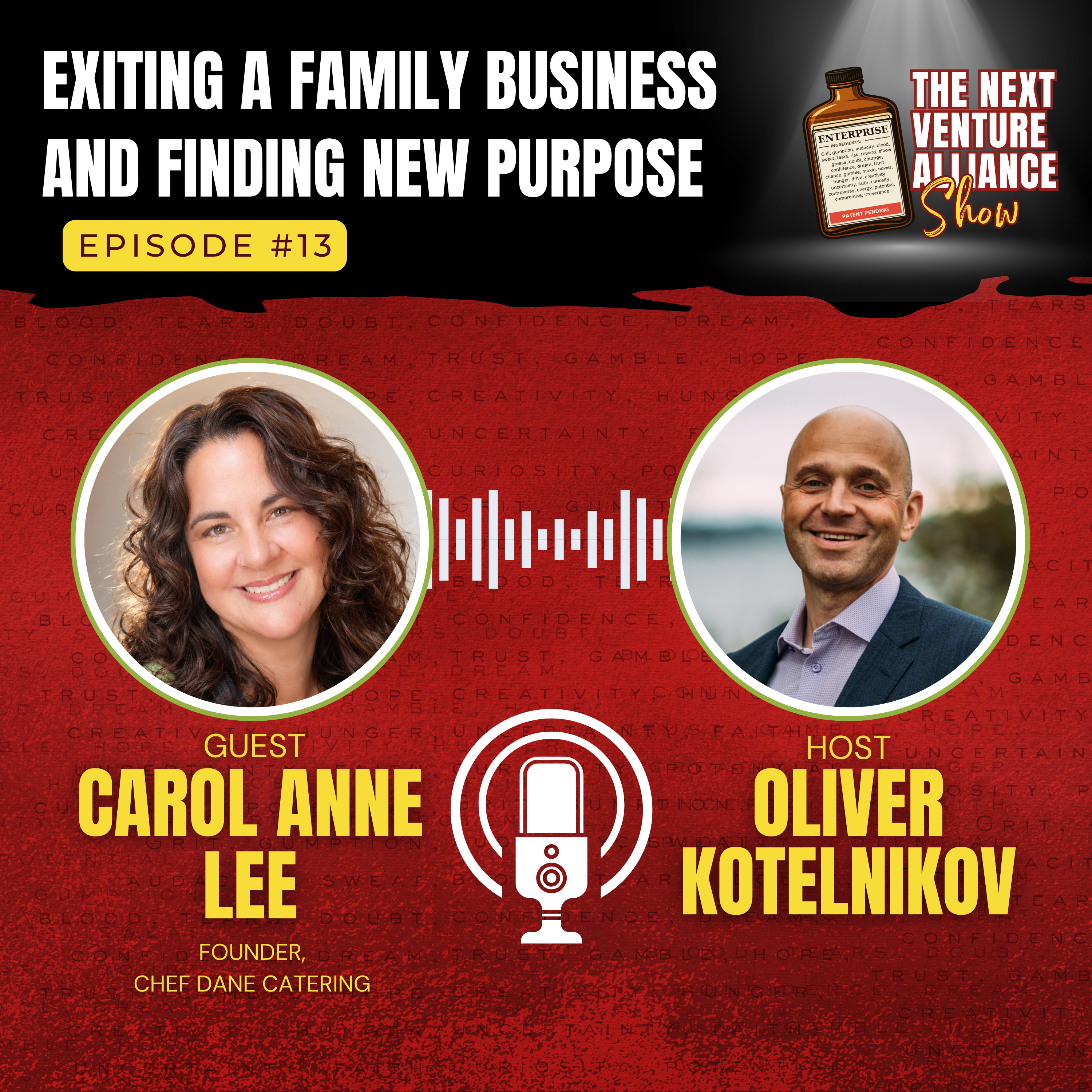
So hello everyone and glad to have you with us today for the next Venture alliance show. My name is Oliver Kotelnikov. I'm an entrepreneur, a storyteller, mergers and acquisitions advisor, and business and commercial real estate broker. On the show we talk with founders, business owners, self starters, industry leaders and trusted advisors who support support them. And together we explore both the strategic and the human side of entrepreneurship. And our guest today is a former business owner and past client, Carol Ann Lee. Carol Ann and her husband Dane owned a very successful catering business in the Puget Sound region called Chef Dane's Catering. They sold the company in 2023 and began their transition to the next chapter. And while they did some typical things you would expect after exiting a business such as traveling, golfing and some well deserved goof off, they did not sail off into the sunset and instead went on to reinvent themselves and ventured on to do some other things that aren't necessarily retirement.
So it's good to have you on the show and good to see you again. Carolyn, welcome.
[00:01:51] Speaker A: Thank you. It's a pleasure. It's been, you know, just over three years, four years since we first met.
[00:01:58] Speaker B: Yeah. Yeah. And so I thought three years would be a good clip to kind of check in and, and catch up and, you know, we can get to, you know, how life's been after selling a business. But I thought, you know, maybe before we get to that to set some context for the listeners, maybe get to talk about the story or, you know, how what led you to owning a business and how we came to be here in the first place.
[00:02:28] Speaker A: Sounds good. I will touch, I think kicking it off though it is ironic in the starting point that next month we get our final payment that pays off our business from the sale of it. So again, I think that timing is interesting how life transpires. So I think that that's a fun starting point. But yes, a long journey. Yeah.
[00:02:49] Speaker B: Three. Yeah. I. And you know, how did you start out in hospitality and then how did you end up even having an idea of opening a business and because for you, you know, what's Interesting. I mean you're both buying a business and exiting kind of happened in that mid career span, you know, where. Which is unusual and I find, you know, fascinating because it sort of breaks some of the societal rules in a good way and sets the life on a different, slightly different time trajectory which I think we could all benefit from. So.
[00:03:30] Speaker A: Well, I mean, I will say I didn't set out to be a business owner and it wasn't part of my vision, I don't think. Like, I think when I was in school I was like, I'll be a teacher or an accountant or some, some of those type of jobs and roles.
I did take a job in a family ran restaurant. It was actually I grew up in Anacortes, so smaller town jobs for teenagers, you know, weren't that abundant. And I had an aunt that ran the restaurant at the Elks 1204, you know, the good classic Elks lodges and everything she made was scratch. And I homemade. I started out washing dishes. I think I was 13 or 14 if I remember at the time. Because you could do that with family.
And then evolved and you know, I was waiting on tables probably by 14, 15 or something and kind of that sort of got my foot in the door to hospitality without any intention of staying in it forever.
I do recall, you know, being in high school and working on Friday nights and friends sort of like scoffing under their breath about oh, you have to work tonight, you can't go out, hang out.
I'd say yeah, but I don't have to get up at six in the morning and ride the bus to go pick strawberries in the field and make a third of the amount of money. So have a good night.
You know, I just.
While hospitality is hard, it also opens up a lot of doors and has huge flexibility for not long shifts. And you can, you can make good money. So that was sort of my starting point.
From that restaurant I dabbled in a few following. I had an older brother that was a chef and so some of the restaurants that he was part of I kind of became a part of.
I eventually moved to Lanner working at a restaurant and it's actually where I met Dane. So my husband.
I was young and just graduating college as in like a two year business degree college, not you know, the big bachelor degree or anything. And just by fate, one day Dane came in and sat in my section and I waited on him and his friend that happened to work at that restaurant. And that kind of kicked off our relationship.
It was the restaurant that was on the reservation side.
And at the time, I wasn't old enough to drive. I wasn't even 16 yet. So my parents had to drive me to be able to work there for when I first started and worked there for a few years. And it was after a couple of years that he came in. So I have great memories of that restaurant. And then I spent time at the seafood and prime rib house.
Dane and I actually kicked off and opened the Channel Lodge, the breakfast program there, the hotel that's on the waterfront. So we spent a lot of time in Laconor and then eventually upon getting married, moved south and I found myself at Ray's and spent 20 years at Ray's Boathouse.
But even at the seafood and prime rib house, I was dabbling in supervisory roles even at the age of 20. So I just kind of naturally took leadership positions and accounting positions, which all really gave me tools eventually to know how to run a business. And I didn't know at the age of 20 that that was, you know, skills that I was starting to gather and Lear.
But moving to Seattle and working at Ray's, you know, clearly much bigger restaurant, Big volume catering, right? Iconic.
[00:06:54] Speaker B: If people ask to name top three, you know, restaurants in Seattle, chances are Raise ends up, you know, everybody's been at the. People want to go and sit on the patio. And that's a kind of a rite of passage of, you know, being in Seattle and dining out and, you know, like he said, volume and busy and that's going to test the metal.
[00:07:15] Speaker A: You know, it's. It's volume, it's quality. And at the time, the. The time that I worked there, the manager and really through the leadership of the owners that ran there, it was a collective of four local business owners that owned Raise.
And they just, they embodied the philosophy that their employees were at the core of all things.
And it wasn't at that you were to ignore your customers that were in the door, but it was really. They believed that if there were benefits and perks and their employees felt amazing coming to work and wanted to be there, that they would have a successful business.
And so I think that that was really kind of core foundational philosophies of then how do I move forward and what type of environment and space do I want to continue to be a part of?
[00:08:04] Speaker B: I mean, 20 years ago, this was groundbreaking. I mean, today, you know, it's everywhere and some. Some, you know, live it and some just sort of live it in statement. But. But it is sort of very en vogue that philosophy. Employees first but you know, a couple decades ago, that was pretty revolutionary for.
[00:08:23] Speaker A: Yeah, you're talking like the mid-90s. And I mean, I started in 93 at Raise. And even prior to that, when the Olympic Athletic Club in Ballard opened, they partnered with Raise and Raise, if you worked at Ray's, you had a membership to the Olympic Athletic Club. All you had to do was show your paycheck. And that was when the Olympic opened. So I mean, that again, was back dating in the 80s and things like that of having again they unique.
[00:08:48] Speaker B: Yeah.
Okay.
[00:08:51] Speaker A: Yeah.
[00:08:52] Speaker B: So they had you for 20 years for, you know, with the, with the, with the company culture and.
[00:08:57] Speaker A: Correct.
And so amazing. I still have fantastic friends that I built at Raise. I think of customers that came in and still have recollection of great conversations. I ran into someone at like the Northwest event show last year and I was like, you look familiar. And we realized that she and her husband and eventually kids came in and dined all the time in the dining room. And I was like, oh my gosh, I can't, you know. And I knew her husband's name and their last name and all these things. So for me, life is about the people and it always has been. And that really resonated that restaurant, really created that. So I was married at the time we started having kids. So I had kids while I was at Ray's, which you don't get quite the amazing benefits that you do nowadays to take time off. But I had flexibility.
At the same time, Dane also being chef, spent time in restaurants and worked like crazy. And he was at Ray's as the catering chef for a year.
And we had had our first child.
He was insane busy. We had. Of course you don't have a baby in December when you work as a catering chef, but Corbin was born on the 9th of December, which, you know, didn't pan out too well with the scheduling. And so for his first birthday, it was. His boss was kind of like, no, you can't have the day off. Like you have to work. And Dane was like, it's my son's first birthday. Like, I'll be going. And so he took the step that was like, I need to do this for myself or do something different. And chose to leave working then and not have that really overloaded, salaried, crazy schedules.
So it was really he that took the first step out the door of having a paycheck and doing things on his own.
[00:10:43] Speaker B: And what was that at that time? Just kind of side gigs or private events out of his.
[00:10:51] Speaker A: Correct. All under the table, out of the house. Nothing approved, really. Kind of friends and family or people that we knew that was like, hey, can you do some food for an event?
And that was in, like, 97, 98.
And so there was kind of a lot of money coming through the tech industry at the time, kind of the kickoff to it. And so he landed a couple clients that was really. They were personal chef clients. So that's where it started. And he had named his business My Personal Chef.
He wanted the philosophy that if he went and was catering an event, was in someone's, you know, kitchen and hosting a party. And the person that hired him as the host of that house, when someone came to them and said, oh, who did your food? Or who's doing your catering? That person could say, oh, it's my personal chef. And so it was like this bragging from the person that was having the party.
[00:11:50] Speaker B: Crafty, crafty. Marketing.
[00:11:51] Speaker A: Crafty, right. But the interesting marketing was he wanted to create this exclusive perspective and didn't believe in business cards. There wasn't a stack of information out on that buffet. It was like you had to ask. You wanted to know about him. You had to ask the host to get to that.
And it worked for the time being. So he had a handful of, you know, half a dozen clients that he did food for. He'd go into the home shop, make their food for the week, follow dietary restrictions, and then that kind of spun off a little bit more into events. That. That started to grow, and it took a while. It was kind of casual. Our kids were young, so while I was working as a salaried manager, he was at home more with the kids being fantastic. Dad. Raising our two boys while kind of casually doing a business.
[00:12:39] Speaker B: You got to be pretty good at your craft to be raising two kids at home and kind of casually kicking out food that, you know, builds a following and business. I mean, you know, he's kind of a.
He's a very skilled chef.
[00:12:58] Speaker A: He's crazy skilled. He would. And. And the planner in me that wants to have, like, a menu and a strategy and what's happening? He do. He started doing lunch and learns for architect firms. And that kind of was a catalyst to sort of growing the catering company. And I. And I. Maybe I shouldn't confess this on air for people to hear or whatnot, but it's sort of like how I think a business grows from being a really small business into, you know, to success and how you have to navigate that, because it is a process to navigate. But I would Be, you know, up in the morning getting the kids out to school because I'd work in the evenings and I'd be like, what are you making today for lunch? Because he'd have lunch for 50 or 60 people.
He'd be like, I'm not sure yet. And I was like, it's like 9:30. What do you mean you're not sure? Don't you have to leave to deliver at 11? He'd be like, yeah, I'll figure it out once I go to the store. And so then he'd leave and he'd go to the store and he would just on a whim be like, oh, I think I'll make this today. And he'd grab ingredients and come back and whip up a lunch buffet, including a dessert, and then go deliver it. And he'd be home by noon. And I would be like, this is not normal behavior. Most people can't do that.
[00:14:12] Speaker B: Yeah, this is, this is not exactly how most people run a business. They would want a little more planning, but I guess talent, right, makes up
[00:14:22] Speaker A: for the talent shine through. And he had a demand because his food was great. It wasn't lunch in a box, it was a buffet. So like the kickoff of sort of being more environmentally friendly appreciated that approach to a lunch and learn type lunch. And it was, wasn't just a cold sandwich. And so that it kind of grew. Those clients that hired him for off parties and it just sort of like organically grew and. And I would say the last probably four years that I was at Raise, I think I heard on a regular, hey, honey, you should quit your job and, and build our business.
Yeah. Dane would say you should quit your job and all this effort that you're putting in to build Raise and make it amazing and how good you are at it. You should do that for us because we can do that. And the cautious planner in me wasn't comfortable taking that leap because it's like, well, that's our whole family then. So it's not just him running a business and doing those risks of being a small business owner. It was now like it's the two of us and it's our family. And so I kept saying, well, you're going to need to take it more seriously and generate more sales in order to get me to feel comfortable to make that move. Like there's things as far as insurances and everything that goes with it that no longer becomes available in retirement plans and you know, things that we did have as perks. So it took a long while it took until I was basically at my 20th anniversary, and raise had seen some management transition, and my GM that I'd been with basically as her AGM for 16 years decided to move on and do something different.
And the new GM came in, and I think we worked together about a month. And we had different philosophies and what was important and how we ran our programming.
And I understand businesses evolve, but it wasn't really like what I wanted to continue to be a part of. And so that was parting ways at Raise after I'd been there for that long.
And Dane was like, hooray, I finally get you.
I said, well, let me go interview for a few jobs first, just in case. I want to make sure this is the right move.
And so, you know, I didn't have a job. I had a little bit of severance and some unemployment to go on. And I did go out and I interviewed and I worked with a recruiter to kind of look to get my feet wet to see if that was what I wanted to do. And I was like, okay, no, that doesn't make sense. Like, I'll partner up with you.
And so he, at that time, again, ran his business very casually.
There wasn't really a huge strategy behind things. Like he'd ought to whim be like, sure, I can do these parties for you for this much, and he'd know how much things would cost. And so just the amount that he really undervalued what he was presenting in product didn't then lend itself to being a business that would be sustainable for the two of us.
[00:17:17] Speaker B: Easy for him. He didn't price it.
[00:17:22] Speaker A: Yes.
[00:17:24] Speaker B: And what people were willing to pay, I mean, he kind of undervalued his own artistic skill and craft, for sure.
[00:17:33] Speaker A: Totally. And so, you know, I came in and obviously we built new clients and things, but the clients that he'd had for a really long time, like, you don't really want to lose them. But on the other hand, you know, many of them, in some ways, I would say, was taking advantage of his generosity in what they were paying. And, you know, there was kind of like the financial crash. And so Dane would, you know, had clients going for a while, and it was someone that maybe couldn't pay more and they were really struggling but still wanted to have it. So he was like, well, just pay me what you can. And then that amount kind of stuck with it. And so I come on board and I'm like, so you're doing a holiday party with premium keto ingredients on the Busiest Saturday in December for X amount of people with staffing and you're charging them like $1,000 or something like that. I was like, so you lose money at this event? And I was like, that's not going to work.
And so I had to gently shift some of those customers and be like, you know, this is, you know, a little bit of raising awareness of the
[00:18:33] Speaker B: reality of what the market is really on your part. I mean it was catering, man, but it was really talent, it was managing Dane's talent to right, line it up with some market metrics.
[00:18:45] Speaker A: Right. And thankfully he understood what I was then bringing to the table. And so we had to figure out that balance from.
He was going from doing it his way for all those years, you know, I mean we're talking probably six years or so of him kind of doing his own thing to now like their sort of, you know, shared role as far as responsibilities. And so it took us a bit to find our lanes of I need you to focus on the kitchen and making amazing food and managing that and let me take control and kind of do the business and get things aligned with where it needed to be. And so we just had to communicate through that. So, you know, it's an adventure being married to your, you know, business partner, but we've had a lot of fun and a lot of laughs.
[00:19:33] Speaker B: So yeah, it's an adventure and it's, it's a skill and it's a game of patience and it's a stroke of luck to make it through because, you know, some people, you know, end up succeeding at the marriage part but, but fail running a business together. Others, you know, like me, we were very successful with my ex wife, a business, but, but you know, we ended up getting divorced.
You know, you guys are, I would say it's rare. I mean, as you know, from family businesses, not, not necessarily married couples, but just family and close relationship businesses and combining those pressures with the pressures of the business, it's not, it's not an easy. You have to be successful at so many different things to succeed. Yeah.
[00:20:31] Speaker A: Yes. And then, and then to top it off, so we'd been living in like a triplex apartment and where Dane was kind of casually doing things. And we moved and bought a house in Edmonds for the purpose of knowing that we felt like we were going to need to have like more kitchen space. And so we, we bought our first home with the filter of will this be a space that we can kind of put a kitchen in. And so, you know, was it flat? Did it have room in a garage. And we chose a house in, you know, kind of the edge of Edmonds that was close to 405 and I5 so that we could work out of that. And that was before I left Ray's and joined with Dane to run the business. And so we had some employees that came to our house. So we truly converted our garage into a catering kitchen. Again, nothing health approved, all still under the table, but commercial equipment that we'd go buy, used and makeshift to make it work and he'd go do deliveries.
So not only did it was it dynamics of a small business, the dynamics of a, you know, the family thing. Like it was now at our house.
And then employees coming in and working out of a back room that had an office and, you know, using the fridge in our house. And so my kids adapting to, you know, I'm like, you have to be dressed kids. You don't get to run around like in your underwear. We have employees coming to work.
[00:21:48] Speaker B: Like when you're like, mom, this is still our house, is it not?
[00:21:52] Speaker A: It was one of the like the happiest moments that I. I won't name which child that it was. But when the business finally moved out from our house, they're like, now I can run around in my underwear. I thought, you don't realize what the impact is on sort of the trickle down of your whole family until something changes. And that was something that stood out. They were very patient with having it. But they also, on the other hand, had food at their fingertips at any. At any moment. And it wasn't your typical family food. It was Chef Dane food that they got to eat and be raised on. So amazing food, which was really great. So anyway, we operated the business out of our house until 2000, out of the garage until 2013. And so we were doing a significant amount of catering for one of the Boeing buildings off their campus there where they hosted airline customers from around the world. And they had plans that they were expanding and it was going to get a lot bigger. And so we knew if we were going to grow with them and we were their primary caterer, that we needed to have more space.
And we just had like, you know, we had bakers showing up at 5 in the morning and we had employees coming to load up events. And thankfully we lived in the county and we had neighbors that we fed food. And so they like, we didn't have any issues with that. But it got to the point where it was too much to keep maintaining at our house. And so we Went looking and found space and found that space in Lynwood. It was an old 7 11. And so it had a great refrigerator and a great space and again, great location for deliveries, but no kitchen. And so we had to build the kitchen out in it. And that was one of the bigger tests of patience, of navigating through trying to still run a business and be busy, but yet you're still, you know, the perspective of the city was, oh, this will be an easy thing. You don't even need approved, you know, architecture plans for the update and then a year plus later of paying a lease that you're not bringing any revenue for. And it was not easy and it was a nightmare to build.
I just retold the story that we were trying to. We bought a used hood system and we had it on dollies and we're wheeling it around outside so we could pressure wash it.
And it slipped off the dolly and landed on my little toe and broke my toe.
I was wearing tennis shoes. I thought I could have lost my foot.
[00:24:14] Speaker B: The metal edge of the hood, the whole thing slips off and just on
[00:24:18] Speaker A: like a low dolly. I mean it went just a couple inches, but like, I mean, I don't know how many pounds that they weigh. I couldn't even tell you how much that they weigh, but more than my toe could handle. So I broke my toe. It's throbbing. And one of the inspectors for the city on his way at the end of the day back to the city, it's like 2:30 in the afternoon, decides to just stop in and check on things. Our contractors are gone. It's just Dane and I. My toe is pulsing in my tennis shoe.
[00:24:46] Speaker B: Emergency in progress.
[00:24:48] Speaker A: Yeah, he just, he had this thought and so he decided he'd come check on it. And I think that was when he dropped this news that the, the wood framing that would be behind the stainless steel on our kitchen line because wood was combustible, that we needed to replace it with metal framing.
Again. This was like building structure. And that was his drop. And I just remember hearing him say that and being so frustrated and wanting to lose my temper while my toe was pulsing in my shoe.
And I can relive that moment. And that's just, I think that's the reality of being a small business owner is you just, you have to figure out those moments and you have to be patient and you have to know that everything on that back end is going to take longer than what you plan and just somehow laugh about it at the end of the day because there's nothing else that you can do. Like you can't get mad, you can't yell at the inspector. You're not going to gain anything by that.
[00:25:44] Speaker B: So the thing is, you don't know if you can actually handle it until it happens.
You're not going into this knowing, hey, these things are going to happen and.
[00:25:53] Speaker A: Right.
[00:25:53] Speaker B: We'll just be really cool, calm and collected and it'll be fine. Like you could have lost your. At the inspector and easily.
And who knows if he, you know, I'm surprised that you didn't. But. Right. You know, that's just one of the thousands of little moments that.
[00:26:10] Speaker A: Thousands. Yep.
[00:26:11] Speaker B: That's not in any business plan.
It's not anything you plan for. It's not anything that anybody can provision for. But, but that is the life of, you know, a small business or it's a thousand of these moments sometimes in one day. Right. It's nothing but a collection of these fire hazards, you know.
[00:26:31] Speaker A: Yeah. So I basically, I built a kitchen at my garage, at my house. I built a, you know, commercial kitchen that was permitted and dealing with contractors and getting that all approved and you know, working with the health department and, and then continued to grow that business. So we were in that space for 10 years before we sold it. And then my funny full circle moment is my house went on the market today or in Edmonds. So I find it fascinating how many things just sort of align in that, in that way.
[00:27:02] Speaker B: Your, your house went on the market today.
[00:27:05] Speaker A: Yeah.
[00:27:07] Speaker B: And that's when it. Okay, wow.
[00:27:08] Speaker A: Right. Like how's. Again, full circle moment that we're having this conversation about how business has evolved and you know, here's that house that we used to stand outside with a grill and grill vegetables because, you know, we didn't have a hood system in our garage, so we did it outside and we had a chef that would be cooking vegetables and she'd go like lay down and rest in the hammock and then she'd get back up and. In the backyard, in our backyard.
[00:27:33] Speaker B: Call it the break room. Right.
[00:27:35] Speaker A: Yeah. It's my hammock.
It's good times. So again, you know,
[00:27:43] Speaker B: great moments and so good to appreciate the opportunity to relive them with you. Yeah, but you're so, you're, you know, the, the journey. I mean, you, you, you leave a successful job to start a business and then you, you sell a successful business to do something else.
Is.
Seems like entrepreneurs are more risk averse or kind of more just willing to part with the comforts and the Safety and the certainty of something that works to try something else. I mean, what is that hunger and that thirst that drives us to kind of want to keep building or trying something new? Because I don't think that that's how ordinary people look at life. And you know, if you get one in the. In the yes column, you keep it right, that's safe. And then you build on that and then, you know, and then that goes into. You work the business until you retire, and then when you retire, you go get to do all these things that you wanted to do, which kind of builds to our conversation. But, but, but what allows you to make these shifts where other people would look at it differently?
[00:29:02] Speaker A: And well, I am married to the visionary and he's the one that pushes and challenges. So like I said, I.
I would have stayed in my comfort lane and probably just continued to have jobs and maybe run a restaurant or something like that. Take over as GM would have been the more likely path for me and how my brain is programmed.
But I think I bring the talent that I can help bring the success out of something. And so Dane had the vision and what did he want to do? And so I was able to help deliver on that.
I loved owning a business, but I mean, to be honest, I'm not someone that's like dying out there to go do a new business. We considered it.
When we did sell the business, I thought maybe I'll take those proceeds and I'll go build commissary kitchens. Because.
[00:29:54] Speaker B: Because, you know, that business model you
[00:29:56] Speaker A: built, we did that.
[00:29:57] Speaker B: That's something we can touch on too briefly, is that it wasn't just a catering kitchen. It was a shared commissary kitchen for other vendors. And that was, yes, an interesting business model that probably could be duplicated and
[00:30:10] Speaker A: works well for sure. And I think that it's a model that frankly, in Snohomish county, if anyone is looking like, I think that there's a massive shortage of commissary kitchen usage.
And I did do that build out. But the struggles and challenges working with the health department with that. So we had existing space, we did a bunch of business for catering. Covid hit, you scaled back. So I really had a kitchen space that wasn't being utilized as much as what it was. And so as additional revenue source, we rented it out to other businesses.
And it was great for our bottom line.
There was no extra expenses. So where you run those really tight margins and restaurants and catering, that was just essentially pure revenue for some additional wear and tear on My equipment and maybe a little bit more electricity usage and some kind of keeping an eye on people and giving them space to be able to work out of it.
My personal.
I was so fulfilled getting to know those small businesses and those small business owners and having that connection and sharing thoughts and struggles that we had been through that I would be able to share with them. And part of our journey too, that we didn't touch on was we bought a food truck in 2019 before COVID hit.
And you know, we thought it was this fantastic expansion. Expansion and was going to be so cohesive or whatever.
And that I think collectively gave Dane and I the most nightmares that we had in our whole business.
The food truck did.
[00:31:48] Speaker B: Yeah. Cool.
[00:31:50] Speaker A: But boy, I have such.
[00:31:51] Speaker B: I remember it was a cool rig, you know, and then. But
[00:31:57] Speaker A: I mean, it was quite a story. And I mean, it was an older food truck. It was one of the first handful in the area of Seattle that we bought from someone else that was a successful business owner, but she was a successful business owner that worked on the truck all the time. And we bought a truck that we paid employees to work on. And that's very different for the profit line when you're running a food truck. And so, you know, take the challenges of running a business looking for that sale, does your kitchen equipment work? And then put it on an old vehicle and try to drive it places and then make sure that the vehicle works and that there's no problems. I mean, kudos to all the food truck owners that are out there. There's a space for them, but it's really an owner operate, I think is a success for food trucks. So. So we had the food truck, it had all of its challenges.
So Covid hit. We took the food truck in neighborhoods to keep getting exposure and marketing and that kept our brand out there. And we built great, you know, PR with doing discounted meals and connecting to hospitals or veterans centers and things to be able to deliver meals to them, which was really rewarding.
But seeing that open space, food trucks don't have to have.
Don't warrant the volume to have their own commercial kitchen and that expense, but they have to work out of a commercial kitchen. And so that's where that commissary kind of launched. So at the time we sold, I had 13 businesses using our space.
I so enjoyed working with all of them.
[00:33:31] Speaker B: I remembered that part which, you know, can be a little tricky to understand because I mean, it's like you managing like, it's like the employees, it's like extra Employees, you're managing personalities, you're managing that tight schedule. You know, hard as it is to manage a, you know, food truck on the road, managing tenants in their space and time and usage of common areas and resources, I mean, that is logisticating times, logisticating to the 10th degree. Like, what is enjoyable about that?
[00:34:09] Speaker A: Oh, to me, like that. That's easy. I mean, so much easier than like, let's do a catered dinner for 500 for plated. Like, I mean, we did those too, but those took a lot more planning. So I think that.
I think I treated them like I did my employees. Like, I gave them the guidelines, here's the structure, and I respected them enough to follow that.
And I guess I was fortunate to have a bunch of amazing other business owners and they were so grateful to have space so that they could run their businesses. Like, you know, there were ones that had been on the hunt for a period of time looking for commissaries and hadn't found one. Well, they couldn't open their food truck if they didn't have a commissary to work out of. And so I think just respecting what they were looking for to create and listening to their challenges and maybe giving them insight created a really good relationship. So it wasn't a struggle. I totally had a joy and I enjoyed all of that.
[00:35:08] Speaker B: I mean, I remember that that was.
That was kind of your crown jewel and that part of the business you ran that, I mean, just exceptionally well. And it was. It was a happy family of tenants and, you know, co op family environment.
[00:35:26] Speaker A: Yeah. So, yeah. So like, like, for me, kind of going. Circling back to like that entrepreneur drive or whatnot.
I think that that was Mordaine that had that drive for that entrepreneurship, and I was like, the support to make it happen in that partnership role. And I loved all of that, but I don't know that I see myself owning and operating something. But I'm also like, I don't have any doors shut. I just like, kind of wait and see what the universe tells me that I need to do.
[00:35:57] Speaker B: Yeah. And it's led you right so far. You know, it's your intuition and, and I, I think your combination kind of the complimentary skill set, you know, and, and relationship with Dane, you know, that's your kind of guiding light. And, and together you guys make great decisions.
But. But I remember that you were a little bit at odds with one another about the decision to sell, if I'm not mistaken. I mean, it's. You're selling a successful Business you're pre retirement.
You know, always a question from buyers and people who are looking from the outside. Why sell a successful business? And then two, you know, what were your guys's thoughts and feelings on it and how did you ultimately come to a decision?
[00:36:47] Speaker A: Yeah. So I recall hearing about a webinar that you were doing through the Washington Hospitality association about strategizing and looking ahead for what does it mean to sell your business.
And it was during COVID I think it was probably 20, 21 or so.
[00:37:04] Speaker B: Yeah. And so interesting for hospitality.
[00:37:06] Speaker A: Interesting times. Yep. And you know, everything is up in the air and what should you do? And I think that we were able to keep successful because I stayed connected with thing organizations like Hospitality association and chamber of Commerces and things and was highly informed as to what was happening with the different grant programs and restaurant revitalization and all of that world that took place for hospitality that supported businesses and gave programming options during COVID And I'm thankful that I'm savvy and was able to navigate that because it wasn't easy for that. But staying connected to those organizations gave me tools that I wouldn't normally have had as a small business owner. And so part of that was that webinar that you were hosting. And so I joined the webinar and I listened to that.
I filed that information.
[00:38:05] Speaker B: Yeah, I remember that.
[00:38:07] Speaker A: And I think it took a bit.
[00:38:09] Speaker B: I mean, the Hospitality association in Covid did a phenomenal job supporting business owners. Granted, it took a lot. There were so many changing regulations. It took a lot to keep up with what needed to happen next. And sometimes it changed multiple times a week, whether it came from governor or state or federal.
But the resources were there, you know, if you were, if you were paying attention and had time to use them.
[00:38:36] Speaker A: Yes, for sure. And I mean that, that changed what we were able to. I mean that kept us our doors open and kept us in business and then able to build on that and make it successful. So I remember listening to your webinar and I filed it and we had gotten to a point where we, we kind of had parked our food truck and we weren't really taking it out to do gigs anymore. And so I'd reached out to you about selling the food truck and just that piece of it wasn't big enough. And so I remember you saying to me, you know, we discussed sort of like what our whole business was. And so I told you about catering or whatnot. And you said, well, if it gets to the point that you decide that you Want to sell the whole thing, let me know, and then that would be something that we could talk about. And so I think it was like a year later, maybe just maybe a little bit longer than a year, and I'd been thinking about what I learned and what we talked about and kind of conversations, and my gut was telling me that it was time to move on and it was time to look at selling our business. And what did that mean? And so I think that being open to thinking differently and not being so focused on, it's only me that can run this business. I mean, we were a catering company that had my husband's name on the building.
And so you think that you can't sell things like that. And sometimes that's not true. In our case, it was not true.
[00:39:57] Speaker B: Wasn't. Obviously it wasn't right. Yeah, we proved you wrong a little bit.
[00:40:01] Speaker A: Proved us wrong. Exactly. And so I think as a business owner, you have to be aware and pay attention to what's happening out there and just kind of have. Even though you're so busy and you think that you don't have time.
Make the time to listen and gain understanding on things that you don't have naturally on your own, connect with professionals like yourself and just learn more and sort of see what's out there.
I'm grateful that I knew that I saw that. That webinar and that I listened to that that first time, or I wouldn't be sitting where I am today, hands down.
[00:40:35] Speaker B: Thank you. No, thank you. And I really appreciate that.
And I mean, you took, you know, you took a year to weigh your options and learn about the process and think about it, and that's about what it takes, you know, Covid, or it takes some time to start wrapping your head around it. And.
Because as you learned, running your business and selling it are two completely different things.
[00:41:03] Speaker A: Correct.
[00:41:04] Speaker B: And some of it is numbers and figures, but others are. It's decision making and separating from the identity of being an owner. Yeah, just the psychological adjustment.
[00:41:16] Speaker A: Totally. It's emotional. It's mental. Like, it's just. It covers the whole gamut. And again, for us, for Dana and I. And you touched on it a little bit.
We were at a point where business was. Was growing again and robust, and there was a lot of catering. And I. I wasn't staffed back up again to where I was pre Covid. I didn't have 25 staff members.
And. And before COVID it was, you know, my kids worked for me, and they were, you know, catering cap captains, and they worked A business from a perspective of knowing that it was their parents business and they really put their heart behind it, even though they were very young men at like, you know, 18 to 22 years old.
And I had other people that I really, I kind of had more of a personal connection with that was our staff.
And some people moved out of state, other people found other careers and just life changed. And so we were looking at rebuilding that staffing. And frankly, I personally knew that I wasn't mentally ready to take that on and I didn't want the company to lose the momentum that we had and where it was growing. And that's why I felt like that was the right timing. It was like it's growing, it's busy. If we don't do it now.
I remember saying to Dane, if we choose to not move forward with selling the business now, then we're going to continue to operate and work as much as what we can and what we can handle and eventually the business is just going to die out.
I don't think that it's going to keep to grow to sell. If we want to sell, now's the time to sell. It's at its peak. The profit was strong and it was an attractive package to put together. So I remember saying, let's just try it. Let's work with Oliver and see what happens. We kind of came up with a number that we felt comfortable with for what that would look like and look ahead. And I remember saying, well, all we can do is put it on the market and try and see what happens. Maybe it sells and maybe it doesn't. Like the universe will speak for itself as to whether it's time again, you
[00:43:12] Speaker B: took a little bit of a leap as an in that entrepreneurial vein. You know, one way to go about it would be to say I need to know exactly what's going to happen and how it's going to go. But you know, that level of guarantees is rarely available whether you're selling the business or starting it or doing anything else in life. So that approach of. And you know, the other thing I think that you did and assessed very accurately is that, you know, selling when things are going well, it's almost the hard when things are going well and getting better. Which is very counterintuitive because the question I sell and think when I'm fully staffed, profitable, everything's going great, but then, you know, you hit burnout, somebody leaves, you know, you're trying to rebuild, maybe the profitability is down and, and you're tired and you're saying, well, now I'm ready to sell.
[00:44:05] Speaker A: And it's not an attractive package, so
[00:44:07] Speaker B: it's not as attractive. Right. So you have to decide what's important and, and is it your time and your next chapter or is it, you know, run it into the ground running until it's good and then see what happens. But it's very different selling from a place of, you know, I don't want to say desperation, but need or being in a rush or having a, you know, a tight set of circumstances and a tight window. I mean, it's a different experience and it happens, you know, but, but your decision making process, I think, led you down a path that produced a much better experience and result.
[00:44:50] Speaker A: Right. I mean, I can't imagine sitting across from a potential buyer when like your business is on the downward spiral or you're so burnt out that you can't even think straight. I mean, I, I knew that I wasn't the wanting to rebuild back to where I knew the potential, where it was headed. So it wasn't that, you know, I was so burnt out that I couldn't function, but I was like, where I see it going, I don't see myself taking it on that journey and I don't want to stop that.
So instead being able to sit across
[00:45:21] Speaker B: on that journey, you just didn't, didn't want to steward it on that you wanted to do something. But when you had put the business in a position, it was on the launching pad, correct?
[00:45:32] Speaker A: It was ready.
[00:45:33] Speaker B: Yeah.
[00:45:33] Speaker A: And it has. And so sitting across from a potential buyer and having that pride and being like, it's successful and here's this great gem that you can take on. And I remember saying, I know that there's huge potential. It's just around the corner if you want to build that structure to do that. And that's what sold it.
[00:45:52] Speaker B: And when you said it, it was so genuine and authentic because, I mean, we were sitting there, I remember, with you know, ice cream cones in our end because, you know, was also a positive individual and sense of humor and.
[00:46:08] Speaker A: Yeah.
[00:46:09] Speaker B: Came in and brought in some ice cream and we talked about it and that really, I mean, it was a one meeting, not a one meeting sale, but a one meeting decision for both. Because, I mean. Yes, because it was so. Well, it was. I mean, things clicked.
People go, okay.
[00:46:26] Speaker A: And I think that as a business owner, that when you're handing over, especially something that had our name on the building, you know, I think that's why it was a bit more difficult for that concept for Dane to let go of that because it was so personal. Like he started it, you know, he invested 10 more years to it than what I had. Right. Like that was his baby that he was then that his wife's like, hey, by the way, we're gonna sell this. Right? So it took a while, it took a little bit to come along with it. So having the right buyer was reassuring to us and it made it easier to hand it off.
[00:47:03] Speaker B: Leaning into golf.
[00:47:04] Speaker A: Right, right, exactly. And I remember we listed it and four months later I was handing over the keys. And I don't know how fast your normal transactions take place, but I felt like selling a business and, and doing it in four months start to finish was like, I felt like I'd been caught in a whirlwind. You know, you're still trying to run your business. I remember we had our largest plated catering event in the history of our business in June. In the middle of the sale we listed in April, we handed over keys. In August the new owner came and walked through to take a look and I remember telling my staff that I was like, oh yeah, he's a potential client. Because like we hadn't disclosed everything was under NDA. It was so stressful.
[00:47:48] Speaker B: Yeah, no, it went fast and it was on the faster end of, you know, timelines. But you know, and I think I told you nine months or six to nine months more normal, you know, which is, which is in there. But you know, that buyer can come day one or they can at the six month mark and in the end one person can buy it. So yeah, if, if the first person walking in is the right person, you know, and, and there is a little bit of a fishing analogy here where you cast the line and you can sit there all night or all day and catch nothing or catch something right before you leave or, or you can get a bite right away. I mean that's, yeah, the excitement of it.
[00:48:34] Speaker A: You know, I'm putting the energy out too because I think my house went on the market at 2 o' clock today. So I'm putting that same energy, four months for the business. I'm going for four days for the house.
[00:48:44] Speaker B: I'm gonna go with four days, four days to a week on the house.
[00:48:50] Speaker A: That's the goal.
[00:48:51] Speaker B: Curious to find out.
[00:48:52] Speaker A: Yeah, but, but even in selling, I mean I, I was good with it because again it was sort of, I initiated the concept and Dane knew that like it was sort of time. It took him until we'd gone on an amazing trip, went through the holidays came back, and I remember he. He swung by the kitchen in, like, January or February after we had sold to pick something up for that.
[00:49:13] Speaker B: Yeah.
[00:49:14] Speaker A: Yeah, he had to run and. Yep. And he came home and he was like, you were so right. But it took that long for him to come to an understanding that it was the right timing for it. And so I. I think respecting that, like, if you're in a business with a business partner or whatnot, knowing that, like, our thought process was. Were different from start to finish. And so I think being open about that and supportive about things like that, then makes it a much smoother, happier process, I think.
[00:49:43] Speaker B: He said, you told me on the phone, he said, yeah, I don't miss this at all. Or like he was expecting to be, you know, emotional or torn, but he walked in there and did something or took something up and was like, yeah, I'm good.
[00:50:00] Speaker A: Yep. Yep, I'm good. And I believe I got a. You were right. So, you know, we'll take. We'll put that on record.
[00:50:07] Speaker B: That's worth a lot. I. I know that hard. You worked hard, and you want for.
For a long time, and. And it wasn't coming, but. Yeah, but. But came at the right time. Right. Like I said, you got to give people space, and, you know, they're big decisions, you know, and I had to give you space. You had to give Dane space.
Transaction. It's space.
Everything needed.
[00:50:36] Speaker A: It's sort of time to curate and cure. You know, I mean, it just. Yes, it all takes time and space. And, you know, the incoming buyer had to, you know, have his processing, too. So there's. There's so many moving parts that you have to just be patient and be thorough and communicate well and sometimes just take the leap to make the decision.
[00:50:58] Speaker B: Like, I think that's the big part. And I think you have to set the wheels in motion and then.
And then give it time that. That it needs and control the things that you can control. But. But those leaps, if you don't list it, if you don't make the decision, you're never at that time where you're deciding yes or no on a buyer. Right. You got to take it step by step by step. So, yeah, so when you sell a business and retire, you know, the roadmap's kind of clear. People are, I'm retired. I'm no longer working.
You know, here are my bucket list items. I'm doing them. You know, in your case, as I mentioned in the intro, you did some of those things, but you also Had a next chapter. You were very cognizant of the fact that you are.
You went on some amazing travels and played some golf and probably had some, you know, margaritas early in the day at some point. But. But you were cognizant the fact that you would need to kind of reinvent yourself and find your next chapter.
What was that process like? What's it been like over the last three years or maybe the early days or anything that you want to mention?
[00:52:08] Speaker A: Yeah, but. Well, the first year was.
Was travel and playing and a lot of golf for sure.
[00:52:15] Speaker B: I mean, what were some of the things that Christmas trip, I mean, you guys went on the trip pretty quickly.
[00:52:20] Speaker A: Yeah, we kicked it off with a trip to Europe.
That was part of why we pushed up the sale date was because I knew I wanted to be done and have all the transition time frame allow enough time for that for me to get on a plane and not have to think about the business.
So we had had an opportunity plan to go to Italy and it was supposed to be like a nine day trip was the initial plan. And then we put the business on the market and I said, I think this is going to sell maybe. And when we saw that it was in motion, I said we should change our return date and just go to Europe for a chunk of time. And so it went from a nine day trip to 47 days. And so we left at the latter part of October and we were there for a month and a half exploring Italy.
[00:53:06] Speaker B: And right before Christmas, I think, yeah,
[00:53:10] Speaker A: we did Italy, Spain and Portugal. We came home and was home for a week and then we went to Texas to see my son for a couple weeks over the holidays. So we'd been. Actually, I think we started with Texas, went to Europe and then went back to Texas. So I think in about, you know, three months, we'd been home for about two weeks. And it was amazing.
And it was, it was travel like I've never experienced before. I wasn't worrying about did an event get staffed right or did they show up or did payroll get ran or like I had nothing that was really linking me that I had responsibilities at home. My kids are, you know, mature and settled.
They didn't need to be kind of managed. So when I was thinking about reaching out to home when I was on that trip, it was because I wanted to share the joy of the trip, not because I was checking in on what was happening at home. And that was something I've never experienced before. You don't get to do that when you Own a business or you're working or anything. Like, it was a totally different world.
[00:54:08] Speaker B: Yeah. And so different world. So how is that world different from, let's say, being really well staffed, having prepped for your departure, everything taken care of, still owning the business, but all the bases covered versus no basis covered because you have no basis to cover. You don't have to worry about. How are those two different?
[00:54:28] Speaker A: Oh, I just think they're extremely different. Like, I mean, I had amazing staff and I knew I had could have utmost trust in them, but I think I was on one trip that we left on a cruise and I think that the food truck went to go out and I don't know, it was like the generator wouldn't start or the truck wouldn't start. And so they were having to troubleshoot and figure out, like how to fix something. I mean, you never know when the sewer is going to back up in the kitchen and you have to call the landlord and you give them the tools and stuff to be able to call places. But things still happen.
There's still occasionally they may have to reach out because it's outside their scope of what they can handle or a decision bigger than what they're equipped to be able to do.
[00:55:07] Speaker B: So you're always on, essentially. You may not be called up, but you're always on.
[00:55:12] Speaker A: I mean, you could have GMs and executive chefs or whoever running your business, but I mean, ultimately it's my name on the business license, it's my name for liabilities, it's my name to make sure that things are all above board and work. And so you just, you can't control when things happen outside of that. And so that was part of why we didn't go the path of keep this successful business and bring in a GM to run it and kind of try to be more hands off and know that you're passing on some of your profit, but yet you still have this growing business. Because I knew as the person that ran the business, it would, you would never be able to. You can't let go. You still have to be paying attention to what's happening or you find yourself in trouble most of the time.
[00:55:54] Speaker B: Was this a brand new feeling for you? When were you able to disconnect? I mean, on this trip.
[00:56:01] Speaker A: And I totally disconnected and loved in the moment. And I remember when we first we'd been on the Amalfi coast and then worked our way up to Rome and we were there one evening and we went for a walk and it was a night and we came around the corner to see the Coliseum at night with the lights all glowing on it, and it was like a step back, like, take your breath away.
Yeah.
[00:56:25] Speaker B: And you weren't thinking about or backed up. Sewers.
[00:56:30] Speaker A: Yeah, exactly. I was like, I want to share this with my kids in this moment. And that was cool.
[00:56:35] Speaker B: Yeah. Such a good moment.
[00:56:37] Speaker A: Big deal. Yeah, totally.
Triggers, obviously, lots of emotions still.
Yeah, it's a big deal.
[00:56:44] Speaker B: That's kind of.
That's what it's all for.
[00:56:48] Speaker A: It is, yeah.
Yeah. So, anyway, travel. We golfed a lot. That next year, we sold my mom's house and moved her into our studio apartment. We'd been doing a remodel on our house, so we kind of were still navigating a lot of that construction with, you know, contractors and things and making our way through that and moving into a new kind of living space on a lovely lake up north.
So that was kind of after travel. We spent the rest of that first year finishing that, getting my son moved into a new apartment, new condo, and then I spent kind of the next year bored, honestly. Like, I think after golf season ended,
[00:57:29] Speaker B: year two, you're roughly. You're starting to get bored.
[00:57:32] Speaker A: Yeah. So, like, summer has ended. It's going into year two, so it's the fall. Like, we did another cruise, which was really cool and amazing, and, you know, had a couple weeks of travel. Our goal is to golf in every state. So we knocked off, you know, some states down in the south. So, you know, to be able to do that was. Was lovely and amazing.
But then winter kind of hits, and you don't get to golf as much. And so I found myself at home and not motivated to do a lot, and I didn't have anything to really spend mental time and effort onto. And for me, I. It didn't work. Like, I needed something to focus on and challenge me and feel like I was contributing to something, because suddenly, like, there wasn't. Like, my kids were grown, settled, successful. I didn't need to continue to nurture them on an ongoing.
My house was remodeled.
[00:58:23] Speaker B: You were kind of drifting and.
[00:58:25] Speaker A: Right.
[00:58:26] Speaker B: Purposeless. Rudderless.
[00:58:28] Speaker A: Correct. A little bit rudderless.
Dane found his life in golf, and I wasn't surprised at that by any means whatsoever. So both last summer and this year,
[00:58:42] Speaker B: he moved into the life in golf at that stage.
[00:58:44] Speaker A: Correct. He fully is embedded and went all in instead of it just sort of, like, flirting with, enjoying golf. And so that was, like, awesome for him, and I'm thrilled. And he loves it all the time. So he he works at the golf course so that he can golf all the time, which is the life that every golfer wants, which is kind of
[00:59:02] Speaker B: the ski bum equivalent. Right. You work at the ski resorts so you can snowboard or ski. Right.
[00:59:07] Speaker A: He's doing.
That's doing what you love so that you can do more of what you love.
[00:59:13] Speaker B: Yeah, yeah. It's a nice virtual cycle.
[00:59:16] Speaker A: Yeah, totally. And so, I mean, I spent some time. I did some consulting for some other small businesses. I helped, like, a cookie company. I did a couple of events for past clients from the perspective of, like, event coordination as opposed to the caterer, which was a unique experience because Chef Dan Catering catered it. And then I helped them, I helped sort of manage them to make sure the event went well from the perspective of the client of who was having the event. So it was a good bridge gap and it worked well, thankfully, and they did a great job. So. But it was, it was interesting to see, right. That they were, you know, here's my business, but it's not my business anymore.
But yeah.
[00:59:57] Speaker B: And did you, I mean, how, you know, when Dane came, kind of had a, A brush with Chef Danes. He found that he wasn't emotionally connected when you were, when you were working with. And then seeing every, I mean, did you feel any, I don't know, emotional urge to go back or any. What were your feelings like when.
[01:00:18] Speaker A: No, I did not feel an emotional urge to go back. I, I, My emotional response was best decision ever.
Yeah, yeah, it was good. But, I mean, I was ready to do that. And so, yeah, I didn't look back at that function.
[01:00:33] Speaker B: Right. You built something. It's kind of like your childhood grown up and you're watching out there in the wild and doing well. You remember their childhood, but you don't want to go back there. Right.
[01:00:47] Speaker A: Right. I think on the flip side, instead, it wasn't, it was, it was prideful moments of the fact that we had built this, a. Built a small business successfully. We, we built something that was a sellable business that someone wanted to buy and purchase our name on that side of the building because, I mean, a catering company was all about those relationships and what clients that we had built. Like, you're not. There's not a lot of tangible things. I'm not selling a physical building or production equipment. I mean, there's some kitchen equipment, but it was, honestly, it was old kitchen equipment. We bought it all used. It had. It was tired, you know, and yet a few vehicles and stuff. But like that, the, the price was associated with the relationships that we had built with our clients. And so to be able to have that be a sellable business, it's such a moment of pride. And that company's doing great. And I know that they've probably doubled the business that they did when I sold it off.
They've really paired back. They don't do commissary. They're down to like three commissary vendors now because they're so busy with catering. So.
[01:01:53] Speaker B: With their own volume.
[01:01:54] Speaker A: Yeah. Taking it a different path. And that's okay. Like, it's their right, it's their story now. But, you know, we built a business that our story continues. It's just not us leading the way anymore. I think that's amazing.
[01:02:06] Speaker B: Yeah. And your name and Dane's name is still, still on there. And interestingly, we keep hitting on full circle moments. But I was at a professional development event today at the Master Builders association and it was catered. Lunch. It was the catering company that brought lunch.
[01:02:24] Speaker A: You know, that's so funny.
[01:02:26] Speaker B: I was like, well, I'm talking to Carol Ann in just a few minutes, so.
Or later on today. But. But it sounds like we're checking some serendipity boxes here.
[01:02:38] Speaker A: Oh, for sure. I think that that's what life is. And I think that our life has always led that way that I know. I would like, think about a client that I hadn't heard from from a while. And then the next day I'd get a phone call from them and they were like, oh, my son's graduating or whatnot. And I hadn't heard from them since it was their fifth birthday or who knows, right? So I think that if you're open to things in the universe, sometimes things come your way. Like, it's just. There's an energy out there way beyond what we have control over.
[01:03:05] Speaker B: Have your, you know, doors open and you can jump through them or, or not. And then they close and then.
Yeah, it's time. Time is of the essence. I know you love the contracts and the, and the, in the legalese portion of it, you know, one of the things in the contracts that I, you know, it always says time is of the essence. And isn't it always and for and for everyone?
[01:03:29] Speaker A: Yeah, just.
[01:03:30] Speaker B: We just don't have enough of it.
Or maybe we have just the right amount. I don't know.
[01:03:35] Speaker A: Yeah, exactly. So, yeah, so if we, so if we look into like where that was like that kind of over that winter, I knew that, like, I was like, I need, I need to go do something. And so again, just sort of like I'd mentioned to people, like, you know, do you need someone to do these jobs or consulting or like, you know, I reached out to a few people that I had good, positive connections with to be like, look, I need something like even on a part time basis, something to give myself focus to. And so like I said, I did a few different kind of one offs.
And then I have a very dear girlfriend of mine that at one point worked for us at Chef Dane.
She and I go back to our days back at Ray's because again, those, those relationships that you built.
We worked together for I think probably like 17 years overlapping at Ray's. Our kids were born. Our first, my firstborn was four months older than hers and we traded babysitting so that we could work shifts at night and not have to pay because you couldn't afford it. So that's, it's a strong bond. So we spent a couple years of kind of like raising our kids together.
And she, at the time when she was working for me, catered and sold an event for Primera, this huge breakfast for like 2,000 people. It was like one of these huge events that we'd never done before and managed to pull it off.
And her point of contact basically poached her from Chef Dane to come work for Primera. And so she came to work at Premier and was doing events and things and so had a departure from our company, which, you know, good for her for, for landing this great position. And she's grown and developed within the job, you know, she was doing events, but then she'd hire Chef Dane to come do them like for future summer
[01:05:23] Speaker B: events or late or after you'd sold.
[01:05:27] Speaker A: That was before we sold. So that was like even before COVID So that was probably like 2018 or so that that took place in your guys's relationship.
It didn't, but we didn't get to spend as much time together, you know, versus what it was when she was showing up at the door or whatnot. But I think that strong relationships and bonds like stand the test of time. So we would get together and go for walks on occasion and still kind of do whatever. And from the, I think probably from six months after she left, she kept saying, caroline, you need to come work at Primera. You'll love it. And I was like, but I own a catering company, I can't really leave.
And there was one point that I was really burned out at work and I remember her saying it to me and I was like, I wonder if I can hire a GM and leave. I was like, how would that work
[01:06:12] Speaker B: day to get you to think about it? Yeah.
[01:06:15] Speaker A: Yeah. There were some times that it crossed,
[01:06:18] Speaker B: by the way, every business of days when you. When it's, no, no, no, everything's great and it's like, you know, that actually sounds good right about now. Like, whatever that, you know, crazy sounding offer was at the time is now appealing.
[01:06:33] Speaker A: Right. So. So the crazy offer, the opportunity came up again. And so that was like in the spring of last year. So spring of 25. So I've spent all winter kind of stewing and feeling not so great. Like, I wouldn't say I was depressed, but I felt like I was. I was definitely kind of like mentally lost as to what was going to be my purpose. And I didn't have anything that was really speaking to me. Like, I want to go spend all my time volunteering it here. Here's something I'd always wanted to do because I think I've always just been doing. I haven't really taken that step back to be like, what is that thing? Which is a hard thing to identify. That that's not easy.
So this opportunity came and I think it was just again, a conversation that I was like, well, Andy, let me know if anything ever happens. And so the next thing I know, she's like, well, there is a position that's open that we're looking to fill.
And so I got, you know, I put my resume together and submitted it and thankfully, obviously, she. She pushed it through. I think I was one of. I think it was like 350 applicants for the job.
[01:07:41] Speaker B: One of three. 50?
[01:07:43] Speaker A: Yeah, like in, like in a matter of days. I think it was like in three days they had like 350 applications or something like that. I mean, it's an amazing company to work for. It has great benefits. It's hybrid, so it's only on campus eight days a month. And so a lot of boxes checked for a lot of people that want to work in that type of space. And there's a lot less hybrid or television commute jobs nowadays. So people were very into that.
[01:08:11] Speaker B: So, so, so, so when was this time?
[01:08:16] Speaker A: That was like LA. April 25th. So like just over a year ago.
[01:08:22] Speaker B: Okay. And. And so was that your next step? Is that where you are now?
[01:08:27] Speaker A: That is where I am now. And I'm coming up on my one year. I started July 7th or so. So the first week in July is when I started. And so my role, I do events and employee recognition.
So I have nothing to do with insurance.
I, I get to plan the fun stuff and I get to do things that take care of employees, which speaks to me and how raise ran their business all those years ago. And I get to be involved in events.
I just don't have to produce the food.
And one of the programs that I'm responsible for to oversee is our on site cafe. So I get to come up with marketing and events and promote them to our employees. So they get to join like cooking classes or different things like that.
[01:09:24] Speaker B: Well, I mean that sounds like it's a custom fit for you and right up your alley.
[01:09:32] Speaker A: Yeah, there's times that I feel a little bit guilty because I get to come to work and I get to hang out with, you know, a friend, which is not normal.
I get to do fun and cool things to take care of employees. So yeah, it's a good fit and I, I think it's good because I was ready to be involved in something to be challenged. I haven't worked for a big corporation ever, so there's a huge learning curve.
[01:09:59] Speaker B: And so you've, you've ventured onto your next chapter. One kind of question I had, you know, and you touched on it a little bit. But what are some of the biggest challenges that business owners may not be thinking about?
You know, selling can seem like a dream retirement or the next chapter.
You know what you mentioned wanting to be busy, wanting to get back out there. I mean, what else is, can be difficult?
In that post, post business ownership phase, is there an identity piece to it? Did you struggle with not being a business owner or not having that as part of your identity?
[01:10:45] Speaker A: I think I struggled more with not feeling like I was contributing and being a part of something.
And our business is so focused on people.
So then to not have those interactions with people, that was hard. To not, you know, go to event and be able to interact with a hundred people whether you knew them or didn't know them. And that sense of energy that comes from that. So to suddenly not have that, that was a transition for sure. And you know, you'd go to get together with your friends, well on a Tuesday during the day, like they're working, they do have jobs and responsibilities. And so to be on the younger end and have that kind of retirement freedom, if you were, you know, to think that way, it's a little bit more difficult to fill your time with the people that you're closest to because they don't have that time.
So I think that was a big challenge, you know, that the sense of Being a business owner and things like, again, I was. I was ready to move to that next.
So that part was a little bit less difficult, but. But I definitely struggled with the like. Like, who am I now and what will I do? And I think you have to give yourself time to process that and know that it's almost like in a way, like the loss of a loved one or something. Right. There's kind of a grieving process, and then you have to gain understanding and then come up with a way to move forward from that with having that be part of your history and find ways to infuse it. So, I mean, I use my knowledge that I had from running a business, even in the role that I do at Primera, and there's things that I catch and because I still think like a business owner, that doesn't ever go away, that you're looking for making smart decisions with whatever personally or in the role that you have.
So I think it's. It's good to not lose that and want to share. And I have.
I just talked yesterday to an.
We have an office in Spokane for Primera, and it's in a new building, and they're looking at figuring out ways to rent space out for events. And, you know, I offered them my knowledge to say, if you ever want to run ideas by me, I'm always open for that because I think I do have good perspective on it from say, oh, they were thrilled with that, you know, and so I think continuing to put that out there keeps me connected. I just talked to one of the food truck owners that owns Split Open and Melt. He was one of my kind of on the first, like, handful of people that rented from the kitchen there, and he still does at Chef Dane. And, you know, I talked to him like two days ago. So I think keeping those relationships helps ease, not mean a business owner any longer, because that's the part that was most important to me. It wasn't to me. In reflection, it's not about how much sales did you do. It's not always like, that's not always the end game. Sometimes just building more sales doesn't make you that success. But, you know, success is those relationships that you get to take with you.
[01:14:08] Speaker B: Any.
Any trouble kind of become, you know, with it becoming an employee again and with that headspace and where are you just a better employee because you think like a business owner.
[01:14:26] Speaker A: It's funny, it's probably was like there was several interviews and getting the job, and that was definitely one of the top questions was what you've done all that. Like, why do you want a job? Like, you know, kind of the 9
[01:14:38] Speaker B: to 5 job kind of a little
[01:14:40] Speaker A: bit to your right. And so, like, you know, they. I mean, I understand they're looking to hire someone that's not going to be like, two months in and being like, oh, yeah, this is pointless. Why am I doing that? Right. They're protecting who they're hiring and, you know, spending that time and effort to bring someone in. But I knew that there would be things that I would be learning, you know, systems and technology and perspective from a corporate business. You know, there's like 3,000 employees here. Like, I haven't been part of an organization that's been that size, and so that's exciting to be able to do that.
But I was good with it because I knew I didn't want to have something that I had to take home and stress about at the end of the day. I was okay with doing my work during my work day and being. Having fun with it and excited about it and not having it carry over so that I could still then go golf in the evening or I enjoy my weekends with my family and, like, that's where my value is. But it gives me a bit more purpose to have some involvement, and I feel prideful of what I'm accomplishing here.
[01:15:49] Speaker B: How many. How many nights a week do you golf?
[01:15:53] Speaker A: I usually. I try to do two.
[01:15:55] Speaker B: Two. Okay.
[01:15:56] Speaker A: It doesn't compare to Dane Danes. Usually golf's like four days a week.
[01:16:02] Speaker B: Nice. So collectively, you guys golf all week.
[01:16:05] Speaker A: Pretty much.
[01:16:06] Speaker B: Pretty much nice.
No, it's.
And I'm, you know, I'm all for that and. And for kind of challenging, you know, that sort of convention of work until you're retired and then sell and then do the things that you want to do.
There's nothing wrong with it.
But it's also, I think, open to interpretation. There are so many other paths that if you have taken the risks to build a business, to start a business, to build it, you've made it a success.
I think that's license to sort of keep creating and charting your own path.
I think at that point, you have no reason to follow a conventional script because you've already gone off it. You know, by opening a business, you've. You've defied all odds by succeeding in running a small business. You know, why be timid and then stop? You know, clearly your gut's telling you the right things.
Listen to it.
[01:17:17] Speaker A: Right. I mean, I will say my perspective of, I think being an employee Here is.
I think my, my perspective is different because I made the choice to come back to work and to take a job. I didn't have to.
I could have, you know, we thankfully did well enough in selling our business and being smart with finances and things would have been okay. Selling a house, what, you know, whatever choices that got us to this point.
So it was me wanting to have something to fill my time, which is a huge luxury in taking a position like, you know, I think again, that's sort of challenging convention, that's not normal, that I get to be like, oh, I think that'd be nice. I think I'll go back to work. Right. Like most people work because they have bills to pay and different things like that. And so I also know that when I, when I come in and I do my job, I think that I, I think I throw ideas out and be creative and maybe push the envelope in a company that's very traditional about things.
Because I'm also not like, afraid that something might happen, you know, with my job. Right. Because I don't have that pressure to it. So it's again, it's kind of like being able to go on a trip and not have pressures from the backside. Like, it's sort of the same in this job. I'm doing it because I'm having fun doing it. And so I think I, I paid some dues with being an entrepreneur and owning my own business. And so to have, have that play is good.
[01:18:47] Speaker B: Yeah. And that autonomy and, and kind of a different decision making.
I think owning your decisions and owning the risks and the rewards of your decision comes from having done that before and, you know, succeeding in business and taking that leap, you can either do it or you can't or. I mean, you can read and write as many books about it as you want, but, you know, if you haven't had a hood drop on your, on your pinky, you know.
[01:19:20] Speaker A: Right.
[01:19:20] Speaker B: Way to simulate that wonderful experience.
[01:19:24] Speaker A: Yeah.
[01:19:25] Speaker B: You have to have done it.
No great stuff.
Any advice for aspiring or early stage business owners?
It's a broad, broad lens and a broad question, but yeah,
[01:19:46] Speaker A: I think, don't be intimidated or embarrassed to ask questions because there's plenty of things that you have no idea about.
And I still take that with me now, like in the role that I'm at. I started a new job and I wasn't intimidated to ask questions and admit that I didn't know things. And I think that's helped me succeed and continue to succeed.
For me, joining like the Hospitality association and the local chambers was very beneficial not only for the knowledge and tools and resources that they provide, but for like the chambers and going out and networking and going to a lunch and meeting other business owners. To be able to be like what are you going through?
Or just have those support and sounding boards was really valuable.
So if your business warrants that.
[01:20:37] Speaker B: Like the local chambers, the Homeish county or Lynwood Chambers. Right. I mean you were right.
[01:20:43] Speaker A: We were. Kitchen was Linwood and so I was part of the Lynwood Chamber which actually was a new kind of. They had just reassembled that there was actually even a Linwood Chamber. And now it's rather successful.
I belong to the Edmonds Chamber. And then there's the economic alliance of Snohomish county, which is a broader, broader business. And then the Hospitality Association. So those were the organizations that I joined.
[01:21:10] Speaker B: Yeah. No, those are great resources and, and the value is phenomenal. Right. Many of the things that they provide are either free or just ask for your time. So it's, you know, it's a free course, free webinar just for an hour or, or, or you know, click a link for an hour and, and then we'll provide you with resources.
[01:21:31] Speaker A: Yeah.
And, and attending those lunches where they would bring in different speakers, I can't, I can't even name how many times I would be list be there and an organization might come in and not necessarily like Small Business Administration, but some of those kind of spin off organizations for that.
There was like an engage group I think it was called or Impact Northwest maybe.
And I remember them talking about the resources that they had for small businesses and helping you like evaluate your business plan or get lending or just a plethora of things that I thought, wow, I should have contacted them before we even opened our doors because they're just amazing resources that have connections and know how to navigate that. I wasn't aware that those existed. So I think like investigating within the community that you're opening and looking reach out to the chamber to say I'm going to look to open my restaurant or open my business.
What organizations are there that might be a support for me to connect to and do it earlier.
By the time I learned about them, we'd already kind of troubleshooted and stumbled our way through.
[01:22:46] Speaker B: Learn the hard way in some cases. Right. But whatever question, the bottom line is whatever questions a business owner might have, whether it's business plan or financing or looking for new opportunities or finding commercial space and there's probably an answer in One of those free resources through trade organizations which, you know, oftentimes they're government funded or regionally or you know, municipally funded to, to help small businesses. So.
[01:23:15] Speaker A: Right. And they keep getting funding when they help people. So like you're allowing them to keep in business or keep operating by utilizing their resources because then they get to report back and say, look, the impact that we've had. And so it's a win, win.
[01:23:31] Speaker B: Anything that you're reading, listening to, I mean apart from trade organizations, this could be books, podcasts, something that you learned in your travels.
I mean what, what stood out the last few years as far as kind of learning and new things?
[01:23:54] Speaker A: I think that I like to surround myself with like the light hearted positivity in the world. So making the choices to do that. So my most current podcast I've been listening to Amy Poehler.
I think she's fascinating and all the different comedians or actors and celebrities that she brings on that are just.
[01:24:18] Speaker B: This is Parks and Rec Amy.
[01:24:20] Speaker A: Yes. Yeah, she's got a great podcast and just it's so fun to listen to the people that you've seen on SNL or whatever on Parks and Rec or all those different amazing shows that she's been a part of, but just she's down to earth and real and all her whole podcast is just built around positivity and I thoroughly enjoy that. That's my go to listen to in the car, other than when I was listening to your podcast, to be able to get caught up on what I was facing today.
[01:24:52] Speaker B: Oh well. And, and, and hopefully that was entertaining and educational and.
Yeah, and just hopefully that brought some positive energy as well.
[01:25:03] Speaker A: It was, it was like having you in my car, having, you know, listening to you talk though. I was like, oh, this is, you know, you don't normally know that. I guess maybe you don't normally know the people when you listen to a podcast. Like clearly I've never heard Amy Bowler talk to me or any of her guests. Like you're not familiar.
No, I don't have quite that relationship.
[01:25:24] Speaker B: This podcast and, and, and then that will be a full circle moment.
[01:25:28] Speaker A: Right.
[01:25:29] Speaker B: Thinking about your podcast and your phone will ring and it'll be, hey, this is Amy Poehler. I really enjoyed you on the next Venture alliance podcast. You should come and be a guest on my podcast.
[01:25:40] Speaker A: Yeah, we'll see how that happens.
Watch, watch, just wait and watch and see it happen or whatnot. So yeah, I just like to do it like a lot of light hearted, I will say it's Funny.
I recently pulled up. There's Chopped Castaways is the name of it. And Dane, with his cooking talent, we've always, for years, has said, you should go and chopped. You'd be really good at that because he just is so good on the fly.
And I don't know if you know. Do you know the premise of Chopped Castaway?
[01:26:15] Speaker B: No, can't say that I do.
[01:26:17] Speaker A: So it's like 12 chefs, and they get brought to an island, and the judges are there, and they have to cook over an open fire.
They still get a chopped basket, smaller pantry, but they're cooking over first. They have to build the fire and kind of set up a mock kitchen camp,
[01:26:35] Speaker B: caveman style, put something together pretty much.
[01:26:38] Speaker A: But they're recognized, amazing chefs that are now doing that. Some of them are, like, barbecue champions and stuff like that that kind of have a familiar take on having to cook over open flame and manage that heat source or whatnot. And we watch it. I think it's fascinating. And I'm still entertained by it all. And Dana almost has a panic attack about it. As far as he's like, this is so stressful. This is not enjoyable.
[01:27:06] Speaker B: Like, watching it is stressful for him.
[01:27:08] Speaker A: Yeah. Watching it. And we tried to watch the bear.
[01:27:10] Speaker B: He's, like, living through it with them or kind of.
[01:27:14] Speaker A: Yeah. And we watched the bear, and that was, like, too stressful to see all those moments of, like, what took place in the kitchen or whatnot. So I think it's still entertaining. So, yeah, he's like, no.
[01:27:24] Speaker B: No.
Two teenage or two boys on his hip and then whip up catered lunch.
[01:27:30] Speaker A: Yeah.
[01:27:31] Speaker B: Before. Before noon.
Someone else do it on tv. Just. It's too stressful for him.
[01:27:37] Speaker A: It's too stressful now. Yeah, he's. He's in golf mode, not cook mode.
[01:27:41] Speaker B: All right. Okay.
[01:27:42] Speaker A: Yeah, yeah.
[01:27:45] Speaker B: Last question. Something you've changed your mind about recently?
[01:27:50] Speaker A: I. This is.
You know, you tipped off a few of the things that you. You said you were going to mention or whatnot. I think this one's stumped me the most. So I spent some kind of reflection on sort of like, what. What that was. And I think that for me, I'm going to bring everything all about back to the people. So you can build a business as big as you want, generate as much in sales, do the production on the hard grind, but it's the connections with the people. And for a while, I know that I went through a phase where I was like, how come maybe those friends, like, I've reached out to half A dozen time don't reach out to me or. And kind of feeling that mift of that not connection. And so I think that my perspective change has been spend my efforts on the things that matter most to me, which is friendships and people. And so I put that beside me and I. If I think of someone then I'm going to reach out to them and I'm going to keep that connection. And so I'm surrounded by a lot of amazing people and amazing friends and that's what gives me fulfillment and satisfaction in life. And that will just. I'll continue to carry that forward. And that's how I have friends like you and friends like that I get to work for, for Andia and just people that I'm surrounded with all the time that are there to have those fun conversations or maybe be there when the moments are hard. And I don't think you can, you can't do anything better than that in life.
[01:29:17] Speaker B: I think that's great insight and it's a nice counterbalance to AI is going to come and replace all of us and replace all of human connection. It's going to replace humor and create beauty. It's just a matter of time before it gets good enough. And all of this stuff that I frankly don't believe. So I'm with you that the conversation that you and I are having now, it's going to be a while before AI connects all the serendipitous moments that we just covered and the energy that we generated just by kind of revisiting our journey and our adventure.
[01:30:08] Speaker A: Yeah. I mean it's a currency that you can't easily.
You have to put the effort into having those friendships and the people currency and it's, it's well worth the effort, without a doubt.
[01:30:19] Speaker B: I think one of the things too you said I, you know, like being a little bit disappointed and people maybe not reciprocating or reaching out.
You know, my dad says something like he's a, you know, or has been all his life. He's 85 now, so he slowed down a bit. But he's always been a very social person and he's, he's a go first person. So when he calls, he doesn't ask, he can't ask how are you? But he will kind of break into a story to tell you something that's going on with him. You know, he's telling, he's calling first, he's sharing what's happening with him.
And, and so when I, when I'm down, maybe sometimes I share something hey, I'm not hearing from this person, or I called this person a bunch of times, and. Because he'll ask me about my friends that he knows, and I'll say, you know, they're just not. They've kind of gone into awol. I can't reach him. And he'll say, you know, he says letters are. Letters are received by the people who write them.
So. So you need to write letters. Right. And you can. You can apply that to phone calls and texts and everything else, but he has to keep. Keep, you know, going first and putting that energy out there and.
And then. And then, you know, people will. People will surface. So.
[01:31:42] Speaker A: Right. And. And I think that, you know, again, we're all in different phases of life. Maybe they own a business, maybe they're working. It's stressful and. And they just don't have time or the capacity. Like, I reached out to someone the other day who, she'd been on my mind and. And is facing, like, a big medical thing that I had no idea about, but she'd been on my mind. So it's like, don't hesitate when somebody crosses your mind and you think about them, like, put the effort in and reach out. There might be a reason why they're on your mind.
[01:32:08] Speaker B: Yeah, that is a. That is fantastic insight and something that, you know, trust your gut. You know, in this age of information and inputs and inbound communication, you know, trusting your. Trusting yourself and, you know, inside out. Right. Start from the inside out versus sort of trying to.
Trying to absorb.
Yeah, no, great. Good stuff. It was really good catching up with you. And I, you know, some of these things I didn't know. I mean, when we reached back, I, you know, I always learned something from.
From these conversations. And I really appreciate you coming on and sharing your story.
[01:32:58] Speaker A: Yeah. See, you had no idea I broke my toe with the hood system. It just added so much more value to that business that you helped me sell.
[01:33:05] Speaker B: I didn't know that. I don't think that I would have put that in the marketing materials. No, I think maybe you can put it in a biography.
[01:33:14] Speaker A: It's like heart and soul from head to toe. All in the business.
[01:33:19] Speaker B: Something like that. Head to toe. Hey, there you go.
[01:33:22] Speaker A: Head to toe right there. Like all that playful. So. Yeah. Well, I will just conclude by.
I appreciate the fact that you continue to reach out. And, you know, I know we got together like, a year and a half ago and had lunch, so, you know, that speaks to what you value in relationships and the effort that you put Forth. I mean, you easily could have been someone that sold my business and just closed the door and kind of washed your hands. And that's not who you are as a person. And I think that that says a lot. And that's why I followed my. Why I was willing to listen to what I instinctively knew and followed my gut and grateful for that. So thank you for what you do for businesses. And, you know, you don't just. You're not just signing paper. You're doing way more than that. For all the community and all the business owners out there.
[01:34:09] Speaker B: Thank you. I know you can't see me. Technical difficulties. Sorry. But hand on my heart, thank you so much.
Yeah.
[01:34:16] Speaker A: Pleasure.
[01:34:16] Speaker B: It's really awesome to know you and keep in touch and say hi to. Say hi to our golfer chef.
[01:34:26] Speaker A: That's right. Golfer Dane. Not Chef Dane anymore. So he's golfer Dane.
[01:34:29] Speaker B: Golfer date Dane, my personal chef.
And the kids as well. I know that they're on. You said Gavin's because he worked in the business and he's in an accounting.
[01:34:42] Speaker A: Yeah, yeah. Both kids worked in the business and helping them build resumes and they were like, it was fun to help them identify on their resumes all the skills that they learned and the roles that they played for our business that they didn't know how to put a word to and that value. And, you know, I was fortunate that I got to spend time with my kids and they're, you know, 18 to 22 year old when normally your kids are off out and about and you don't get that. So I have an amazing relationship with my boys and they committed a ton of effort and energy into our company and helping make it a success. So. And it let us help them buy their houses. So there's so much, there's so many wins that life is good and I'm just grateful for what, what the business did allow us, the life that allows our whole family to live now.
[01:35:29] Speaker B: And they, I mean, they're, you know, the lessons that they learned from watching you go through journey and build a business and working in it.
You know, there are lessons to be learned in school and formal education, but these lessons cannot be learned anywhere else. And they're great kids. And how old are they both?
[01:35:49] Speaker A: Gavin just turned 25 and Corbin turns 30 in December. So it's a big year for me with my kids hitting 25 and 30. It's a little bit hard to believe.
[01:36:01] Speaker B: And they own their own houses in
[01:36:03] Speaker A: the owner and houses and are both successful and very stable. And I hear both of them talk about how happy they are in life, and it's like, what do you need? And they're like, I don't need anything. Life is amazing. Life is great. And so, yeah, how fortunate am I to be in that type of position to to make the choices that I'm able to make and be surrounded with people and have family that's so happy in where they are in life. Like, I know that that's not.
There's a lot of people that aren't anywhere close to that. And so I'm grateful all the time for it.
[01:36:37] Speaker B: Fantastic note to end on. We'll send that out into the universe. Carolyn, sounds wonderful.
[01:36:43] Speaker A: Pleasure talking to you, Oliver, you too. Take care.
Bye.
Thanks for listening to the next Venture alliance show. We hope today's conversation left you inspired, informed, and ready to take bold steps towards your next venture.
Don't forget to subscribe and leave a review on Spotify, Apple Podcasts, Amazon Music, or wherever you're tuning in. It really helps more entrepreneurs discover the show. For resources, show notes, and more inspiring stories, visit us
[email protected] and stay connected until next time. Keep building, keep growing and keep moving forward.