[00:00:00] Speaker A: What does it really take to build something extraordinary? Behind every thriving business is a powerful mix of grit, creativity, risk and the relentless drive to keep going when others would stop.
Welcome to the Next Venture alliance show. The podcast where entrepreneurs, innovators and trusted advisors come together to uncover the stories and strategies behind remarkable ventures. With your host, Oliver Kotelnikov. Whether you're building, buying, scaling or selling, this is your space to learn, gain, get inspired and prepare for your next venture.
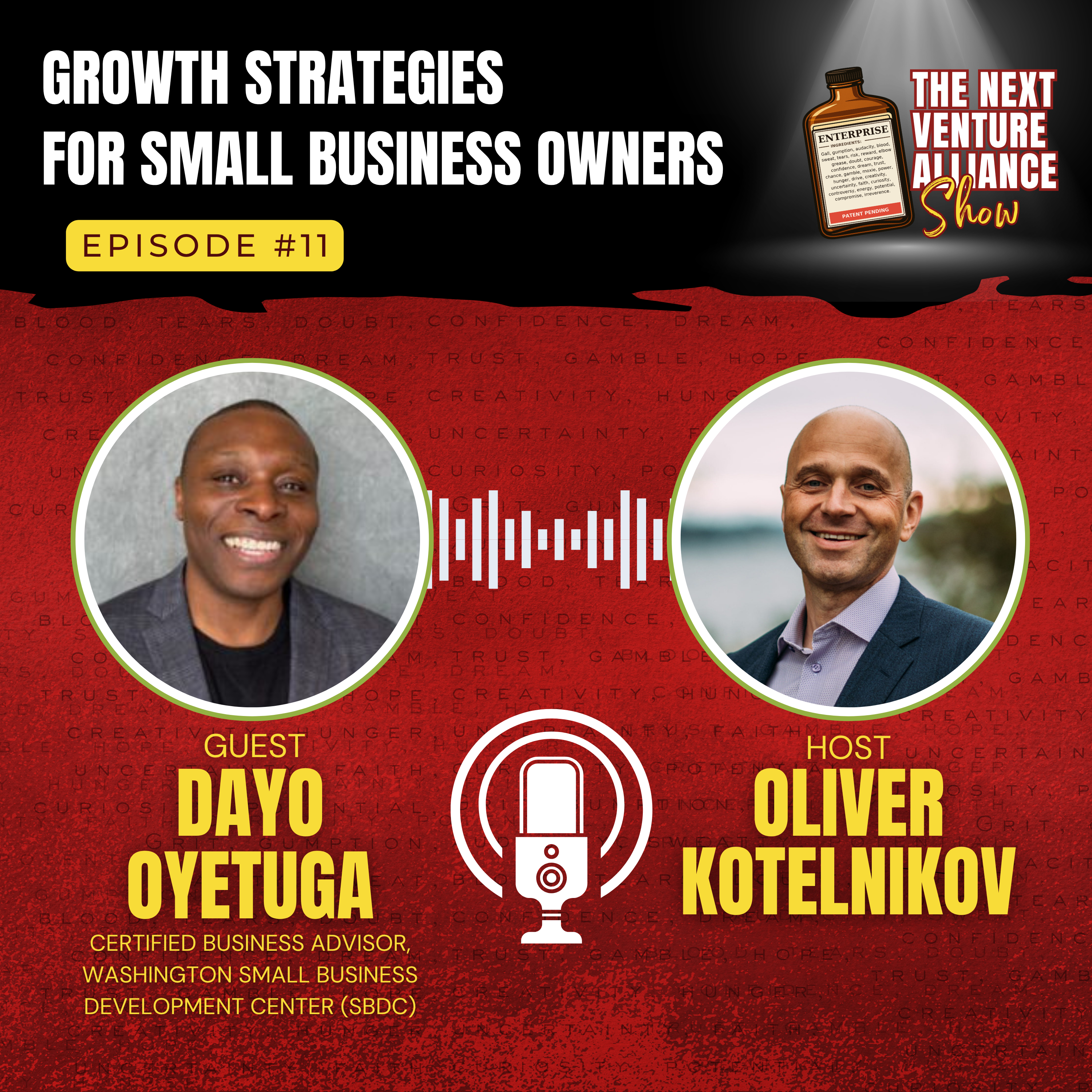
[00:00:34] Speaker B: Hello everyone and welcome back to the next Venture Alliance Show. We are joined today by Dayo Oyetouga. Dayo is a certified Business Advisor with the Washington Small Business Development center where he helps entrepreneurs and small business owners build stronger, more resilient companies.
He brings years of experience in organizational transformation, innovation strategy and operations.
Drawing on his background as both a consultant and a multi business owner, Dio specializes in helping founders clarify their vision, streamline their operations and adopt practical systems that support long term growth. His approach is human centered and community focused with a commitment to inclusive economic development across the Pacific Northwest region.
He works with businesses at every stage, from new startups to established companies, preparing to scale, guiding them with straightforward insights and a focus on real, measurable progress.
Now, I've worked with Small Business Development center many times and find this organization to be a tremendous resource to business owners.
Dayo, thanks for joining us and welcome to the Next Venture alliance show.
[00:01:51] Speaker C: Yes, I am so excited to have this conversation with you. Been looking forward to it for, for a while now. So it's about time.
[00:02:01] Speaker B: Yeah, likewise, likewise. And thanks for jumping on. And you're, you know, you're someone of an incredibly diverse background as I'd alluded to in a very brief intro. But you know, tell us what led to your current role at the small, Small Business Development Center.
[00:02:21] Speaker C: And yeah, that's a great question. So it was one of those random things, making a transition from that consulting world of working ridiculous amount of hours of trying to satisfy an enterprise and executive level leadership and supporting them in all sorts of ways.
Yeah, so and I decided to just jump out of that pool and kind of start my own, my own consulting firm.
And then during that process is when I discovered there is such thing as SBDC that supports small businesses and entrepreneurs and supports people that want to grow their business. And that's what my consulting firm wanted to do. So I reached out to the state director, just a random person, I didn't know who she was.
And they're like yes, we were looking for someone to help us with this. I'm like, well my Company does this. This is what I'm trying to do with my company. I want to support small, small businesses and entrepreneurs and I like the idea of teaching them how to manage and structure their business so they can grow and be successful.
So we went through a short loop.
We had the city involved and on board. I came and all of a sudden I'm doing exactly what I sought out to do. What I, I meant to do it in a private sector, but now I'm doing it in a government capacity because we're government funded with matching funds coming from the city of Bellevue. That's why my focus area is Bellevue and general Greater east side and just support. But I can work with any business in the state of Washington.
Since Bellevue kind of supports the funding, the matching fund that comes from the federal government, I tend to focus more on this side and there's more tech driven and operation like processes that I can help with for some of these businesses that are around here. So excited. So that's.
[00:04:54] Speaker B: It sounds like you're it, you know, you're exactly in a position where you should be. It's, it's a fantastic fit both for the organization and, and for the business owners that you engage with. And as I mentioned, you know, I'd worked with SBDC on, on you know, multiple different occasions and all throughout the state. And in my opinion it is one of the most underrepresented resources available to business owners statewide. I mean hands down, talk about the organization a little bit and what types of services does it provide? What can you do for business owners?
[00:05:36] Speaker C: Yeah, so that is the biggest part that I really falls in like three different buckets.
First is system operations.
Helping business owners just really understand how their business actually runs. I think that's critical and where there may be some inefficiencies, I think that's an area. Second is just their decision making, helping make sure they have clear financials and visibility into their actual business. And they're not just doing guesswork. It's more data driven. So providing some of those enterprise tools to small business owners because what really matters is actually being able to set that up at an early stage. And that doesn't really happen because again small business owners have tons of things running through their heads at once to get, keep the lights on, make sure employees getting paid. So it's a lot to manage. So I understand that. That's why I love working with small communities like small business community. And the third thing is just growth readiness.
A lot aren't ready for that. So making sure that their business is actually prepared for capital and scale when.
When it's the right time.
And I mean, those are some critical parts that I really try to focus on to support small business owners throughout the state of Washington right now.
[00:07:19] Speaker B: And so who is a typical client? I mean, are these business owners that are just looking to optimize their existing operations?
You know, are these entrepreneurs who are kind of lost in paperwork and not sure where they are? You mentioned scaling and growth.
You know, are these folks looking to acquire or start a new business? I mean, who is it?
[00:07:42] Speaker C: Who do you.
[00:07:43] Speaker B: Who's a typical client?
[00:07:43] Speaker C: We are talking their entire spectrum. We're looking at whether you just have an idea and you just need to have generate a plan on how to execute this to bring this to life, or you've been in operation for 10, 20 years, 30 years, or you're getting ready to exit your company or creating a succession plan all through that spectrum. We can support you through that.
Yes, we focus on access to capital, but again, it's making sure, helping owners systemize these processes on how to help them grow, how to make this venture more sustainable over the long term. Because you, because again, you have so many things that you, you have to make sure are in place and you don't have some sort of system that you can follow to lay that core player foundation at an early stage or when your business is already in operation. Because one thing that I try to get people to think about is think you're going to sell your business at some point or think you're going to go to an investor or a lender.
We want to plan our business with that in mind. We don't necessarily have to, but if we're thinking about that, we really allows us to have great clarity on how we operate, why we're doing this business, and what reasons I, as an investor, would want to put money into this.
We want to help you grow in the direction you think your business should go.
[00:09:39] Speaker B: So, I mean, it sounds like planning, advanced planning and preparation and.
[00:09:44] Speaker C: Crazy concept, huh?
[00:09:46] Speaker B: It's certainly where we, you know, overlap with, with SBDC as well. Is that things like buying a business, exiting succession, planning, you know, the common blind spot is that it inevitably requires more time and resources than what the business owner thinks. Right. So, I mean, you mentioned access to capital and we can address that part of your practice. But what are some of the biggest blind spots and that you see and you know, in kind of the entrepreneurial mind?
And what does a plan look like? What sort of things do we need to be looking at if we're starting to assess scaling exits, you know, growth by acquisition, Any of those things.
[00:10:32] Speaker C: Yeah.
So some, some challenges that, that I think small business owners tend to face is they fall short in that the actual understanding of how their business operates and then being able to identify certain processes. Finding the leaks within your business to help you really have a solid ground that you could help your customers communicate better with your customers, communicate better with your vendors.
Just being able to have someone that you can strategically bounce ideas off of to then help you execute some of these initiatives. Because that's what large enterprises are capable. They have massive teams that are able to do this as an individual business owner, those are hard things to come by. But when you have someone that you can actually have conversations, conversations with to help you strategize on what needs to happen next and give you that freed up space in your mind so you can actually go after other aspect of, or other verticals that might generate more income for your business and allows it to create greater value over the long term is extremely valuable. And that gets missed quite often because again, we're just so busy doing a lot of things.
[00:12:14] Speaker B: Yeah, business owners are often, you know, they're, they're, you know, geniuses at sort of, you know, what they do. Right. Whether it's making a product or you know, providing a service or sometimes it's a fantastic idea.
But an idea, you know, often can, it doesn't get to market or doesn't, doesn't materialize if it doesn't have some of those supports that you're talking about.
[00:12:44] Speaker C: Everybody comes up with an idea. It's who can execute it best.
[00:12:50] Speaker B: And you saw, you know, I see your role as sort of holding up a mirror to, you know, a high resolution screen to everything that's going on in the business and saying, I know we think, think that we're doing well. I know we're excited about this.
You know, I know we're planning to do this. I know this is in the hopper. But here's the snapshot, you know, we're looking at. Here's what the numbers are actually telling us. And if you want to do that, like it's just making it more concrete and making it a roadmap from sort of a, a composite of, you know, random ideas and pieces of information that may be forgotten, that may be written on scraps of paper, you know, that discussed at a pool party someplace. Right.
[00:13:35] Speaker C: And another part of that is also what I get a lot of. I just, I need more marketing. I Need more sales. It's like, okay, very general, very high level.
[00:13:47] Speaker B: Right?
[00:13:47] Speaker C: Yeah, those are great things to want. But are you actually ready for it?
Are you ready for more sales? We're all of a sudden, we just got 20,000 more sales. Then are we going to be able to fulfill that? Well, let's think about it. Probably not.
So that's a good thing that you want to happen, but you're not actually ready to receive it because you haven't structured yourself or organized yourself well enough to be able to manage that, that good thing that potentially could happen to you. That's why we always start with we gotta have some sort of plan. We want to have the big picture, the dream. What do we want it to look like and then we can build off of that allows us to, to be more creative, you know, And I like
[00:14:39] Speaker B: that, you know, it's dream big. But are you, you know, careful what you wish for because you just might get it right.
[00:14:45] Speaker C: Yeah.
[00:14:46] Speaker B: And then are you ready? So like if you're a small food manufacturer and you're, you're approaching Costco.
[00:14:54] Speaker C: Yeah.
[00:14:55] Speaker B: You know, for, for, for that one fantastic, you know, muffin that you're making or, or an enchilada or, you know, a frozen meal, you know, a frozen keto meal. And they say, great, we love your product. How about 300,000 units next week? Can you deliver? And you, and you are operating out of a thousand square feet, everything made by hand. You're probably at, you know, 5% of that capacity.
What have you won with Costco at that point? Right. What has that marketing done for you? Yeah, it's, you know, you're shooting yourself in the foot if you're not ready for the full execution on your own business plan.
[00:15:40] Speaker C: Exactly. It's lost opportunity that's coming to market when you're not ready. It's, I mean, better to shoot big, but be prepared for when that opportunity comes in.
That's. I always harp on that. I know it's hard on initial conversations to just look at that, but it pays off multiple times. If you just take that time to actually understand what needs to happen to allow these great things that might happen in the future or should that you want to happen.
[00:16:18] Speaker B: You know, is this a paid service or how do you, how does SBDC charge or does it or price its work? I guess.
[00:16:29] Speaker C: Yes. So this is one of the amazing things your taxes pays for.
Not very many people know that.
So SBDC comes at no cost to any business owner, entrepreneur that we work with because we're Federally funded, that goes through the sba, SBA and then wsu, because it's a land grant university and we're under the research umbrella at the university.
And we have what, five, five subrecipient center, which are Western Washington University, Green River Community College, Highline College, county of Okanagan.
Yeah, and a couple of others.
So those are subrecipient. They usually have around three to five people within their office, and they're supported by the, by the community or the schools that their higher education entity that they're associated with, and they get a small portion of SBA, SBDC's funding from the federal government and they're able to share data with, with us that we. So we can continue to get funded. And then for someone like me in Bellevue, which is just one individual that manages an entire area, the federal funding comes to me, and then the city of Bellevue provides the dollar for dollar matching fund.
[00:18:13] Speaker B: And that's why the city of Bellevue does, in this case, in your office. Okay.
[00:18:17] Speaker C: Yes, yes. And yeah. So I have to. I provide them quarterly reports on what's happening within the community, business, community, understanding.
Just give them good data so they can again, continue to fund this program. And how most of my clients kind of pay us back is by providing some impact numbers. So whether they're able to do some capital infusion with their own money, however much it is, maybe they were able to get loans from a lender or investor or family and friends, whatever it is, just sharing some of that data. They were able to hire new employees.
They share that data and aggregate it. Because again, all our conversations with any client that we work with is confidential. We don't share your information with anybody. Even when I'm. If I work with Oliver at some point, I, I mean, I wouldn't share the client name, but I can provide your contact to them so they can reach out to you and then they can connect us back again because, again, confidential. And then I share that information with, with the city so they kind of know exactly what's going on. And that's why they continue to fund this program based on that data that I generate.
[00:19:51] Speaker B: Yeah, so that's what I mean, you know, when I say one of the most underrepresented, you know, one of the most valuable resources, because some of the things that you just described, marketing, sales, you know, projections, I mean, that's easily, you know, a hundred thousand dollar plan from a business advisory service. Right. That someone. $100,000 that someone, you know, starting a business probably doesn't have no.
So I. I mean, I'm kind of just in awe of the service that that's available to business owners through your organization. And so, you know, a couple of things where we've worked together and crossed paths with SBDC is when there's an SBA loan in process, and the owner, the. The buyer is, you know, focused on trying to understand the business, making an offer, trying to see if this is the right fit, then that progresses. Then the bank requires, you know, the bank asks for a large. The SBA loan package. It can be a complex process. Right.
So if we're asking for, you know, where SBDC has helped out as projections, not everybody knows how to, you know, put together accurate projections. And then a business plan. Right. And that can take, you know, writing a business plan can either take a lot of time or cost a lot of money.
Do you work with the SBA hand in hand, and can you provide those services to buyers who need help in those areas?
[00:21:25] Speaker C: Absolutely. That's exactly what area we help, Especially new businesses or even business already in operation that just need, like, equipment or whatever it is they might need or new or have a new building they want to build.
So we can support you in making sure that you have all your documentation ready so when they come to you.
[00:21:54] Speaker B: For the sba.
[00:21:56] Speaker C: For the sba.
But we don't work directly with the sba. We would work only with the client and making sure your lender ready.
Because the SBA doesn't provide the lending. It's the banking institution that provides the lending.
So we make sure that you have all your proper documentation, whether it's your projections, your business plan. How I try to put it is your business plan is the narrative for your financial workbook that gets missed. Quite often people are like, well, let me just give them my financials. It looks great. I'm like, yes, it does look great.
[00:22:43] Speaker B: Who's gonna decipher it? What does it all mean? Right?
[00:22:46] Speaker C: Yeah, Yeah. I don't know where you got those numbers from. I don't understand it. So.
But when we write your business plan, we want to make sure that, yes, I had. I made $500,000 this year in revenue.
I had 30 clients, 30 customers.
I spent X amount of dollars on advertising all that. Nice. It says that in your business plan. Then I can just look, oh, you got $500,000. I understand how you got that money. That makes sense to me. And your dscr, all this stuff, it just makes it clear to me as a lender that you are a wordy, a worthy candidate for us to actually give you this money gives you a greater opportunity when you're prepared and organized. And I think it's also an opportunity to really understand why your business or venture needs this money, what you're going to do with it, how you're going to pay back. It gives you greater clarity that you can actually tell a clear story to a lender because it's like put yourself in the same shoe or, or even an investor. You can tell a great story if you have an understanding of how you make money and what you're going to do with this money and how you're going to pay them back. And actually, first of all, how are you going to pay yourself and pay them back? Because if you can't pay yourself, your chances are you're not going to pay me back.
[00:24:27] Speaker B: And so you threw out a term. Right. Dscr. So debt service to cash flow ratio. I mean, how many business owners know what that is? And how closely do banks look at that? Right. So a gap. Right. If you can't tell it, clear clarity can make or break alone if you have all the money. But we don't understand, you know, to the left or to the right of it, or where it comes from or where it goes.
[00:24:54] Speaker C: Yeah.
[00:24:55] Speaker B: Or whether it will be there next year and for the next 10 years, which is a typical SBA loan.
[00:25:00] Speaker C: Yeah.
[00:25:01] Speaker B: And you can't pay us back again, then we're not presenting ourselves in the best light.
[00:25:07] Speaker C: Exactly.
[00:25:08] Speaker B: I mean, talk about just what is dser? You know, what should owners know about that? And what does that even mean?
[00:25:15] Speaker C: I think that is the fund that is basically your. It's like your credit score for your business that allows a banking institution to know that you, your, your business is able to handle the level of debt that you're requesting from them and it
[00:25:38] Speaker B: looks at your expenses. Right. You mentioned can you pay yourself?
[00:25:42] Speaker C: Yeah.
[00:25:42] Speaker B: Can you pay yourself enough to support yourself, to go to work and be healthy and relatively happy so that you can make the business profitable, which is what people miss. It's like, why do they want to know how much I pay myself? Why?
Because all of that has to do with your ability to successfully run the business and pay the bank back, who you're asking them for funds. They are taking all the risk at this point. Right. Some of these concepts, you know, are, I'm sure, part of your initial interview with a potential client and seeing if this is a good fit.
[00:26:18] Speaker C: Yeah, absolutely. It's about.
I just remind business owners, all we want to do is de risk the situation as much as possible.
And that comes with a clear understanding of what you do and how you currently operate. If you can articulate that clearly you, you're in a winning position, you're likely going to qualify for that, for that loan. They're going to see you in good light because they feel good, they feel confident about you.
And that's. And also as we create a business plan, create a financial workbook, we also create an executive summary. A simple. That gets. Again that's something that gets missed quite often because everybody thinks we just want to read. We have a 30 page business plan document. Someone is going to try to read through that. Well, I want, I need the funding pretty soon.
So in order to get. To give them greater clarity, let's create a one page executive summary that kind of outlines exactly what's in your document. So now we can use that same document to actually to hand to the, to the lender and they can use that to ask us questions or they
[00:27:45] Speaker B: can assess it right off the bat very quickly if this is even a good fit. Right. If we're, if the kind of business that we're planning to expand into is on page 35.
[00:27:56] Speaker C: Yeah.
[00:27:56] Speaker B: And that business doesn't, that bank doesn't fund deals in that sector.
[00:28:01] Speaker C: Yeah.
[00:28:03] Speaker B: It can take us two months to find out that this is not the right bank.
[00:28:06] Speaker C: Yeah, yeah, yeah. So just keeping it simple, bullet points clear the ask how it's going to be paid back, what we do. I mean just really simple and not even a full page. Just clear outline of exactly what's happening and what to look for.
It just makes, it makes them feel more confident again de risking as much as possible at the earliest stage. First introduction. If I'm able to drop that into someone's lap without having to look through all this document. Yes, they, they might look at it but to validate that you are actually telling the right story.
But still it just saves a ton of time. Especially with these days where things are moving so fast, you know.
[00:28:56] Speaker B: Well, informatting that document and submission to address exactly the things that are important to a decision maker. Right. A business plan can be so many different things. If some of these things aren't relevant or important, you know, and we're putting them at the top of the top of the list.
[00:29:18] Speaker C: Yeah. And we're future plans, our expansion goals beyond.
[00:29:24] Speaker B: Yeah, way beyond. You know, in the next 20 years. I mean all of those things. Like part of the benefit of working with somebody like your organization like yourself is to know what is, what are they looking for. How do we need to organize this information? Where do we spend our time? Yeah, right. Which is something. Having been through the process, you can counsel on and say these are the things you need to focus on and probably bullet it one through five. Right. Not one through 37.
[00:29:53] Speaker C: Yes, yes. Just keeping it simple. That people don't want more complexity. We want it very simple. And again, it gives that opportunity to walk through it yourself to see how you can even optimize your business.
I mean, it just creates even greater.
You might even find out going through the process, hey, maybe we don't need all that cash because we had leakages all over the place. We had inventory that we didn't even know about.
It's a discovery. That's why it's step by step.
Because sometimes I get people, we need this cash right now. Okay, have you looked at your current books? Do you know where you're leaking or what tools you have in place that you're not even using or using to its fullest capacity?
Can we eliminate some of that? That's. That's cost saving. We don't want to necessarily take out a huge amount of loan when you already have some money just sitting there doing nothing.
[00:30:58] Speaker B: Let's you know, the penny earned. Right. You may not need extra business. You may need to be become more efficient with the business that the and the resources you already have. And that gets you to that goal of you don't need to build a new building. Right. You need to stop paying three people to do the same thing.
[00:31:17] Speaker C: Yeah, yeah.
So that's where. That's a big opportunity that I try to present because again, a lot of business, because again, moving really fast, really just want to get to that endpoint. Just get me whatever the resource that I need. It's like, no, let's actually walk through it because then you might see some things that you're like, oh, I didn't, I didn't know that was, that was falling apart. I didn't know we had that great opportunity. It also gives you again, you can grow other pillars because you know how your business is functioning. You can optimize potential clients that you have that you like, oh, they've been paying us X amount of dollars. Oh, we could actually offer them this other service to make more money. I mean, it's just opportunities galore that you can find within your current operating business or you can find some major issues too that you can at least get the opportunity correct.
[00:32:20] Speaker B: And also before you grow, becoming optimizing before you grow because you don't want to grow inefficiencies. Right?
Right. If you have bottlenecks and constraints and you're duplicating them and replicating them at scale, then you're growing in the wrong direction, possibly. Right. Do you want to.
And so what, what do you typically ask for? Like what kind of documents that, what does a business owner, what does working with you look like?
Is it a series of meetings, is it phone calls, is it a submission of company financials? What do we need to have on hand or gathered to work with you?
[00:33:04] Speaker C: So initially you go through the intake process where you simply just submit that I'm interested in working with an SBDC advisor. Depending on what stage you're at, if you're current operations, you can come directly to me and you're able to complete the intake form and sign some documents to show that we are.
All your, all your information that you share with us is confidential.
And then you're able to come in, I'm able to do an analysis and understand what's needed and how you're currently operating. So I let you share that information. Just getting to know each other a little bit and then you're able, able to set up as many meetings as you want. I work at your own, at your speed and again with my calendar, I have my calendar that's always open. So if you can find time on there, you try to book as much time as you want.
You can book an hour, two hours session or you can come every week, you can find availability because again there's tons of people that are looking for support in all sorts of ways. So get on the calendar and we're able to just systematically talk through your problem and get you to us, meet you where you're at, but then bring you back so we can get you to where you're at and maybe even accelerate because sometimes you still have to continue to operate the business, but we're making adjustments on the back end and to get you there and go beyond.
And that's how the, my, at least my support works. And a lot of SBDC advisors tend to work similarly because I, I try to focus, I look from the operations lens quite often. And what does that mean?
[00:35:06] Speaker B: What does that mean? Looking through the operation lens?
[00:35:10] Speaker C: Again, it's about the structure of how your business is operating, what it's doing, how you're functioning within the business.
[00:35:20] Speaker B: So not necessarily the financial documents, but sort of the day to day flow of work, the role of ownership and that's a very important part of a business. That people may not be thinking about. So what are you analyzing there?
[00:35:35] Speaker C: I'm just analyzing, just getting a clearer understanding of what you might, what you are doing that we can maybe make adjustments on or optimize in some way to help you get to that goal that you want. Because I try to understand the dream and then I like if I get clarity, then I can guide you towards make. Towards that goal.
[00:36:06] Speaker B: So again, back to clarity, right? I mean you need clarity before you convey that clarity.
Onwards lender.
[00:36:14] Speaker C: And the challenge is that a lot there. They don't have the clarity yet. So it gives them that opportunity to actually express that in how they see it.
[00:36:26] Speaker B: So in providing clarity to you, they're clarifying their business for themselves. I mean that's the process. So before you.
[00:36:35] Speaker C: Nobody says that, but yes, that's what's supposed to be happening.
[00:36:38] Speaker B: Yeah, but that's kind of the underlying mechanism. Right.
And analyzing financials, you know, I mean that can be complex, but arguably analyzing operations and understanding the role of the owner. Yeah, and, and kind of the day to day operations and the logistics and depending on the industry and the business model, I mean that, that can take some time.
[00:37:04] Speaker C: Takes a little bit of time.
[00:37:05] Speaker B: Always.
That's not always a written policy. Right. I mean how many business owners have policies and procedures?
Yeah, some. Right, but okay, but, but that could be a deliverable. Right after the analysis. Yeah, you can deliver standard operating procedure that now says, hey, here's, here's your title, Mr. Owner. You're not just the owner, you are actually, you know, the main salesperson.
[00:37:33] Speaker C: Yeah, yeah.
[00:37:35] Speaker B: Right. Or you know, who occasionally wears the janitor hat. But which is all small businesses.
[00:37:40] Speaker C: But. Yep.
[00:37:41] Speaker B: But I mean that level of clarity,
[00:37:43] Speaker C: it just opens and it makes it easier to look at the financials when they have.
[00:37:50] Speaker B: Because they have context now. Now there's context.
[00:37:53] Speaker C: Yeah, because it, because when they come in initially, I don't want to look at that. When was the last time you spoke to your accountant? Oh, it's been, I talked to him within a year. I'm like, okay, so this will give us that opportunity. When you're getting that clarity, it's like, oh, do you think we should be communicating with your accountant maybe once or twice a month because you're marketing.
[00:38:21] Speaker B: How about a standing quarterly call with the cpa, Right?
[00:38:26] Speaker C: Yeah, yeah. Just because decisions you could adjusted early in the year from you losing you. You didn't because you waited so long and you lost so much X amount of dollars. And we can identify that because you're spending it Again, it's unintentional. Yes. There's so much stuff going on. But if you can help yourself by taking the time to organize a little bit more effectively to create efficiencies, reduce waste, just.
And it makes you more excited about your business. And again, it's that goal. If we want to sell, if we decide we want to sell, I don't want to buy you as the owner. I want to buy a functional business, not the operator.
[00:39:20] Speaker B: So getting the operator leaving, right?
[00:39:22] Speaker C: Yeah, yeah, yeah.
And because we get some. I haven't, I haven't taken vacation in months. I'm like, yes, because if you left, the business would crash. Yeah. So how can we start taking you out of that role? By making adjustments.
So you're not the cognitive that's just constantly going, now you can get something that you can actually give to somebody else, sell, do whatever you want with.
[00:39:55] Speaker B: And oftentimes that's a time consuming process.
[00:39:59] Speaker C: It is. That's why it's not done.
[00:40:01] Speaker B: That is difficult. Kind of bordering on uncomfortable. Right. So it's easy to kick it down the road because, you know, money is coming in, it's working like it always has.
And the inefficiency, you're sort of aware of it peripherally and in the background, but it isn't a pressing matter. Right. It's, it's sort of like, you know, maybe quitting smoking or something. Like, everybody knows it's bad, but it's not killing you today.
[00:40:31] Speaker C: So, yes, I still got time.
[00:40:33] Speaker B: I got time. Right. And so.
But it is more urgent. I think those conversations are more urgent. And it's kind of a latent urgency, but it compounds exponentially because now you've had one year of poor record keeping, now you have two. Now you find an accountant and you're three. And he's saying, okay, I got to sort through three years of historical. Hey, do you remember what you bought here in July of 2022 for $11,000?
[00:41:09] Speaker C: No.
[00:41:09] Speaker B: Right. It was five years ago.
[00:41:11] Speaker C: So.
[00:41:13] Speaker B: But that's a question that a buyer may ask. And if we don't have an answer, it's a problem. It's a problem. And if you can't answer in a straightforward way to a buyer, hey, what's, what's your role with the business? What do you do when you say, well, you know, I'm kind of a jack of all trades. Worst possible answer. Yeah, because it's not a business, like you said, you know, at that point, it may be a highly paid job, but it isn't. It isn't a business. And it's directly proportional to the exit value and to some, to how someone assesses risk and the attractiveness of that opportunity. Because if it's all about the owner, if we can't quantify the role of the owner, then we can't quantify the risk of their exit.
[00:42:01] Speaker C: Yeah.
You can't even quantify the price of
[00:42:07] Speaker B: the business, of the enterprise. Yeah.
And then the bank is going to ask that question and they're going to say, okay, so who is the owner? What do they do? Who are we replacing? And they're going to look at the buyer's qualifications.
If both of those aren't clear, if we can't say, here's the seller, here's the buyer, here's how the transition and the exit is going to work. And the lender says, no, thank you. Right. In most cases it's too risky.
[00:42:35] Speaker C: Yeah, it's way too risky. Even though, I mean, you have those businesses that still are in that situation that are making good amount of money.
[00:42:44] Speaker B: Yeah.
[00:42:45] Speaker C: They don't realize that they actually cap themselves to a certain point when it's like we get to $500,000, but we can't go beyond that. And we always wondering, yes, we're making enough money, but I don't understand why we're not growing anymore. Well, we haven't made any adjustments since we've started this. This business.
So if we can start doing that from an early point and assuming so we can get you that vacation and the business can still be operating and you can take a couple of a week off or whatever it is. So. And come back to a functioning business and still be doing well. That's.
[00:43:29] Speaker B: And be rested and be generating. So you'd be thinking clearly, generating some new creative ideas, having thought about how to grow the business, start working on the business versus just continuing work in it.
[00:43:42] Speaker C: Right.
[00:43:42] Speaker B: And looking.
[00:43:43] Speaker C: So, yeah, that's one of the great books. E Myth Revisited is a fantastic book for people that are interested in just understanding how. How they should fulfill their role from transitioning from an employee to a business owner.
[00:44:06] Speaker B: What's it called again? What's the book?
[00:44:07] Speaker C: E Myth Revisited.
E.
Emit Revisited.
[00:44:14] Speaker B: Emit Revisited. Okay.
Yeah. We'll touch on some of your recommended resources kind of towards the end of the conversation.
But certainly anything that addresses, you know, the owner, the business and how they intertwine and what the role of the owner is in the business and how much of the business is the owner.
[00:44:39] Speaker C: Yeah, right.
[00:44:40] Speaker B: Kind of the owner dependency factor.
Do you work with first time buyers and then, and you know, that's an area that we've intersected on before, is if somebody's just starting out their journey, let's say they're trying to exit the corporate world.
You know, we can take a very sort of prevalent script as of late. They're afraid of what AI? Let's say it's somebody from a tech industry. They're, they're sort of concerned about the impacts of AI on their profession down the line. They're saying I need to get out or, or, or I just want to, you know, I just want to sort of implement my vision, my entrepreneurial vision.
Don't know where to start or have some ideas.
How does that work? Is there a time where it's too early or too late to come to you?
[00:45:32] Speaker C: No, it's never too late or never too early.
I think those are some of the best people because they do have the right skill set sometimes to maybe acquire a business or even start a business.
But it's that shift of mindset that we were just talking about from an employee to an owner that's a challenging shift for.
[00:46:01] Speaker B: Because what are some of the most important like kind of difficulties there or some ideas that are tough to let go from? You know, what do you need to understand to become an owner?
[00:46:11] Speaker C: To become an owner, you really need to understand that you are now the provider.
You are now the one that needs to go out and fish for that new customer. You're the one that needs to make sure that all the different roles are, duties are being completed.
So having an ability to be able to delegate, to make good decisions about how your business should operate is critical. I think that gets left sometimes because people are coming from that employee mindset where you're, I come in, do my job, I get paid, I get to
[00:46:57] Speaker B: go home and then I get vacation, I get sick days, I get stock options, I get insurance. Yes, it all kind of goes away, right?
[00:47:08] Speaker C: I mean, yes, right out the door, but. So you're quitting 40 hour work week to do 80 hours at your own leisure.
[00:47:21] Speaker B: Right.
Risk and leisure and peril. Yeah, yeah.
[00:47:25] Speaker C: You know, but it's a choice and it's amazing and wonderful opportunity to be able to be in that space.
But on initial groundwork, it's hard. It's hard work, but it's doable. It's just shifting your mindset to knowing that how can I make this shape, this into my, my life, not vice versa. Because you just go to work, you do your thing. It's just it's just there you, you feel secure, golden handcuff, whatever it is. But here you get to shape it for yourself. You get the freedom and you get to make as much money or as little money as you want, but you have to make that. You get to make all those decisions.
[00:48:15] Speaker B: The autonomy fully. Right. The risk and the reward.
[00:48:19] Speaker C: Yeah, yeah. So if you plan it right and you take, you don't have to take the perfect steps, but you're able to adjust as you're going, there's a. You have a great opportunity to do a lot of different things. I even tell people sometimes, if you want to go back into the regular work world for a corporate role, that skill set is transferable because you are bringing essentially managerial skill, how to delegate tasks, how to operate a business, how to generate income with your business, with what you do, identifying the specific skill set that you bring to the table that can generate income. And you can take that into a corporate world and help help them shape that, if you choose to do that. But I would still stay in that entrepreneurial world because it's exciting, it's fun,
[00:49:21] Speaker B: and it's smaller, but it's yours.
[00:49:24] Speaker C: Yes, yes. You get to decide everything. You go as big or as little as you want.
[00:49:31] Speaker B: Now you were, you've had experience and success in both of those worlds and have gone back and forth very successfully.
What's the most useful kind of carryover skill from the corporate world to the small business ownership?
What can we expect to, what can be expected to kind of be repurposed, I guess. And what may not have a place in small business ownership?
[00:50:05] Speaker C: Laziness does not have a place in being a small business owner.
[00:50:12] Speaker B: So you can't, you can't show up and, and like finish the, whatever Netflix episode at work that you were watching last night.
[00:50:21] Speaker C: I mean, I like, it feels like you can, but if you really want to win and you know, and you want to provide for your family or leave something for your, for your kids in the future, you instinctively want to make one because you, you're doing something you enjoy.
I would hope you don't have to love it to death, but you're act, you're creating this for yourself. Someone else isn't telling you how you should do it, how you shouldn't do it. You are creating this for yourself. So I think you should have that passion that you're going to be able to get up at whatever time you need to get up to go take action, to make this thing grow. And that's the biggest switch. It's like, nobody's going to.
You're not going to make money. You shouldn't have to even think about it. Like, oh, I just enjoy this. I'm just going to go do it. Or yes, I don't love it that much, but I still want to go do it.
[00:51:27] Speaker B: Yeah, I have good days and bad days, but the reality is I'm now in a situation where if I don't do anything, it won't move.
[00:51:35] Speaker C: Yeah.
[00:51:35] Speaker B: There isn't a large team or corporation that, you know, my week of complacency doesn't change anything. Oh, it will in a small business.
[00:51:46] Speaker C: Oh, absolutely.
Want to pay rent this month or do you want to pay. If you have employees, you want to pay your employees? I mean, yeah, absolutely. There's an impact there and that's the excitement.
And when I, when people come in like that, I try to get them to again, create a plan.
We need a plan. How do you see yourself manage any kind of business you get? How do you see yourself managing it?
What do you even want it to do?
And get people thinking in those terms again, creating that dream for themselves?
Because it doesn't matter. At the end of the day, business has fundamentals.
Right. So we can, if we can stick to the fundamentals, we can operate almost any business.
[00:52:41] Speaker B: Right.
[00:52:41] Speaker C: But if you choose not to absorb those and you're just coming in, just, I'm just going to buy the business. I'm just going to be a passive owner and I'll show up every now and then, and then I'm still going to make lots of money. It's like, well, that's nice. If that worked, I think a lot of people would be doing that.
[00:53:05] Speaker B: Yeah. That's just not how the small business and this asset class works. I mean, we see a lot of, you know, the general narrative is, you know, I, you know, I want the bank to pay for it. I want the, the owner to stay and run it for me.
[00:53:21] Speaker C: Yeah.
[00:53:22] Speaker B: And then I'm, I'm the big picture guy.
[00:53:24] Speaker C: Right.
[00:53:24] Speaker B: Or the big picture person.
And, and it's this idea of a passive income.
And, and maybe some of these concepts that could apply to larger businesses where the owner role often diminishes or as, you know, the business becomes more and more autonomous. It's, you know, the owner's role is maybe less important, but if you're between, you know, 1 and 20 employees, you're hands on whether you like it or not. So this idea that you can be running it, you know, from halfway across the world or you know, check in from Hawaii.
[00:54:04] Speaker C: Yeah.
[00:54:04] Speaker B: And then see how the sales are going. I'm sure there are situations like that that occur, but generally that's a myth.
[00:54:10] Speaker C: Yeah, it's not happening.
[00:54:14] Speaker B: You can optimize, you can grow, you can kind of improve on what the previous owner did if you're coming in as the new owner.
But you know, typically what we see in successful businesses is a long hands on period, or substantial enough hands on period to where the new owner learns exactly what made the business successful. Not through financials, not through talking to the owner, through working in the business. Right. And understanding. Okay, this is how it ticks. Now I can make changes because I have verifiable, you know, concrete data on some of these inefficiencies and say, you know, here's how we're going to change.
You know, I'm coming at it from a base of knowledge versus just coming in and saying we're gonna make changes without even understanding how the old value stayed on the road.
[00:55:07] Speaker C: Yeah, that's, that's the best part because I get quite a few individuals that come in. I, when I get this business, I'm just gonna change everything. I'm gonna optimize this, I'm gonna optimize that. I'm like, yes, that would be, that'd be really great.
But maybe what you think might not be quite accurate. We need to actually understand that that thing that you're planning to change an owner might not be interested in that. I don't want to give my baby to somebody to have them change them completely or tell me that's what they're going to come in and do right away.
So if you understand that you need to have greater clarity of how this is currently operating, how they're making money.
If you have clarity on that, then you can maybe want to make some adjustments. But you can't just outright just revamp everything because what would be the point of buying the business? You should just start it, correct?
[00:56:15] Speaker B: Yeah, yeah. Why are you, why are you buying it? And, and I think you're right in the fact that, you know, most owners, retiring owners, they have no problem with the buyer building on their success and improving the business. Which requires changing the business.
[00:56:36] Speaker C: Yes.
[00:56:36] Speaker B: You know, I think, I think kind of the, the, the, the resistance starts when they, off the bat, hear that the buyer isn't interested in spending any more time in the business than he needs, so he's trying to optimize, trying to just make everything more efficient. And it's just a widget, right. It doesn't matter. You know, buyers always say, I gotta look at a lot of different businesses, a lot of different opportunities. Which business is this again? You know, and so it just becomes very clear very quickly that it doesn't matter to them what it is or what it doesn't. They're not planning to understand.
Right. If the conversation is, hey, you know, I want to grow the business, that's perfectly fine, but learn at least what the owner has spent their lifetime and their blood, sweat and tears. Give them the opportunity to pass on the playbook, be respectful, absorb the lessons, analyze them. If there's things there that don't work, of course it's your business and you can, you want, like it's, well, I'm paying for it, I can do what I want, granted. But you got something here like the, the, you know, one of the biggest things we've seen transition is kind of the surprise of, you know, and many of them go well. But the ones that are sort of struggled in transitions are the ones where the owners say, I'm trying to explain something, I'm trying, but they're not interested. Right. They're not listening to me. Right. And oftentimes it's sort of built into the purchase price. There's no cost, but the buyer is completely disinterested in, you know, in someone's 30, 40, sometimes 50 years of experience.
This very business, it's mind boggling, but it's a reality. Like, I don't understand, why wouldn't you listen to that? They're here trying to tell you how
[00:58:27] Speaker C: they, they've been making money, they've been doing good. That's why you want to buy the business.
[00:58:32] Speaker B: You're buying it, right. Why don't you listen to them? Right.
[00:58:34] Speaker C: Yeah.
[00:58:35] Speaker B: And it's just, they don't. And so, yeah, I mean, I, I suppose a lot of your practice, I mean it centers around, you know, we keep coming back to clarity. But those questions you're asking, you know, people, well, why do you want to buy a business? Well, I want to work for myself. Right. Again, very general. What does that mean? You know, does working for yourself means working 20 hours a week? Because if that's your definition, we need to talk about that. Right. You're not going to get that here.
And so just maybe talk about your initial intake process. And what kind of questions are you asking of new business buyers? To right size it, I guess, or right size the expectations and make sure they're going in with eyes open and there aren't any massive blind Spots.
[00:59:29] Speaker C: It's really, again, really getting them to see, to understand.
What do you want? What do you want out of this?
Why do you think this is a good idea for you? Why does it fit your current lifestyle? Yes, I understand you might have left your role at a company or something happened, but why do you think this is a good idea for you?
[00:59:58] Speaker B: How your problem. Right. Whatever.
[01:00:01] Speaker C: Yeah.
[01:00:02] Speaker B: Or reach. Or help you reach your goal.
[01:00:04] Speaker C: Yeah. So.
And also identify, how much money do you want to make?
[01:00:11] Speaker B: That's a tough question. That's a question many people can't answer.
[01:00:14] Speaker C: How much money do you need?
[01:00:17] Speaker B: End game. Right. What are you trying to do?
[01:00:19] Speaker C: Yeah, yeah.
Even, like, how much money do you want to make personally? How much money do you want the company to make?
Giving them that picture and then that forces you to actually think, like, oh, I actually have to do this.
And then. And you get in a situation where sometimes, oh, I only want to make 200,000.
Okay, that sounds good. So how much do you want the company to make? Oh, I wanted to make maybe 600,000. Okay. Okay, good. So what happens when you. When your business gets to that 600,000?
Do we shut it down or do we want to go bigger?
[01:01:06] Speaker B: Oh, and they haven't thought past that, right?
[01:01:10] Speaker C: No.
So I'm like, that's why we need to go, I want to make 10 million. I want to make 20 million.
Yes. Because if we get to that 600 now, we can re.
Adjust some of the things that we. Or continue some of the things that we did well, adjust some of the things that didn't work. And then maybe the next year we're at 700,000.
But now we're building. We built ourselves a pathway towards something that is substantial.
And then your personal income is 200,000. Okay.
Forever.
Or would you want to grow that?
See how those two tie together?
Like, oh, yes.
Yeah. So that's why we don't want to lower the bar for ourselves. Just because we're assuming we're working for somebody else. Get.
Let's. Let's reach. Let's reach. And then work our way up. We don't have to get there, but we know we're working our way forward.
You know, that's one of the most critical thing I try to get
[01:02:25] Speaker B: new
[01:02:26] Speaker C: potential buyer investors to really look at before we continue on this journey. Because some of them don't want to do the work for that.
[01:02:36] Speaker B: They don't want to think through it that deeply.
But if they do, the reward on the flip side is you're saying, hey, Actually, this opportunity you're looking at doesn't check four out of the five of your boxes.
Your criteria makes sense, but we should be looking at businesses and you give them some parameters and refocus them and help them be better at identifying the right opportunity.
[01:03:06] Speaker C: Yes.
[01:03:07] Speaker B: And also conversations.
[01:03:09] Speaker C: Yeah. What, what are you good at? What do you think you're good at? Again, that all goes in the document of that planning. What are you good at? If you had the business right now, what thing do you think you bring to the table to help this business
[01:03:27] Speaker B: value? Yeah, yeah.
[01:03:29] Speaker C: And again, those are things that we don't think about early on. But if you're able to outline that for yourself, then when you're looking for a business, you're more focused, not just assuming. Oh, yeah, I'm just hunting for a business for that Passive income business.
[01:03:50] Speaker B: Yeah, I'm hunting for. I, I want to be a business owner because I want to work for myself and I want passive income. Like that is, you know, 90 of buyers out there. But, but it's, it's about 97 short of what you need.
[01:04:05] Speaker C: Yeah.
[01:04:06] Speaker B: To buy the right business. Right. But it's amazing how many people leave it at that and then go out there searching and then wonder why they can't find the right thing.
[01:04:16] Speaker C: Yes.
I found this other business online. I think I, I'm interested in it. What do they do?
I don't know. I think it, it would be a good one. It'll be a good passive. Passive income. Like. Okay, yeah.
[01:04:31] Speaker B: Now, I mean, asking the right questions is critical. And I think, and this is, I think touches on general kind of the qualifications for a professional advisor, whether you're an attorney or, you know, broker, financial planner, an accountant, you know, whoever you are advising clients is having hard conversations and those start with the right questions. You have to be able to steer towards the right question and get the gears turning because if, you know, if you're not even solving the right problem, the chances of you arriving at the right answer are, you know, your ladder is up against the wrong building. You may get to the top, but it's.
[01:05:14] Speaker C: There's no roof on that building
[01:05:18] Speaker B: for. Isn't there? So I, you know, I appreciate that in your practice is that you take the time to analyze and ask the right questions so that we can, you know, be solving the right problem.
I want to talk about, you know, the, the other side of the equation, which is the perils of paralysis by analysis.
You get some very, very analytical individuals who, you know, are looking through everything, at everything, through A computer screen and through data, which we're in a time where we have access to lots of data and it's. And it's a great blessing. But when is it time to stop analyzing and start taking action and to make your business idea a reality?
Where do you find that kind of balance?
[01:06:14] Speaker C: For me, I think that is right now you have a lot of individuals that come that do massive amounts of research because we have so much data online that you can just research yourself to death.
But doing research is great, but the action is what really makes the difference.
What are you doing this research for?
Why are you. Why is this research so important?
Is it important for you to acquire or start this business?
Or is it more important for you just continue to do research
[01:07:00] Speaker B: because that makes you feel productive or it makes you feel like you're doing something right?
[01:07:06] Speaker C: So if we can overcome that, because I've had a few clients that have been in this situation where they, they continue to research. Oh, I want to research this new tool because I want to add it on to. For my business. Oh, I wanna.
On a research this new venture that I think might be good. Might be good for. For my business or to start. It's like, okay, so how much research have you done? What have you learned?
Okay, you've learned that. So what have you done with this information that you're learning?
[01:07:40] Speaker B: Can you learn everything done? Very little, right?
[01:07:44] Speaker C: Yeah. So where is it taking you?
Are we still interested in building this idea that you already had that we've already assessed? It's a pretty good idea.
How does that, that research, how does it help you move this forward once?
[01:08:04] Speaker B: Because it needs to progress. Right. Are we on to the next phase?
How are you applying this information?
[01:08:11] Speaker C: Yeah, yeah. So I typically help create a roadmap for individuals like that that have that. That can fall into that little.
They can have that pitfall.
So creating a roadmap. So this week I want, I want to make sure that you do some research, give you that opportunity because you seem to enjoy it. So that out of that research that you do, we need to have this aspect of the business completed based off of the research that you just did to move us forward, whether it's getting contact.
[01:08:50] Speaker B: I mean, what are the accountability mechanisms that you implement or sort of insist on with clients?
[01:08:57] Speaker C: It's for you to be able to schedule another appointment if you're really interested in it. You'll have that done and shared with me prior to our next meeting.
[01:09:09] Speaker B: So they can't just keep scheduling meetings and talk about the Same thing. There needs to be forward progress kind of at your sole discretion.
[01:09:18] Speaker C: Yeah, yeah. So we. I need to make sure I get that document, I need to make sure I review it. And then I want to be able to provide you some feedback on it, on what we should be doing next or how we should move. And you also need to provide me that information, what you think you should be doing next.
So it moves them out of that category. Because now someone is saying all your research is great, but we need to continue working on this because they can't get it all done all at once without sacrificing the research aspect. So now we shift the focus.
That research mindset is focused now on the actual business because we have it embedded into what they need to do.
So it's combined. It's not two separate things anymore because they tend to want to.
[01:10:13] Speaker B: You're integrating the process. At some point, things are moving forward and yeah, you know, as a self contained.
[01:10:21] Speaker C: It's not notice. It's not noticed initially because they've separated it in their minds. Like, oh, this is a business. This is the research. I got to do that, all the research first before I can do anything with the business. But if you bring them together, all of a sudden it's the same thing, but really not focusing on the research as much, but focusing on actually taking action for the business to move forward.
[01:10:48] Speaker B: So at some point all that information needs to. And research needs to translate into actionable steps.
[01:10:54] Speaker C: Yes.
[01:10:55] Speaker B: Moving this toward a. Yeah. What we've identified as our goal.
[01:10:59] Speaker C: Yes. Because I make sure I get all the, all the research. I want to. I want you to share and talk me through it. Okay, great. So these are some things that the researcher has provided us. So now we got to use all those things inside to move our business forward, however that might be.
So it really gets people just excited a little bit because they don't see the transition themselves because they're in it.
So when they start moving forward, like getting even, getting the license, same thing. I want to do more research or getting some sort of permit or looking for the building.
It.
It's like, no, we don't need to do any more research. Contact this person. This is how many calls you need to make for. For sales.
We want to, we want to do more marketing. Okay, why are we doing more marketing? Well, are you targeting a specific audience? Oh, no, I think it's everybody like,
[01:12:09] Speaker B: okay, we're zooming out so we don't have to be specific because that's a lot easier to feel good. About, right?
[01:12:16] Speaker C: Yeah, yeah, yeah.
[01:12:16] Speaker B: Marketing, Right. We're targeting customers. What does that really mean?
[01:12:20] Speaker C: Yeah.
[01:12:21] Speaker B: In your specific case.
[01:12:22] Speaker C: Yeah.
[01:12:23] Speaker B: You know, marketing is different for Microsoft than it is for, you know, for Joey's watering hole in a neighborhood. Very different thing. Targeting customers, things. Right.
So what are we doing in your specific case?
Do people appreciate that part of the process? I mean, do they realize that sometimes having accountability, like, maybe, like if you had a. People like having a personal trainer, because at some point they'll say, look, I don't have the discipline to go to the gym. You know, I've identified. I need to work out four times a week. I don't have the discipline. I. I need a personal trainer. This helps me. This is an asset. Do you get the same kind of response or do people just say, oh, man, I was pain in the ass, making me do work?
[01:13:06] Speaker C: No, some people are really excited about it. And because, again, it's. We're working together.
It's us learning together. It's not me teaching you anything. It's both of us. We're learning from each other. So we're moving forward together at the same pace. And yes, I'm guiding, but I'm not, like, coming over the top, not giving
[01:13:30] Speaker B: them a grade, right?
[01:13:31] Speaker C: No, no. It's like, hey, I need to learn from you in order to help you. But I'm. It's like a counseling kind of. It's like just having someone that they can share those ideas with and then being able to say, have you thought about this? Have you thought about.
Have you thought about why you're doing it this way?
Oh, no, I haven't thought about that. I didn't know I could do that. Of course you can. Why can't you? What's making you think you can? Oh, because I used to work at a place where if I did that, it just didn't. It wasn't very good. I'm like, you're running your own business. You get to make it. You're the CEO. You get to make the decisions.
[01:14:17] Speaker B: Yeah, you don't need that old script anymore.
[01:14:19] Speaker C: Yeah,
[01:14:21] Speaker B: it's wide open.
[01:14:23] Speaker C: That's. Actually, I had someone tell me that yesterday.
He was like. He was like, oh, my gosh, I'm going to have this conversation with a potential partner. He's like, I was going in to look for a job, but after talking to you, I think we need to. I need to just be an executive.
I'm like, yes, you are an executive. You. You. Oh, you run your own company and you're talking to another company owner. You're not going to him for a job. You're going to tell him what you are going to help him with.
[01:14:56] Speaker B: You're now, you're now peers, right? You're professional partner. Yes.
[01:15:01] Speaker C: Yeah. He's like, that's a complete mind shift.
He's like, yes, I used to manage teams and all this. I'm like, this is different world.
You get to be the leader, you get to make all the decisions, spend more time as the executive than the employee.
That's the change.
[01:15:22] Speaker B: No, that's a com. I mean, and that goes back to one of our, you know, earlier questions is the mind shift and you know, mind shifts, you know, changing your headspace and the way you look at frame things, it can be, it's a long term play, right? I mean people can recognize what they need to do, but some of those ideas and they've been there for a long time, right? You look at, then you go, yeah, that's not the right way to look at things anymore. That no longer serves me. But man, it's hard to change, right? And so you're there as a. And we deal with that professionally and personally. But sometimes in a long term advisory relationship, you know, you're there to remind people what they told you at some point was important.
Hey, I want to be my own boss, I want to run the company. And then they're going into this meeting as a subordinate and you're saying, no, no, no, no, you wanted to do this, we're here now. You now own the company. You go in there and you know, you don't have to sit in the corner, you have a seat at the table.
[01:16:24] Speaker C: Yes, yes.
Yeah.
[01:16:27] Speaker B: So that's your opinion. And then be, be a peer to your professional counterparts.
[01:16:35] Speaker C: Yes, yes. And it gets people excited and also going into the financial aspect of things, realizing how much they can actually make, what, how they can make this money, really outlining that just blows people. I'm like, yes, it's a little bit of math, but really at the end of the day it's not that much math. It's. You like money, right? You like to make some money. So yeah, you need it to live. So it's same thing when we're doing your financials.
You, you have clarity on how you are operating and therefore you, you have clarity on your finances. You know where the money is going, you know what you need to buy, you know what you don't need to buy, you know how much you want and you know what type of partnerships you want to Create.
And then they start looking at it from that perspective. It's like, oh, okay, I think I can do okay in this, you know.
[01:17:41] Speaker B: Yeah. And then you can see that shift occurring.
[01:17:43] Speaker C: Yeah.
[01:17:45] Speaker B: Can you share some examples? I mean, you just mentioned this client, but you know, the, the types of projects or clients that you've worked with just to kind of demonstrate a range.
[01:17:56] Speaker C: So I've had, I had a couple of a client that had like a gardening and horticulture. So implementing new tools and things like that. They had all sorts of different tools within their business that was, that was actually an horticulture.
[01:18:18] Speaker B: Like a retail store or.
[01:18:20] Speaker C: No, just regular. A general business to, to just help high income households.
[01:18:29] Speaker B: Okay.
[01:18:30] Speaker C: To help them with their. With like landscaping, design, lawn mowing. It's like specialty, specialty gardening. Right.
Roses and all this stuff.
[01:18:40] Speaker B: Unique plants and whatnot. Okay.
[01:18:43] Speaker C: So we're trying to shift this into more of a franchise type of business rather than just being one individual just managing a bunch of different people. But now shifting it to the idea of you can have a bunch of different leads that are essentially owning their own business within your business under your umbrella.
So the challenge was how do we get all these different tools that you have?
How do we identify what they currently do for you and how they would work for a stream of employees that might come into your. Under your umbrella and why they would even want to come under your umbrella to work as their own separate business providing their own clients and all this stuff like that.
[01:19:41] Speaker B: So that is assessing whether that model is franchisable. Is that in essence kind of the scope of.
[01:19:48] Speaker C: It's not a franchise, it's just using the model, the model style. Because it's an environment where these types of entrepreneurs don't want to do the work, the, the setup work, the billing, the invoicing, like the HR in the back end and yeah, the. All the back end stuff. Acquiring new customers or advertising, all that stuff. So creating a system where you can plug in. She can, she can still operate her own, but have others under her. Not necessarily under her, still their own business, but working with her own tool sets that she's created that allows for all these.
Taking pictures, doing what they call it, showing like plans for how they should manage this garden and billing cycles, all that stuff. So having that in one place. So that was a big challenge, just getting.
Consolidating all that when they're used to doing it one way and wanting to charge premium price for the service they provide. Because it's like right now charging really low prices because we don't feel comfortable charging people that own $10 million homes that want their garden, and we don't want to charge them $200 an hour. It's like, it's. I think they can afford it. I think. Okay, but.
[01:21:22] Speaker B: But you have to have a product for that. Right. They have to understand what they're paying for, which is product development. In essence, it sounds like.
[01:21:29] Speaker C: Yes. So they. They not in part of it also is trying explaining what you do in a clear, concise way coming in. And rather than just be like, oh, you're just going to mow the lawn or you're just going to do this, it's like, no, it's a specialty. I have to know exactly what type of soil you have. I have to know what kind of plant can actually go into this environment.
I have to know what time of year to plant these things.
I mean, that's a skill set that you just can't acquire in a day. That requires a lot of time and that demands high, high fees to do that, to just even come consult. Like, I'll drive miles to go consult and end up not getting a deal. And it's. That consultation is free. It's like, no, let's change that model. You need to charge for that or.
[01:22:28] Speaker B: And it's, in essence, professional services at that point. Right. If you have that kind of unique capability.
[01:22:35] Speaker C: Yeah.
[01:22:37] Speaker B: You need to charge as a professional advisor consultant would.
[01:22:41] Speaker C: Right, Absolutely.
[01:22:43] Speaker B: An hour isn't.
Is low.
[01:22:46] Speaker C: Yeah, yeah. So shifting that mindset to be like you. You can charge whatever amount, you're offering them a unique service, and you're creating opportunities for others within your industry to actually capitalize on this. Because you getting people charging $50 with high skill sets to do this thing that just not anybody can do, because it's not. It's like, it's like at one point, like a plumber or something. We don't want to pay them very much because. Oh, it's. Nobody wants to do that type of job.
[01:23:22] Speaker B: It's like, now everybody's paying 350 an hour to have a kitchen p trap
[01:23:27] Speaker C: replaced, you know, or even for me to just show up at your house to come look at it.
[01:23:33] Speaker B: Yeah. And if you don't want the service, then, you know, we'll. We'll. We'll pay you to show up and if you do, will refund it or.
[01:23:40] Speaker C: Exactly.
Yeah. So that's kind of the model that I, we're kind of shifting to. And then again, it's all about changing that mindset and seeing what you can actually build and walking through people, how that can be done with the type of resources that are available right now and they're actually doing the work. Because I'm not doing the work, I'm just guiding you to process within process so you can do the work in an effective way that still matches you, that meets you where you're at.
Because again, you still have to operate the business. So really helping people in that way, that's a customer client that I'm super excited for them for how rapidly they're adopting these new ways of doing things and wanting to grow their business.
Yeah, it's just really exciting to see. It's still a work in progress, but it's for the, and the transition to using technology also is another part that makes me really excited for them. Like, oh, we can use these tools. I'm like, yes, it's not just for high tech people, it's for you use it.
[01:24:59] Speaker B: Well, that was my next question. I mean, how do you integrate technology into this project? Or I mean your background is, is very tech oriented and then you've always made use of that tool even when it wasn't mainstream or prevalent. I mean, at a time where it's widely available, how do you integrate it into your practice and do you recommend it to clients and if so, how?
[01:25:23] Speaker C: Oh, absolutely.
I think it's how you use it, not necessarily what you're putting into it and getting people to understand again what you want it to do for you.
It's not going to get your email inbox and clean it out for you. It's not going to respond to random emails. Like we have a lot of small businesses that are interested in just getting the tool to apply to other tools without really understanding what we currently have.
That's why I said earlier we have, you have a tool, you have a bunch of different tools within your business that you are not optimizing and you're paying a good amount of money for it or you don't even have any effective tools.
So being able to look at those, again, opportunity to learn how your business works and, and how it can work more efficiently.
Before we bring in any sort of tool, that's how I start the conversation. Let's do an analysis. What tools do you have? How do you use them? Why are you using them? What did they do for you? So if we have clarity on that now we can identify what tools can we get rid of and then identify that one tool that can replace all those other ones.
CRM is a big one.
The People have different things that rather than just getting one tool, they'll have a bunch of different things. So you have all these tools, you know, all what they do. Can this tool do that for you? Let's play around with it, let's test it out, let's ask questions. We'll sit down and identify questions that you should ask the salesperson to make sure that it fits into how you work, how you want your company to work. So it's a learning for them as well. Because I'm not just providing the answers like, yes, we have these three different, these three tools that could potentially replace some of these things that you've identified.
So you go test them all out, tell me which ones you like, and then we'll reconvene. Sometimes I'll join them on a call with the demo so they can, so I can ask questions and kind of support them.
[01:27:53] Speaker B: So you help them assess the kind of the efficiency and the utility of whatever high tech tool they're looking at.
[01:28:00] Speaker C: Absolutely, absolutely. Yeah.
They'll request that can be amazed.
[01:28:05] Speaker B: I mean, there's so much there. Yeah. You know, even understanding what tools you should be looking at or which problems are actually, you know, can benefit from, from the application of technology and AI. Yeah, some of it. Maybe it's too early for some problems, right?
[01:28:21] Speaker C: Yes. Or you don't need it at all.
[01:28:23] Speaker B: Yeah.
[01:28:25] Speaker C: But you, because they think everybody, oh my, my competitor just added it to theirs. It's like, yeah, so what?
It might not be doing anything for them because they don't quite know how to use it.
[01:28:40] Speaker B: Yeah. They may just have added an extra monthly expense with nothing to show for it.
[01:28:46] Speaker C: That's exactly it.
So there's a way, cut some cost, consolidate. And you're also learning, and you're learning how these different tools can actually help you work better, have better relationships, have better products, better communications.
Yeah. It just makes a huge difference for, for business owners. So that's how I kind of support them in making that transition to using new, new technology is, I mean, it's,
[01:29:19] Speaker B: I think it's a, you know, not, not just an important but a critical skill set, you know, for professional advisors to understand how AI integrates and understanding what it can and can't replace.
[01:29:35] Speaker C: Yes, yes.
[01:29:35] Speaker B: Because the knowledge base of an experienced professional advisor is still very valuable to a business owner.
And on that note, who should a business owner have in their corner in terms of the advisory circle? You know, someone like yourself who advises on growth scaling in general, you know, business advisory services. Are we talking CPAs attorneys, financial planners.
[01:30:00] Speaker C: Yes.
You want to make sure you have a good cpa.
That's, that's critical. I mean any stage, don't wait till tax time to be like, we need a cpa. I mean, that's critical.
[01:30:15] Speaker B: Do we have a CPA and a bookkeeper or do we, do you suggest, recommend that up to a certain size business owners run their own day to day kind of operational bookkeeping or do we, we outsource that as well? And
[01:30:28] Speaker C: I think depending on how big the business is, how complex it is, you might want to outsource that. But if you, if you're still small enough, you, it's probably more manageable internally. But making sure you have at least contact with the CPA on a continual basis. And you don't have to, you can pay them, maybe even quarterly for them to just make sure that you have everything up to date and communicating with them but still managing the books. But for some bigger, slightly bigger organizations, I recommend outsourcing that to a second party because some, some, oh yeah, I can manage it. But then you get caught up in so many other things that you, you start forgetting to even taking a look at that document when you could just communicate with a bookkeeper or a CPA and having an attorney that at least have some sort of contact, having SBDC advisor to just bounce that idea off of or to have someone to, to say that sounds like a crazy idea, but let's, let's talk it through. Let's talk it through.
I think that because I think people don't recognize that the reason for consulting is large, the reason why larger organizations, enterprises can't bring consultants on board is to help, is to have someone look from the outside to help us solve a problem that we're too much in the weeds to even identify or don't have the capability.
[01:32:19] Speaker B: You know, can you as a business owner address your own sort of legal blind spots?
[01:32:25] Speaker C: Right.
[01:32:25] Speaker B: Do you know, do you know business law enough to say, yes, I'm kind of in hot water here. Or you know, this is creating liabilities. You don't know that until a knowledgeable attorney looks at it and says, here are the things you should possibly reassess. We can help you?
[01:32:43] Speaker C: Yeah.
So just having some of those contacts in your, on your tool belt ready to go is invaluable at this level. And just again, not keeping them on retainer or anything like that, but just knowing, having a contact.
And people sometimes want to use like the advisory aspect of the SBDC as just a simple resource of, hey, connect Me with so. And so connect me with that. It's like, no, I. Or connect me with this tool. What tool should I use for this? I'm like, I'm not a tool expert, and I'm not a resource expert, but I can talk you through it, what needs to happen, and then maybe we can connect you with somebody.
Because I want you to go there.
Whoever I connect you with, I want you to be prepared to not waste their time. So you have the right questions ready, or you have the right documentation prepared, or you have a specific reason you want to connect with them. And because if I can't understand that, I'm. I don't want. Oh, I sent someone to Oliver. Oh, gosh. I don't know why you. Why Dyer sent me this person. I mean, I don't even understand.
[01:34:11] Speaker B: We don't have accountants or, you know, cpi. Is this an accounting or legal problem? Right. Am I setting up an appointment with the CPA to discuss a legal issue or vice versa? Versa. Am I talking to the right person? Right. And that's. And that's part of it. And oftentimes the professionals can help you assess it again and point you in the right direction.
[01:34:32] Speaker C: Exactly.
[01:34:32] Speaker B: But, you know, I'm a big proponent of having the right team in place and preferably, you know, before things happen. Right. Because it can be preventative. So legal and accounting issues, especially can, you know, talking to the right attorney can keep you out of legal hot water, which is a lot better than trying to problem solve a hot button issue when you're in the hot seat, involved in litigation. Like, they can help you avoid that whole thing.
Tax issues. Same thing. You know, not getting into kind of getting behind on taxes.
[01:35:15] Speaker C: Yeah. Don't get on their radar.
[01:35:17] Speaker B: Yeah.
[01:35:19] Speaker C: And Chat GPT is not going to help you with that either.
[01:35:23] Speaker B: That's the danger of the Chat GPT is when people just oversubscribe to that stuff. It's like, let me.
I need a medical diagnosis. I need a legal diagnosis. I need, you know, from financial advice, let me go to Chat GPT. And next thing you know, it's like, well, Chat GPT does not have an agency relationship with you.
[01:35:44] Speaker C: No.
[01:35:44] Speaker B: It's not required to look out for your best interest.
So, you know, talk to a professional. AI doesn't replace.
[01:35:56] Speaker C: You can consult it for questions and things like that. But, yeah, go to a professional.
It's helpful.
[01:36:06] Speaker B: You mentioned you're not a resource expert, but you come across a lot of quality resources and professionals. I mean, what are some of the top resources that people Should. SBDC is one of them. Your website's great.
You know, what are some others that the business owners should. Should have in there in their bookmarks?
[01:36:27] Speaker C: Gosh, that's a good one.
I think just knowing. I think sometimes it's important to just know where.
Who to ask, who to ask in general. I mean, going to the SBDC site is amazing. There's a lot of information and just being aware of what's happening, how the laws are changing within your. Your.
Within the business world, understanding what's going on within community. I think going into the. Using the Bellevue sites, the newsletters that come out, I think that, like Bellevue
[01:37:12] Speaker B: Chamber of Commerce, I mean, those types of things.
[01:37:15] Speaker C: Yes, I think those are really helpful in making sure that you have clarity on what's happening within your environment, how things are changing. Because especially right now, things are changing so fast that I think you could get yourself in some hot water or maybe you can even find opportunities by simply just keeping your ears to the ground and knowing what's happening. You don't have to be steeped in it. But just going to sites like that, there's a lot of information that's just hidden that if you didn't visit those sites. Because that's how I found this opportunity to be able to do this. Because no, I just, it was an accident. I just went in and started looking around thinking how can I generate more business?
And then found this. That it wasn't advertised.
Yeah, EDC doesn't advertise. That's part of the problem. We can't advertise because it's government funded. We can't compete against private entity.
So again, so I just really push people to go to their community websites to.
[01:38:32] Speaker B: It's a great website and you know, you mentioned information being hidden or out of sight and oftentimes it's, it's available, but the information that the business owner requires is region specific and industry specific and more importantly, bit specific to that business. So are you looking at things that are very kind of zoomed out in general, or are you getting valuable information, valuable advice that's. That's very, that's applicable to your specific case? Industry, business.
[01:39:06] Speaker C: Yeah.
[01:39:07] Speaker B: Geography, sector, you know, asset class, whatever the case may be. Right. Are we, are we looking at the right loan? Are we looking at, you know, at the raise, sort of, you know, predictions or modeling for a certain industry? Because it's different, you know, what the hospitality or the manufacturing industry is doing in Washington is different than what it's doing in Florida or Minnesota.
[01:39:31] Speaker C: Absolutely, yeah.
[01:39:33] Speaker B: Getting a loan for acquiring that business might be different based on those prospects. So.
[01:39:39] Speaker C: Yeah, and SBA website is also another great one that I.
Because there's so much information on that and in there for starting a business, how to acquire business, all of the above. The whole entire spectrum is on, on their site.
[01:39:58] Speaker B: And SBA is, I mean there's a lot of information and it's easy to get lost.
[01:40:05] Speaker C: But you can narrow it down to your area too, which is you can, you can.
[01:40:09] Speaker B: If you spend a little, if you learn to use that resource, it can me again.
[01:40:14] Speaker C: Right.
[01:40:14] Speaker B: Knowing how to use the, the tools.
[01:40:16] Speaker C: Right. Yeah, yeah.
[01:40:18] Speaker B: And. And you know, you mentioned one of the books, you know, what are some of your other recommendations for sort of call it peak performance for business owners. This could be books, podcasts, you know, lifestyle practices, daily routines. I mean, anything. Publications.
What are you, what are you doing? What are you reading? What are you recommending to business owners?
[01:40:43] Speaker C: I am recommending email over and over and over again.
Because I just think that is just the.
For anybody that, whether you've been in business for decades or for you're thinking about it is just the right book that really gets you to see what it's like to be an entrepreneur or what it's like to make a transition from an employee to an entrepreneur.
[01:41:16] Speaker B: And you feel like it pulls back the curtain in a way that makes it real.
[01:41:21] Speaker C: Absolutely.
[01:41:23] Speaker B: Because it can be hard to explain. Right. That shift.
[01:41:25] Speaker C: Yeah, yeah, yeah. It's really hard of getting, of really understanding of working on the business rather than in the business. That's one of the quotes they, they use in there. They repeat that over and over again. Work on your business, not in the business.
Because a lot of people get stuck in the business, therefore they're not. They're not allowing themselves to actually run the business as it should be run because they want to do everything.
[01:41:57] Speaker B: And we assume, you know, the blind spot there often as business owners and we all as humans sort of assume that we have infinite maybe time, resources or capability. But the reality is that if you're spending eight hours of your time a day working in the business, you have a very limited, if any time left. Right. To work. Because that time is limited.
[01:42:19] Speaker C: Yeah.
[01:42:20] Speaker B: You know, starting with the idea of our time in general is limited. Our time for specific, specific tasks is limited. How are we using this?
[01:42:28] Speaker C: Yeah.
[01:42:28] Speaker B: You know, the ultimate non renewable resource. Right. Because when this day is gone, we don't get it back. Did we do something with it worthwhile or did we.
[01:42:35] Speaker C: Not exactly. Exactly.
I wish I had more stuff to, to share that. I mean, I think having routines is, is a great way to, to fall into the entrepreneurial world of just being methodical in how you do things. I think it really helps you as an entrepreneur and really allowing and connecting with others to just see what they're doing, how they're doing it and being open to that. I think those are, those are things that I would, I would recommend, but it's, it's hard. Easy to say, but hard to do.
[01:43:22] Speaker B: Yeah. And then, I mean, great tools and suggestions and, you know, joining the business of the peer community with a peer community mindset. Hey, I'm here, I'm a business owner. I'm here to, you know, communicate and just network with other business owners and talk about challenges on that level.
[01:43:45] Speaker C: Yeah.
[01:43:45] Speaker B: You know, and, and so, and, and that can be just eye opening what other business owners are doing and sometimes they're closed. And there are many organizations locally, regionally, where it's specific to entrepreneurs and we can put those resources in the show notes. But it's, it's sort of, you know, there's a vulnerable vulnerability aspect to it where people share, you know, specifically those challenges and what they're doing and how they're overcoming. And it could be, you know, it could be taking more vacation. Like, you don't need to read another book. You just need to be more rested. Right. You need to take vacation every eight weeks. Right. You need to unplug. Hey, you know, you need to lose a few pounds, get in, get in shape, start feeling better about yourself. Right. Start, start cold, plunging start. You know, like all those are tools that business owners that, that can be as valuable as just quote, unquote information, which is what we tend to gravitate to as a way to solve problems. I just need to find more information.
[01:44:47] Speaker C: Right.
[01:44:48] Speaker B: Maybe don't. Maybe you need to have less information in general and just have more time to yourself to see what I come to you when, when you don't have earbuds in.
[01:44:57] Speaker C: Yeah. So it can be creative. It's just, yeah, it, you just described it exactly. Right. Because again, it's that freedom to be able to just let go for a second and then you can, when you jump back in, you're refreshed and you can actually be your creative self that you.
[01:45:17] Speaker B: I've seen that time and time again where people less is more.
[01:45:21] Speaker C: Yeah.
[01:45:21] Speaker B: You know, and I mean there's, you have an interesting kind of a chapter in your professional background which kind of ties I think into a philosophy or an ethos. But 71 and change. Oh, and there's a part about bird formations and how they fly and. And how that translates. So talk about that a little bit.
[01:45:43] Speaker C: Yeah. Oh, my gosh.
71 and change. That was amazing organization that I was a part of that we eventually migrated to.
To West Monroe partners with SO71 and Change. The philosophy was to bring all as one, because as you have those. Those birds flying, the leader isn't always the leader there.
[01:46:17] Speaker B: We're talking like the V shape.
[01:46:19] Speaker C: Yeah, V shape. Yeah, It's. They're all rotating and it's to save energy as you go long distance.
[01:46:27] Speaker B: So as we look at that V shape in the sky, the birds are actually shifting in that formation.
[01:46:35] Speaker C: Yes. Yeah, they're rotating to.
So not having one person lead, everybody's contributing the same same amount of energy, regardless of what position you're in. And that's kind of how the business was operated where we help clients with change management and bringing organizations together so they can work more efficiently, understand how to make change within their organization, especially with the leadership cohort.
Because leadership has one set of mind, one set of ideas.
We're bringing in this new tool where. Where we need to make X amount of dollars in revenue and employees are thinking or management or the management team is thinking.
Everything we're doing is working just fine. Looks great.
[01:47:35] Speaker B: We don't need to change anything.
[01:47:36] Speaker C: We don't need to change anything.
So there's a disconnect.
[01:47:40] Speaker B: So what we have to still fly. Right. They have to be part of that same unit.
[01:47:45] Speaker C: So.
Exactly. So what we did was try to bring them together so they can actually fly where they're using.
Everybody is putting out the same amount of energy without trying extra again. All has to do with communication and what's being relayed back to the team. So we acted as the bridge to communicate. The reason why the leadership wants you to make this adjustment because this is what's in it for you.
Because before I didn't know that. I didn't know that I could get potential, a raise or I could get better tools to use or more time to do exit activity.
Now I know that my work is actually contributing to the overall business goal because now I know the value that I bring to it. Before, I didn't know that. I just was just told do this.
And it was. I had no feelings to it. It's just like, yeah, I'm just doing stuff.
[01:49:00] Speaker B: But now you're part of something bigger.
[01:49:02] Speaker C: Yes.
Now you're connected to it and now you want to You. You are working together as one.
Yeah, that's what I mean.
[01:49:12] Speaker B: It adds meaning, right? It adds meaning, which is one of those rare commodities that I think we all need as human beings. It's hard to operate for a shallow goal. Right. Or to do your best. Like people tend to do the bare minimum from a shallow goal. They give their best for something that is meaningful.
[01:49:34] Speaker C: Exactly. They. They really do. And when they have something to get out of it, know the value of it.
Leadership knows the. Knows what they're offering is actually beneficial to them and they're getting something out of it because now they get to.
To share with their stakeholders. Our team is accomplishing this. Our team has generated X amount increase in efficiency or in revenue. I mean, those are pos. Everybody's synchronized. We're getting something out of it. And that's exciting.
Before, you weren't see, you couldn't see that because, oh, I got to protect my little space here. They. They're protecting. They're just trying to control us. It's like, no, they will have the same goal at the end of the day. Just. Someone just needed to connect that for you.
[01:50:30] Speaker B: You know, I get the. I get the image of a simile of a rowboat where, you know, there's 10 people rowing, but occasionally three or four of them start rowing in a different direction.
[01:50:41] Speaker C: Yeah.
[01:50:42] Speaker B: You know, of muscle of the three. But. But they're not moving forward as quickly as they could if all 10 were going in the same direction.
[01:50:52] Speaker C: Yeah, that's 71 and change. Yeah, that was.
[01:50:54] Speaker B: Yeah, that's a great philosophy and an intelligent way to operate. Certainly a good proxy. Like. I mean.
[01:51:00] Speaker C: Yeah, it was so. It was so great. It was.
Yeah, it was exciting to get.
To get acquired. That was an amazing, amazing feeling.
And then we had to spend, obviously spend a little bit of time with the other organization to make sure everything was working efficiently and.
[01:51:24] Speaker B: Yeah, I mean, that's when you went through an acquisition process.
I mean, you were acquired. You had to see the transaction from beginning to end and then facilitate a successful transition and. And then ultimately an exit on the other end, which, I mean, it's invaluable. Advising buyers and sellers experience. It was hard.
[01:51:51] Speaker C: It was. I mean, you'd be easy, but it was.
[01:51:55] Speaker B: I mean, I wouldn't, but.
[01:51:57] Speaker C: But I think, you know. Yeah, yeah, it was. Oh, my gosh, I was glad. I'm glad it's over, but it's good. It's good.
[01:52:05] Speaker B: It was like, there's a lot there and maybe another conversation.
But another thing I Saw in your, on your, in your kind of list of credentials or history is you were a soccer player.
[01:52:22] Speaker C: Yeah, I kicked the ball around for a little while.
[01:52:24] Speaker B: Yeah.
[01:52:24] Speaker C: Yeah.
[01:52:25] Speaker B: Where did you play? Because, I mean, I'm. Where I'm going with this is we got the World cup coming and just wanted to.
[01:52:30] Speaker C: Yeah, I, I. So I went to uw.
I played soccer there for four years with the first team and then I went to Europe for a few years where I played in Berlin, a team called Optic Rathnau, and then went to Sweden.
Guys.
[01:52:57] Speaker B: And then what level teams were these? I mean, you're post college, so you're kind of. You trying to become GoPro or. No.
[01:53:02] Speaker C: Yeah, it was a professional team, so third division in Germany and then first division in Sweden and first division in.
In Finland.
[01:53:16] Speaker B: Okay.
[01:53:17] Speaker C: Yeah.
[01:53:17] Speaker B: Wow.
[01:53:18] Speaker C: Yeah. So it was, it was pretty fun.
Part of my life. I, I loved every moment of it. Because you're young. I was poor, so it was great. So leaving was easy. That's actually one.
[01:53:33] Speaker B: A lot of opportunities, I bet.
[01:53:35] Speaker C: No, because, I mean, we didn't have the Sounders. We had the, we had the, the A league team. Sounders and okay, was great level of play and then.
But there, it just wasn't enough money to actually make a good living. Yeah, you get a couple of people that made enough money, but for the most part, you have to have multiple jobs to sustain yourself, which is great.
[01:54:04] Speaker B: Yeah.
[01:54:05] Speaker C: Yeah. So go. Go in there.
I just.
My, the advice that I got from.
During my exit at uw, from the.
Or the athletic director, because everybody has to go. All the athletes to go through an exit.
I was. She's like, what do you want to do?
I think I want to go to Europe, but I don't know where I'm going to get the money to get to get on a plane. She's like, well, you're already poor.
[01:54:38] Speaker B: What a great jumping off point. You're already broke.
[01:54:40] Speaker C: She's like, you're already broke. So what do you think? You can, you can. How do you think you can figure it out? I was like, I don't know.
I guess I. I might sell my car or something and see what I. But at first I got to make contact there to see if I can get over there. It's like, yeah, you should just go for it. What do you have to lose?
I'm like, just.
[01:55:05] Speaker B: Just. Yeah, just do it. See what happens. Yeah, you got nothing to lose. You got. And then just notoriety to gain, you know?
[01:55:12] Speaker C: Yeah. Yeah. She's like, just. Just go. Just Go try it out. So, so I, I mean a few weeks later, I mean, just speaking about it, a few weeks later, a friend calls me. He was playing at Nuremberg. He calls me, he's like, dio, I think you should come, you should come to Germany and play. I was like, what, what position did you play for? Striker.
[01:55:36] Speaker B: Oh, you were a striker. Okay.
[01:55:39] Speaker C: So he's like, yeah, you should come down.
I'm like, well, I, well how, how am I going to try out? Do you have it in with the coach or something that they could let me come out? He's like, yeah, we'll figure it out. Just, just get over here. I was like, okay. So I, I talked to my dad. He's like, yeah, you can go stay with your aunt in New York for a few weeks till you can, till we can sell your car and then we'll send you some money so you can go. It's like, okay. And so I go to my aunt said I stay there for a few weeks in New York. And he's like, I sold your car. You got $1,000. I was like, crap, that's not enough
[01:56:18] Speaker B: for a little more than that.
[01:56:21] Speaker C: I was like, that's not enough. I was like, oh, well.
I look online, one way ticket, 500 and something dollars. So I still have 500 bucks or 400 and something dollars left.
[01:56:35] Speaker B: You know you're doing quick, easy math, right? I got a grand. I spent 500 bucks to get there.
[01:56:39] Speaker C: Yeah, yeah. So I get there.
Don't know anybody show up the team?
There's a team bus or a van. Someone from the team comes up. It's like you're, you're dial. I was like, yeah, yeah, yeah.
[01:56:57] Speaker B: Oh, they've got a sign.
[01:56:58] Speaker C: Yeah, they got a sign. I was like, what the heck?
[01:57:00] Speaker B: It's a good start. You're like, okay, this is looking.
[01:57:03] Speaker C: Yeah. So I, he like grabs my bag, I got this two huge bags because I'm going forever. I'm never coming back again.
Just dumb 19 year old kid. Just.
So I get in the car and we get to the, to the training facility. They're like, well we're, we're having training right now. You want to jump out and can start? I just came from a long flight. You're jump out, just get a little run around and then you can meet the, some of the coaches and things like that. Talk to them. It's like, okay. And again, not even thinking straight, like, well you got to. Because I knew, I was like, if I get an opportunity, I have to make the Team. Otherwise I don't even know how I'm going to get back home if I don't make the team. I mean, I only have a few hundred bucks in my pocket.
[01:58:00] Speaker B: You just got enough money to stay there and hope it goes somewhere?
[01:58:04] Speaker C: Yeah, yeah. I mean, I don't have enough money to buy a ticket back home.
I don't have money to have a place to stay. So, I mean, but I ended up, I did training and then they had a couple of games a week later or so they put me in a place.
Couple of weeks later, we had games.
I, I played well, I guess. So they kept me on the team. So I stayed there for a couple of years and then. Yeah, and that's, that's the story. And they just got to play and hang out and it was the most amazing time ever. Just.
[01:58:42] Speaker B: So this was a couple years maybe between like Sweden and Finland and ground
[01:58:48] Speaker C: for couple years because I, my, my contract got sold or bought by guys, the team in Sweden. So I went there and then my agent was like, well, I think someone wants you in Finland. So I was like, yeah, I'll go.
[01:59:07] Speaker B: I mean, so you, you have an agent, you have a contract. I mean, you got team buying rights. So you, you kind of made it a go. You know, from, from selling a car for a grand and just having somebody meet you with a sign like you, you made a business of it.
[01:59:22] Speaker C: Yeah, I didn't even know. I, I mean, it was just the most amazing thing. I, I actually just saw my, my buddy that was, that was in Nuremberg then that called me up.
[01:59:36] Speaker B: He.
[01:59:36] Speaker C: Yeah, I, I was just like, oh, I hadn't seen him in quite a while.
I was like, oh, my gosh. Do you remember you calling me up? I don't even know why you called me. He's like, yeah, because. So he started. He actually runs a sports agency now.
[01:59:53] Speaker B: Okay.
[01:59:53] Speaker C: So I think that's what he was kind of thinking back then, but I was, of course, wasn't thinking like that. So. Yeah, so, yeah, it was so great to see him. And. Yeah, I'm here, I'm here now.
[02:00:09] Speaker B: Right. How's your German? Swedish and Finnish.
[02:00:12] Speaker C: Oh, gosh. The German I could, I could get away with. It's not as good as it was back then because they put me in a class and got to take courses.
It was pretty good, but it's not as good anymore.
And then. Sweet. Not. Not even try. Not even try.
[02:00:34] Speaker B: I mean, language is a use it or lose it proposition, right? Unless you speak it from birth. I mean, you Gotta practice it. Becomes like any other skill. You either practice it and get better or you get worse and forget it.
[02:00:47] Speaker C: Yeah.
Gosh.
[02:00:49] Speaker B: What are you thinking for the World Cup? I mean, are you watching it pretty closely? Do you have any thoughts, predictions with
[02:00:55] Speaker C: all this stuff going on?
I'm not even looking very much.
I think it's exciting that it's coming here to the US Again, but
[02:01:08] Speaker B: I think the world's.
World's kind of a bit of a powder keg.
[02:01:14] Speaker C: Yeah. Just a little bit. Yeah. I think it'll be fun. I'm excited for the teams to come here, but I just don't see as many people maybe. I don't know. I just don't feel like there's going to be 40.
[02:01:30] Speaker B: I mean, the biggest ever, you know.
[02:01:31] Speaker C: Yeah.
[02:01:32] Speaker B: Crazy. Just the, the, the amount of participants and, you know, three countries and I'm
[02:01:38] Speaker C: just worried that the people aren't gonna show up.
[02:01:42] Speaker B: Yeah.
[02:01:43] Speaker C: Because of all this stuff. Because it's such.
It's a big deal.
Right. For. And people show up in droves and
[02:01:52] Speaker B: it's expensive too, you know, and you gotta kind of. There's kind of the risks.
[02:01:57] Speaker C: Yeah.
[02:01:57] Speaker B: And there's already some countries that, you know, with Iran and. Yeah, we have games here with Iran. Are they gonna play? Are they not gonna play?
[02:02:05] Speaker C: Yeah.
[02:02:06] Speaker B: You know, who's. Is anybody from Iran showing up? Probably not. You know, it's.
[02:02:11] Speaker C: Can't afford it. I mean.
[02:02:13] Speaker B: Yeah. Yeah.
[02:02:14] Speaker C: If you're in transition, you try to move away, get away from danger. I mean, the market.
[02:02:21] Speaker B: Yeah. There's some volatility and some uncertainty. It'll be interesting to see how it plays out. I'm certainly hopeful that, you know, it boosts the local economy. I think our businesses in Seattle.
[02:02:30] Speaker C: Yeah.
[02:02:32] Speaker B: You know, need it and would benefit from it. And I, I think what people don't realize is. And I've been to the World Cup, I don't know if you've ever attended, but how. Just how massive that event is. It's. It's not the World Series and it's not the super bowl and it's not the NBA Finals. This is the world three put together. It's bigger than. It's just. It's massive.
[02:02:54] Speaker C: Yeah. It's massive. Everybody.
[02:02:57] Speaker B: Global event.
[02:02:57] Speaker C: Yeah. Everybody. Every corner of the world is watching.
[02:03:02] Speaker B: Everybody's watching.
[02:03:03] Speaker C: Yeah. Watching. It's. I mean, if. Especially if you have a team in it and.
Yeah.
[02:03:10] Speaker B: Yeah.
[02:03:10] Speaker C: It's pretty exciting times for. It is just again, I'm. Again, I'm like you. I'm optimistic. I Think it's going to be good. I think people are going to.
Hopefully the US does well.
I hope we go past. I want to at least make it to round of 16. If we can do that, I'll be happy.
Because soccer is getting pretty big here in the States.
[02:03:36] Speaker B: You know, I think. What's that?
[02:03:37] Speaker C: I. Soccer is getting pretty big here in the States. It's already pretty big. The MLS is doing awesome.
Women are. Do. Have always done awesome. And, yeah, I feel like it's time for men to actually start doing something.
[02:03:51] Speaker B: I mean, I think every round they progress is going to exponentially increase the popularity of the game for years to come. Like, if they get into the, you know, quarterfinals or semifinals or somehow win it. I mean, imagine the boom and just the.
The economic boom, the soccer boom. I mean, that's gonna rattle. That's gonna linger for years.
[02:04:16] Speaker C: Yeah, the whole world would go nuts. Yeah, we'd be like, no, we can't let them win because, I mean, we have the best.
The best environment to have the best athletes, soccer to be new. I mean, there's so many different countries here that come from places where soccer is life. That's all they do. And there's so many here that kids that are coming up are just getting better and better.
I mean, a lot better than I was, I'm sure.
[02:04:52] Speaker B: Well, you know, arguably the world's going to go nuts anyway, so it might as well go over nuts over a US Victory.
[02:04:59] Speaker C: So I'm in. I'm in for it. I'm in. I just want to get to 16. If we can get to 16 beyond. That's like, extra.
[02:05:09] Speaker B: I think that's a good bar. I think that's a good. Aspirational. Kind of achievable.
[02:05:15] Speaker C: Yeah.
[02:05:16] Speaker B: And then it will.
That will resonate if we make the theme.
[02:05:20] Speaker C: Oh, my gosh. I would. I would even cheer. I will be so elated about it.
[02:05:27] Speaker B: You're gonna bring out your old UW jersey.
[02:05:34] Speaker C: Go. They're hidden in a closet somewhere I don't even know.
[02:05:38] Speaker B: Stowed away.
[02:05:39] Speaker C: Yeah.
[02:05:40] Speaker B: Well, hey, this has been a phenomenal conversation diamond. I appreciate you joining, jumping on and. And a ton of great insights. Some value for business owners. Where can people find you?
What's the best way to get in touch?
[02:05:53] Speaker C: Just reach me at my SBDC email DIO OYTUGASU EDU or on LinkedIn. Connect with me and I'm more than happy to have any conversations to help support any local small business or entrepreneur.
[02:06:19] Speaker B: Awesome. We'll put the contact information in the show notes and you know, you'll be able to find the episode on YouTube and bits of LinkedIn. So I, I really hope people reach out and, and take note. Like as I said, like I said in the beginning, I mean, you guys provide a phenomenal service.
There's just absolutely no reason to not tap into it if, you know, for business owners. So thank you for everything you do.
[02:06:46] Speaker C: Thank you so much. I appreciate you for having me. Looking forward to more.
All right, and onwards.
[02:06:53] Speaker B: We'll chat soon. All right, thanks.
[02:06:56] Speaker A: Thanks for listening to the next Venture alliance show. We hope today's conversation left you inspired, informed and ready to take bold steps towards your next venture. Don't forget to subscribe and leave a review on Spotify, Apple Podcasts, Amazon Music or wherever you're tuning in. It really helps more entrepreneurs discover the show. For resources, show notes and more inspiring stories, visit us
[email protected] and stay connected until next time. Keep building, keep growing and keep moving forward.