[00:00:00] Speaker A: What does it really take to build something extraordinary? Behind every thriving business is a powerful mix of grit, creativity, risk, and the relentless drive to keep going when others would stop.
Welcome to the next Venture alliance show. The podcast where entrepreneurs, innovators and trusted advisors come together to uncover the stories and strategies behind remarkable ventures. With your host, Oliver Kotelnikov. Whether you're building, buying, scaling or selling, this is your space to learn, gain, get inspired and prepare for your next venture.
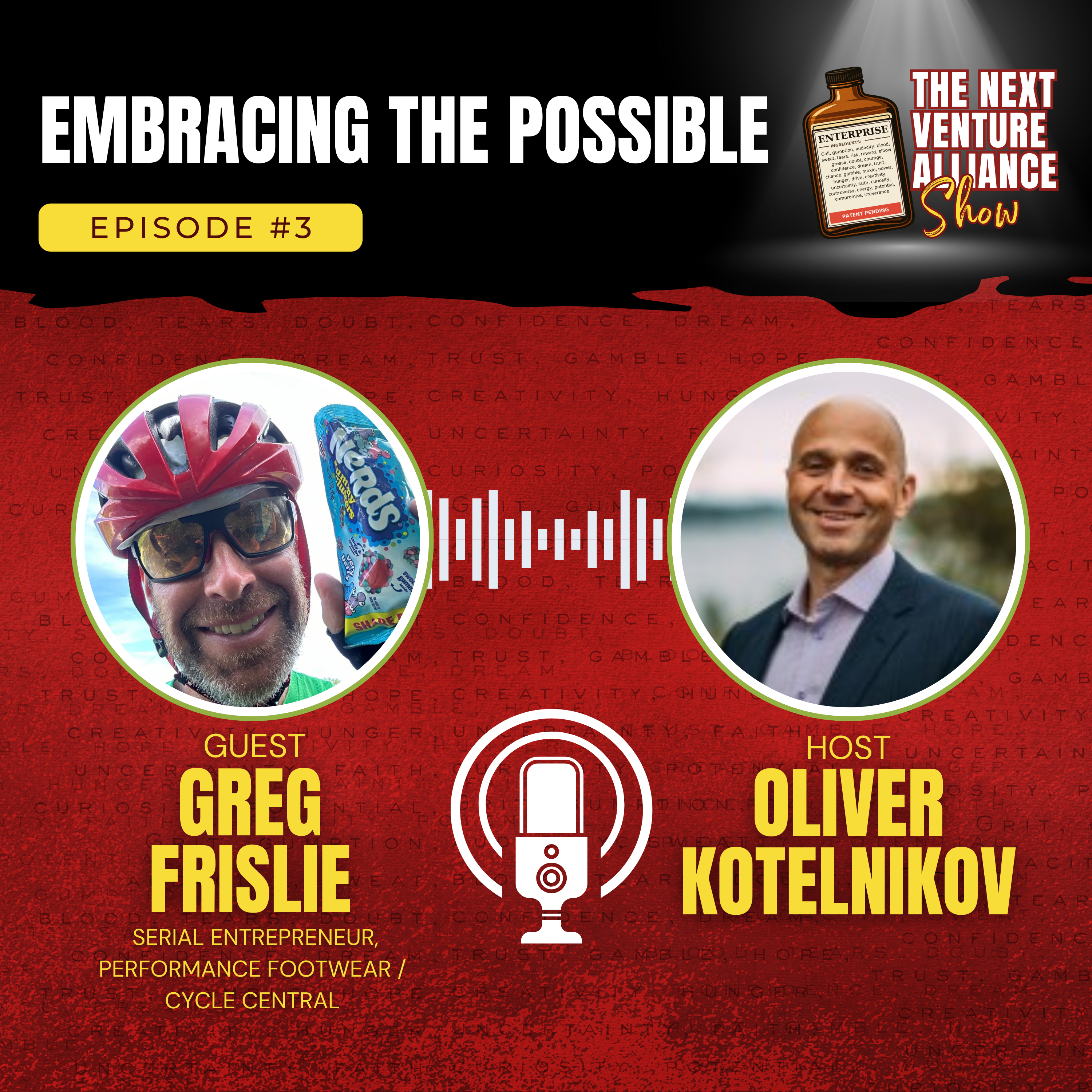
[00:00:33] Speaker B: Glad to have you with us today for the next Venture alliance show. My name is Oliver Kotelnikov. I'm an entrepreneur, storyteller, mergers and acquisitions advisor, and a business and commercial real estate broker. If this is your first time tuning in, welcome. On the show we talk to founders, business owners, self starters, industry leaders and trusted advisors who support them together. Together we explore both the strategic and the human side of entrepreneurship. And on today's episode, I'm joined by a serial entrepreneur and a good friend, Greg Frisley. Among many successful ventures, Greg built and successfully exited such well known companies as Cycle Central and Performance Footwear. And he's done it all by putting people first, serving deeply, listening intently and consistently exceeding customer expectations while outworking the competition. Competition. I know this is just a brief introduction. I'm probably, probably selling them short. But lucky for us, the man, the myth, the legend is with us here today and he'll fill in the gaps. Greg, welcome.
[00:01:42] Speaker C: Thank you. Oh, I can't. You know, I hear all that and I honestly have to say my wife should be sitting here next to me because she really was the wheels.
We always look good when we have a strong person behind us. So.
[00:01:55] Speaker B: Yeah, no, for sure. And you know, I know Carmen well and I know the role that, that, that she has played in all your success and yeah, I'm sure continues, continues to do so.
But we met in the performance footwear chapter of, of your career. But, but that's not really where your, your story began.
Can you take us back to the origins and.
[00:02:21] Speaker C: Well, I would start saying that Monopoly was my best game, my favorite game growing up. I played that with my best friend when I was, before I was 10 years old. I think we played every day in the trailer park I grew up in in north Idaho. It was just a fun game. I got it. I loved it. I loved, I love seeing growth. I loved seeing numbers increase and whatnot. And so, you know, he was my buddy that had the Kool Aid stand and we had a candy store that we ran at the school kind of, you know, in the background.
[00:02:54] Speaker B: This is all happening parallel. When you're what, seven, eight years old?
[00:02:58] Speaker C: Eight. Eight years old.
[00:02:59] Speaker B: You got three. You got three things going, @ least by the.
[00:03:02] Speaker C: Age. By the time you're eight. Yeah, we had a whole hustle going on with lawn mowing and, and snow shoveling and all that type of stuff. When you grow up poor, you just kind of figure it out because there's a lot to go around. So, you know, in order to go do the things that we wanted to do, we just had to work and make it happen. So nothing against my upbringing. It was phenomenal. It just is what it is. And so we.
[00:03:28] Speaker B: Played.
Is it.
[00:03:30] Speaker C: Idaho? No. Yeah, North Idaho. Okay. Yeah. Post Falls, Idaho. So, yeah. And you know, it's kind of skipping through it. I wasn't a college educated person.
I have a pretty strong feeling on purpose on college and who should go and who doesn't need to go. And I.
[00:03:48] Speaker B: Was. They have that in common. We've talked about.
[00:03:50] Speaker C: It. Yeah. Yeah. And so, you know, I actually, out of high school, I got into the auto industry and I sold cars. And it was fun. I loved it. It was like a sport. You know, you see the customer out on the, on the lot and you get to go meet them, greet them, you know, test drive them, ask them to buy and then work the deal and make. And so that's really where pretty much cut my teeth in that industry. It was a difficult industry.
Yeah, it's gotten more difficult obviously as the Internet has stepped in and it's not as fun.
My car dealer buddies would probably disagree with that, but I like connecting with people and it's really become more kind of where our world has become is more about price and, you know, how cheap can you sell me this thing? It's really not about the service anymore and what you can get or give. You know, people want to know what they can pay for.
[00:04:46] Speaker B: It. So sadly more transparent that way on one hand. Right. But you know, the facts are out there in the car business. Somebody shows up with a Carfax and a, you know, manufacturer's invoice and says, I'm buying it for X.
[00:05:01] Speaker C: Right. Somewhere. So yeah, yeah, somewhere may not be here, but I want to go. Drive.
Worked my way through that industry into sales management. And when my now 23 year old was born, I didn't want to work until 3am anymore, you know, cranking out.
[00:05:19] Speaker B: Deals. What ages were these? I mean, you started at what, 20 kind of was your college in.
[00:05:24] Speaker C: Essence? I started at 18. 18? Yeah. I bought my first home at 19. So I had to hustle. I had to get that thing paid for and whatnot. And started kind of working on the whole, you know, real estate acquisitions at that point, because I realized I don't have a college education.
I'm probably not going to fit into the box of the people that they build. And so I'm not going to have a pension. I have to create some sort of a future, you know, value type of a thing. And so I figured, well, just buy homes or rent them out. So that's what I did over in Spokane.
But I was 18 when I started. When I got out of the auto industry, I ended up. I was 31 and a half, like, something like that. But then I marketed those insurance products to auto dealers. And so it wasn't like I was out of it. I spent another decade in the wholesale end of it showing auto dealers how to become more profitable, sold insurance policies to help with their profitability and things like that. So that was fun, you know, something.
[00:06:34] Speaker B: That. And I remember, you know, we talked about kind of your start and how you got started and how your roots, you know, impacted what you're telling your family. Right. And your boys. And I know Corbin and Brennan well, and I've seen you interact. And one of the conversations you and I had was, you know, about college and who should go and who shouldn't go, and you saying, give you 15 grand and a car and you drive around the country and work your way through it. And if, when this money runs out, it's out. But that's kind of your, you know, experience. Go out there, make something happen, get some life experiences, meet people, learn to make connections, you know, learn about what you like and what you don't like. Learn about the country, what places you like or don't. So basically, you know, hands on. Right. Everything is. Versus sitting in the classroom and learning something. And I have nothing against kind of higher education and concept, but it's a different path. Right. And it's not an inferior path. Just learn by.
[00:07:40] Speaker C: Doing. Right?
Yep. Yeah. And I think that has been a pretty big shift on that style of thinking because I was definitely an outsider, you know, in that arena of thought, I guess, that a lot of people would be like for a long.
[00:07:57] Speaker B: Time, because that was the mainstay, you.
[00:07:59] Speaker C: Know. Yeah. Your kids have to go to college. Well, what are they going to do in college? They're going to rack up debt, they're going to party, they're. No, yeah. They're going to have some life experiences and stuff that they wouldn't get, but they're not the kind of life experiences that, you know, I'm going to support, really. You know, they can go do that on their own with their own money. I would rather, you know, they. I think Brennan was 16 and Corbin was 19, and they bought their first homes, live on the same piece of property in two separate homes. They put 50 grand each down that they had earned in the stock market.
And they're got, you know, $300,000.
[00:08:37] Speaker B: In equity versus $300,000 in.
[00:08:40] Speaker C: Debt. Yes. And they own and operate a pool maintenance business over here. They have a great little solid book of business that they're growing. And, you know, they work different than you and I do. You know, they work.
[00:08:53] Speaker B: Smarter.
[00:08:54] Speaker C: Yeah. They don't work harder. You know, and that's part of that generation, you know, that's. That, honestly, I really struggled with as a. As a business owner when we were in business is the whole. That whole concept of things are shifting. People, they don't want to work 60 or 70 hours a week. Like.
[00:09:15] Speaker B: That'S. And that's what you employ.
[00:09:16] Speaker C: Is.
[00:09:16] Speaker B: Right. You employed a lot of people, and you're getting this feedback from employees, like, I interested, but I have this, this, and this. I have these other priorities.
Can this job fit into, you know, with all these.
[00:09:31] Speaker C: Other.
Yeah, no, or. Or. Or the other one, you know, is like, hey, you know, after Covid, a lot of things change, and. And that's when we met up, you know, that's when I think the wind was just a little out of my sails at that time, and my wife's. And we had ran really hard, you know, growing these stores, and the hard one was, hey, you know, I'm not feeling it today, you know, and be like, you're not feeling it? It's like, Saturday, you know, we're gonna do $18,000 worth of business today, and we need you. You're like a key person, you know, and it's like just.
[00:10:10] Speaker B: Yeah. And that's. Yeah. There's not that common.
[00:10:13] Speaker C: Ground.
[00:10:14] Speaker B: Right. They're just like, yeah, no, I'm just not coming in today. Well, yeah, figure it out. Yeah, I'll be there. I'll be there Monday, you.
[00:10:21] Speaker C: Know. Yeah. You know, and I thought about, like, in my past background, you know, when I worked for the insurance company, you know, that our sales people were all making 150 grand a year, so they were a little bit easier to leverage. Yeah. Motivate you. That's probably a more politically correct term than.
[00:10:41] Speaker B: Leverage. It's an umbrella term. There's a lot that goes into that. But we're not going to talk about all the motivational tactics in the.
[00:10:47] Speaker C: Car sales, but the, the, you know, the, the employees in a, you know, in a minimum wage type of an environment, it's really difficult to figure out how they're motivated. And most of them, you know, honestly what we discovered is most people want to know their value. Like it really is about getting kudos and pats on the back and those types of things. And honestly, that's probably my worst, you know, being completely transparent. I'm probably the worst in the world at telling people, good job.
I just, because I think I grew up through my life, I never got that really, you know, from a father figure. And so I just figured out how to make it happen and like, just do it for a different reason, you know? Right.
[00:11:38] Speaker B: Yeah. And that can be a big gap, you know, because the generation that's now entering the workforce, that's probably their biggest. That's what they're looking.
[00:11:46] Speaker C: For.
[00:11:47] Speaker B: Right. It's not necessarily the money. Like, if you look at what, you know, millennials and Gen Z's are looking for, like, money is like number 93 on that.
[00:11:57] Speaker C: List. Right.
And I'm doing the math and I'm like, you guys, you gotta figure this out. It's not getting cheaper.
Right. You know, and it's not a scary world out there because if you're resourceful, you can figure it out.
Yeah. I keep telling Carmen we need to buy another business so Oliver can sell.
[00:12:17] Speaker B: It. Yeah. And then, you know, we've, we've talked about that many times and we revisit the idea.
But.
Yeah, no, we'll find some for you. I know you still have the itch, you got the skill and obviously a lot to impart. And furthermore, I mean, I think that, you know, still at this point, kind of, you know, like you recipes for success. I mean, you can look at them and you can say they're outdated, they don't match, you know, the values of today's generation.
You do have success under your belt. Whereas some of these other schools of thought really are just theoretical yet. Right. Like you don't really have to work hard to.
[00:12:57] Speaker C: Win.
[00:12:58] Speaker B: Yeah. Some people have done it. Some people work smarter, you know, over, work harder, never work.
[00:13:03] Speaker C: Hard.
[00:13:04] Speaker B: Yeah. But in many cases, I do think it's still theory.
It hasn't been proven that you can run the world from your couch and from your.
[00:13:15] Speaker C: Phone. Right.
Yeah, some people can. For some, Some.
[00:13:19] Speaker B: People. Some people can. Right. But if you're 18 and 19 and saying, you know, I'm just gonna figure out something where I don't have to be someplace.
And then, you know, zeros and ones will kind of connect and money will end up in my account. You know, some people can do it, but, but, but I think there's still more success in your court than there is at this point than the other side. But hey, I mean, how did you get in, how did the transition happen from car business and consulting? And then you exit that and then you enter kind of the world of small business.
Right. And small business ownership because you go from pretty big business to you know, the dialed.
[00:14:01] Speaker C: In. Yeah. And you know, and I an idea of like this company was based out of Eugene area and you know, it was just to give a idea like a hundred million dollar, you know, valuation on this big deal.
And they took on an equity partner.
After a decade, we quit from a 10 million to 100 million in a 10 year period. So it was a big run. We had a blast. Awesome ownership, amazing work, family.
We worked hard and we did great. They took really good care of.
[00:14:36] Speaker B: Us.
How many people, what's the core group that, that's responsible for the 10x.
[00:14:41] Speaker C: Growth?
Oh, there were 40 employees likely.
You know, we, we owned and our own insurance company with our own actuarial department, our own claims department.
We from A to Z. It was a one stop shop. And you know, the local ownership, the, the you know, generation help that we would, you know, give to the departments in there to help them learn how to maximize their opportunities and, and speak logic customers, they could understand why yes is the right.
[00:15:13] Speaker B: Answer.
[00:15:14] Speaker C: Right. So that's what we did. But you know, I was gone a lot. I was gone probably three nights a week for a decade.
And that puts strain on a family. And you know, Carmen became the dad and the mom and then when I would get home, I was the dad. And it was confusing, you know, for the kids. And she stayed at home, you.
[00:15:34] Speaker B: Know, and this is about like 20 decade, like between 20 years, 25 and 35. Somewhere in that range, age.
[00:15:40] Speaker C: Wise. No, I was, I was then 42 when, okay, 30 to.
[00:15:46] Speaker B: 40. That decade. You're, you're running the big conglomerate, you know, missing time at home. Some questions are starting to develop. Am I doing the right.
[00:15:55] Speaker C: Thing? Yeah. And I was frustrated and especially, you know, as the acquisition kind of happened and the equity partner came in and you know, purchased it. We were managed out of an office in Atlanta.
So if you kind of admit it, and this isn't me being Negative. This is just me being transparent. Black and white is if you imagine you, you want to go camping this summer and so you go buy a truck and, you know, if you took the RV and you put it on the front of the truck, it would be backwards. And so, yes, it's kind of how I felt. And a lot of us felt, you know, like we're being led by the trailer here. We need. We're the.
[00:16:37] Speaker B: Company. Yeah. Cart before the horse type.
[00:16:40] Speaker C: Thing. Yeah.
So Carmen, you know, for a couple years, she's like, well, shoot, just leave.
And. And that's.
[00:16:47] Speaker B: Hard. I can see her saying that too.
She just has these like, revelations, like, why don't we just do.
[00:16:53] Speaker C: This? And it's like, yeah, it doesn't like I'm logic. And she's all faith, you know what I mean? And usually if I follow her, she, you know, in her suggestions, they usually work out, you know, and so far, so.
[00:17:05] Speaker B: Good. I wouldn't have that setting if I were you. Honestly. You don't need to know why it.
[00:17:09] Speaker C: Works.
Yeah.
So, you know, I, I just kind of, you know, as I'm driving 70,000 miles a year and flying several times a week to different towns and staying in hotels and eating, you know, at the same restaurants all the time and whatnot, I don't know, I just was like, yeah, this sounds good. I'm going to take a couple years off. I'm going to kind of semi retire, see if I can make it on this little, you know, pentance that has been created and, and getting all the kids and my wife in a family should know, know each other and being home and hanging out, doing things. And literally, I think I played like, you know, 14,000 games of words with Friends, you know, and don't laugh.
I know I played you at chess and that doesn't last. I was better at Words with Friends than I.
[00:18:01] Speaker B: Would. You're saying this is at home. You're.
[00:18:03] Speaker C: Back. I'm just trying to stay, you know, doing something and, and that, you know, stay insane.
Yeah. And I think it was about 45 days in, I told Carmen, I go, I can't. I'm. I'm 40 years. I. I can't like, unplug that. And, you know, we were doing triathlon at the time, so I was trying to focus on running and biking and swimming and doing all that type of stuff. But I'm a builder, you know, I love creating. And so she's like, well, why don't you do something then? And so we got a whiteboard out in our living room. And for probably 60 days, we had, I don't know, 50 to 100 ideas written on this board and like.
[00:18:49] Speaker B: A family brainstorming session in the living room.
[00:18:52] Speaker C: Just. Yeah.
[00:18:53] Speaker B: Yeah. Free associating business.
[00:18:55] Speaker C: Ideas. Yeah, yeah. And. And I'm, you know, mind.
I'm just not really good at putting things into motion, so. Weakness of mine is, like, I can come up with great ideas.
I'm not very good at the next part in order, you know, but once that part's done, that's when I hop back in the. And then, like, I can, I can.
I'm just not good in the minutiae of the. Of.
[00:19:22] Speaker B: That.
Yeah, And I mean, I share that too. I mean, you're kind of a big picture concept guy, but. And, you know, throwing out ideas, and if someone's listening, you know, a few of those are just gems. Right? But. But you're spitting all 100 in a row. Which ones are gems? It's a little clear, unclear to decipher, but, like, I'm with you to where, you know, my.
The main driver, my kind of entrepreneurial gene, whatever that is, is curiosity. Like, people say, well, you know, you have to have the big why, you know, why? Like, you know, to me, it's why not, right? Or what.
[00:19:58] Speaker C: If.
[00:19:59] Speaker B: Right. Like, those are my sort of drivers. And I like to get out there and. And put things and just try it, you.
[00:20:05] Speaker C: Know. See, you had a wildly successful business over in the Seattle.
[00:20:10] Speaker B: Area.
Correct.
[00:20:12] Speaker C: But.
[00:20:12] Speaker B: But. But, you know, from my family, from my mom and dad, and, you know, inherited the same philosophy. It was experimentation. Like, we had a platform for experimenting, and there wasn't the need for long theoretical discussions of what ingredients, you know, would work in the pastry and add, you know, a baking business.
And, you know, it was. Let's just try it. Let's put it together, put it out there.
You know, if people buy it, then it's a good idea. If they go, you know, that looks interesting. I'll get that next time.
It's probably not that great, right? Or maybe not. There's some room there. But it was trial and error, right? And curiosity driving it. Let's try this. And some of the things. And it's a, you know, it was a wildly successful business. Some of the things that are items and concepts and ideas and, you know, things on the menu that are the most successful, I know their origin story. I can tell you exactly how they came.
[00:21:08] Speaker C: About.
[00:21:09] Speaker B: Right? It was just trial and error, and people always want to have some big story behind it. Like it was, you know, this was your grandma's recipe and you carried it, you know, for, for, for 15. You, you know, followed it exactly to a T. That's not what happens. Like, you just try some stuff. Yeah.
Hey, this is good. Can you add that to mine? You know, and you, you throw in, you know, another ingredient and the next person goes, wow, that looks good. You know, I'll take that. But, but you don't, that unless you're experimenting in the live setting, you, you can't have that.
[00:21:38] Speaker C: Dynamic. Well, like this is, this is old sourdough. Yeah.
[00:21:44] Speaker B: Really?
[00:21:45] Speaker C: Yeah.
Twelve.
[00:21:48] Speaker B: Days. Yeah, yeah. Maybe 12, 900. You know, maybe there's all these things that like, but, but ultimately it down to just trying stuff and seeing what works. Because if that recipe for success could be replicated, there wouldn't be so many failures in corporate America with unlimited budgets. Like there are businesses in chains, large chains of, you know, 300 that open up and do nothing and they have to be closed down. You would think that with all the research dollars, all the information, all the perfect locations that they would do well, but they don't. They close.
[00:22:27] Speaker C: Yeah.
I think part of the. No, I think the thing that people, they don't do is they, they don't have a why and they don't, they don't and. Because it's not easy. And you know, I know that when we had our bike shop, you know, the, you know, we're in state and it's, it gets cold in the winter and you don't sell a lot of bicycles, you know, in the winter. And so you have to understand that, gosh, in the springtime, this thing's going to take off and we're going to be super busy. And I remember there were times when I think Carmen and I worked like five months straight every single day from ding to dong, you know, every single day. And you would have an employee go, I've worked five days straight. I got.
[00:23:19] Speaker B: To.
How do you like that for? I'm not feeling it today. How about five months straight of not feeling it and still doing it every.
[00:23:27] Speaker C: Day? Yeah, but we were having fun, you know, our why when we, you know, kind of going past back to the whiteboard, you know, we had all these ideas that were money making ideas like inventions that would just crush it.
But we weren't able to connect with people.
And we're people people and we serving people. And so our goal was to find something that we could do with the public where we could, you know, we wanted to challenge ourselves really really see, you know how this would work. We're, you know, Christian people. We really believe that the door was open. The Lord opened the door for. For the opportunities. We're moving to a new community where we knew two.
[00:24:11] Speaker B: Families. And this is you moving to.
[00:24:13] Speaker C: Wenatchee?
Yeah, two. We knew. And we were sitting in a restaurant when we had committed to track bicycles.
And we were sitting in this restaurant that probably had 75 people in it, 100 people. It was a busier.
[00:24:27] Speaker B: One. What do you mean you committed to Trek? Like, what was the setting? Like, how do you end up in a restaurant committing to a business deal? What's that look.
[00:24:35] Speaker C: Like? Well, we committed to Trek, and then we had to go find a location to put the store.
[00:24:41] Speaker B: In.
[00:24:41] Speaker C: Okay. And we committed to Trek the middle of December. And then right after Christmas, we're driving to Wenatchee to find a location because we decided that's where we're going.
And we're. We. We found. Which was across the street from the. The Specialized retailer had been there for 20 some years.
And we're like, well, you know, that's what Burger King does. Right? They go where the McDonald's is, because that's. You do when you want to make it happen, you know.
[00:25:11] Speaker B: Right. Go where the end is.
[00:25:12] Speaker C: Already. Yeah. So that's what we did. But.
And we'll get into that. But when we're in this restaurant that, that night when, like, okay, that's where we want to go, we're looking around the room and we're like, we don't know anybody in here. But it's weird because in two years, we'll know everybody.
That was really strange, you know, and that, that, that was opportunity because when we first got there, we'd have customers come in and go, do you know that there's a bike shop right across the.
[00:25:41] Speaker B: Street?
And you go, no. We didn't.
[00:25:43] Speaker C: Notice.
I would just laugh. I'd go, well, yeah.
And we just. We just.
And it was amazing what happened in that. In that space. And we were in business there for seven years. We. We ended up selling our store to Trek.
[00:26:01] Speaker B: You. So, you know, basically, you know, Trek buys it back as a franchise.
[00:26:06] Speaker C: Location.
Yeah. We actually ended up.
End of our season there.
I think it was the sixth year we became the. A top 100 Trek retailer in North.
[00:26:17] Speaker B: America.
And you started in an empty space. I mean, I know that space. There was nothing there.
[00:26:24] Speaker C: Before.
We started with one space, and then we acquired the space next to us and we built it out. We cased out all the bikes like, it was artwork. And the mountain bike room had, you know, artwork on the wall as far as, like, painting and, you know, clouds up above and trails that the bikes would be on. I mean, it was.
It was a cool place. People would come from all over, they'd hear about it, they'd check it out because it was just fun. We got tons of people from the west side that would come over and do business with us because they love the.
[00:26:58] Speaker B: Environment.
And you were able to add some personality to, you know, franchise location, which. Which can be a little difficult. Right? I mean, I don't.
[00:27:07] Speaker C: Know.
Yeah, it's not a typical franchise. It's, you know, represent their product. You become selected, you have to go through an approval process, but it's not like a. A standard. Like, okay, you know, back to McDonald's, like, you know, the egg McMuffin, you know, you, you know, do them in this or the muffin this long, and then you, here's your egg that you take out of a package, and then heat up this, and then you wrap it up. It's. You just sell their product and.
[00:27:33] Speaker B: You got some autonomy and some sort of room to operate as an entrepreneur and. Yeah, manifest your own.
[00:27:41] Speaker C: Vision.
The opportunity came along as we're doing business and we're, you know, disrupting the. The way that this small little town has always operated with, you know, like a lot of small towns, do they, you know, people support the local economy.
Some of the attitudes might have been like, hey, you know, you need to be grateful we're here, you know, for us. We were flipped around. We were like, we are so grateful you're here, and we're going to prove it. You know, you're going to get a hug when you come in, or you're gonna, you know, we're. We're gonna serve you. We're gonna never say no. We're gonna, you know, basically love you. And. And it was.
[00:28:24] Speaker B: Odd. They're gonna love on you when you come in.
[00:28:26] Speaker C: Here. Yes. Yeah. And it'll take time, because at first you're gonna think it's kind of weird, but then you're gonna start coming in here because you don't know why you're here. You're just gonna be.
[00:28:35] Speaker B: Here. And this happens every.
[00:28:38] Speaker C: Time. Yeah. Yep. Yep. Consistent. And. And about halfway, you know, Dan and Cheryl, who used to own the shoe store, they approached us and said, hey, we would love for you to buy our store. Or kind of in this transition. We're thinking about, you know, our next steps. And. And we.
We consider.
And My wife was like, you know, I just don't feel like right now is the right time. I think we need to, you know, kind of keep going on this and get some people in place that, you know, can.
[00:29:10] Speaker B: Help.
And this is. You said, like, year seven a year already in.
[00:29:14] Speaker C: Your. No, this. Probably five. Year five. Okay. Yeah. And so we stepped away from it, and a couple years later, we're putting snowboards out in the. In the winter room. We had a frozen, you know, central kind of a frozen department in the store where we brought snowboards and boots and, you know, it was called.
[00:29:35] Speaker B: The frozen department of the bike.
[00:29:36] Speaker C: Shop. It was called, heck did we call it. I didn't even want to start singing the Arctic Room.
Yeah, whatever. A little.
But they came back in to see what we were doing. And I asked Dan, you know, this was probably December 10th.
And I said, are you guys still wanting to sell your. Your store? And he goes, yes.
Are you ready? And I said, I haven't talked to Carmen for quite a long time about it, but I think we might be ready. And. And at the end of the year, we were done, and we were in there January 1st doing business or.
[00:30:08] Speaker B: 2Nd. And how does. How does that overlap with. I mean, they come to you, they say, hey, the store is doing so well, we'd like to buy it, or. I mean, how does that interaction.
[00:30:18] Speaker C: Go? Yeah, so. So that was kind of. You know, we had a manager that we approached about, you know, purchasing it and kind of didn't really come together or come to tuition on that. And. And then we just kept doing business. But what had happened is when we bought the shoe store, I went and worked at the shoe store. Carmen ran the bike shop.
And it's just a big. It was difficult to operate, you know, with one person, especially the way that we operated it. And we just felt like, oh, and her health was starting to kind of deteriorate. You know, she has some rheumatoid arthritis issues. Stress kind of activated a lot of that pain. And so she was not loving life.
And so we just kind of got to the point where we really felt like the best call for us at the time was to approach Trek and see if they had any dealers that were interested in expanding into an amazing opportunity in Wenatchee. And, well, they said, well, we're actually interested if you want to talk. And so I think it took about eight months or so of kind of talking about it. Then all of a sudden they're like, we're ready to go. If you're ready we're like, well, I ended up in Philly. You know, I loved it.
Yeah.
[00:31:39] Speaker B: Yeah. Window of opportunity opens up. I mean, you got to kind of walk through it or not, it's not going to stay open forever.
[00:31:46] Speaker C: And. Yeah. So then, you know, when that closed, Carmen and our office manager, Rochelle came to the bike shop, and we just kept plowing ahead and grew that thing a.
[00:32:00] Speaker B: Lot.
Yeah, yeah. I mean, when you bought performance footwear, I mean, it was a great business.
It was, it was well known, but, you know, it was kind of. It wasn't doing anything.
[00:32:12] Speaker C: Spectacular.
[00:32:13] Speaker B: Right. It was solid. People loved it. It was, you know, where you went and everybody, everybody in Wenatchee knew it. But, you know, you come in seemingly same location, same product, but you more or less double the numbers in little over, what, two.
[00:32:34] Speaker C: Years.
Yeah.
[00:32:36] Speaker B: Yeah. How does that happen.
[00:32:38] Speaker C: Huh?
It's the same model. You know, we. We care for people we don't know, you know, and that costs you money. But we don't advertise. Like, we, we don't. We're.
[00:32:50] Speaker B: Not. You had no marketing budget. You know.
[00:32:53] Speaker C: You. You were like, how are you this with like 300 bucks a.
[00:32:55] Speaker B: Month? Well, it wasn't just me. I mean, we interacted with many buyers and these questions. Yeah, you know, kept coming. Hey, here's this. Retail, it's a great business. We understand, but how does something like that. Well, how. Well, it was around for what, 15, 20 years when you bought.
[00:33:11] Speaker C: It.
Yeah, something like.
[00:33:13] Speaker B: That. Right. And then you hockey stick, you know, trajectory, you know, you scale it.
How do you do it? And, you know, in that short amount of time, even with the, with the changes of the business model and company culture, but you are getting into some of these kind of, I guess, more difficult kind of advanced entrepreneurial concepts because, well, they're.
[00:33:37] Speaker C: Not. I mean, really, it was. It's what everybody's looking for opportunity. Like, like you and I, you know, we like to grow things. And so what why I would salivate is, you know, I would go in, look at their inventory, I would get feedback on customer, you know, treatment, because we're just two blocks down the road, so, you know, what's going on everywhere. And I'm looking at it like this is a slam dunk opportunity with our model and just buying more inventory and creating more options. You know, it's a great little town with people that want to support local.
There are online buyers and whatnot. But I mean, it's, It's. They really want to have a place to go and experience a shopping. You Know, visit. And so that's all we did is we just, you know, put the, in the mix. Our, our design which is have.
Okay, so I learned this at the meat shop that I worked at in high school because here we.
[00:34:35] Speaker B: Go. We're.
[00:34:35] Speaker C: We'Re. Yeah. I always wondered how come when you have the meat case, when there's two steaks left on a rack, they'll sit there for three hours on a crazy busy Saturday. People are just all over the place. But you cut new steaks and you stack them three high, those will sell like that.
[00:34:57] Speaker B: Yeah. And the two that would have been there selling the next five.
[00:35:00] Speaker C: Minutes. Right.
And they did. And so I caught that, put it in my pocket. I was like, it's all about the inventory. People want to, they genuinely want to up a situation. So they look at the stack of stakes and they think, that's a lot of stakes. I gotta help these guys out. I'm gonna buy.
[00:35:17] Speaker B: Some. You think it's their better nature.
[00:35:19] Speaker C: That.
Yeah, but I, I, you know, we, we started and stocked the, you know, brand, the bike shop with a lot of inventory and we served people and we, you know, they, they didn't have certain sizes.
Women, like, they would go up to size 10 in, in a few pairs. Well, we had sizes 11s in almost every item that we had. That's a big shoe. But you know What? The size 11s didn't shop there because they knew that they didn't have the inventory. So we just opened up a new.
[00:35:55] Speaker B: Avenue. I mean, how do you change public perception though? Like if a business has a certain image, there's a, there's kind of a, you know, brand.
[00:36:02] Speaker C: Identity.
[00:36:03] Speaker B: Right. I mean, this is a great place, but this is what they do and this is what they don't do. Especially in a smaller town. It can take a while for, you know, once people make up their mind, it's, you know, it can take a little change.
It's one, I mean, other than one customer at a time coming in. How do you let them know that this business is.
[00:36:22] Speaker C: Now? Well, I think, I think the, you know, we, the newspaper would do write ups, the radio would have me on live once a month. Just talking about life, kind of like what we're doing right now for a season. We did unsold inventory in the beginning with the radio station because there's not TV station here. We get TV from Spokane and Seattle and radio is kind of a big deal. And I bought unsold inventory and we'd get 3,000 spots a month on, you Know the biggest radio group here in town. And so the word got out pretty quick on what was going on, you know, those ways. But we just had favor. I mean, people, they. They experience this thing. Like, let's look at Nordstrom. You remember when you used to go into Nordstrom and used to actually get this amazing.
[00:37:16] Speaker B: Service? People would drive those days. Yeah, I miss.
[00:37:19] Speaker C: Them. Yeah. Well, people drive to your house to show you the outfit. Well, what does that create?
Obligation. So, like at the shoe store, we sit and fit every customer. Like, you don't just come in and, you know, I'd like to buy these shoes. And I know this is like, all the sales people are listening. This are going to be like, well, then you take it to the register. No, we would take the shoes out, make sure they fit their feet, and let them walk around and make sure that that's not going to come back as a return because it doesn't feel right or they're too small or too big or too wide or whatever. The thing is, it's the experience.
And when you sit and fit somebody and you take 10 or 15 or 30 minutes with somebody and you try on four or five or six, seven pairs of shoes patiently, it's an obligation. They. They feel like, you know what? I'm gonna support these guys because they supported me. And that's kind of. I mean, you.
[00:38:13] Speaker B: Did. You went as far as doing, you know, gait analysis and making sure that the shoe fits. And then some of them were kind of more medical, and you had. You were contracting, I think, orthopedic local hospital, and you were fitting the medic, you know, the kind of shoes for crews and fitting people in different professions. It really depended on a quality shoe fit.
I mean, that's not something you get out of a ordinary shoe store.
[00:38:41] Speaker C: Right? That's a.
Yeah. Well, we worked with one of the podiatrists in town, like the main podiatrist, and he trained.
[00:38:49] Speaker B: Us.
Okay, so podiatrist came. Oh, he actually, I remember he came in and he trained a podiatrist, trained your sales.
[00:38:56] Speaker C: Staff. Okay. Yeah, yeah. So we learned about.
And, you know, bunions and things that cause people pain. And we listened. And so we actually got to the point where people would call his number to schedule an appointment because they had heel pain. And after a few questions on the phone from the. The front desk, they would say, give yourself 300 bucks. Go down to performance footwear. You likely have plantar fasciitis, and they know what to.
[00:39:26] Speaker B: Do. So you. You became kind of the, the medical community. And you were the fulfillment center for, for the.
[00:39:33] Speaker C: Local.
Yeah, because they want to do real, real work. They didn't want to.
You know, we had rules, we had agreements, and we knew the guidelines they were supporting us on. And when we had questions, we would call or we'd send them back.
But there were certain shoes we weren't allowed to sell to those people that, that don't have the support types of things. So anyway, yeah, I mean, they would.
[00:39:58] Speaker B: Walk. I mean, I remember they'd walk in the store, right, and you'd actually watch and they go, I love these shoes. And you would go, well, these are not the right shoes for you. And you get them into something else. But, but again, you have seven opportunities to just come to the register and ring them out. But you don't.
Because you want to do it.
[00:40:19] Speaker C: Right? Yeah, yeah, yeah. So, you know, Covid changed a lot of things in the environment and a lot of the mentalities, I think, of the customer base and the way people would treat people. And it also changed the scope of our town and demographic because a lot of people were moving here, you know, and it just, it just changed the funness. That's a word, you know, for us. Because people that were moving in didn't want the hug, they didn't want the care. They just wanted to be left alone. And that's just not our model, you know, so we just had to reach the difficult point of like, look, could keep beating our head up against the wall.
You know, we would have people come in and you'd be trying to help and they would go, you can just run along.
I'll let you know if I have any questions. And it's like, well, you know, you want to say, well, probably not the place for you to shop, because that's not how we do business. You know, there's other options, but it won't be here. You know, you can't do that. So you just have to kind of swallow your pride and move on and, and say, well, take their money and take their.
[00:41:31] Speaker B: Money. Right, which, which would be, you know, the end all, be all for many operators. But. But it didn't quite fit this model, which we touched on this and in, I think if you remember conversations with potential buyers, because the question was always, you know, is online retail going to come and destroy performance footwear and all of brick and mortar with it? Because, you know, the modern day religion of the consumer is convenience often, right? And it's. And, you know, price, shopping price and convenience. And if those Two match. Then, you know, then they buy.
And I think you'd said something to the effect of, you know, service and knowledge and product knowledge will be delivered in a corrugated box at your front porch. So we're safe. The proof is in the pudding. And we had the numbers to prove it. But there was again that like, sort of double take of what's happening here. And, and I mean, you leaned into business model ultimately and, and the company culture at the time, which was challenged by Covid. But, but even during COVID I mean, all the restrictions, which, if you remember, kept changing.
You had people in there with masks and keeping distance and doing all these things just so they could try on a pair of shoes at your.
[00:42:51] Speaker C: Store.
[00:42:52] Speaker B: Yeah. Which they could have ordered.
[00:42:53] Speaker C: At.
Totally. And I think, you know, I still am a firm believer in customer service and how.
And that's just such a loose term, customer service. Like, what does that even mean? What does that mean? Yeah, it's like truly serving people.
And that's where that word actually, that's where it originated. Customer service was serving. And I think it's a lost art, you know, And I'll give you an example. We, you know, we have a home down in Arizona. Been to it.
[00:43:26] Speaker B: Yeah. We celebrated the wind down.
[00:43:28] Speaker C: There.
We. We got fired from our landscaper a few weeks.
[00:43:33] Speaker B: Ago. Does that happen? Is that.
[00:43:34] Speaker C: Possible? I didn't know that it did, but we did.
And how it happened was I called him and I asked him if he would come and take a look at the job that was done and wonder why, you know, we have this cactus that's leaning up against our golf cart garage. And then there's another, you know, the tree coming into another saguaro we have. And just a lot of. I couldn't get to the barbecue because the bush was being continued to grow over and over and over.
And so he said, yeah, we'll definitely address this. And then a couple weeks later, I get. I, you know, I'm looking and I'm like, nothing was taken care of that we talked about. And he said, you're probably going to want to find another landscaper because I can't get my guys to do what I'm asking them to do.
Okay. That's been like a two year relationship. You know, we're pretty low maintenance. We're only there half the year.
[00:44:27] Speaker B: You know, and so different, different business model, different understanding of word service, clearly.
[00:44:33] Speaker C: Right. Could you imagine me doing that? I would be over there myself, Herman and I would have our gloves on and our saw or whatever. The heck it is that night, fixing the problem.
Yeah. This guy is like, well, I'm up in Flagstaff. I'll be down, and next week I'll see if I can do the job with those guys. Never did. It's just.
[00:44:53] Speaker B: Different.
I mean, both of you were at the store all night counting inventory. I mean, we all were, but.
But there was no, you know, so somebody else will do it or. Or it just got.
[00:45:07] Speaker C: Done. I was. It was good time. I. I missed those days. I honestly, I missed that store. Yeah.
Yeah, I missed that store. I.
Carmen threatens me. I, you know, do another business. She says she's gonna get a cat. And so, I don't know. I'm picking. I'm. I've been looking at.
[00:45:27] Speaker B: Cats.
You know, I think you're always. I just. Sometimes I hear it in your voice, and it's like, okay, this.
[00:45:34] Speaker C: Is.
[00:45:34] Speaker B: He's. This is probably two strong headwinds in the direction of, like, he's gonna buy something. He's gonna get back out.
[00:45:42] Speaker C: There.
Likely. I don't.
[00:45:44] Speaker B: Know. I mean, what is it about, you know, general, you know, like, entrepreneurship and, you know, if you saw, you know.
[00:45:51] Speaker C: The.
[00:45:53] Speaker B: The. The, I guess, the poster or the label, it has a bottle on it, and on the bottle are ingredients. Ingredients of entrepreneurship. And it has different words and different ingredients. Some of them are things like moxie, irreverence and passion and curiosity and drive and patience and all of these things. And I tried to put it together, and I realized that I'm trying to formulate something there really isn't ever going to be, you know, that you can't really put in a.
[00:46:30] Speaker C: Bottle.
[00:46:30] Speaker B: Right. It's never the same. The recipe isn't ever the same. Ingredients for me are a little different than for me. It's kind of like if, you know, if entrepreneurship would be the person, it'd be a wild animal or free spirit or, you know, something like that. So, I mean, what is it about continually wanting to get out there, continuing to bet on yourself rather than, you know, trying to. Trying to count up your vacation days or, you know, retirement benefits. A corporate.
[00:46:59] Speaker C: Culture.
[00:46:59] Speaker B: Yeah. You're saying, okay, what else can I do? What else can I start? What else can I buy? Where, you know, it's risk. Right. Where can I take another.
[00:47:08] Speaker C: Risk?
[00:47:09] Speaker B: Yeah. Why is it that you're thinking that way versus someone else? Thinking conservatively, you know, and trying to. Different mindset? What makes an.
[00:47:18] Speaker C: Arch.
Well, I think you can, you know, an easy cop out purpose, you know.
Yeah. And it isn't. I Mean, this is kind of a overrated term. Think. And it's a, it's kind of a cop. There's so many angles to that answer. I think you have to kind of go back to like, for me, my, my, my, my childhood. And there were things that drove me when I was younger with, with financial things.
You know, I wasn't, I think I graduated in a, in a high school, like 328 students. And I think I was like the 324th. I, I just wasn't. I hated school in terms of.
[00:48:04] Speaker B: Grades and performance, like, academically. You were bottom of the.
[00:48:09] Speaker C: Ladder. Yeah. Yeah. And I don't know, I mean, I don't know if I was 324 then, being a little funny, but I graduated with a 2.83 grade point average in high school.
And that's not great, you know, and, but the thing is, is I've been smart. I've always been sharp.
And so, you know, when I see an opportunity, I can do the math really quick and it makes sense. And then I get excited because I know we have the secret sauce, which isn't super secret because we told everybody what we did and we still do. It's just that we also have the endurance to make it happen, you know? You know, I, I've told these stories, you know, some of the, some of the, you know, that our, our employees would do or, you know, some of the, the things that happen to us, our employees just like, wow.
Yeah, that, you know, because we just, you know, they knew why we were there, you know, was to serve our community. But it just. Not everybody can adapt to that.
[00:49:12] Speaker B: Model. And I think it comes, you know, it's the understanding, like there's a term of service. Right. And what does that mean? But, but also, you know, and that's main. Another term, like, what is the.
[00:49:22] Speaker C: Success?
[00:49:23] Speaker B: Right? You know, it's how much are you, what are you willing to.
[00:49:27] Speaker C: Do?
Yeah.
[00:49:28] Speaker B: Right. And you hear and you. When you maybe sometimes you hire people, sometimes talk to other entrepreneurs, but how many times have you heard this from a potential employee who's coming in saying, look, I really want this job. I'm 100% in, I'm committed. I got this thing on Tuesday night, this other thing on Thursday morning, and then I'm leaving on vacation and I'm going on this trip. My buddies, which we do every year in the summer. But like, other than that, I'm all in. And it's like, you, well, you just told you're not all in. And no, no, I am. I'm really committed. This is completely different understanding of what commitment and means and what you're willing to.
To.
[00:50:07] Speaker C: Bop. Yeah.
[00:50:08] Speaker B: Right. For.
[00:50:09] Speaker C: Success.
Yeah. And I think, you know, you. I don't know that I really. Your question. I think, you know, the. For me, I'm just a grower and a builder, and I don't know that the money has ever been a big driver for me, but I love numbers. I love making money. I don't really love the money, if that makes.
[00:50:28] Speaker B: Sense. We have spending it. I.
[00:50:30] Speaker C: Know.
Spending it. I. That absolutely agree. I mean, we definitely, you know, likely are. Are fine the rest of our life. You know, there's some catastrophic thing that happens. But so. And, and we're super conservative, you know. You know, we don't spend a lot and so.
But I love growing, you know, and I love growing.
[00:50:54] Speaker B: Numbers. And that part is separated from the dollar figures. I mean, that's a passion, you know, the numbers.
[00:51:01] Speaker C: Beware.
[00:51:02] Speaker B: Yeah. Growing something is building something right.
[00:51:07] Speaker C: Now. Don't get me wrong. It's not. You know, you could also not throw the money in and then I probably would lose interest because I know I can make it right. So you can. Well, you could grow at our business. And I'm not paying because you like.
No, I want to get.
[00:51:22] Speaker B: Paid. But you aren't going to sit with a spreadsheet. And this is very common today. Is, is and model everything. Here's what's going to happen year one, here's year two, here's the dollars and cents you feel like. I guess the question is, how important is your gut and trusting your.
[00:51:41] Speaker C: Instinct?
Most of.
[00:51:43] Speaker B: It. Most of it. That's.
[00:51:44] Speaker C: You.
[00:51:45] Speaker B: Yeah. You know, something is right and it's gonna work. The degree to which it's gonna work isn't that important at the outset. It's either a good idea or it isn't.
[00:51:54] Speaker C: Right. I can look at. I can look like when we bought the shoe store, you know, it was all on, you know, this handwritten ledger, you know, and you just have to trust when you look at the numbers. You're like, we can definitely do more than that. I mean, I, I don't, you.
[00:52:12] Speaker B: Know, I don't have to put Excel to tell you that. This is.
[00:52:16] Speaker C: Pencil. Right. For this price or compute.
[00:52:19] Speaker B: Yeah. Whatever the case may.
[00:52:21] Speaker C: Be. Yeah. Like right now we're in the middle of buying a building in town with a entrepreneur who is a serial entrepreneur, and he and his foundation buy businesses.
And, you know, I wish that I would have known he did this when we were selling ours because it would have been a great acquisition for him for sure. But he just bought a company and needs a retail facility. And so he found the building and called and said, do you want to own this? And we own another corner that he's going to be starting a lease on in January for a different business. And so it's like I look at it, look at the numbers. I haven't even been in the building. Like it's, it's just the numbers work and location where it's at. I, I know what's going on around the little neighborhood. And so it's no brainer acquisition for us.
I don't go into, you know, call me naive or whatever, but I'll go into the building, you know, I'm looking at, you know, we'll have it checked for mold and all those types of things. But it's just a gut feeling. I believe in them. I believe in their abilities and I like the rent that, yeah, I.
[00:53:34] Speaker B: Think that's a critical part. That's, you know, if I had to pick the one thing that's missing in sort of the entrepreneurial model in general and you know, I use the term these days, is that is the trust feeling and the instinct which comes from experience. A lot of it, it.
[00:53:54] Speaker C: Right.
[00:53:54] Speaker B: Yeah. I mean it's, it's not something that you, it's a little bit of a 22 where you have to do some stuff and, and maybe fail at some things and develop, you know, that, that sense.
But what we're with a lot of the time in kind of the world of buying and selling and mergers and acquisitions, is this over analysis, this over subscription to this ever growing, you know, data capable world. Right. You can plug anything into anything and get some result that says this is what it is, it's 3.79, you know, add another 85 digits and, and this is given to you someone with you know, some, maybe some success and sort of Alphabet soup after their.
[00:54:38] Speaker C: Name.
[00:54:38] Speaker B: Right. But, but still isn't the end all y'. All Right. It can't be the, the determining factor of a business. And it's important, but you can analyze something over and over at a certain, you have to get out there and do it. And you know, if you're taking advice and you're, it's good to get information, listen to and you know, and read, read again. At the end of the day you are still passively consuming content and somebody else's experience.
At a certain point. The value of it is go out there and do it learn by doing, apply what, what you learned. But you know, otherwise you're always on the outside in and, and you have all the information, you see all the angles, but you never play a.
[00:55:29] Speaker C: Hand. Yeah. And live like, live like a.
[00:55:33] Speaker B: Popper.
[00:55:34] Speaker C: Yeah. You're making, I mean I, and, and create opportunities and create a flow that can't be broken. You know what I'm saying? And so what do you mean.
[00:55:47] Speaker B: By that, a flow that can't be.
[00:55:48] Speaker C: Broken? Well, you know, a lot of people and I, and this is, I was going to say this earlier but you know, you know, a lot of times you'll get an affluent person that you're doing business with and if you are selling something, for example, and maybe the income of that job is less than, and that affluence sometimes creates some arrogance where they feel like they, they're better.
And there have been many years of my life, I know what, what a lot of affluent people make. You know, like what somebody would consider an affluent person. Maybe like a 350k a year person. Maybe that's an affluent person. And you know, there were a lot of years that I was generating more income than them and they were thinking I was not. Yeah. So they treat you different. But the thing is he didn't.
[00:56:38] Speaker B: Have the attitude to go with it and the entitlement. So they immediately assumed that if you were making more, you would be an a.
[00:56:44] Speaker C: Hole. Right. Yeah.
So the, the live like a pauper is like live the way I grew up, you know, like don't, don't live above your means because it's not about the money you make, it's about the money you save.
You can make as much as you want to make, but if you spend it all, it's worthless. You know, and so the efforts that you're putting into your day to day, it really has, at the end of the day it's, it's not the money you make, it's the money you save because it's, it's what you're going to be able to use down the road to either a, start an opportunity, a business or buy, buy a property or go on a cruise or have a baby or.
[00:57:25] Speaker B: Whatever.
Yeah, no, I mean a penny saves a penny earned, you know, for sure. And, and that also is maybe missing a little bit because it's all about growth and scaling and growth that at any.
[00:57:40] Speaker C: Cost.
[00:57:40] Speaker B: Right. Is how do I get from 5 million to 10 million and then to 20.
[00:57:44] Speaker C: Million? Yeah. Well, I have 100.
[00:57:46] Speaker B: Million.
[00:57:47] Speaker C: Yeah. Yeah.
Warren, Warren Buffett. How do you become a millionaire? Warren Buffett says buy $2 million in airline stock.
Yeah.
[00:57:57] Speaker B: Yeah. How do you make a small.
In an XYZ industry, you start with a large.
[00:58:03] Speaker C: Fortune. Yeah.
[00:58:04] Speaker B: Right.
Well, so is it. Is entrepreneurship a. You know, is a character trait? A character flaw is a learned behavior. Is it genetic? I mean, it seems like to you, it's. It's what you. Early on and your upbringing shaped you and, you know, that's kind of your lens on.
[00:58:25] Speaker C: It. Yeah. I loved DACA High school. You know, DECA.
[00:58:30] Speaker B: Was. Yeah, yeah, I know the.
[00:58:31] Speaker C: Organization.
Such a great. And Brock.
Forget Brock's last name. But Brock was our teacher. This was back in the 80s. And he just made it fun. He wasn't actually a teacher. He just came in and taught deca. He was. He did for work, but he. He taught every day, and he made it fun. He really did. He kind of the dream. And my buddy Scott and I created this heated toilet seat. So when you'd lift up.
[00:58:59] Speaker B: The. You know, this is what, like 11th grade and high. Your junior in high school or.
[00:59:04] Speaker C: Something? Yeah. You'd lift the thing up and the coils would. Would, you know, on the heat.
And it was kind.
[00:59:09] Speaker B: Of. I think they stole your idea since then. And there's $10 market cap and heated toilet seats right.
[00:59:15] Speaker C: Now.
Yeah, it's kind of like now. Now they're probably making them out of the force deals because they can put the coils in there or something. You know, this was the padding that you'd find at your grandma's house. You know, it would slice into and warm it up.
[00:59:30] Speaker B: But.
But so you guys put this thing and did it. I mean, did any traction, like, did you at least get, like, an award for it? But did people vote for.
[00:59:38] Speaker C: It? No.
[00:59:40] Speaker B: Yeah. I mean, we don't have a toilet seat on our.
At our house at.
[00:59:44] Speaker C: All now. We just sit on those little heat pads that you pull out of the package. You know, you warm it up and.
[00:59:53] Speaker B: No. Yeah, no, they'll come away. And again, it's that. It's that idea of a religion of convenience and.
[01:00:01] Speaker C: Comfort. Right. I mean.
[01:00:03] Speaker B: That'S. That's a lot of, you know, consumers is how quickly can I get it?
How little do I have to do for it?
The price.
[01:00:12] Speaker C: Matters.
[01:00:13] Speaker B: But. But that's sort of like, you know, what can I get delivered to my house in the next 12.
[01:00:18] Speaker C: Hours?
Right.
[01:00:20] Speaker B: Right. You know, what would you do? I mean, if you were out there starting. Starting out, you know what? You know, you had a Runway of 2530 years. What businesses are you starting.
[01:00:34] Speaker C: Today?
Yeah, we just were talking this on our drive. We just drove back up to Washington for the holidays and we're talking a little bit about that because I don't know that retail would be.
Although I think retail is fun. It's the way you can connect with a lot of people. I just don't know that today I have the patience for it anymore, you know. And that's good to know too.
[01:01:02] Speaker B: Right? You got to know what you don't want to do.
[01:01:04] Speaker C: Yeah. And I'm a little concerned. I have a philosophy on where retail is going and, and you know, what is.
[01:01:11] Speaker B: It? What is your.
[01:01:12] Speaker C: Philosophy? I think that, you know, the manufacturers. One of the frustrations that I had was this. The, you know, all manufacturers going online and becoming our competitor. And what I'm doing, like just take the shoe store, the bike shop, for example, I'm stocking my shit with your product and then I'm representing your product. I'm investing the time and the dollars and the energy to sell that product. And then you have products that I can't even get available on your website. And then people just go on there and order.
[01:01:48] Speaker B: It.
This is a shoe brand who has done, you know, any of the stock market.
[01:01:54] Speaker C: Etc. Yeah, all of them do this, you know, and so where I really believe and, and we're a ways there, there's a couple pieces that I believe and one of them offline. I'll kind of tell you some thoughts that I've been having on. On one market itself would be phenomenal.
[01:02:13] Speaker B: Generally. I mean, what is, what is the, of this.
[01:02:15] Speaker C: Industry?
I think what's going to happen is retailers are going to become prior honor facilities, you know. So let's take Hoka for example.
You know, our biggest brand at the shoe store in the nation.
Let's just say hoka pays us 200 grand a year to be the representation for their product.
And as shipping, you know, breaks down to 12 hours this afternoon. You know, you could have this at your door or tomorrow afternoon. The quicker they can get this going, the faster this is gonna as.
[01:02:53] Speaker B: A consumer or as a retail business or as a.
[01:02:56] Speaker C: Distributor. Yeah. Your new retail business I think would be where you form all these relationships with these vendors and you become the try on place so that people can feel it. They order it right there. It gets shipped to their house and you're paid by the yearly fee to house their.
[01:03:17] Speaker B: Inventory.
And based on your volume, I mean it's a six figure number of some sort.
[01:03:24] Speaker C: Or. Yeah, Possibly. I mean, the only problem is where does the service go? You know what I'm saying? Like, well, I've already gotten paid, you know, so I'm sure that there would be stipulations to it and whatnot. But I don't know, I think that that's possible. That, you know, that could definitely.
[01:03:41] Speaker B: Happen in the consumer's mind of a retail product. Is buying something online, trying it on, sending it back if it doesn't work the same value as going into the store to try it.
[01:03:54] Speaker C: On.
Oh, totally, yeah. Yeah. I mean, we know people that, that's what they do. Order, you know, 10 and eight.
[01:04:03] Speaker B: Of them back and it's free shipping and labels are in there and.
[01:04:08] Speaker C: It'S. Yeah, I think in theory, that's all theory. It's not, you know, like, fact. It's just in a, you know, the mindset of the customer and where they're at. And as you, you know, stated, the, the whole way that has changed things.
I think that it would be valuable. It would keep the local, you know, business owner intact. It would satisfy the, you know, the line for the company that's in the product to the retailer and they don't have to carry inventory. You know, like, you eliminate that whole thing and all you do is have a group of people that let you try on those pants or, you know, drive that car or, you know, sample that.
[01:04:54] Speaker B: Cereal. You're basically.
You're a can mortar dressing.
[01:04:58] Speaker C: Room. Yeah, yeah.
[01:05:00] Speaker B: Yeah. For, for, for the, yeah, for the.
[01:05:02] Speaker C: Manufacturer.
[01:05:03] Speaker B: Yes. I mean, it's not a very glamorous role. I would say that's a downgrade. You know, like, you're just, you're just on and. Okay, we just need you to, to pedal this product. Yeah. The face to face interaction, the stuff we don't want to deal with, we just want to slap a label on it, charge the card and send.
[01:05:22] Speaker C: It.
I mean, honestly, it feels like that sometimes. You know, we, we would put into the, the try on and, and the energy and excitement and our whole process. And then you'd see somebody go out to their car and get on their phone right there and order their item and drive away.
And it's like, I wouldn't be able to do.
[01:05:41] Speaker B: That.
I mean, that is sort of a, a disappointing intervention of the whole business.
[01:05:47] Speaker C: Concept.
[01:05:48] Speaker B: Right. If you see that full circle, you just did it. Like, you know, they walk out and they just go, okay. You look at that and you go, I don't know how many times over I could see this take place before I'm out.
[01:06:01] Speaker C: Right.
Thankfully, again, as I said earlier, like, you know, we have an amazing community of people that supported us 99.9 of the time. But even that one, that got away, you know, I'd get frustrated because I'd be like, oh gosh, you know, we just.
What? I'll be.
[01:06:19] Speaker B: Back. Yeah, I remember you got frustrated with me because I went and bought something at the store today after the transaction.
[01:06:25] Speaker C: Closed. I know that. Like, yeah, like why didn't.
[01:06:30] Speaker B: You. I was like, sorry, sorry. I was just at home. I was, I was staying house too. I came back with a story like you wanted that and bought it.
You got a competitive. Yeah, you got a streak in.
[01:06:43] Speaker C: You. Oh, that's for sure.
Yeah. How are things going? I mean, are, how, how are business? Are a lot of things available out there?
Not enough.
[01:06:53] Speaker B: Inventory?
Things are available. There's enough inventory. I think everybody's a little more selective. There's probably, you know, three or four things happening on a grander scale with what's happening in the world geopolitically and trade tariffs and some of the monetary policy stuff, you know, stateside and interest rates that there's just uncertainty. So I'd say all businesses are still trading and you know, the Main street and the middle market businesses, family owned businesses, privately held companies.
But, but it is changing environments never the same. Because it's always. Every day you wake up, it's some combination of factors that we all know, but it's never, they haven't. Almost never kind of not ever the same.
At the, at that time it's like the Rubik's Cube where you know, the size and the colors, but every time you flip it it's something a little bit.
[01:07:54] Speaker C: Different.
[01:07:55] Speaker B: So.
Or a chest position is that way too, right? It's like, it's just a different chest position. And, but, but I think there's. Overall, there is the.
One of the things you mentioned is that the change towards the hands on kind of trade businesses, you know, and people wanting to do what they call.
They give, you know, the boring. I'm just looking for a boring business, right? Something that just services a need that doesn't. And then there's generally. And then the other trend is the emergence of AI and you know, the kind of, the entire, sort of entire career fields just sort of just jobs hundreds of thousands which, you know, many of the, the large kind of giants.
You know, you've seen the layoffs. I mean they're not small layoffs, they're you know, five six figure slashes and in the, in the workforce. So, so a lot of kind of experienced, very knowledgeable, very smart professionals exiting and some of them kind of towards the later stage in their career. You know, they may have five, ten years left, but, but they're not sure they'll have their.
[01:09:14] Speaker C: Job.
[01:09:15] Speaker B: Yeah.
Because things are changing so quickly, you know, and, and the rating of AI is I think most people would agree, much faster than anybody.
[01:09:25] Speaker C: Imagined.
[01:09:26] Speaker B: Yeah. And so there's that happening. You're trying to get into a business that run for another 10, 15 years and then sell it for.
[01:09:35] Speaker C: Retirement.
Yeah. And I think I kind of question again, I'm kind of an outside thinker.
I think AI probably, if I was in my 20s and I had a plan, I would probably be like, shoot, I've got to do something different, you know, like a service.
You know, like I need to get in H vac or I need to become an electrician or I want to do.
[01:09:59] Speaker B: Something. If when you were on the horizon, that would be your thought.
[01:10:03] Speaker C: Pattern. Yeah, yeah. I'm going to get a service industry like my kids, you know, in their pool business and, and whatnot. I'm gonna get into something that you can't.
You know, computers aren't going.
[01:10:13] Speaker B: Outsource. You.
[01:10:14] Speaker C: Can'T. Yeah, yeah, yeah. In some time. And you know, and then I again, on top of that, I look at like, you know, this is the danger, I think, and where we led our youth over the last decade and where the Internet's kind of screwed that up, I think for us.
Again, service industries or just serving people, as you stated earlier, it doesn't happen online.
AI cannot serve people people. And so if you have, it's trying real hard, but it won't. It's, I think, you know, a lot of these, these people and answering the why and if the fear is the AI, it's like how can I re.
Develop myself into some. Someone who cares and not. I'm not just in here doing a thing. I'm actually going to be the best at it because I believe that I'm going to be. Bring more.
[01:11:06] Speaker B: Quality. So now that's a tall order. Like listen to how can I turn. Turn myself again, it's now on you into someone who.
[01:11:15] Speaker C: Cares. Right? Yeah. Right. And how do I see myself as more valuable and more of an asset? Because you, you. There's companies out there everywhere that are looking for people that, that are like that. Right. They're not looking for a number or, or a, a robot. They're looking for somebody who has heart and grit and they Want to grow. And there's business owners looking for partners that, you know, honestly, if we could have found somebody that we really truly. I mean, that's hard. I'm not even gonna. I'm there because I. I don't know that I could.
Never mind. Scratch that. Cut that out of this little conversation that we're having.
[01:11:54] Speaker B: Because. Well, finish the sentence. Find someone like you who could run the.
[01:11:58] Speaker C: Business. Yeah, I. I've always wanted to have a lot of businesses.
I don't think I am the right. And you could ask everybody who's worked.
I guess for me, I'm probably don't fit that. That deal. I'm. I'm really bad areas and one of them is just, you know, walking away and.
Yeah. I.
[01:12:18] Speaker B: Mean. And it's hard to delegate yourself. You are kind of uniquely capable at doing you Right. And you've kind of perfected that art and you found. Because everybody is uniquely capable at, you know, doing me or yourself, but not everybody trusts it to the degree that you do.
So they're trying to do something or someone.
[01:12:38] Speaker C: Else.
[01:12:39] Speaker B: Right. Ultimately, it's. Can you do you.
And through thick and thin, you know, and trust.
[01:12:45] Speaker C: It.
[01:12:46] Speaker B: Yeah. And in business, probably. I mean, I think you touched on it. And this is just a very valuable nugget. Like you can do everything right. And you can be polished, which is. AI is great. You can put together a business plan. But if you're not different in some way in today's world, you know, and it can be a little quirky different. It can be. You can. Right. But you have to be different to be memorable. Otherwise, you're just a drop in the sea of all this.
[01:13:15] Speaker C: Sameness. Yeah. Right.
[01:13:17] Speaker B: Right. Because there's a lot of this sort of polished. Everything is perfect. We've got the, you know, the phone and the website and you can call and there's an answering. And then we'll ship it away and we'll follow up with you and you, you know, we'll do like all of this happens, but it's.
Everybody's doing that. So what are you doing that's different? And the only way I think entrepreneurially that you can get there is to be authentic and try and just put yourself out there as a person and as an entrepreneur. And your. Your. Your entrepreneurship and your concept becomes an extension of.
[01:13:48] Speaker C: You.
[01:13:48] Speaker B: Yeah. And. And that's a unique business. I don't know if that's scalable because ultimately, every time you scale as, you know, you're asked to cut that out. It's like Stop doing these unique things that only you can do.
You're the bottleneck. We need to reduce you. We need to make sure that, you know, everybody can do what you do. And somehow that's the recipe for.
[01:14:10] Speaker C: Growth.
[01:14:10] Speaker B: Right. And that's kind of the, that's the tough.
[01:14:13] Speaker C: Part. Well, and as the evaluation stage when you were valuing our business, you know, one of your things was, look, you guys are.
Will be a missing component. And that is, is really if, if you would have been able to step away from your business and say, hey, we can operate at these kind of numbers without you guys, your company is so more valuable than it is. You know what I mean? And so it is kind of a learning lesson too, that that's something I never. I learned that from you. It was like, how, how could have I been better at, at stepping away? We had awesome employees. It wasn't like they weren't capable. It was, it was me capable. But how could have I interfered with myself and said, hey, you're just gonna have to figure out how to learn how to like this and do this forever. Or if you're wanting to sell your company, you know, this is gonna make it more valuable because when I walk away, it won't even matter. Nobody cares on there or.
[01:15:10] Speaker B: Not. And that's so counterintuitive to an owner founder. It's like, how do I make myself smaller or go away? Like how. How do I take myself out of the equation of the company that I built? Right. And it's very difficult for, for many owners is then, you know, in, in industry terms, this is real popular now. They call it owner dependency. And it's probably become even more highly rated as, you know, an element of attractiveness in a business. Since you and I talked, because a buyer is looking at it in an owner highly owner depending on. And in business, they're looking at it as a job, even a highly paid job.
If you're having to work in it and it doesn't work without you or you being absent is a big risk, then it's really a job. It's not a.
[01:15:55] Speaker C: Business.
[01:15:55] Speaker B: Right. Or it's less of a business.
[01:15:57] Speaker C: Because of it, I should.
[01:15:58] Speaker B: Say. So you can understand the buy side perspective. But also, you know, if you're buying a small business, you get the other side of it where, you know, someone's buying a business like yours and you've met some of these people and their first priority to how do I, how do I self out of the equation? How do. How do I just. How does it Just run without me and make me money.
Right. Whatever the widget is that you're selling doesn't matter to me. I don't care how do I just collect the pay and does it pencil financially. And that's dispiriting to an owner, founder, like you or anybody who has built something from the ground up. And I, I mean, I always don't represent the buyer, but I dissuade them from this narrative of I'm here to grow and scale. Great job building the business. I'm here to blow it up. I'm the big picture guy. Not going to be there, not going to run any. Don't really care who your employees are. I'll meet him once or twice. Like, you know, it's like this kind of.
[01:16:56] Speaker C: Thing. Yeah.
[01:16:57] Speaker B: Right. And it's just not, it doesn't inspire anybody. Even though if that is the reality.
[01:17:02] Speaker C: Sometimes. Yeah, yeah. It's even hard for me to wrap my head around that. You know, Even though I know the big picture would be like, I'd love to have my hand in several businesses and be kind of involved in, you know, meetings or whatever and just kind of get excited about the growth of it. But it just, I would have to get involved and you know, somebody calls in sick, I'm there, you know, or somebody's like, I can't think. There's a customer that just walked in and walked out because nobody was there to help them.
[01:17:34] Speaker B: That. That's you up at night. I mean, I remember that. I mean, you did bleed, you know, and you would spin on that stuff. The only thing that would take you out of it is a dip in Columbia River. I remember we, I remember the cold water and it was after one of those, like real stressful meetings and, and you were spinning and it was like, let's just, let's just go do this. And honestly, it's one of the happiest. Like you were not the happiest at that time, but you were at kind of a higher register of. Yeah, just blissfulness. You were, you know, freezing your ass off in the Columbia because you couldn't think about any of this other.
[01:18:12] Speaker C: Stuff. Yeah, I, I've been doing a cold water swimming down in, in Arizona because we don't, you know, heat the pool and it's not cold like the cold we were in. I mean, it's, you know what, I, I think it's degrees or something. It's. It's very warm for you. It's probably what you take your showers.
[01:18:27] Speaker B: In.62. But I mean, I'M not.
[01:18:29] Speaker C: Extremely.
[01:18:30] Speaker B: I'm. I'm probably, my temp is probably 45 to 50 is where I consider, you.
[01:18:36] Speaker C: Know. Yeah.
[01:18:36] Speaker B: Cold. Cold therapy. I don't, I, I don't think that, you know, the Instagrammable of the ice with an ax and then getting in there, like, you don't need to do all that. That's.
[01:18:46] Speaker C: All. I'd be afraid I would get under the ice and then the, the drift would take away and I'd be.
I should.
[01:18:51] Speaker B: Have.
[01:18:51] Speaker C: Yeah. Type of way to breathe under.
[01:18:53] Speaker B: Here.
So. So you're, you're doing a.
[01:18:55] Speaker C: Little dip in there. Five minutes or whatever. And, and you know, a little sun or.
[01:19:03] Speaker B: Whatever. Well, so you build it, right. Performance foot or is successful. You. You build it. It's running. And we kind of got into this transition stage and then, so we can. And then you sell.
[01:19:19] Speaker C: It. Yeah.
[01:19:20] Speaker B: Right. And. And so, you know, the, and this is changing, but the model is you buy or build a successful business. You run it till you, you know, until you retire, and then maybe the kids take it or you sell it to someone.
[01:19:33] Speaker C: Else.
[01:19:34] Speaker B: Yep. And now, you know, more and more people are, you know, entering and exiting businesses and taking sabbaticals and taking early retirements. Re entering business ownership.
But still, I would say the question to you, you know, and this comes up a lot, why sell a successful.
[01:19:51] Speaker C: Business?
Yeah. Well, it came up on our, you know, with the prospects that came to the table on ours, because it doesn't make sense. I think you just are in a point in your life where you just like, I, I kind of reached a pinnacle. I'm a grower.
You know, when you, when I feel kind of at the point where I'm kind of topped out a little bit, I know we could still grow it. We could buy another, you know, facility. We could initiate the same processes. We could buy another facility. I mean, that's the growth. But you're limited on your, on your population types of things. So they're all factors. And I think most people want.
So this is the answer is most people want a business at that stage, when I'm ready to be done with.
[01:20:35] Speaker B: It. And that's cracks the question, right. It's very counterintuitive. What makes you want to be done with it versus someone else who can't wait to get their hands on.
[01:20:43] Speaker C: It. I think I get bored.
It's like, you know, it's grown. We've maxed the.
We squeezed as much as we can, within reason.
Obviously. There's always growth. There's always ways there's different ideas that I. Not smart enough probably to even understand.
We could have stepped away and let the leadership that was in the store run it. They would have done a great job.
But I think again, it's proof. What I said earlier, it's like I'm a numbers guy. I don't really care about the money as much as I care about, you know, the numbers and the growth and, and this. I, I kind of want to see this going on. I don't like these things, you know, I don't like the, the threat.
[01:21:25] Speaker B: Even of you don't want to be present for too long when it's just doing.
[01:21:28] Speaker C: This. Yeah, right.
Yeah. Yeah. You know, we do. Carmen and I, we, we are in face to face business that we're, that we're in and it involves naturopathic doctor formulated supplements. And for the last year and a half we've been, you know, meeting people and showing them the product and we just recently were like, this is hard.
It's hard because everybody's got supplements. You can get them at the store, everybody's selling something, everybody, you know, all that type of thing. So you have to have something special and people aren't going to know that it's special until they try it. And so what came up was like, we've got to talk about the opportunity.
And so this is the mindset, this is the adjustment to kind of answer your question. Maybe this answers it. I don't know if it does or doesn't.
It's great stuff, but it's like the, the fun, the growth aspect. So that's kind of the answer is like for me, if I'm not growing and we're not, we're not adding want to take this on, I lose interest. And, but if you can come up with a new way to present it and it piques interest, I'm excited. It all boils down to that. Like if, do you have to.
[01:22:43] Speaker B: For that within yourself or is that, I mean have that been the.
[01:22:48] Speaker C: Business? Well, no, we.
[01:22:49] Speaker B: Just. Is there, is there. You have to kind of dig within yourself and you're the bottleneck and, and you need that resource within you versus leaving the.
[01:22:57] Speaker C: Business. No, it's, it's completely teachable in a matter of. And that's the, that's the thing though. It's just like I got hit with a two by four in my face. Like people, everybody wants an additional 500 to a thousand bucks a month and if you can easily provide that for somebody or teach them how to do it, it's kind of a no brainer. Everybody wants that.
So why have I been talking about something? It takes the products to afford the opportunity. But if you focus on the opportunity, it changes the way people's brains link in because they're like, shoot, I can.
[01:23:30] Speaker B: Easily. And are you able to do that successfully? Are you able to change someone's mind in 30 seconds about something that, that they felt completely different.
[01:23:38] Speaker C: About? Yeah, yeah. I mean if I called you and I said, hey Oliver, we're representing, you know, some naturopathic doctor formulated supplements. Here's what they do. I did it. And you're like, great, awesome for you.
[01:23:51] Speaker B: Guys. You look fantastic by the way. I mean you're a great spokesperson for, for the brand. I think you look, you look more and more energized than you did, you know, a few years ago when you're running the business. So.
[01:24:02] Speaker C: That. Oh yeah, no, I have bags under my eye now, but turn it and not even talk about that. And I can say if there were a way that I could easily show you how to add an additional 500 to $1,000 a month to your income, would you want to know about it? So I've asked a question that everybody's going to answer yes to and it opens the door to have the conversation.
And yeah, numbers work out easily if you buy in. But that's the answer to your.
[01:24:28] Speaker B: Question.
Yeah, no, and, and I mean to yet the next venture. But you know, what I was interesting about your reasoning is and again, it takes a little bit of kind of introspecting and a little bit of character to understand that I may not be the best person at this point to lead this company anymore. Again, you know, in that, along that same vein, for an owner to realize, hey, I need to start taking myself out of the equation. One of the reasons for sale and some of the common reasons, you know, as you know, could be retirement, it could be health, it could be, you know, conflict. Any of those are reasons for, for, for sale.
One could be, hey, the company is in a place where it needs to grow and I'm not the best person to do it. Yeah, it has outgrown better some, you know, in someone else's hands. It may need additional talent, additional capital, some fresh ideas, fresh.
[01:25:25] Speaker C: Energy.
[01:25:26] Speaker B: Right. New new legs. Fresh legs. I think that's very valuable.
One of the mistakes that we see is owners wait too long.
They just wait too long because they can't come around to this reason that's kind of been in front of them for, for quite some time. Now. Right. That it's time to move.
[01:25:44] Speaker C: On. Well, and they're the same people that don't change with the times, they just change, stick with their own difficult to.
[01:25:50] Speaker B: Do. It's, it's simple but not right. It's like you don't wake up one day and go, all right, you know, I'm gonna be a better me. I'm gonna start changing with the times. Like that's a second to second decision. Everything you do. And you've made some health changes. Right. And lifestyle.
[01:26:04] Speaker C: Changes.
[01:26:05] Speaker B: Yep. Whether that's coffee or alcohol or exercise. Like we all know what they are. But like if, you know, you know, saying like if, if, if having the. Enough. We'd all be billionaires with, with six pack abs or something like.
[01:26:19] Speaker C: That.
[01:26:19] Speaker B: Right.
Just enough. So it takes some character and understanding to just say, okay, what, you know, doesn't mean a lot. What are you doing.
[01:26:28] Speaker C: Regularly?
[01:26:29] Speaker B: Yeah. And that's running businesses, starting them. I mean that rule applies.
What are you doing? So.
So the exit happens. Talked about being in Arizona. That happened. We kind of, you know, went down there and hung out for a little bit and sat in the hot tub and looked at the stars and you were just fresh, fresh out. Right. And probably some, you know, cathartic release. But. But then, you know, the bigger questions at some point arrived. Where, okay, where am I? What am I doing now? Who am I if I don't own a successful, well known business?
You know, questions of identity, what's that space like? Because changes, chapters of change are easily defined and you can kind of look at them and say, this was my business here. This is what I did here. This was my corporate career. Like what happens in those in between.
[01:27:22] Speaker C: Spaces?
Yeah, great question.
And one, I don't know that I completely, I, I think from day to day I'm going to answer it differently. Yeah, I know. I remember. What is it today? Well, I remember one of my, my Trek rep, Rick Abrams, he was, we went to have a sandwich one day here in Wenatchee and you know, this was the day kind of at, at the height of the bike shop. And everybody knows who you are because you're a retailer. That's. Everybody's been in your store. And he was like, man, you're like the mayor in this.
[01:27:54] Speaker B: Town. And I, by the way, we couldn't go into a grocery store or gas station and, and it didn't change in Arizona. I noticed it was a much bigger place. I thought it was the town. But like everybody knows you there.
[01:28:06] Speaker C: Too.
Yeah, it's Just a weird, you know, I don't, I would say that I don't really miss that.
We're not really, you know, limelight kind of people. We don't, we're. We typically, we love people but we know that there's a lot more to, you know, any success that we had that, that wasn't us completely faith wise and stuff. We know that there were a lot of doors open for us and, and continually, I mean that happened that were unexplainable because of that. And so that was always a weird thing. And so I don't know about, you know, getting away. I, I think for me like I start feeling like, you know, my brain's not as sharp anymore. I'm a little bit more like trip over my thoughts a little bit because I'm not in this routine of doing something.
You know. I had an opportunity a couple years ago to start training for this. I went erase my country in June a couple.
[01:29:03] Speaker B: Years. One of the things you did after retirement or after.
[01:29:05] Speaker C: Selling.
[01:29:06] Speaker B: Right. Probably something you couldn't have done if.
[01:29:10] Speaker C: You. Oh, there's no way. No, because I was riding, you know, 80 miles a day and you know that takes, you know, five to.
[01:29:17] Speaker B: Six hours and, and from where to? I mean talk about that trip a little.
[01:29:20] Speaker C: Bit.
That race, it was called the Great American Wheel Race and it went from Seattle to Washington D.C.
on back roads and dirt roads and kind of the off the beaten path.
It was 3,616.
[01:29:35] Speaker B: Miles.
That's.
[01:29:36] Speaker C: It.
That's it. It took me 28 to do it and it was an amazing experience. Yeah. One I couldn't have done. But I mean I, we're, you know, we're engin and we love doing it. It's something I've always right across it but I wouldn't have ever thought about racing. You know, I've always thought, well gosh, we could go like Carmen wants to go, you know, next year or the year after and we'll do 70 miles a day like anybody can. I mean not anybody, but most people can do that with three or four months under their belt of really riding their.
[01:30:08] Speaker B: Bike. Seven supplements.
[01:30:10] Speaker C: And. Yeah, yeah, yes. Yeah. 70 very far. It's running 12 miles, you know, maybe something like that or 13. You're sitting down and you just go with easy pace and low heart rate and it works. Well, I, I don't even know. See, here we go. It's.
[01:30:26] Speaker B: Just.
No, that's, that's.
[01:30:27] Speaker C: Okay. So what I was is like I, my brain goes, goes now. So that Just happened. I'm experiencing. That's.
[01:30:35] Speaker B: Great. You're relaxed, you're not wearing a.
[01:30:37] Speaker C: Mask. You're just.
[01:30:38] Speaker B: Right. The thoughts that come to you, you don't have an agenda. Not for me, not for anybody else. You're gonna walk out there and say something that you don't expect, which.
[01:30:44] Speaker C: Is probably a good thing. Well, but what I experience on that, that whole deal is brain kind of goes more numb because you're just in a trance all the time. You're riding by yourself. It's just during the trek, you're just training during everything. And I think it actually like slowed my brain down more because you're just out there, you know, getting the air and the blood. I mean it was an amazing experience. I tried to do another one this last summer from astoria to Washington D.C. and that one was 3200 miles.
And I don't think I lifted enough during the year as much as I did the year before. And so my core just was, wasn't very strong and got this, this condition called Shermer's neck. And it's from being kind of hunched over and just in this position, you know, for too long every day your muscles just aren't strong enough. And so I just had this neck strain that was going on and Carmen had to come get me in Stanley, Idaho.
It was 700 miles and like 50000ft of climbing or something. I think I.
[01:31:47] Speaker B: Did. And that you're anywhere near your.
[01:31:48] Speaker C: Hometown?
No, this was down, down just by Boise. I've been that region close to the, the Utah.
[01:31:58] Speaker B: Border.
So you had to, you had to be, you had, you had to be rescued by Carmen. Which isn't nearly the first or the last time that you.
[01:32:06] Speaker C: Know, she's conditioned to keep me, you know, I want to leave her.
[01:32:12] Speaker B: Hanging. I, I think, I think that kind of her self chosen, higher purpose, she's like, look, this guy is a permanent disaster and waiting.
I need to be on.
[01:32:24] Speaker C: Call.
Yeah, yeah. Definitely has one of those pagers, you know the.
[01:32:29] Speaker B: Pager.
No, I mean I've witnessed it many times and to where, I mean her presence is sort of, you know, magical and it, and then her intuitive decisions in any situation. I mean we talk about gut instincts and I mean it's, it's pretty phenomenal where you know, she comes up with a direction on the spot and has absolute confidence and faith in it and it turns out to be the right.
[01:32:59] Speaker C: Things. So. Oh, we all buy in. We're like, yep, no, you're.
[01:33:02] Speaker B: Right.
Matter of fact, you know I think I, I've sometimes I've messaged it to buyers in the formal environment where it's like we need to do this and that or Carmen mentioned something about going in the alley and figuring it out there, you know. Well, it's your choice. I stoption a you guys tell me what you want to.
[01:33:23] Speaker C: Do. Yeah. I was going to share that story earlier, but I.
[01:33:26] Speaker B: Didn'T. I highly recommend the answer that doesn't have the word alley in.
[01:33:31] Speaker C: It. Yeah, yeah. Alley brawls are never, they never work out in a retail.
[01:33:36] Speaker B: Environment.
Yeah. Yeah. No, so. So no, it's.
You guys are definitely you. You're a team and you're sending life and then in.
[01:33:46] Speaker C: Transition.
[01:33:47] Speaker B: Right. If we're to that. I, I mean, I don't think could have navigated some of those tougher, you know, areas of uncertainty if, if she's not there for you and giving you that.
[01:34:00] Speaker C: Confidence. Well, and I think too, you know, even going to another opportunity, you know, she's, she's enjoying retirement. She's really have a lot of interest in getting back in a grind, you know, and I can't ask her because I have a dream, you know, of that I don't. Oh. Important the dream is, you know, because I know she would if I really, really wanted her to. But at the same time it's like we don't need to. And I go back and forth so much. You know, it's. It's. That's a good enough. Not do anything if you're, if you're not all.
[01:34:33] Speaker B: In.
Yeah. If it's not an absolute hands down yes, maybe it's a no for now, you.
[01:34:39] Speaker C: Know. Yeah. Right. Yeah.
[01:34:41] Speaker B: Yep. Okay to. It's okay to not.
Not busy yourself every day. Right. Sometimes just time to. Time to reflect and maybe that's, that's an opportunity that not a business owner and you need some time under your belt with.
[01:34:55] Speaker C: That.
[01:34:55] Speaker B: Right. To find that space where there's days where you have space and then there isn't a burn energy or some kind of an underlying anxiety, you know, for the next.
[01:35:08] Speaker C: Thing.
[01:35:09] Speaker B: Yeah. You know, there.
[01:35:10] Speaker C: Isn'T.
[01:35:11] Speaker B: Right. Email, phone, text, you know, order or whatever it is.
Those are all I think blessings of transition which, which we need to recognize, embrace as people and business.
[01:35:24] Speaker C: Owners. Yeah, yeah.
[01:35:26] Speaker B: Yeah. So what else. I mean, what else has happened? Races, you've trained, you know, I know Corbin, Corbin got married and then got some new ventures happening. I mean talk about some of the other.
[01:35:39] Speaker C: Exciting.
You know, they're partnering.
Corbin started the. This pool business after he had, you know, four years of.
Or three years, I guess, of. Of working with other people, kind of learning the ropes. So he went and started it and then, you know, his brother was like, hey, I want to. I want to do this. And so, you know, they're, they're, they're growing it and the community, well, they've got favor. You know, again, it's. People know who they are. And, you know, a lot of people know Corbin is. Because he worked at the shoe store, so he.
With a lot of people. And so, you know, they're still benefiting from, you know, some of that. Although it's been four years now. I don't know if you know that it's been a four years old.
[01:36:24] Speaker B: That.
Yeah, yeah, it's.
So what was our.
[01:36:28] Speaker C: 21?
I think it was. Yeah. Or something. I don't.
[01:36:32] Speaker B: Know. Maybe. Yeah, I mean, we're. Yeah, we're for. We're. We're coming up on that.
[01:36:37] Speaker C: Yeah.
Yeah. So, yeah, I, you know, we're just enjoying. We're. We're kind of going here and going there and trying to do some things as. As reasonably as we can.
You know, we worked on the yard a lot this summer up here in Wenatchee and kind of had some fun, you know, doing that kind of stuff. And, you know, there's. There's nothing super exciting.
You know, we're just kind of taking it day by day and still out, you know, meeting with people and, and having people over, you know, for dinners and. And grabbing coffee and trying to stay connected with the community as well as we can.
At the same time, it's. It's changed. You know, we recognize a lot of people anymore. We're just not out there in Main.
[01:37:26] Speaker B: Street. But what I think is great that you. And, you know, as somebody who, you know, had the opportunity to be a part of that transition, what I love to see is that you've got a full next chapter, a next chapter in full bloom. You're. You're doing things. You're capable. You know, you have your, you have your health, you. You've got your family.
You know, this idea of running the business until you, quote, unquote, retire and are then, you know, relegated to kind of puttering around or, you know, walking around, you know, a tourist site with a camera around your neck like, you know, there's nothing wrong with. But, but, but, like doing them across the country after you sell is. Was, to me a more, you know, a better way of enjoying the fruits of your labor than. Than waiting too long. And then just saying, well, I'm just. I'm just now someone in this business, and I retired. That's kind of the end of your identity. You don't have much past that to me. That's a little. A little sad, to be.
[01:38:30] Speaker C: Honest. Yeah, I think, you know, I don't know. You know, you reach different chapters of your life and, you know, you open and close them and the. The bigger purpose. There's got to be a bigger purpose for your existence than, you know, doing business and neighbor or, you know, donating money to so and so, you know, you have to kind of know where your destination is and be secure with that, your final destination, you know, so that's a big part for us.
Life is, you know, is really the question of the answer. There really were a heaven, there really were a hell. Where do you believe that you would be at the end of the day if you were to die? And so it's just a big question. And if you're not comfortable asking that, it doesn't matter what chapter of life you're in, you have to answer that and feel confident in your answer. And everybody's got. Everybody's their own individual person. And so that's your responsibility as a person to be able to answer that. That.
[01:39:31] Speaker B: And. And then the rest falls into.
[01:39:33] Speaker C: Place. Yeah. You know, and so, like, for us right now, you know, like, yeah, we're in a different. We don't. We don't, you know, wear sweats or pajamas sometimes until evening. We might not even take a shower. And, you know, and. And I would say, you know, initially, like, and. And probably even still today, I would say retirement is definitely overrated if you don't have purpose. It's. You see images or these. The people walking on the beach, you know, and they're holding hands and it's the, you know, it's the. For fidelity, you know, do you have your retirement savings, you know, set up free or whatever? And you just. Everybody got the image or they've got the picture on their fridge of.
Or, gosh, when I'm retired, I'm gonna go do all these things, you know, and it's like, well, you're still there.
You're at home, or you're on the beach, or you're still you wherever you're at. So selling a business or retiring is never going to change that. You are you.
So if you're not happy with yourself while you're in business and you're stressed out on all those types of things, you're not going to Be happy with yourself at retirement. You have too much time to not be happy with yourself. And so it's important, I think, to be able to really consider that and be like, well, you know, I want to quit or I want to sell or I want to get out or I want to do all these things because I don't want to deal with, you know, xyz, fall back in love with it, you know. And that's, that's like I said earlier, part of the regret, I think. I, I wish we still had shoe store. I really wish, you know, I could have just figured out a way to unplug for a couple years and then go grind it out again for another decade.
So.
But at the same time enjoy my freedom. So I'm kind of in the middle. I'm really kind of don't know what's next. I, that's why I, if we do another venture. But I also won't be surprised if we don't do another venture. I'm kind of like if, if the right opportunity presented itself, we'd probably be very interested in.
[01:41:40] Speaker B: Something.
You feel like you got the energy to kind of re up.
[01:41:44] Speaker C: Again. And I feel like I have a different perspective and I feel like if I did it, I would have to go in with a different position.
I'd have to go in as more of a mentor and less of a hands on, you know, and I'd have to be able to just let people figure it out.
And that's hard to do with your.
[01:42:04] Speaker B: Money. Yeah, yeah. It would require you to grow as a business owner once.
[01:42:09] Speaker C: Again. Which I'm up.
[01:42:12] Speaker B: For. You're up for.
[01:42:13] Speaker C: It? Oh, I'm up for challenges. You know, that's part of the growth.
Growth. And that's the thing, like if we're not growing, I think that's, that's the, the comment, you know, me and like I'm just, you know, at times you feel like you're just existing, like, okay, I woke up today.
You know, we have some things on our, on our, on our schedule. A dinner tonight with some friends that are coming over and I, a phone call that's going to happen after this. You're, you know, this conversation with you. And so I have things to do, but if I don't go out, do more or I don't read or I don't, you know, go out, get on my bike or do those types of things, I'm just kind of like getting through the day and it's like, well that's, that's a Ridiculous thing of.
[01:42:55] Speaker B: Reading, I mean, and just growing. What sort of stuff are you reading, listening to, you know, paying attention to, like, what's catching your eye and ear these.
[01:43:05] Speaker C: Days? Well, I was getting into this podcast when I was on my bike. They're called the Faith Driven Investor.
Faith Driven Entrepreneur. And they're, they're a group that just deals with, you know, foundations and causes that are for the betterment of, you know, society.
And they're, they're. I like me, pretty inspired, you know, during training. Been a while since I've listened to him because I haven't really been on my bike too much.
But it's that night, you know, I read the Bible. Those are. That's, that's as far as reading goes. I don't, I hate reading a bit. My mind wanders all over the place and so I really have to kind of plan the time and, and, you.
[01:43:47] Speaker B: Know. Yeah, but, but, but I think you sort of. You're more perceptive and you pay attention. Like, I remember driving around with you in Arizona and, you know, we're spinning on business ideas. We actually ended up pulling over to places. There's some place that had a pizza oven that we wanted to import and you know, sort of kind of improving people's backyards and enemy off the road and change your plan to attend to some highly important.
[01:44:17] Speaker C: Priorities. Yeah, I love, you know, I think probably my dream, and I, and I know that I view this before, but I think my dream opportunity would be to be a consultant, but almost like angel investor. But investment is time.
And, you know, because I believe that we do have a secret sauce that isn't so secret.
I just think it's difficult for people in the how.
They can understand the why. It's the how and it's the consistent consistency of doing it day in and day out, you know, and I would love, I, I go into businesses all the time and I'm like, we could crank this place up if you would only listen.
Six months and 10% equity and we'll make this thing happen. Or you're going to close your doors in a year or two years. Because it's.
[01:45:08] Speaker B: Just. And you're able to see that too if you walk in. I mean, you can see the.
The for them if you.
[01:45:13] Speaker C: Don'T. Yeah, 100%.
[01:45:15] Speaker B: Yeah.
I mean, that's what I'm talking about is like you, you walk in, you spend seconds in a retail location and you can write a book. Book about.
[01:45:25] Speaker C: It. Yeah, it's, you know, if you're, it's the, the much of it, first of all. Right. Because you know, you go into a market like let's say Spokane, you know, because I'm pretty familiar with that because I grew up in the, in the region there. But okay, one restaurant works. Now we have 150 of them, the same concept. You come into Wenatchee. There's, there's likely a hundred Mexican.
[01:45:52] Speaker B: Restaurants. Probably about right.
[01:45:53] Speaker C: Yeah. Right. So. So if I was gonna start a Mexican restaurant, why would I pick when. Why would I think I do this better than the other 99 Mexican restaurants? You're just, I don't.
[01:46:04] Speaker B: Know. Why do you think.
[01:46:05] Speaker C: That? Yeah, it doesn't, you couldn't. I mean, first of all, like for me, I'm not even going to attempt it. Because you don't think that.
[01:46:12] Speaker B: No.
[01:46:12] Speaker C: Okay.
I think 85 of them need to find.
[01:46:18] Speaker B: Way. 15 is.
[01:46:19] Speaker C: Plenty. Yeah, 15 is probably 15 good ones is plenty. Yeah. We have a new, a new group bought the old fire station here in town and they're going to turn it into a, a nicer restaurant when actually that place is going to be slammed if they know how to serve people and these guys have a background so they're going to, you know, it's like McLennan's. Oh, the, the kind of sought after restaurant town. It's always busy. It's the.
[01:46:46] Speaker B: Restaurant. Which one is.
[01:46:47] Speaker C: It?
[01:46:48] Speaker B: McGlynn's. Oh, McLennan. Yeah. I mean we, we had, it was right across almost the street from.
[01:46:53] Speaker C: Yeah. Great place. Yeah. But it's, you know, first of all, if, if, if the opportunity is there and you look around and you're like, you guys have no idea what you have. If you would just like say hi to me when I walk in the door, even notice that I'm here, even have a parking spot somewhere for me, which we.
[01:47:14] Speaker B: Weren'T. You know, I think you're pushing it a little bit.
[01:47:16] Speaker C: But. Yeah, we didn't have that very well. But, but it's, it's a thing. Oh, it's, it's those that, that we see in a number of seconds.
You know, I, I mean there's just. I, my.
[01:47:30] Speaker B: Brain. I mean I, I, I see the same without like, I don't want to see it anymore. But I walk into, you know, a restaurant and a cafe and I mean I have a, a training manual and, and sort of a, a plan for them head. Which doesn't mean that's always there's anything wrong. But I just, you just pick up detail and, and a lot of it is the Big things, you know, they're doing everything right. Like location's good, you know, prices, food, whatever, it's all fine. But it is the.
I've been standing here for a minute and a half. You walk by me.
You don't have to seat me, but you could have said hello, I'll be right with you as you walk by. And that would have been a fantastic touch and would have, would have introduced kind of a, you know, it would have landed differently. The fact that I'm standing here and you walk by me three times and said nothing is this easy.
[01:48:27] Speaker C: Fix. It tells me that I'm here.
It tells me that I'm for you, you're not here for me.
And.
[01:48:34] Speaker B: As.
Yeah, a lot of different things.
[01:48:37] Speaker C: But. Yeah, but what, what I is like, you know, in those types of situations, like you're standing there and they look at you and they're like yes, how can I. And then the phone rings and then they answer.
Standing there, we turn around and walk out. We won't stay like that. It's a non negotiable. If you're going to take the phone over a customer that's ready to do business with you right now, I'm not even going to game.
[01:49:00] Speaker B: Over. It's game over. It's not even the company phone, it's their cell.
[01:49:04] Speaker C: Phone.
I'm on.
[01:49:07] Speaker B: Facebook. Yeah.
I mean what is there to instruct at that level? I mean are we too far apart at that.
[01:49:14] Speaker C: Point? Probably, yeah. Well, yeah, there's probably a non existent.
[01:49:19] Speaker B: Owner. Yeah.
Yeah. And, and who knows? Challenging, you know, part of that is again the shifting idea of service, you know, and it's that kind of the, the, the image and the, and, and maybe some press and the decor all add up to the shifting dynamic where I'm, I, as the customer, I'm be privileged to be there. Which I will not accept.
No, I mean much like you as a customer, like if, if, if the privilege is mine, you know, I'll just, I'll just find somewhere else, you.
[01:49:53] Speaker C: Know.
[01:49:53] Speaker B: Right. Thank.
[01:49:54] Speaker C: You. But yeah, I'll go to doordash or something. At least they'll go up and say.
[01:49:58] Speaker B: Hi.
Yeah, right. Well talk touch on bravenly and then what you're doing there, I mean that's, that's the new venture and you know.
[01:50:08] Speaker C: Something. Yeah. So we, we have some friends. I was surfing around on Facebook about a year and a half ago and this friend of ours, they had lost a ton of weight. I'm always like interested in what the heck are you guys Doing, you know, and they said, well, we. You know, we started representing naturopathic supplements, and.
And I was like, well, do they have anything for energy? Because I was kind of low on energy. And they're like, absolutely, we'll send you a sample. And so that kind of started the whole process. Carmen was like, I'm not doing anything. As, you know, like I mentioned earlier, she's had this situation going on where she's had this journey with rheumatoid arthritis, and it's just debilitating on your body. Your joints get all jacked up, they hurt, and you have a hard time moving. And she battled through that, through all the days of working and.
[01:51:00] Speaker B: Pain. And I remember I asked her, and she physically showed me, and, like, with a. A finger.
[01:51:07] Speaker C: Joint. Yeah, it was like, you know, this.
[01:51:10] Speaker B: It. Yeah, it pictures a million words in that case. I mean.
[01:51:14] Speaker C: Yeah. So she's. She's like, you know, I go, hey, I think I want to get some of these things. And, you know, obviously, there's a opportunity to make a business out of it. And she goes, well, you can do whatever you want to do. I'm not talking to anybody, anybody about anything. And so I was like, that's fine. I don't know if I am either. But if we were going to, we'll just sign up so that we can, if we decide we want that. So after about three days of taking these things, her. Her arm, she used to have to get it going to lift it up over her head. She comes downstairs and she goes, greg, look.
And I was like, what?
[01:51:48] Speaker B: What? After three.
[01:51:49] Speaker C: Days? Yeah, she used to come down our stairs, like, sidestep. And it was take her, like, 30 or 45 seconds to get down the stairs. And she's bebopping down the stairs, just. And I'm like, what is going on? After 30 days, she hasn't had joint pain for almost a year and a half now. She's running, she's walking Now, I don't know that that would work that way for everybody, but it's worked for her. Right. And it works for a lot of.
[01:52:16] Speaker B: People.
And I mean, is that. I imagine you're not finding a lot of success with everyone, but generally, like, what.
[01:52:24] Speaker C: Is.
Yep, people have awesome results. And, you know, some people will loot. Like, we have friends that have been using it for a year now, and they've each lost over 50.
[01:52:32] Speaker B: Pounds. I take other changes, like, you have to. Lifestyle changes. I mean, food, exercise, any of that. You just gotta prioritize it or part of.
[01:52:43] Speaker C: It. Is appetite control, you know. And so some of the supplements, they help with appetite control. And the little pantry hands or whatever they call it, you know, where, where I'm a snacker, I love snacks. I love chips and crackers, cheese and things like.
[01:52:57] Speaker B: That. Chocula cereal, Costco. When that stuff is on discount, man, you can't resist.
[01:53:04] Speaker C: It. But you know, it's. Everybody has different results and big, you know, change, but you just don't want to eat the junk, you know. And so anyway, we get a month into it. She can't stop talking about it to everybody. In fact, I think she even called you and ground.
[01:53:21] Speaker B: On. I remember the stages. Yeah, I mean we were talking about it and she seemed genuinely, totally.
[01:53:28] Speaker C: Excited. Yeah. So, so, you know, it's been a year and a half and you know, we've kind of moved up the ranks, I guess, if that's a thing. And, and it's just kind of fun. I think we have, I don't know, 50 or 60 people that have, you know, come on board under us and, and now we have this new way to present it and it's working, you know, and they're getting behind it. That's all it takes, you know, to make, to make money in this business. It's like any business, you have to have people, you know, and people is what instead of the grocery store making income, you're making income for kind of representative of it. So Bravenly is based out of Florida or the sixth fastest growing private company in the state of Florida.
This year they, the, the company will do a hundred million dollars this year and they're five years.
[01:54:19] Speaker B: Old. Just celebrated on par with performance.
[01:54:22] Speaker C: Footwear. They just celebrated their fifth category. Yeah.
So, you know, it's a crazy thing. And you know, the only way, you know, it started out at a million the first year and that was five years ago.
And then they went to like 2 million and then they went to 10 million and then 18 or something like that. And then they just kept going. And this year, you know, they'll do 100 million. And it, that can only happen through, you know, people that reorder, you know, add to it because the product works. It's not just a flukey deal, not inexpensive. It's not like somebody. Because they're like, wow, these are cheap and they work great.
They're. They're expensive and they work great. But you also have an opportunity to earn enough money to pay for them. And so that's what we help people do. We help them kind of see the big picture and go out, tell all their friends. And we're still hoping to get you on board. I mean, you got things in your family. You're probably not getting a lot of sleep right now at.
[01:55:19] Speaker B: Home. Yeah, yeah. Greg, as soon as the cold water stuff's working for me, I mean, you're, you're the next step. I'm just, just, I'm a believer.
How do. I mean, we'll put the notes and we'll put the link in the show notes. But how do people find out about it? Do they just get in touch with you or.
[01:55:36] Speaker C: Just. Yeah, there's a, There's. I think I shared a link with.
[01:55:39] Speaker B: You. Yeah, yeah.
[01:55:40] Speaker C: Yeah.
Just reach out on that link.
[01:55:43] Speaker B: And is it something they can talk to you about or is it, is.
[01:55:47] Speaker C: It kind of a. Yep. Yep.
If, you know, if you lose weight or you lack energy, you get brain fog, you can't sleep at night, you know, you have joint pain. There's a lot. I mean it's, there's millions, a lot. Most of it is around nootropics, you know, the functional mushrooms and things like that that are the good mushrooms, not the, not the ones that, not.
[01:56:12] Speaker B: The Alice in Wonderland, not the vision. I mean, maybe those are good mushrooms too. I don't.
[01:56:18] Speaker C: Know. But yeah, 15 minute phone conversation definitely can answer all the questions. So, yeah, happy to talk to anybody. Thank you for asking about.
[01:56:26] Speaker B: It. Absolutely. We'll. We'll spread the good word.
Other than that, I. It's been a phenomenal conversation. You know, part of the. For have reason for having these conversations because you have talked like this many times and just there's so much there that I will.
A client or.
And some of these questions will come up and in my head I'm like, she could have been a fly on the wall in this conversation because we talked about this at length. Right. But it's hard to, it's hard to kind of tap into that notice.
So I just really appreciate you sharing all the knowledge and experience.
[01:57:05] Speaker C: And.
[01:57:06] Speaker B: Yeah. Your wealth of information. I mean, anything you'd like to share with business.
[01:57:12] Speaker C: Owners?
Yeah, I think Lat's notes, it's not even like necessarily just like a cookie cutter, you know, a business owner going into a sale or a purchase or you know, what, whatever, whatever place you're at. I think probably the biggest that I would leave behind is, you know, you can.
And I think, you know, that's the world that we live in says you.
[01:57:39] Speaker B: Can'T. And in general, as a concept, like limitations, you know, sell, grow, buy you.
[01:57:46] Speaker C: Can. You can. And. And it's a thing that you have to make. Like, the only thing that holds you back is you, you know, and so, you know, like, your business, like, done some miraculous, awesome things.
We did some miraculous and awesome things, and we believed.
And at the end of the day, I think it all comes down to, you know, who owes who, you know, and we just talked about it with the restaurants. We don't owe them.
[01:58:15] Speaker B: Anything. You know, fundamentally, I believe that the client doesn't owe me.
[01:58:20] Speaker C: Anything.
And so as a. As a. Whether you're working for somebody now, own your own business, or you want to own your business, don't ever forget that, like, they are not there for you. You know, you are there for them. And you. Your responsibility, even as a worker for a business, responsibility is to the business that houses your job, that you can serve their people at any capacity. You could be in the back office doing, you know, paperwork and punching numbers. You still can serve. There's still a way to be able to do that and to infect, you know, a community of people, the people around you or whatever. And so I think a lot of people, they. They stop right when they get an idea because they think, well, I could do that. Would.
[01:59:06] Speaker B: Right. And they forget that they ever had.
[01:59:08] Speaker C: It. Right. They're on to the next thing, you know, gosh, if I would have just come up with a bubble gum, you know, I would have been a millionaire. It's like, well, millionaire isn't much anymore. Everybody's a millionaire now. But it's like, you're not. Even if you came up with a gun, the gum, you probably wouldn't have brought it into market because you didn't believe in.
[01:59:28] Speaker B: Yourself. But you think that's the limitation. It's not the money. It's not the time. It's not any of these external things.
It's you. And the message is, you.
[01:59:39] Speaker C: Can. You can. Yeah, because if. If you have an idea and you fire about it, like you. You can't stop and then talking and living it in it, you're gonna tell the story and somebody's gonna buy that. They've got everybody's. There's a lot of money out.
[01:59:54] Speaker B: There. It could be millions of someone's. If you're passionate about.
[01:59:57] Speaker C: It.
Yep.
Yeah. So figure out what the why is and then get excited about it and then have belief that you can make it.
[02:00:07] Speaker B: Happen.
[02:00:07] Speaker C: Because.
[02:00:07] Speaker B: Yeah. Because if you don't, you know, it's like that. You think you can or you can't. You're.
[02:00:13] Speaker C: Right.
Right. Yep.
Yep. Yeah. You don't have to be the smartest kid in the room.
You know, you just have to have some ambition and a plan and a why. And then you have to be able to believe that you are gonna make it.
[02:00:28] Speaker B: Happen. That's a. That's an inspiring message. I really love that.
No, said it better.
And I think it needs to be.
[02:00:36] Speaker C: Heard.
Yeah, I believe so, too. I love it. You know, and these kids today just don't.
You know, they don't live in that environment. You know, either it's absent at home, that message, or dad's gone, you know, working, because everybody's working two jobs. Or the schools don't teach it. You know, they teach other things.
[02:00:57] Speaker B: Other. They do teach other things or the opposite. The message is, you.
[02:01:00] Speaker C: Can'T. Yeah. Go home. Go home and rest. The government's gonna take. Not gonna go there.
[02:01:05] Speaker B: Anyway. Yeah, I know. I know where you're going. We get a whole episode on.
[02:01:09] Speaker C: That. Yeah, I just. I. I really.
I believe in people. I believe we've all been, you know, created for something great.
And if you don't ever tap into that, you'll never know. You'll just die. A person that didn't and wonders.
[02:01:29] Speaker B: About the roads not traveled.
[02:01:31] Speaker C: Right.
[02:01:31] Speaker B: Yeah. Which is probably internally one of the biggest kind of. That's what regret.
[02:01:37] Speaker C: Is.
[02:01:37] Speaker B: Right? Regret is ruminating on what you didn't do. You know, so by, you know.
[02:01:46] Speaker C: Like, man, if I would have. You know, we all do that.
[02:01:49] Speaker B: Yeah. Or. Or then you develop, you know, some years go by and you develop a total sense of confidence. You're like, if I did that for sure, like, you know, I would have and such and such is to blame for me. Not bit. But, man, you know, if that didn't happen, if that didn't pers. If that person in my way, you know, I would have been, you know, like. Remember the movie Napoleon.
[02:02:08] Speaker C: Dynamite? Oh.
[02:02:09] Speaker B: Yeah.
Remember Uncle Rico, you know, like, you know, chilling in the hot tub with my soul mate? And then he'd have these, like, spot. Like these, like these sort of inspirations of the secular. How much you want to bet I can throw a ball over the mountains?
You know, I mean, it's like whatever. The coach would have just put me in. You know, we would have. We would have won, stayed. I would have got that with my soulmate. I mean, like, it's a funny movie, but it's a true.
[02:02:36] Speaker C: Story. There's a.
[02:02:37] Speaker B: Lot. Like, if the coach put me in, like, put yourself in and find your soulmate, you.
[02:02:43] Speaker C: Know? Yep. Dream a little bit. Write things down, you know, pursue things and find somebody that gets excited about it with.
[02:02:51] Speaker B: You. Messaging. You know, I will say, I know you're not doing the YouTube channel anymore, but for me, if you're, if you're someone between the ages of 3 and 103, Greg, the idea guy on YouTube has some, some, some nuggets for you. So I'll tell people that, that out. I mean, anything else that people should.
[02:03:09] Speaker C: Know?
I don't think so. I think I, you know, I'm looking forward to getting, getting any feedback, you know, from, from this message or whatever from people that might be across this anytime. I mean, this is going to live forever.
[02:03:22] Speaker B: Right? So I, it will and I think, I think you've manifested it and you've put that out there and it will kind of take on a life of its own and find its, find its, its end user and the listener. I know who, who it will be, but I think the contents and, and the value there, so that's what.
[02:03:43] Speaker C: That'S focused on and, and obviously, you know, I'm going to plug you, Oliver, at the end of this.
Not a paid advertisement, please.
You know, I, yeah, obviously we're.
[02:03:55] Speaker B: Friends and so I think that much has been established. Yeah.
[02:03:59] Speaker C: Yeah. You know, we, and I've said it. I'm just going to say it publicly. I mean, you already know Carmen and I like, like thoroughly enjoyed working with you and you, your, and your patience and you, you helped my hand through it because I know I in oblivion so many different times, like frustrated and you know, you just, you know, you just had a way also having confidence in the process and the timing and you nailed it. You were spot on with that.
You know, you brought an amazing buyer, a group, two guys that have done a phenomenal job with business. So they carried on, you know, what we kind of started or what Dan and Cheryl started.
But you got us what we were, what you said we would get and you were confident about that and, and you were just really good at it and I, we referred you and I know you, you've done the same job for those guys. So excited to see what's next for you.
Still waiting for the, the job offer from, from you to be your assistant still hasn't come. But you know, I'm.
[02:05:08] Speaker B: Excited. Faith, great. You know, take, take your own.
[02:05:11] Speaker C: Advice. Just.
Yeah, right.
[02:05:13] Speaker B: Yeah. Anyway, I, I really appreciate it and I think it was, you know, we came together at the right time and yeah, worked well together. But, but yeah, it's highly appreciated and have been a part of your journey. And obviously we're still here, you know, a chunk of time later. So.
[02:05:38] Speaker C: It'S. Man, we'll probably do another deal.
[02:05:40] Speaker B: We. It sounds like we're working on another.
[02:05:42] Speaker C: One.
Maybe, maybe we can get Carmen's YouTube channel up and. So we could sell that. That's Carmen's.
[02:05:50] Speaker B: World. Carmen's World. Okay. So I, I remember seeing that Still. That's.
[02:05:55] Speaker C: Still.
Okay, we'll put, we'll put Carmen's.
[02:06:00] Speaker B: World on there as well.
[02:06:01] Speaker C: Stuff. Yeah, yeah, it's pretty funny. She's, she's kind of, you know, it kind of delightened, lightened up message. So anyway, yeah, maybe we can get that thing.
[02:06:11] Speaker B: Sold. It's all. If it's, you know, if it's got followers and goodwill. I mean it's. But, but here's the thing. It's. It's very owner.
[02:06:19] Speaker C: Dependent.
I would have to change the name. Well, we'll just name the new person Carmen. Yeah.
Anyway, appreciate you. Thanks for having me.
[02:06:28] Speaker B: On. Hey, what's you guys doing? Something for the holidays. Christmas. What's.
[02:06:33] Speaker C: Up?
Got the mom coming over from Spokane and the, the boys will come over at some point. I don't. We. I, I looked at Carmen because, you know, we've been up here. We'll be here for the whole month and it's cold and, you know, dark and cloudy and gloomy and all that kind of stuff. And I was like, are you going to Hawaii? From what you told me, well, that's in.
[02:06:54] Speaker B: January.
January.
[02:06:55] Speaker C: Okay. But, but we could have just come up for a week around Christmas and, and not left Arizona where it's 76 today, you know, or 67 or something like that. But I told her I go this year if the kids don't hang out a bunch with us. I'm done with coming up here for a whole month because there's nothing to do. Like we're sitting, waiting as a parent with, with kids that are in their 20s now. They have their own.
[02:07:22] Speaker B: Lives.
They do.
I'm experiencing it myself. I mean, I'm a little behind you. They're younger. But I can, I can. The preview of coming attractions is. Certainly is right in front of.
[02:07:34] Speaker C: Me. And, and we don't blame them. I mean, we were this way and so I just told them the other day, hey guys, we're here because you're here and that's the only reason we're here. So if we don't see you guys a lot, no manipulation here or anything, but it's totally fine. It's just next year we might have you guys down to Arizona for Christmas or we'll just come up for a week or whatever. But I think that send Corbin.
[02:07:59] Speaker B: A text that just says after the speech you just go, hey, Corbin, we're here. You're not.
[02:08:05] Speaker C: Here. We're out of.
[02:08:06] Speaker B: Here.
Why are we right? And just start, you know, pick that mode of communication of just the, the slightly sarcastic, passive aggressive, abandoned, empty nester parent tone because I, I, I hear that works.
[02:08:21] Speaker C: Well. Yeah, yeah, yeah, yeah. It seems to get a lot of mileage. Well, get your, get your license down in Arizona so we can get you, get you on selling the next.
[02:08:30] Speaker B: Deal. Not sure if that is but I'd love to see you and, and maybe connect and Wenatchee or when you guys come up here. But, but let's sync up.
[02:08:38] Speaker C: Soon. Okay? Sounds good. Thanks.
[02:08:40] Speaker B: Oliver. Good.
[02:08:41] Speaker C: Thanks.
We'll talk.
[02:08:42] Speaker B: Soon. See you next.
[02:08:43] Speaker C: Time.
[02:08:43] Speaker A: Bye. Thanks for listening to the next Venture alliance show. We hope today's conversation left you inspired, informed, and ready to take bold steps towards your next venture. Don't forget to subscribe and leave a review on Spotify, Apple Podcasts, Amazon Music, or wherever you're tuning in. It really helps more entrepreneurs discover the show. For resources, show notes and more more inspiring stories, visit us
[email protected] and stay connected until next time. Keep building, keep growing and keep moving.