[00:00:00] Speaker A: What does it really take to build something extraordinary? Behind every thriving business is a powerful mix of grit, creativity, risk, and the relentless drive to keep going when others would stop.
Welcome to the Next Venture alliance show, the podcast where entrepreneurs, innovators and trusted advisors come together to uncover the stories and strategies behind remarkable ventures with your host, Oliver Kotelnikov. Whether you're building, buying, scaling, or selling, this is your space to learn, gain, get inspired and prepare for your next venture.
[00:00:35] Speaker B: Glad to have you with us today for the next Venture alliance show. My name is Oliver Kotelnikov. I'm an entrepreneur, a storyteller, a mergers and acquisitions advisor, and a business and commercial real estate broker at iba.
On this show, we talk with founders, business owners, self starters, industry leaders, and the trusted advisors who support them on this journey.
Together, we explore both the strategic and the human side of entrepreneurship.
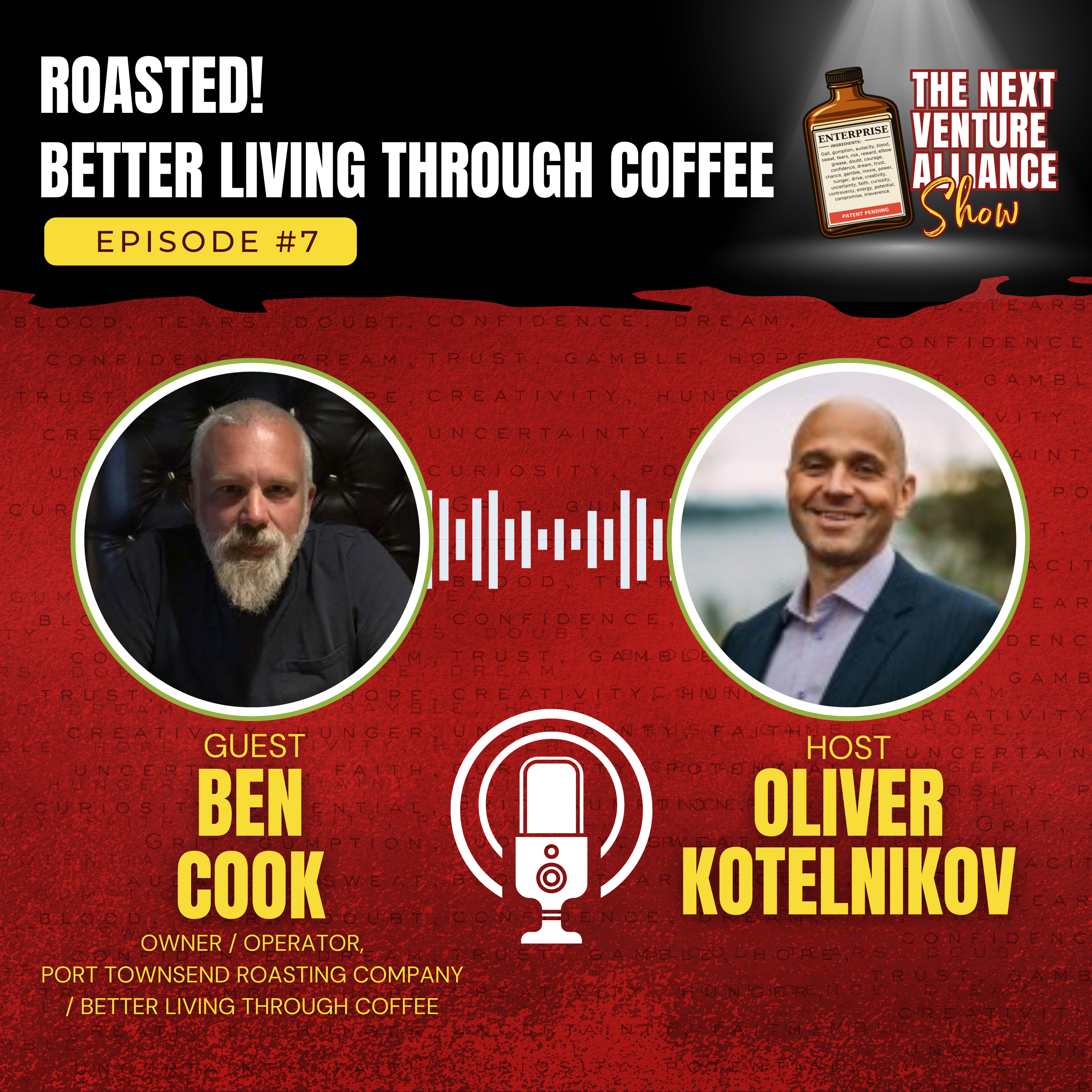
And with us today is a longtime friend and the owner of Better Living Through Coffee, which is the coolest coffee shop on earth, in my opinion. He also owns Port Townsend Coffee Roasters, which supplies Better Living Through Coffee and many other coffee shops. Can I say cool beans or is that too much of a cheesy pun?
[00:01:27] Speaker C: Sure.
Okay.
[00:01:30] Speaker B: I wanted to say cool beans.
Well, Ben, I really appreciate you joining.
I've known you for, for a little while now and you know, typically an entrepreneurial journey would we, you know, we'd start someplace at where the business end of it began. But your story is, as we discussed to me is fascinating because you're probably as far your childhood and how you grew up and you know, your kind of, your, your life trajectory is probably as far from being a business owner and a coffee business owner as it could have been. I mean, you've had two or three lifetimes before this.
[00:02:14] Speaker C: Sure.
[00:02:15] Speaker B: You know. Yeah. So you grow up In Berkeley, California, mid to late 70s, kind of a bohemian atmosphere. You're, you're exposed to all kinds of, you know, interesting influences early on. You become independent, you travel, you're citizen of the world.
I mean, talk about how things began a little bit in Berkeley.
[00:02:45] Speaker C: Sure.
Well, you know, you can only imagine the, the Berkeley in the 70s is exactly how you probably. It was even more interesting than the movies, you know, portrayed it.
Just lots of different lifestyle choices and, you know, I was pretty young when I was there at first, so it was all just kind of a blur, but it definitely left an impact on me. As I mentioned, uh, before, one of my earliest memories was going to the original Pete's Coffee in North Berkeley and hanging out there on the weekends with My family getting, I don't remember if they had hot chocolate, but my parents would let me have sips of their coffee. Yeah, you know, there's a reason why Pete's and Starbucks were so popular. And that was kind of the germ of all of that, that, that one store was the beginning of the whole coffee trade that we now experience every day.
[00:03:43] Speaker B: So let's, you know, let's say that original Starbucks location in the market, like this is the original Pete's.
The first retail, first ever. Pete's.
[00:03:53] Speaker C: This was it. Pete originally, it was the same shop. Pete, he didn't, he, he, he wasn't Italian. He was from somewhere else in Europe. And I, I, I can't remember exactly where, but he, he used to fix machines for other people that made coffee.
So there was no actual retail coffee for sale. It was just simply.
[00:04:16] Speaker B: So Pete's was a equipment repair shop.
[00:04:20] Speaker C: Equipment, yeah, yeah, he would sell, he was, you know, he was a vendor for equipment. He would repair equipment. He was an expert at the equipment, the roasting equipment to, to create coffee, to roast coffee. I see.
And I guess he did such a good job. And he also, I remember reading somewhere a quote where he was confused by the American kind of the Americana concept of people in the 50s, 60s would brag about how many cups of coffee they would have in one day.
[00:04:49] Speaker B: True. It is a little bit of a.
[00:04:50] Speaker C: Competition in this country.
Well, why would you want that much coffee? You know, it should, it's one or two should do. And that's more of the Italian, the European style of drinking coffee. You know, you drink it throughout the day. So, but you're not just trying to go to the restroom every hour because of how much liquid you're hydrating.
[00:05:08] Speaker B: It's not a competition. Right. And it takes longer to drink a cup of coffee in Europe than it does, than it does a 39 ounce Americano here in America.
[00:05:20] Speaker C: Yeah, it was more diner coffee at that point and Folgers and things like that. And because of that, I guess he decided to start selling it out of his shop, the one that I used to go to in the 70s. And it became quite popular quite quickly. And probably after I was going there when I was a little kid, I'd have to look at the dates. But around the same time, before Howard Schultz at Starbucks, there was another guy who really kind of started Starbucks and Howard is one that spearheaded it to make it what it is today. And the original guy, I, I, I'd have to look up his name. Whoever's listening, you can look it up, was inspired and said, you know, we should open more of these. And Pete was quite hesitant about it. He didn't really care about that. He was. He was kind of more of a Zen master purist about it all. And I don't think he wanted to be around that many people. It wasn't really interesting to him. So he trained the guy that basically started Starbucks, and then he took that information back to Seattle, started the Pikes Place store. I don't think the Pikes Placement was actually even the original one that they. They kind of flagshiped it after the fact and called it that. But there was another location in another part of Seattle that was the original.
[00:06:30] Speaker B: Yeah, it. You know, there's always that. That origin story that, yeah, everybody knows. And then there's one that it actually.
[00:06:37] Speaker C: Is of their first lease and all that stuff. But anyways, I digress.
The culture was started then in the 70s, and I was. You know, we lived less than five minutes away, so we would walk there on the weekends. And it was just a part of our, you know, enjoying living where we lived.
And the coffee was quite good. And I remember I really enjoyed it, so much so that I would. I would sneak extra sips when no one was looking because I like the taste of it. And maybe this is me even elaborating a little bit more than what actually. But this is my memory about coffee. Being a little kid.
[00:07:10] Speaker B: This was your first memory around coffee? You and coffee first cross paths.
[00:07:16] Speaker C: Yes, yes. And also my first memory of. Of. Of people kind of congregating and relaxing and enjoy. You know, we. I was a little kid. We weren't going to restaurants that much or bars at all. So this was a place where there. It was social and there was a lot of comings and goings and people and everyone was sitting outside. It was a pretty special time, the 70s, in Berkeley. The weather was really nice, and there's a lot of oak trees, and it was a lovely. The spot's still there, you know, so.
[00:07:44] Speaker B: And it sounds very time and place and in a sense, very different than what a coffee shop is today. But I would say that when I first walked into your coffee shop, better living, it sort of channels that a little bit. I mean, there's that energy.
[00:08:00] Speaker C: I could say that I planned it that way, but that's just. But I agree with you, it does have that. And maybe that's the. The whole foreshadowing or whatever you want to call it, destiny part of it. But back to your original question. Yeah, I really didn't have any plans into diving into coffee outside of I enjoyed it and I had, I had taste about what I did or didn't like, but it was just, you know, like every, the truth of the matter is now I only drink one cup a day. Now I don't. Even when I need to taste it for cuppings or anything, that's fine, but that's definitely just work. And I usually spit it out because I don't want to get too wired. Our coffee is really, really strong.
[00:08:39] Speaker B: So I know your coffee is actually phenomenal in terms of product quality. And you know, back to kind of that difference in the European view or maybe some other part. How other parts of the world view coffee. Yeah, the product quality is one. But we, you know, we keep already looping back to this time kind of issue of it's how it's consumed. Right. It's not. So there is a rushed aspect to, you know, let's get it as quickly as possible, as much of it as possible and preferably as affordably as possible with as much other stuff mixed in as possible versus I think that your business in this, you know, based on what you're describing, there's a time, there's, there's kind of the culture around it is different and the time aspect of it is super important. Because you, you don't drink coffee fast, right? I mean, that's kind of the first.
[00:09:34] Speaker C: No. No.
[00:09:34] Speaker B: Of coffee, I think, is, it's not meant to be, as you said, consumed.
You know, with a trip to the bathroom to follow as quickly as possible.
[00:09:44] Speaker C: It should be consumed like a glass of wine.
Yeah, yeah. More so than chugging some water before you go to the gym? Something like that, I guess. Yeah, yeah, yeah.
[00:09:56] Speaker B: So, so I think that's what's, you know, what's resonating about your, your product and, and your business is that it's not just a different cup of coffee, it's a different product. In, in that cup is many different things. And one of them is, you know, it's culture and, and how it's consumed and kind of a, an essence of what coffee is all about.
[00:10:19] Speaker C: You know, I, I agree. You know, I have a hard time kind of pontificating over things like that because I, I, I, I, I fear that I start to sound like some of the people that I don't really enjoy listening to about how I have the corner on this or how I've figured this out. So I'm always a little weary of kind of like giving my, my dream state about you know, like the North Star and all of that. But, but, but, you know, I guess one way that I sum it up sometimes to people is when people come in and they're a little hesitant because of the price point or, or whatever. I really, especially if I'm, if I'm behind the counter, which is rare these days, but if I am, I really try to lean into it. Not as a salesman, but more of like, you should just try this and I'm not going to tell you anything. Just, just drink it. Because your taste buds, they, they don't care which side that you, you vote on. They don't care any of that stuff. Either it tastes good to you or it doesn't.
[00:11:15] Speaker B: Or, or it doesn't. Right. And the same can be said about art.
[00:11:21] Speaker C: Yeah. Yeah.
[00:11:22] Speaker B: You look at a piece of art, right?
[00:11:23] Speaker C: Yeah.
[00:11:24] Speaker B: Before someone starts telling you what it is, do you like it or not?
[00:11:28] Speaker C: Right. Music and. Yeah.
[00:11:30] Speaker B: Or wine. You mentioned wine. Right. You know, how many times in a restaurant, dc, you know, they're still pouring the wine or they're already in the person's ear about what it is, what they should be tasting or it. And let them taste.
[00:11:43] Speaker C: I'll let you know if I like it or not.
[00:11:45] Speaker B: Correct.
[00:11:46] Speaker C: No, I don't care how much it.
[00:11:48] Speaker B: Costs or how many award it's won. I can taste it and let you know what I think. And that's probably the most honest inner product interaction.
[00:11:56] Speaker C: That, that's my point with that. I, I really, I stress with my staff that you should be competent. You should know what you're talking about in a relaxed manner. But it should never feel like you're lecturing anyone about anything ever. I really, you know, like they're, they're not allowed. But it's fine if they do art on that, but it's not required. And I personally would prefer they don't.
It's not a magic trick.
I don't need to look at a leaf or a heart or anything like that. You go ahead if you want to express yourself and it's not too busy. That's the other thing. We're incredibly busy. So it's just like, yeah, you have to. This isn't Tokyo. You don't need to do that here. Just make sure it tastes good.
And that, that's for me, is what's the most important thing. I was actually talking to my bean broker about this the other day, how I got cornered by someone at a dinner about coffee. And, you know, no, no fault to them, they were really enthusiastic about it. And I wasn't able to answer some of their questions in a way that I think they. That satisfied them that I knew as much as I should.
And I was saying, like, you know, I really. I was kind of recoiling from the conversation. I was like, I don't really want to talk to you anymore.
[00:13:03] Speaker B: I want to talk about it. Yeah.
[00:13:04] Speaker C: I don't want to talk about. In this way. Like, I'm sniffing a cork. And, and the woman, my broker, she's been doing this for 35 years. She's then that. That's. That's the, The. The outer fringe. The people that actually do this for a living, they don't talk like that.
[00:13:18] Speaker B: Right.
[00:13:18] Speaker C: And that's the first time I ever heard that. I was like, oh, good, I feel better.
I don't need to, like, I don't need to be up on all the trends and all that crap, because if you do it for a living, it's. It's just. It's different.
[00:13:27] Speaker B: Yeah. Yeah. I mean, that, that. That part. That part of it goes away.
You perceive it differently.
But you know, back to your background a little bit. And I think maybe what's in. In your approach and, and in the day. So you have, you know, world traveling experience. You spent time in Portugal, Russia, Caribbean at a fairly early age, exposed to various influences. You were part of what, the Harvest Festival with your dad, maybe the retail aspect of things.
You know, what was that experience like?
[00:14:05] Speaker C: It was definitely. I was. I was always surrounded by entrepreneurs.
He. The best way to describe it, it was. It was all based out of Northern California, the Bay Area. He was kind of like the. The Bill Graham of crafts fairs, you know, okay. You know, like the Fillmore, like the Grateful Dead and all the big shows he did in the 60s and 70s. The. The guy who, who presented all of those, the producer, his name was Bill Graham, and he owned a couple clubs, venues in the Bay Area that were quite popular and famous now. But my dad was kind of the. The Craftsman, the arts and crafts version of Bill Grant.
[00:14:42] Speaker B: And so the Harvest Festival was kind of a traveling. This traveling venue of retail arts and crafts.
[00:14:50] Speaker C: It would take over like huge, massive convention centers from like Thanksgiving to Christmas.
And there was some multiple cities on the same weekend. And, you know, by. It was probably by the end, as kind of its heyday, at least 500 exhibitors and 10,000 plus people a day paying customers to it. So it was quite a scene. It was. It was like a rock concert basically for people to buy Christmas gifts. And after a while, people were Just a bit religious about it, where they would come every year and they had all of these like famous like bluegrass musicians and singers and uh, all these food. So it was quite an event. And I literally, that's. I grew up around that from age as early as I can remember into my twenties.
[00:15:40] Speaker B: So you were, this was you like eight, nine years old. You're setting up retail stands, you're interacting with customers.
[00:15:47] Speaker C: I wasn't doing any of that. I was helping my dad in the office.
Yeah. Yes. Because he was the producer of it all. So he was basically fielding all the problems and issues and just kind of organizing the whole event.
You know, it started Friday and went through Sunday. And you know, by the end of it, that'd be over 30,000 people that would have attended. And then you could just imagine how many questions or security issues or, you know, so many scenarios with that level of, of madness.
[00:16:17] Speaker B: So he's kind of the face of it. And you're handling like.
[00:16:20] Speaker C: I wasn't, I was just a kid observing it all. But my point is, from all I ever knew was to be an entrepreneur, that that was normal to me, a regular day job. I, that I wasn't exposed to that.
So, you know, you would end up, we would end up being at the festival from like 6 in the morning till 11 at night. And so these kind of big pushes to get through the event was normal for me. That was normal way to take care of business. You, There was no clocking out.
[00:16:53] Speaker B: Right.
[00:16:54] Speaker C: You, you finished when it was.
[00:16:56] Speaker B: And that's, and that's, that's such an important trait for entrepreneurs. Like, you know, you hear this, all this like, work life balance I need to have.
[00:17:06] Speaker C: Yeah.
[00:17:07] Speaker B: Doesn't exist. Never did.
[00:17:09] Speaker C: Not if you want to win.
You know, if there's, if there's a healthy competition in your market, which, gosh, you know, unless you. Some kind of innovator, which, hey, that's great. If you figured out something where you're alone and you have the time to clock in and out, there's someone else that's always doing a better job than you. And really to keep your place at the table, so to speak, you got to work really hard at whatever it is.
There's so. There's so many people on this planet now that have a similar or even a better idea. And sometimes, you know, the reason why you get to keep your place, the pole position and the business, so to speak, is that you were there first.
And so you have to have a, you have to keep your, you have to keep earning it, or else someone else is going to come along and swipe you out of the way.
[00:17:54] Speaker B: Because, because, I mean, your reputation, it's only as good as the last cup of coffee you serve. Right. You can't talk about, look at my Yelp reviews or my, my reviews three years ago. Right.
[00:18:04] Speaker C: Someone's doing so on your laurels.
Yeah.
[00:18:09] Speaker B: So obviously, I mean, you know, you're, you're kind of all in on, without knowing it, on this entrepreneurial mindset, but you're still of, you know, you're still a school age kid, so that probably, you know, cuts into, you know, school and your typical responsibilities of that age. I mean, your motivation ebbs and flows.
You know, you're, you're class president and captain of the lacrosse team one day and, and then you're getting kicked out for next.
[00:18:38] Speaker C: Yeah, yeah, yeah. Talking about the bio, you sort of.
[00:18:41] Speaker B: Make occasional appearances in school and.
[00:18:44] Speaker C: Yeah, yeah, I was a bit of a wild card, you know, and I, I'm sure there's so many stories about entrepreneurs being that way. Sure.
You know, to some respect as far as keeping my attention.
It's a bit self serving and, and, and, and you know, until you learn to have some manners and how to be out in the world, you could people, you come off as dismissive people because you just don't want to listen or you don't care, you don't see the value and what they're doing right then and you know, being 14 and raising your hand and asking bigger questions about like, why are you showing me this? Why are you teaching me this? It's embarrassing for the teacher to have questions like that in the class and it's unacceptable behavior. And you know, when you're young, you're full of vinegar, you know, so you ask questions like that and you know, you don't care, you know, but you're.
[00:19:37] Speaker B: Challenging their authority every day. You're undermining them. They're making their job hard. So what was the, what was it that they said that Ben's a brilliant kid, but he doesn't seem to be interested in learning or being here.
[00:19:48] Speaker C: He doesn't feel like following the rules. Yeah. And the one teacher that was kind of the, the straw that broke the.
[00:19:54] Speaker B: Back.
[00:19:56] Speaker C: She said that. Yeah. When he doesn't like what you have to say, he goes for the jugular.
And that always stuck with me. I was like, oh, wow, that's a pretty poignant thing for you to say about me.
Yeah, well, it is true. And you know that that kind of instinct also really Lends itself to being an entrepreneur because that's, you know, hopefully you're, you're, you're a good king as opposed to a bad king. But that definitely is a part of, of going to war, so to speak. The war of success is that cunning to resolve.
[00:20:28] Speaker B: You know, isn't it amazing that when you're, you know, your kids are just, even throughout life, you know, they'll, you display a characteristic or a character trait and somebody will say you're selfish, you are, you know, you are a, you know, barbaric. And then you, you know, you get into the world of business and, and people will turn it into puzzles. Say you're, yes, you're, you're an opportunistic. Like, you know, you're, you employ good strategy, you're, you're smart, you're, you're ahead of the curve. All of a sudden it's really the same trait, right, that you've always had. Just depends on which context, how it's presented. You know, all of a sudden you're brilliant businessman who saw the opportunity that no one saw and, and, and took it.
[00:21:13] Speaker C: Right.
[00:21:13] Speaker B: Versus being difficult.
[00:21:15] Speaker C: I mean, I, I guess, you know, to. One way to kind of phrase that, to kind of sum up what you're saying is if you're, if you're in a, you know, let's say a tribe, a Native American triber or something before modern day times, before the, the combustion engine and you guys are basically living off the land, so to speak. They wanted the kids to, to keep the peace as far as, you know, around, around the teepee or the fire or just kind of like not be troublesome while everyone was doing their work. But as soon as they become of age, especially men, they needed to go hunt and, and, and, and their lives are on the line to kill the saber tooth or whatever was come coming at them where they were chasing after. And so it's the same thing. It's just it, it switches, you know, suddenly like no. To survive and for us to survive, you need to be that way and.
[00:22:01] Speaker B: Can you produce results, right? You're not going to be in business very long. Regardless of your philosophies, whatever they are, if you're not, if they're not delivering, if they're producing good results, then people turn them into virtues. If they're not producing results, they'll say, you know what you need to change.
[00:22:16] Speaker C: This isn't really working out.
[00:22:17] Speaker B: Yeah, you need to change these settings, right? Your landlord's gonna come to you and say, you know, Ben, you're a great guy, but you gotta pay the rent, you know.
[00:22:24] Speaker C: No, sometimes I have to say that to, to my wife about, you know, luckily I try my best to shield, you know, the income and the outcome of bills, but sometimes when she brings something up, I'm like, the MX card does not care.
It just wants its money and it does not care any of your, any of that. It's just, it does not care. And that's really, that's the same thing as like being out in the wild hunting for it. Like the thing that you're trying to kill does not want to be killed. So it's, it's the same idea. It's just like you got to keep it all straight.
[00:22:57] Speaker B: It actually wants to kill you.
[00:22:59] Speaker C: It wants to kill you. It's trying to defend itself because you're trying to eat it.
And being out in the world as far in modern day times, oddly enough, paying your amex card and making sure you make payroll and all of the things are needed all the time. So really my biggest job most days now is keeping the peace.
I have 27 employees for both businesses and my job is to basically cool the place out and make sure that everyone's relaxed and that everything's taken care of. And that's my job, you know, and really it's just like being like a film actor or anything. You're putting on a show half the time because that's not how you feel.
But that, you know, sharing that with them is not going to be constructive in any way.
[00:23:45] Speaker B: Yeah, you can't walk in and say, you know, look, I'm, I'm having a rough day, the house is on fire, we're all going to, we're all going down, you know, what do you, what do you guys suggest we do? Right? You need to bring some leadership. I mean, how do you do that? What are some of the skills that you employ? Employed to steady the ship.
[00:24:03] Speaker C: Yeah, I, I tend to overpay my employees, my long term employees and over time that's created a culture where they, they leave me alone and they really like their paycheck and so they take me seriously. And so we have a kind of a match to rapport about it. And over the years, as time goes on, they get great at their job. Sometimes they're bored, you know, working at a coffee shop or roasting coffee, it's not everyone's life dream. But living in a, in a quaint little seaside town like we live in and actually making a good living, working 3/4 time and making what Most people are having to grind out at a regular nine to five, you know, eight hour day job. There's an appreciation for that and after a while you build the team that kind of like helps support that. And the long way around, to answer your question, they help you figure it out. You know, they, they, what's, what's the term I use sometimes? They predict your needs and they protect what you, what you have going on. They're protecting, they protect your interest and they predict your needs.
[00:25:15] Speaker B: And that's, I mean you, you sort of impart your vision of what you would like the culture of the company to be.
You give them the tools and the resources and you sort of implore and empower them to create that. Because with 30 people you can't single handedly do that.
[00:25:34] Speaker C: Right?
[00:25:34] Speaker B: You need, you need a, you need a tribe who kind of represents that in numbers. And then when new employees come in, and I had this as well, is it was important for me as a business owner that when new employees came in, it wasn't just me or the manager talking about X, Y and Z. It was being made evident around them. Co workers immediately like these concepts that we're talking about, they're being put into practice right here. Hey, we say hello first thing when, when customers come in, three seconds later they hear hello to an incoming customer.
[00:26:12] Speaker C: Right.
[00:26:12] Speaker B: That lands with, with some resonance and some, some impact versus.
Okay, you say that right.
[00:26:19] Speaker C: But yeah, what, what I've done over time, because this is my, no, this is my 13th going on to my 14th year being involved with the, with the cafe, which then you know, kind of spurred on everything else that's happened around it.
Having to train people to say, because you're right, you do need to have them acknowledge people when they walk in door so they feel welcome.
I've taken it a step further that that's a given.
But the way that it's a relaxed atmosphere where almost like if you or I walked into each other's office, even if we didn't know each other, most likely we would give the stranger a warm acknowledgment of them being there, but in a very relaxed manner. And so it really kind of disarms people about how they're used to being treated in the hospitality business where suddenly they're around, relaxed, capable, interesting, smart people, they're going to take really good care of them. And so that, that kind of like washes over them where they're like, oh, this is different.
And that's that for me, that's not some Kind of pipe dream that. That's what I'm paying for.
My target person to hire is, you know, graduated college. Usually they're kind of in the middle transition, like they started and that didn't work out for them, and they happen to be in this area, and we think they're a good fit, but they're. They're. Most of them are a kind of a ticking time bomb. As long as how long I have them, I only get for a year or two, and then they move on with their lives, and I'm the first one to wish them the best.
And so what it's done is create a culture of people that are more like us, you or I. And a lot of times, you know, longer customers, regulars would be like, where do you find these people? Like, they're just magnificent. They're like. Were talking about Russian philosophy yesterday. I was like, oh, yeah, I think. I think they studied that in school. And so it's just kind of like this is like a safe haven until they move on. But I never try to trick anyone to stay. I never try to coerce them. I'm grateful for the time that they gave me and then they move on. But over time, it's attracted more people like that.
It's not a, you know, 100%, you know, target. I always get these kinds of people. But over time, with the core staff that has decided to stay, you know, one of our people has been here for 12 years, another one 10, and then seven, five. And so like you said, like from day one, like, it's a given that how's this place is going to be run, but if we would have to remind someone that they need to say hello to someone, then it's probably already looking like they're not the right fit.
It's possible.
[00:28:54] Speaker B: I mean, I. I agree with you, but. But I think the definition of what's given in the recent years has changed. You know, so I. And I'm with you on the philosophy of you don't have to do these things or agree with them fundamentally or philosophically, but for the time that you're here, you know, this is. This is sort of. These are the guidelines. These are the parameters, you know, the relationship. This is a working relationship. We try to have fun, but. But these are our, you know, basic ground rules. And there's some range, right, you want to give, you know, know, people are different. They have personalities. Sometimes what they bring, I can't predict. And I'm like, man, this is. This person's bringing something really amazing. Right. They like to sing out loud. Is it in the company policy that we're allowed or not allowed to sing out loud? No, but it's kind of cool. So.
And the next thing you know, they move on and somebody walks in, hey, where's that person that. That was.
Well, they're not here, unfortunately. Like, well, can you get someone. No, we can't get someone to like, you know, as a matter of policy.
[00:29:55] Speaker C: Not a CSA talent agent where.
[00:29:58] Speaker B: But people do that kind of stuff.
[00:29:59] Speaker C: Right.
[00:29:59] Speaker B: And you get those little.
[00:30:00] Speaker C: After a while, it feels the charm. Yeah. Over the years. Yeah. No, I completely agree. Yeah. No, this place is very unique in that way where people do get to express themselves. And usually we're enjoying the show as much as the customers. Yeah, yeah.
[00:30:17] Speaker B: And that's, and that's the key, right? And that's the key to, I think, you know, that term. I don't like it, but it's out there. Work life balance. Like it's, you integrate it. Right. If, if your work and your life as a business owner sort of are, are, are the same, you know, and, and you're, you're enjoying both and you don't always know which one you're in. Right. Sometimes you're at work and, and that's part of your life and sometimes you're doing life and, you know, work is in it. I think as a small business owner, as an entrepreneur, you know, you can graduate out of that to where there are hard, rigid lines.
But I'm against people entering and saying, I want to be a business owner, but work life balance is important to me. Hey, this concept is way down the line.
[00:31:02] Speaker C: It sounds like we're gonna lose money. Yeah, that's what it sounds like I would recommend. You know, I stopped giving that type of advice to people because when I was too honest with them, I could tell that they were offended and they wish they hadn't asked me. So I don't really give unsolicited advice unless someone really like that that I trust enough to want to be honest with them. And they schedule like, you know, not like this exactly, but that they schedule time with me, then I'll talk with them and give them my honest opinion. Or, or sometimes I don't have one. I say, I, I don't know. I don't know enough about this.
[00:31:32] Speaker B: Yeah, yeah.
[00:31:35] Speaker C: Yeah, yeah. I really, I really cherish people that I trust saying, I don't know, you know, but, but to that point, the whole work life balance thing, that, that feels like a tick tock ad. It doesn't feel like reality.
[00:31:48] Speaker B: That's what it is.
[00:31:50] Speaker C: Yeah. So some of my staff years prior, especially around Covid, when things got a little bumpy, I noticed a trend because I was around more, because I needed to be where people, younger people in their 30s were referring to the golden days of when their parents were gone and they would get all of their stuff.
[00:32:10] Speaker B: Wow.
[00:32:11] Speaker C: And. And that was really like.
Yeah. Blew my mind that, that basically, not that they're wishing, you know, ill against their parents, but that was their long term game plan.
And not that they're lazy, but things seem so bleak to them now that that's all they have left to look forward to.
[00:32:29] Speaker B: And that's a revelation to you. That can be a given to you. Right, we're back to that. Like, what is a given? When somebody walks in the door and you don't know that somebody holds that sort of concept in their head, you know, so. Okay.
[00:32:43] Speaker C: More than one too. That was a theme where they talked about basically their parents, stuff becoming theirs.
[00:32:49] Speaker B: How, how old, what's the a age range that sort of embod that inhabits this type of head space in your.
[00:32:55] Speaker C: Late 20s, early 30s. So basically they went out into the world. Things didn't work out so well. These are the ones that usually were low performance and didn't stick around over time. In hindsight.
But I did notice that that was a topic where basically there, you know, there's something to be said for in trying times having a group together with your family. And there can be a lot of beauty in that because when we were younger, you were just trying to get out the door and go away from your family as quickly as possible, you know, and. But there was plenty of 600amonth apartments to choose from. You just pick. They're everywhere. And, and, and you always had enough for gas and to go get a burger and go out on the way. It was just.
I. I didn't even know how lucky we had it.
Yeah.
[00:33:39] Speaker B: So this whole idea of moving out at the age of 18 and 19 and with your buddies or friends and having, you know, some kind of car, having some kind of job and having some kind of pocket money and still having your own place, that doesn't exist anymore, at least not in where we live. So.
[00:33:54] Speaker C: And that's why they're talking the way that they were talking. Yeah. Is that that's the only thing they have to look forward to? You know, I wouldn't say that, of course. Like, you know, actually I had a. I had one Harvard graduate and she Was the cum laude or whatever, Every imaginable accolade.
[00:34:13] Speaker B: Yeah.
[00:34:13] Speaker C: And, and, and, and when she said it was just for the summer and it was the middle of COVID and I read a resume and I was like, what the. And so I called her and I was just like, what are you doing?
I'm like, why are you applying for this job? And she was a bit like, put off. She's like, because, Because I need a job for the summer. And I was like, oh, okay.
[00:34:31] Speaker B: That's a good answer.
[00:34:33] Speaker C: She, she, she ended up moving to France and she works for the UN now. She's like a translator. But, but to that point, it's like, I know that most of the people that are coming and going aren't that, but sometimes I've even had that. So. So maybe they're shooting a little too low. Maybe they didn't get the social skills or the work ethic in place.
So I don't have like the best people around me to, to say that, like, things aren't looking great, but the people that I'm immediately around are, are definitely, I would say, overachievers, but achievers. And, and the math isn't adding up. They can't, they can't afford to do anything else. So. Yeah.
[00:35:11] Speaker B: Which is, which is unfortunate. And despite, you know, the, the differences in opinions and views and philosophies.
[00:35:21] Speaker C: I.
[00:35:21] Speaker B: Don'T wish that upon anybody. I think being able to, to have that first chapter of independence, whatever. Like, fine. You know, it's a, it's a beat up car and it's an apartment that's nothing to be proud of. But you're doing it right. You're kind of paying the phone bill or whatever, the, the electricity bill or the rent bill, you know, the, the, the, the $17 gas or electrical bill on your own. Right. And if you're late, it gets shut off and then you have to deal with the company.
[00:35:48] Speaker C: Yeah.
[00:35:49] Speaker B: You know, those are all experiences that then someone carries forward to the workforce.
[00:35:55] Speaker C: Right.
[00:35:55] Speaker B: Sometimes you get the employees that haven't had any of those experiences, which is where I go back to saying hello when you first come in the door. They just don't have. Sometimes it might be like just the ground level stuff. Like, okay, if, if you spill something, you need to wipe it.
[00:36:12] Speaker C: Yeah. Right.
[00:36:14] Speaker B: Not a given.
[00:36:15] Speaker C: No, no, no. Actually, no, it's true. Yeah. You're surprised. You're like, wow, really?
[00:36:20] Speaker B: Yeah.
[00:36:21] Speaker C: I got to break this down to you right now.
[00:36:26] Speaker B: Is this my job?
It's common sense. You know.
[00:36:32] Speaker C: What is my Job.
A lot of it feels very Shakespearean, kind of like to be or not to be, when really it's just like just, just clean it up. Just do it in their mind. It's much more layered and complicated and nuanced. You're like, nope, not really. Just.
[00:36:48] Speaker B: Yeah, yeah.
[00:36:51] Speaker C: You know. Yeah. I, I don't know what your parents were teaching you when you were younger or, or what classes you took, but this is not, you know. Yeah.
I think most young people, rightfully so, have a really good sense of their ego.
It's. It's well checked and it's in place. It's. It's a survival tool to get yourself to the next lily pad and that in that way it's valuable, but it can be very deceiving as well.
[00:37:17] Speaker B: You know, sometimes it goes under, you know, self esteem or sort of self care and all of those things. But, but like, you know, even if someone else spilled the cream, grabbing a rag and cleaning it up isn't going to cut into your time or your resource or make you love yourself less or respect yourself. Right. Those are not big things. But, but sometimes they, you find that they're kind of in that calculus and like. Well, I, I don't want to do that. Right. That's not part of my job.
[00:37:44] Speaker C: My hunch is maybe it's the helicopter parents that actually swooped in too fast to do everything for them. I was, I was a latchkey kid. I was. I had to walk. Sounds like one of those stories, but I had to walk to school or ride my bike a mile and a half every day into town.
Rain, sleet or snow is the only way to get there. And. And I would come home to a dark house by myself and. And I stopped having a babysitter on the weekends if my mom was out of town at maybe like eight.
And so I was on my own and I was cooking my own food and I had to do my own laundry and I had to do dishes every night. And, and that wasn't even up for grabs. That was normal. So a lot of it was independence left alone with responsibilities.
You know, there wasn't any real like, or else abuse, but it was just in that time, you didn't really question if you did or didn't have to do it. You just.
[00:38:35] Speaker B: Yeah, it wasn't a. And the check and balances, like if you didn't do it, it just didn't get done. You didn't have clean clothes or you didn't have food or you were the smelly kid.
[00:38:45] Speaker C: You were Hungry.
[00:38:47] Speaker B: That pretty early and pretty effectively. Right. It's like.
[00:38:50] Speaker C: Yeah. Having siblings too. You end up, you, you gotta fight for resources. So you're playing with.
[00:38:56] Speaker B: Right.
[00:38:57] Speaker C: Yeah.
[00:38:58] Speaker B: All right, so, so we're kind of in. You're a teenager, you're school, school's not for you. You've decided this, it's the early 90s. And then you, something else, you know, comes. You spot the next thing, you become excited about the club scene and the music and you start learning to dj.
Yeah, I have that about right. Kind of chronologically, early 90s.
[00:39:20] Speaker C: Oh, that's, that's about right. Yeah. This kind of the, the heyday in the Bay Area was kind of like the modern day electronic Woodstock in the early 90s in San Francisco, really in California, but specifically in San Francisco where, you know, young kids 17 and up were, were going out with fake IDs, going to nightclubs, going to raves, staying up all night and just sort of had, it had a key to the city after hours in San Francisco. And that place was, was so progressive then that, you know, depending on your, your living situation. And I, I lived on my own. I moved out on my 18th birthday, which, you know, had its, its ups and downs back to the point about responsibilities.
But I, I, you know, I didn't have any background in music whatsoever, so it was as much of a surprise to me that I cared about this, that this was interesting to me, that I actually thought that I had any ability to do any of it.
But similar to, you know, sometimes this stuff just kind of lands on your doorstep.
There was plenty of opportunities for me to not care about it as much and go kind of back to college or stay in college, but something would always happen that would kind of be an exciting opportunity that led me to keep showing up to that. And, you know, that's the way that I, you know, people that are struggling with alcohol addiction or my friends in the past that were figuring out their lives and I was like, you know, the thing that really seems to matter for people, and this is a little different, I'm talking about my career choices, is what are you excited about when you wake up in the morning?
That's what's going to lead you, is what do you care about that day? And until it's something better than that, you're going to just keep choosing that other thing.
[00:41:06] Speaker B: You're going to keep doing that thing.
[00:41:07] Speaker C: Yeah, doing the other thing, right or wrong, good or bad, or, you know, detriment to you, whatever. But you really got to find something that that you're passionate about.
So for me, I, I, you know, I originally was just girls.
I just wanted to meet girls. And then the, the nightclubs were happening and it was exciting and, and I lived on my own and so I was able to come and go as I please, which was a little too much independence, a little too early. In hindsight now, you know, I would never allow my son unless he just on his 18th birthday, moved out like me. I, I would not recommend what I did to anyone. I don't think it's that safe, to be honest.
[00:41:44] Speaker B: Yeah, I mean, different, different time.
What places were you hidden? Where were you living in San Fran or what places were you hidden? What's the club scene like?
[00:41:53] Speaker C: I was, I was, I was going to junior college in Santa Rosa, California. My family moved from Berkeley up to the Napa Valley. And I ended up going to high school at a Catholic school until they politely asked me to leave, like you mentioned, and I went off to boarding school. And I realized because of where my birthday fell, because me being me, that I, I could not, I didn't have to finish my senior year, that I could leave and get my GED and just go to college immediately.
And so I, I, I, you know, I sweet talked to everyone around me saying I'd rather do this. And for the first six months, my dad helped me with, with rent and you know, everyone helped me move in and they're really excited about it. And then I just completely, just became a dud as far as showing up to classes and I was just going. So I was commuting to the Bay area two or three nights a week to go out to nightclubs. So I was officially, I was a bad kid.
[00:42:47] Speaker B: Were you driving? I thought you had a license or.
[00:42:50] Speaker C: You were, you know, whoever, Friends. Yeah, whatever. I had a fake idea to get into nightclubs, but yeah, I, I don't, I don't, I never, I didn't really own a car back then, but I just knew a lot of people and there was a whole scene around it. And my point is that I quickly realized that I didn't want to live in Santa Rosa, California. I wanted to live in the Bay Area.
And so I, maybe with like 500 bucks, I, I found an opportunity to live in a really questionable neighborhood in kind of the ghettos of Oakland, California.
Neighborhood. Like, the closer you got to my house, the more dangerous it felt, right the other way around. But I was like walking into the.
[00:43:30] Speaker B: Dock, you know, you're on your own.
[00:43:32] Speaker C: You got your own dealers. After a While they all knew me, they would leave me alone and we acknowledged each other and they kind of had an understanding that they wouldn't rob me basically.
And, and, and I just pieced it together. And in hindsight it, it sounds way too cavalier and, and not even me now to do that, but at the time it made perfect sense and that's all I wanted to do. Back to that point about, you know, choosing, being passionate about it for whatever reason. I was just gung ho on doing this. And so I, I, I got a.
[00:44:03] Speaker B: Job and DJing and spinning for first yet.
[00:44:07] Speaker C: That's a funny term.
First I got a job at a record store and, and also making coffee at a coffee shop in Berkeley. And you know, supposedly I was going back to college, trying to keep faith in my family, but, but I wasn't, I was just immersed in, in music and, and I quickly learned one experience going on Telegraph Avenue, which is kind of the main strip, kind of the Haight street of Berkeley, that I, I bought a record for 50 cents. And when I took it to the record shop I worked at, my manager bought it off me for $10.
And that blew my mind that I just made $9 and 50 cents off this. When I just walked from there to there. And it just kind of opened up my.
[00:44:52] Speaker B: You just put together a transaction that you didn't know you'd done.
[00:44:55] Speaker C: I didn't know that that wasn't even an option for me to profit off, but, you know, pounding the pavement and picking these records. And so I quickly realized, like, hey, this is a good, good gig for me. This is better than having a day job. And, and I got really good at it and I started to figure out where there was a lot of music. And this was the very beginning of eBay. EBay just started, maybe, maybe 96, 97. And so at that point I was selling a lot of records to people.
People were coming from Europe and buying records off me. And I was known as this guy that had records. But more importantly, so I really didn't have to have a day job.
[00:45:31] Speaker B: Records at that time. Is it CDs you're selling?
[00:45:33] Speaker C: Is it vinyl records?
[00:45:35] Speaker B: Actual vinyl yourself?
[00:45:37] Speaker C: Vinyl records? Yeah, yeah. San Francisco had a really big kind of disco and soul scene in the 70s.
And then it dropped off. Like, you know, most of it did. And most people when I was collecting this stuff were, it was a novelty. The idea that I was, I was playing with records, they were like, wow, I didn't even know people were still using those. So CDs were very prevalent at that point, which was to my benefit, because I went, name, I scooped them all up.
[00:46:06] Speaker B: Which records? Like, name a couple artists that you would. I mean, what's in your collection? I've seen your collection. It's wild.
[00:46:11] Speaker C: But like, yeah, there's too many to name. You know, it could be as a.
A certain Jackson 5 record to, you know, Miles Davis record, to some kind of like white disco band from Ireland.
Everything and anything. It's. It, there's. It's this. We don't have enough time to talk about why things are rare, why they are. But I had a natural kind of Jedi ability to. To find them or more they found me. And so my point in all this is, is it why I had the ability to keep going when I had no background, no theory, no support, was these little kind of like moments that afforded me to keep doing what I wanted to do.
That's not usually the case. Usually like, okay, you gave it a shot. Now you got to hit the books, you got to find a profession, you got to grow up. And I didn't. I kept not having to grow up. I kept learning how to do this more and more to the point where I taught myself how to produce music. The kind of music I was DJing with was a certain style of music where it was kind of like, like dub reggae meets disco soul. And years later, when I had my record label, I really kind of pinpointed that and became kind of a genre making style where we were like the. This is years later, but we were kind of the darlings of New York for about five or six years.
[00:47:41] Speaker B: This is wrong music.
[00:47:43] Speaker C: Wrong music. Yeah, my record label out of Manhattan, we were the talk of the town. You know, we were throwing parties and doing these big parties with MoMA and then like, you know, tens of thousands of people. And yeah, we were hip, we were happening, but. But all of this earlier on kind of led up to that where we were the first ones we taste makers of this sound.
I didn't realize I was pioneering anything.
It was just what I was doing.
[00:48:10] Speaker B: Hanging around, kicking and doing what you wanted to do figured out.
[00:48:14] Speaker C: And, you know, I, I liked how it sounded like this. And, you know, the other thing I ran into a lot is engineers, people that were smarter than me. Same with the coffee business. Telling me that I was doing it wrong a lot. And that's why I came up with that name.
[00:48:27] Speaker B: Oh, that's where it's from.
[00:48:29] Speaker C: Okay.
A flipping ironic response to it. You know, I know you think it's all Wrong. And that ended up being kind of a.
[00:48:38] Speaker B: And you spell it R, O, N, G.
Yeah. Did you, did you ever pinpoint, did you ever give this your style? You said you kind of dialed it in a little bit. Was there a name for it? Did you come up with something or.
[00:48:49] Speaker C: By the end, when it was really happening in New York, you would call it kind of a punk disco. So an easy way for older listeners, if you like the Talking Heads, you probably would like some of this stuff, would be to say it. Stuff like that. Yeah.
[00:49:04] Speaker B: Did you catch the David Byrne movie, the recent one, by the way?
[00:49:07] Speaker C: I saw that. No, I don't know what, anything about it. What is it?
[00:49:12] Speaker B: I forget the name of it now, but it's, it's, it's a pretty memorable name, but I forget it's one of their songs, but yeah. Anyway, so I, I, I get, I get the sense. So Talking Heads, kind of like Ramones meets Donna Summers or something.
[00:49:31] Speaker C: Yeah, sure, yeah. Blondie. Yeah. So. So for, for more modern, younger listeners or people that go to festivals, I did a record label with, with the band. LCD sound system.
[00:49:42] Speaker B: Yeah, I know LCD sound system. Well, there you go.
[00:49:45] Speaker C: So I did a record label with those guys for, for a number of years too.
[00:49:48] Speaker B: Well, if we're, if we have enough time and we'll, we'll, we'll spin a little bit of your music at the end of this. So those listening hang out, you'll get a taste of what Ben's doing today.
[00:49:58] Speaker C: But the one that I pulled up is me trying to sound like Pink Floyd. So.
[00:50:01] Speaker B: Yeah, you sent it to me like this is.
It still sounded like you. I mean, I've heard your stuff and it's, I always, I think when we talked about music and, and maybe this extends to your business philosophy. Remember I told you you remind me of Rick Rubin kind of in your. I've heard that your approach to where. And he's famous for saying, look, I, I don't know anything about equipment or what the style is or what you play or don't play.
I just want you to do this.
Yeah. I'll tell you what I like and I'll give you some suggestions. But he's known for, you know, pushing creativity by getting rid of the limits and the kind of the, you know, the typical stamps of things and, and getting people to do their best work by getting out of the box, really, oddly enough.
[00:50:55] Speaker C: And back to, you know, one of your curiosities there, there ended up being a parallel with that and what I'm doing now.
It's, it's much more kind of like boots on the ground as opposed to people buying units or me performing. But something kind of that, that ethos transferred over to the culture of people needing a safe place to have a cup of coffee.
Feel like that, that they're, it sounds kind of, you know, hippie dippy, but that they're seeing that they're respected, they're appreciated, that we're not trying to turn a table on them.
It's that same kind of ethos that we're talking about, Rick Rubin, where it's just sort of like come as you are, whatever it is, as long as you're not causing problems in here, you're all welcome in here.
And naturally, you know, some people said, gosh, you should, shouldn't let people just sit in here and drink a cup of water. And I go, you know, because of how busy gets in here, they naturally will leave because they'll feel it, that it's time for them to go.
Even the biggest pest will go. You know what, I'm really in the way. You know, if it's that busy and that kind of energetic and chaotic and so, so it's really created kind of this same with my employees where it's just like you get to be more of yourself than you ever would imagined. Most places you walk into, you know, whether you realize it or not, you're kind of like there's a certain button down approach to how you're supposed to get through the line or order your meal and then get out there afterwards. It's not like that at all at our place.
[00:52:26] Speaker B: Well, it is kind of a Ruben esque parallel and interaction in a way, you know, how, how he would say just let's just play this tune and see.
Let the art kind of take us where it's going to go. In a way, every customer interaction and the way you treat your customers is okay, you know, it's a little bit of a creation, right? You've served them something. Whether they sit there for 15 minutes or 45 minutes at that point is up to them. You know, that's the art form of it. In a way that's every customer interaction is like a poem or a song or a piece of art, right?
[00:53:02] Speaker C: Yeah, that's exactly. It's an acceptance of what is.
That's what it is or whatever it is. It's an acceptance of that and you know, once your self esteem and, and, and you have enough success, which luckily I've had enough now, at least in this field of Running this cafe, I can honestly say that it is a successful business and that's not up for grabs, but it gives you kind of, you become more relaxed about these things. Things that maybe would have bothered you or people think that should bother you, that don't bother you at all anymore.
And that's similar with me. I, I, you know, I played some of the music I'm working on now, and it's getting good enough now. Like, you heard of, like, a version of it from about a year ago. Like, the stuff that I'm finishing is way, way further along than the version you heard, but I'm starting to play it for friends, you know, sending it to them, and they're like, so what are you doing with this? What's your plan? And they're kind of wanting me to chomp at the bit, to go back to my old ways. And I just keep saying, I don't know. Yeah, we'll see. You know, I, I don't, I don't need it to be anything. And the biggest one is I don't, I don't want to make any money off of it. That's the biggest one for me. And that, that kind of blows people away there. You could totally make money off this. You used to do it. And I was like, yeah, that didn't work out so well for me, so I'm not going to do that anymore. And that's really the, the coffee business has afforded me the ability to say no thank you to the commerce part of the music now. And I heard makes it better. It.
[00:54:28] Speaker B: Well, you've, you're at a point in your career and in life where you've earned the right to define your own success and your own boundaries and say, okay, I, I don't have to do this for money because I, I don't want to. Right.
[00:54:42] Speaker C: For the sake, sake of art. That's, that's all it is, just for the sake of doing it.
And that's usually when, when, in my experience, when, when magnificent things tend to happen is when you really aren't trying to put all these labels and expectations on it, and you kind of love it and you let it go. And that's where it seems like the magic shows up. Well, that's about as close to religion as I think I can get.
Whatever that process is of really, really passionately just, just grinding away and making something perfect and then, and then letting it go.
[00:55:15] Speaker B: Well, I think this, this actually brings us to the point in the conversation of how you transition into the coffee business, because so there's this end of the career or what ended up being the end of the commercial part of your career of music where you, you traveled the world and you can talk about places you visited and, and, and sort of where you've played music. But then you, you know, that becomes clear to you that that's not the direction you want to take. You want something new and you come to Port Townsend with a completely open mind and a clean slate. Right, Right. You had no idea this coffee shop existed. You came to reconnect with your mom and that sounded like that was the end of the agenda, if there was one.
[00:55:55] Speaker C: Yeah, yeah. So, so I'll give, I'll give the listeners a little bit backstory. With the success of the record label and the production career and the DJing and all of the associations, we had brought some pretty big opportunities as far as doing music for film and TV commercials etc and different opportunities. But quickly after is what I quickly learned was that people were just fighting over money and it got so bad that one of my lawyers is actually Lady Gaga's lawyer. I just say that for like the state.
[00:56:30] Speaker B: You lawyered up.
[00:56:31] Speaker C: It sounds like pretty fast. Yeah, yeah. Things got super heavy and fast forward like two or three years later of just arguing over, you know, piles of money.
I was exhausted and I just, I just didn't care anymore. And, and a friend of mine, when I was out to dinner with her, she's like, you know, I don't think I've heard any new music from you in years now. So like, what's up with you?
And I was like, I don't, I don't even do that anymore. I just, I just yell at people and get yelled at. Basically.
[00:57:02] Speaker B: You're on the phone all day, every day trying to sort administrative.
[00:57:05] Speaker C: Yeah, trying to like, you know, a lot, a lot of it was stuff is out of my control where, you know, distributor or partner for whatever, X is not giving all of the, the reports. And it's been nine months and this is triggering this band that's unhappy wanting this and saying we're not going to let you, even though you're allowed to license this song because we haven't gotten those reports. And we go, we, we can't make them give them to us. We just have to keep, you know, kind of pestering them to do it, which is one lawyer. And then after a while, you know, band A gets mad at you and they get their own lawyer. And then so suddenly you're talking to multiple lawyers about stuff and then suddenly it's like, you know, big corporations getting involved. Like, like, I, I almost held up the release of that movie, 127 Hours.
[00:57:56] Speaker B: Because you were writing a soundtrack. You were contributing a song.
[00:57:59] Speaker C: Yeah, yeah, yeah. I, I, I was a producer on it, but I was also the record label that was licensed to get to.
[00:58:04] Speaker B: So this is the one with James Franco where he gets hung up in.
[00:58:07] Speaker C: The whole beginning scene.
Yeah, yeah, yeah. And he said he, he's, like, driving through the night to go to the desert. That whole first five minutes is a song that I was involved with with this band called Free Blood. And so you hold up the release. Well, well, so, so because of all the stuff I just described, this is one example of it.
I get a call from a boardroom of lawyers at 20th Century Fox, and they're like, what are we, what are we doing here, Ben?
And they're like, you have so and so and so. And they named all the people there in the room just to intimidate me. And I was like, hello, everyone. Luckily, I've been working at an office because I took a day job for a little while.
And so I wasn't as, as intimidated as, as easily as maybe they wanted me to be, because I, I had done a lot of meetings.
[00:58:54] Speaker B: They just wanted you to fold.
[00:58:55] Speaker C: They wanted me to fold, and rightfully so. And, and the, the issues were out of my control. And so really what stuck with me was what they said was, have you ever heard of a movie not coming out the day it's. It's scheduled to be released? I was like, no, I've never heard of that. And what they said was, us either.
And then it was radio silence. And I was like, oh, I'm about to hold up this Danny Boyle movie, like, because of this license issue.
[00:59:23] Speaker B: Could have been cool.
[00:59:25] Speaker C: Yeah.
Like, I was about to, like, hold.
[00:59:28] Speaker B: Up a daddy ruined the movie.
[00:59:32] Speaker C: Yeah.
And so what I said immediately after that was like, look, I'll give the artist all of the money. Does that solve the problem? And they all said, yep.
And so, but, but, you know, that was just one example. There was, like, 20 other things that happened. What I learned was that a lot of these artists and people in the industry aren't used to actually having real success, and when it shows up, they have misgivings about the deal that they made.
And, and I tried to be as above board as I could and take care of everyone, but I, I didn't have experience of defending myself so much. I didn't know that that was a prerequisite of the job.
And you know what? Now, in hindsight, what a valuable thing I learned about how the work world, especially the entertainment industry, actually works. You know, there's all kinds of carryover.
[01:00:21] Speaker B: In that dynamic because that happens every day in the world of business.
[01:00:25] Speaker C: Talk about shrewd and cunning people. The entertainment, they're cutthroat, man. They mean business. And it's all on a schedule. Everything's very tight. You know, it's just like, you know, the, the time is money more so than any other industry than that one.
So from that, to go back to your original question about how I landed here, I, I sold my, my half of the record label pretty much overnight. Fire sale. And the, the full amount that I got for it. I went and I, I paid off as much of the, the royalties that I owed to all of the, the artists.
And then that was it. And I walked away with nothing, with nothing at all except my head. The headache was gone.
And so I, I, effectively, you're clean.
[01:01:14] Speaker B: Out of the music business.
[01:01:15] Speaker C: I'm out of it. I'm out of it completely. Ye.
Out of frustration. You know, if I, when I was younger, when I, when I was going out to clubs and starting college, if I told myself that's what was going to happen, I would have said, forget that's not going to happen. So excited that I would have that interesting of a life.
So I, I, I take it with a grain of salt to have some gratitude. But hey, man, at least you were, you were in the show. You know, you got to do it for a little while.
[01:01:44] Speaker B: And I mean, you're, you're in it at that point. You're traveling the world. You mentioned you played in Russia, you played in Spain a lot.
[01:01:52] Speaker C: In, in, in a lot, a lot. I had a residency at a club called Fabric in London for a few years, and I would play there all the time.
We would go to Tokyo on tours a lot because our record label is really popular in Tokyo.
[01:02:04] Speaker B: And this is like 95 90.
[01:02:08] Speaker C: Yeah, the record didn't really start in 2003 degree I was DJing. I had my own career prior to that, really starting in like 97, 98.
Prior to that, I was just a local, you know, playing at clubs and bars in the Bay Area again, me learning how to make music myself and some opportunities just pure chance gave me. I met people in England and I, I was brave enough to just hop on a plane and go over there and hang out with them. And I created a whole kind of network of friends and, you know, as strong I, I, some of those friends over there are closer friends than I have here back in America now, to be honest. So, so from that, the record label just kind of grew naturally out of that.
So to answer your question, yeah, it all, it all, it was just me and then it was a big group of people, and then it was just this big performance, and then it all got kind of like, blown out of control.
That's you.
[01:03:08] Speaker B: You take the proceeds from the sale, you pay off the debt, you pay off the headache. You're clean slate.
[01:03:15] Speaker C: Yeah. And you, they move to Africa.
[01:03:18] Speaker B: You go to Nairobi.
[01:03:19] Speaker C: I go to Nairobi, yeah.
[01:03:20] Speaker B: You do. You do a Dave Chappelle?
[01:03:22] Speaker C: I did, yeah. Today Chappelle, Yeah. I think even when I was doing it, I knew that's what I was doing. I don't, I don't know if he went to Kenya or not, but I was doing my own version of Dave.
[01:03:31] Speaker B: But, but I mean, he walked away from the entertainment.
[01:03:34] Speaker C: He just walked away from. Yeah, it was, this is a funny story. I, I, I, before I decided to do that, I was living on a sailboat in Marina del Re, which is a really kind of posh neighborhood next to Santa Monica.
And, and I was, you know, applying for jobs. This was after I had sold the record label but hadn't figured out what's next. And I, I got an interview for this YouTube station that Madonna was starting in Hollywood.
[01:04:05] Speaker B: Madonna.
[01:04:06] Speaker C: Madonna, Yeah. I mean, it might still be around. I've never really researched it.
[01:04:10] Speaker B: Okay.
[01:04:10] Speaker C: At that point, you know, YouTube was the new thing, and she wanted to basically start her own Madonna TV type thing, which makes. Perfect.
[01:04:19] Speaker B: Unbelievable.
[01:04:20] Speaker C: Oh, yeah, totally. Yeah. So I walked into this office and oddly enough, it was all women.
It was just like this group of women behind desks, all like in their mid-20s to early-30s, all very fashionable and beautiful.
[01:04:34] Speaker B: In your wheelhouse.
[01:04:36] Speaker C: Well, I know it was like you, you would think it was a daydream. I was just like you, you hit man. You were the luckiest.
[01:04:42] Speaker B: You hit the jackpot again.
[01:04:44] Speaker C: Totally did.
[01:04:45] Speaker B: So buying lottery tickets and hitting jackpots and doesn't know what it's not like to hit a jackpot.
[01:04:51] Speaker C: Five people, lottery tickets. Yeah, but. So I go into the boardroom and I could tell the vibe because of my resume and a quick phone call I had prior to the interview that I already had the job.
I didn't even know what the job was really. I didn't understand it. And so the, the CEO, kind of the, the founder and then kind of her, like her manager who was Definitely older, in her 40s, and kind of had a business acumen. And my hunch was that the girl that I met, the younger woman who was in charge, was probably family friends with Madonna. That's kind of the vibe that I got.
[01:05:24] Speaker B: She was what just had the comfort level and ease with the whole thing.
[01:05:28] Speaker C: You know, she must have had a great idea. And it was at dinner with Madonna. Madonna's like, let's bankroll it. Let's do it, you know, and gave her the money. And they started this company above the. The Waffle House on. On Sunset in Hollywood. And. And so I was sitting in this boardroom, and I could tell, like, oh, this job is mine if I wanted, once I figured out exactly what it is.
And so everything was going great. And even before I kind of. I messed it up, she asked, how much do you want to get paid? And I was like, I don't know yet. We'd have to talk more about it before I can answer that question. And she goes, so what kind of music do you like to listen to? And I was at such kind of a weird place with everything I just described, where I was like, I only listen to music.
[01:06:12] Speaker B: That's probably the one thing you could have said to bomb yourself out of.
[01:06:15] Speaker C: That job right there in front of me. I was just. I was like, I listen to podcast. And she. And so she was trying to kind of salvage the. The. The conversation. She's like, but you could, right? I'm like, yeah, of course. That's what I do.
[01:06:27] Speaker B: I know how to listen to music.
[01:06:29] Speaker C: I'm strong listener of music. Yes. I know a lot about music. I even brought her this big bag of. Of CDs of stuff that I was helping license, and two of them were ones that she was looking for, so she knew that I knew what I was talking about, but I just. I just was too honest in that moment.
So obviously, I did not get that job. And I was. I was stuck in traffic trying to get home, because I usually didn't even venture into that part of LA at that point, because it just sucked getting back to the. To the west side, to the beach.
And. And I was stuck in traffic. And a friend of mine, on Facebook, when everyone was still Facebook messaging one another, asked me how it was going, and I was like, I. I don't know. Yeah, I don't know. And she. She lived in Nairobi, and she said, you should come visit me. And I said, okay, that sounds right. Yeah. Yeah. Because I was just like, you're not even trying anymore. You're you're it up. And, you know, you just walked away from the best job in the world. Every guy wants this job, and you just blew it up on By Design.
[01:07:28] Speaker B: Yeah. You're in the wrong place, wrong time.
[01:07:31] Speaker C: You know, you don't want to be a mover and shaker in Hollywood. Obviously, that's not interesting to you.
I went back to my boat and. And found the cheap.
[01:07:40] Speaker B: You said where? Marina Del Rey.
[01:07:42] Speaker C: Marina del Rey? Yeah. That's kind of like.
[01:07:46] Speaker B: There'S.
[01:07:46] Speaker C: There's a Venice Beach.
[01:07:48] Speaker B: Yeah. Yeah.
[01:07:50] Speaker C: And then after Venice, it kind of ventures into what kind of La Brea goes in there.
[01:07:55] Speaker B: There's airport, and then.
[01:07:56] Speaker C: Yeah. And then Marina Del Rey.
It's very, like. Like hip, kind of. Everything's nice, you know, like across the street.
[01:08:04] Speaker B: A lot of people living on boats, reassessing their next step.
[01:08:07] Speaker C: Yes, I found that out, actually. Yeah.
[01:08:09] Speaker B: Yeah. Millionaires or whether they.
[01:08:13] Speaker C: There was a lot of interesting people around me on boats. Yeah.
And. But that was short term. You know, the guy. Actually, the month before I decided to bail, he offered to sell me the boat so I could stay there for the rest of my life, I guess, and live happily ever after in my boat slip.
[01:08:30] Speaker B: But why do that when you can go to Nairobi?
[01:08:32] Speaker C: Well, yeah. And just really throw caution to the wind. And at this point, I think it maybe only had like three or four thousand dollars to my name. It wasn't a great decision. You know, it's like, what are you gonna do there? What's. What's your plan?
[01:08:43] Speaker B: You know, you're like, what, 25 to your mid-20s at this point?
[01:08:49] Speaker C: Yeah, I'm in my 30s. Yeah.
I'd have to. This was. This was 2011, whenever that was. I'm. I'm 51 now. Yeah.
I wasn't 40 yet. I was in my 30s. Yeah.
So I go there and, you know, there was kind of an attraction thing with the girl, which kind of motivated me, but that wasn't really why I was going.
I don't know. In heights. I don't know why I went, but I went. And she was from San Jose or the Bay Area, and. And when she answered the door, she had a fake English accent. Suddenly.
[01:09:24] Speaker B: Oh.
[01:09:24] Speaker C: And I was like.
[01:09:25] Speaker B: I almost want to say that. That's almost like it's, you know, that's just not a good sign.
[01:09:30] Speaker C: No, I was like, oh, I. I.
[01:09:32] Speaker B: Fake English accent is not.
[01:09:33] Speaker C: Yeah. I was like, yo. Like, you didn't have. And I. I was like, I should have zoomed with you before I did all of this.
But I was so caught up in the spirit of just saying yes.
[01:09:44] Speaker B: Yeah, you were in yes mode. There was no, I was in yes mode.
[01:09:48] Speaker C: And so, so I went there and, and I stayed for, you know, I think like six months, a little bit more than that. And, and I ended up going to Mombasa because we weren't getting along because she had her own stuff going on obviously.
And, and it ended up where I, I, I, I ended up staying on this compound with the, the, the, this couple. She was the, the president or the head of the Save the Kids foundation in Africa, which is a pretty big deal over there, saving all the kids.
And she was the president of that organization. She was like the face you went to visit.
No, no, she, that we went to, we went together to go visit this couple on, in Mombasa on the island.
And, and they happened to be, she was this, the, the woman there. And her, her husband was basically just kind of a house husband. He didn't have to work and, and they had a beautiful home and so he was bored and he's like, you should just, we got along, so you should just stay here with me for a while. I was like, oh, all right. So I did not go back with my friend and I stayed in Mombasa for, you know, like a month and a half, a little bit more. And that was a whole nother trip. You know, I, I discovered a dead body on the beach one day.
[01:11:05] Speaker B: What's the protocol in Mombasa when you come across something like that?
[01:11:09] Speaker C: You know, I was really nervous about sticking around because I was like, I don't want to get caught up in any of this stuff. And you know, I'm definitely, there's some stuff going on.
[01:11:18] Speaker B: I mean, it's, there's, at first I.
[01:11:20] Speaker C: Thought it was a seal or a small whale because, you know, my, I'm walking, I do my, my morning walk on the beach and I was like. And then I started to see colors, like a polo shirt. I was like, oh, that's.
And so up on the, on the bluff above the beach, there's all these fancy resorts, kind of five star resorts. And I, I started to, you know, flag down one of the security guys and I was like, hey, hey, down, down here.
And, and outside of this is kind of an interesting story. The reason why I tell you, just so you understand what it's like there, I, I went home and I told the guy and he's like, yeah, you know, stuff happens. And the next day I wake up to go take my Walk again. And lo and behold, the body is still effing there.
[01:12:00] Speaker B: And 24 hours later, nobody, the body's still there.
[01:12:04] Speaker C: And I was just like, what?
And so I just, you know, I was like, bad juju. I just turned around, walk back and my friend again, he's like, yeah, dead man can't bribe.
The next day, the body was no. So, so the human value of life is, is way, way low there. And that, that was, you know, that was actually probably one of the biggest things I took away. Plus there was like this low level, you know, I wouldn't call it racism, but kind of it felt like slavery as far as a lot of the people that I was hanging out with had money and they were excited to hang out with a cool guy like me. And they all live behind kind of large compound walls and, and they had staff. And the staff was basically glorified slaves in my opinion. And that was really hard for very.
[01:12:49] Speaker B: Elite protected circle that, you know, it can't be bothered to attend to a, a dead body on the beach or anything else. That doesn't really concern them.
[01:12:59] Speaker C: It doesn't concern them. It's just, there's different rules there. But more importantly, you know, one of the reasons why, because I, you know, some of you, like, you should stay, we'll help you find like a business to you. You can be a titan of industry. I know people kind of thing was the way that they were treating their staff.
I really couldn't stomach it because it felt like it was human rights issues.
But there it's normal and they justify like if you talk to, if you, if you don't treat them like that, they'll get out of line.
[01:13:29] Speaker B: And so you realize that you want nothing to do with these.
[01:13:32] Speaker C: I want nothing to do with this. I gotta get the out of here.
And so, so I left and then at this point when I came back, gosh, I, I, I, I had enough money from something music thing that happened to buy a car when I got back. And I pretty much just bought a car and drove up to Port Townsend from, from Los Angeles where my ticket return ticket was. And I had a hundred dollars and, and some credit card debt and some student loan debt.
And that's to answer long way around this is when I didn't make any plans anymore.
[01:14:08] Speaker B: Like, you know the retail world, right? You got 80% of your or 70 or some majority coming from, from this much. And, and then something happens and.
[01:14:19] Speaker C: I've.
[01:14:20] Speaker B: I've been on the wrong end of that many times. That's all to me, part of the.
Part of the deal in the cycle.
[01:14:26] Speaker C: Yeah. You know, the. The. For us, it's the. The bridge closing.
The. That bridge that we have, the. The drawbridge.
As soon as that goes down, then we're cut off.
[01:14:38] Speaker B: The one that's between, like, Port Gamble and kind of across that one.
[01:14:43] Speaker C: Whenever I need to remember the name of it, I always forget it. But whatever that's called, you know, pretty often, like, I think the other day.
[01:14:51] Speaker B: And that's just wind or water coming over or whatever.
[01:14:56] Speaker C: Sometimes the. The bridge breaks. Sometimes it's. Yeah, the wind can be a big one.
Sometimes it's construction. But as soon as that closes, we're cut off from.
[01:15:05] Speaker B: From everyone.
[01:15:06] Speaker C: Yeah, yeah, yeah.
[01:15:07] Speaker B: You know, you've been to Russia. I think you were in Moscow, you said. But St. Petersburg has the drawbridges, you know, there's the Vasilisky Ostrov, which is the island.
[01:15:17] Speaker C: Yeah, yeah, yeah.
[01:15:18] Speaker B: City center. Right. And they. They're always opening and closing and those things. Those things are like the American Express bills, billing cycle that you mentioned. They're open or they're closed if you.
[01:15:30] Speaker C: Don'T make it, you know.
Yeah.
[01:15:32] Speaker B: You didn't make it, you know, so.
[01:15:34] Speaker C: You know, I kind of appreciated the. The. The. The matter of factness of that over there in Russia. Just like, they're just shrugging their shoulders. Like, that's just.
You don't. No whining.
[01:15:47] Speaker B: Yeah, no, that's. That's what it is, that saying, like, reality is whatever is the case. Right. Like, whatever is happening, that's what is.
[01:15:57] Speaker C: You know, it toughens you up and, and, you know, not that I want to hang out with those people every night, but I. I found that really appealing.
[01:16:06] Speaker B: Most people do at first. They're taken aback and they're offended and they're like, wait, this person is actually telling me exactly what they think.
[01:16:13] Speaker C: Yeah.
[01:16:14] Speaker B: And I don't have to worry about what they're actually.
[01:16:17] Speaker C: No motives. No, it's like. It's like they're like. Like true cowboys, you know, they're just. Just telling it how it is and, you know, and they don't care what you think, by the way. Yeah, yeah.
[01:16:27] Speaker B: And by the way, the, you know, the fair side of it is they invite you to do the same. It's not like they're sensitive.
[01:16:35] Speaker C: Yeah, yeah. No, completely. Yeah. I. I had such. I mean, now I don't know if I'll ever go back there again. And I went just enough times that I don't really feel the need to go back to Moscow. I never thought I would go as many times as I did, to be honest. It was, it was odd.
[01:16:48] Speaker B: How many, how many times did you go in those years?
[01:16:51] Speaker C: Seven. Seven times. Wow. Yeah, I went a lot. I, I did, I did this route where I would go to Europe and I would play around Europe, especially in England.
And then I would hop on a plane and play in Croatia. And then from. To Zagreb. And then from Zagreb I would go to Moscow and I would. Then, you know, over time I would get more and more gigs. And these were kind of like the wild times. This was like 2001, 2006. And so there was a lot of money.
Yeah, there was a lot of black market. They were kind of opulence was like at a fever pitch high. And so you, you would just go into these places that felt like out of a movie.
[01:17:31] Speaker B: Yeah.
[01:17:31] Speaker C: You know, like just a lot.
[01:17:33] Speaker B: And that's exactly the time when it happened. The 90s and then the two 2000s when, you know, everything got denationalized and privatized. All the government interests. And so there were people who all of a sudden owned, you know, elements of the military. Military industrial complex. They own, you know, land, they own gold mines, they owned oil fields.
[01:17:56] Speaker C: One guy would own all the power. You know, it's just like. You're like, what? Who? No.
[01:18:02] Speaker B: And you meet him and you go to his house and he's like, yeah, I.
I supply power to the entire country.
[01:18:08] Speaker C: And those guys are usually so kooky.
You know, the guys, the real movers and shakes, they have no business being there. Like, yeah, super wild eyed. You're like, you are a crazy dude.
[01:18:20] Speaker B: Yeah, yeah.
[01:18:21] Speaker C: And then the women, like, the women are such a trick there. Like the, the whole Asian influence.
And so they, they look like supermodels, but they, they look like they would punch you in the mouth. They're like so intensely angry. And their eye contact, you're like, I'm not. I was more intimidated by the women than I was the men.
[01:18:43] Speaker B: But then you'll sit down with them and they'll go into that, you know, Russian literature discussion that you had three different master's degrees in something.
[01:18:53] Speaker C: Totally. Yeah. No, it was such. Trying to just kind of figure out which way was up there and. And again, I went enough times where I started to figure stuff out at the beginning of it, which was interesting. It was more. Because after a while I started to choose more who I would hang out with. I would go to people's apartments before an event or afterwards and Hang out. And half of the room I could see them staring at me. Because of their upbringing, their propaganda. No, no judgment on that. That their eyes look pretty sinister at me. Yeah. Really not happy that I was there.
And then the other half were so excited that I was there. And so it was very like.
[01:19:30] Speaker B: You're like a representation and a hologram of what they'd seen in the news, you know, for the past 10 years, which has nothing to do with reality. That there's still, you know, you're still a result of a propaganda machine. You're there to.
[01:19:46] Speaker C: The enemy. The propaganda. The enemy. I am the enemy there. And you know, they're still happy that I'm there. I guess they kept booking me, so obviously they, they liked it. But, but, but no. And the, the, the, the best quote I had the first time I went hanging out like maybe two or three in the morning at the place that I was staying. So I wasn't really allowed to go to bed. I was just up hanging out with these guys before the night was because the Russians drink and stay up a long, long time.
[01:20:14] Speaker B: Right?
[01:20:15] Speaker C: Yeah, it's sunny outside. It's just the, it's tomorrow and they'll. We sleep later. Don't worry. Don't worry about drinking.
But the, the famous quote I had is I was talking with someone just like I'm talking now, and this, this woman interrupted me. She's like, your accent makes me want to kill you.
And I just started cracking up laughing because I was like, that is hilarious.
[01:20:40] Speaker B: That just means she wanted to drag you into the bedroom.
[01:20:43] Speaker C: You know, it can mean so many things. Yeah.
[01:20:45] Speaker B: The interpretation are too far apart from one another. But yeah.
[01:20:49] Speaker C: The level of candor I was just like so amused with, you know, and the fact that she interrupted me to tell me that she wanted to kill me because of my American accent.
[01:20:57] Speaker B: Yeah.
How many, how many girls in the United States would you have to talk to to get to that level?
[01:21:04] Speaker C: Never. Yeah. I mean, I don't know what kind of bar you'd have to go to to have those kinds of conversations.
I mean, now I, I guess.
[01:21:12] Speaker B: Hey, your accent's really cute.
[01:21:14] Speaker C: Yeah.
[01:21:15] Speaker B: Your accent makes me want to murder you.
[01:21:17] Speaker C: I know. I know. You know, I don't, I don't to want like to, to hate on our country because there's a lot of great things. But. But some of the. I. I prefer personality traits from other countries would be the nice way to say it.
I prefer.
[01:21:31] Speaker B: Yeah, it's just a more. It's a wider range and it Seems more genuine, just on balance. Not that it's everybody and there's some disingenuous people there and some really honest people here, but in general, I think you're right.
[01:21:43] Speaker C: It feels naive here. People are really naive and, and that's okay. Just the culture is naive and, and the, the pulled over from the 50s, that earnestness and like, hey, that's really neat and kind of like the Buddy Holly era.
It's, it's just, it's so, it's, it's so immature and there's just not a level of, kind of.
[01:22:09] Speaker B: I mean, I think, you know, shelter, being sheltered is a part of it. I mean, there are a lot of people that haven't really seen, seen any kind of real hardship. They've heard about it. They're sort of pining for authenticity for something. And so then they start making up, you know, these experiences for themselves to, to feel real. Whereas in reality, you know, it's hard to wake up at 50 or 60 and realize that you've never really experienced anything or, or much of anything, which is.
[01:22:39] Speaker C: Yeah, hey, I, I. Let me respond to this real quick. I need. This is my bean delivery right now, and I don't want to mess it up. As soon as we get off the phone today, I gotta go unload six pounds of coffee.
[01:22:51] Speaker B: Yeah, you have time. Are you good on time?
[01:22:54] Speaker C: As soon as I do this, I'm all good again.
All right. I'm surprised he's at. This guy's picked up our coffee so many times, but every time he asked me what the address of the place is.
[01:23:07] Speaker B: Can you just respond? Same, don't you?
[01:23:09] Speaker C: Yeah, same. Yeah. Well, that would be the impolite way to do it. I'm not going to do that. But yes, that, that's, that's what I prefer to do. Take your time on a second.
Let me just get this done.
Okay.
Okay, perfect.
Yeah, go ahead.
[01:23:34] Speaker B: Yeah, I was just saying, you know, we can back to, you know, you're, you're, you're sort of. You come back from Nairobi, right, and you got $100 to your name, all debts cleared, no real kind of defined direction or purpose. But you're, you're off to Port Townsend to reconnect with your mom who you haven't spent time with for a while, and that's, that's the end of the agenda. Right?
[01:24:00] Speaker C: Or, or just made a conscious choice.
[01:24:03] Speaker B: The agenda is no agenda. Right.
[01:24:04] Speaker C: Please.
It was like kind of one of those philosophical whatever things where I was like, you know, the, the strokes of Luck that I've had are, are, are even kind of jaw dropping or fascinating to me where you know, I was raised in a, in a way, you know, an alternative lifestyle, but still really just a middle class suburban lifestyle at the end of the day.
But that stuff doesn't seem to apply to me and you know, it sounds like bragging. And when you even asked me to do this and you asked me to do a bio which gave you this information to talk about, I have a hard time talking about what's just the facts of my life and not sounding like I'm bragging. And so I struggle with how to share that stuff with people. But it's just my experience you can.
[01:24:51] Speaker B: Answer it in any way, you see, but we're just shooting the, you know.
[01:24:55] Speaker C: It'S just a funny thing because you, you just sound like most people's lives compare. I've lived a few different lives compared to what most people have had in their experience.
[01:25:03] Speaker B: I think me recounting it is making you realize just how wild a ride.
[01:25:07] Speaker C: You had, how wild of a ride it really has been. Yeah, but, but to that point of like reflect, personal reflection about, you know, you seem to be able to get to do whatever you want and, and hasn't really brought you the happiness that you, you, that you, you think you're looking for whatever to the satisfaction.
So I made a conscious choice, you know, hearing your listeners. Everything that happened to me before.
I'm sure I could have got back on the poker table and probably found a new source of inspiration or luck, but I was just burnt out on it and I was more fascinated about the process that led me to always be being given these opportunities when most people just, just don't, you know, it doesn't matter you go to college, it doesn't matter that you work really hard for your boss. Life just isn't like this for most people unless you're like independently wealthy and then you just get to, to buy your way into any of these things. But this was never money based, this was just my life.
So, so I, I chose not to choose anything and I wanted to see what would happen and I basically, once again I was being kind of rebellious or flippant where it's like to the universe, the cosmos, like fine, I'm not going to choose anything.
I'm gonna see what happens when I don't choose and, and I don't press the button.
And obviously I know some sense of self preservation where I needed a place to stay and I had no money, you know, so in theory. You know, at that time how it feels. I was moving home to my mom's.
All this stuff happened to me. But it was, you know, the truth was I was making a conscious choice to move home to my mom, and I could have done any number of other things. I wasn't, it wasn't like that was my only opportunity.
And so I drove up here and.
[01:26:48] Speaker B: Had you been here before? I mean, have you been in Washington or you have. No. Never? Yeah.
[01:26:52] Speaker C: No, no. My mom moved up here from the Bay Area from, to the Napa Valley in the mid-90s. And so I come up a few times for Christmas.
I had no interest in living up here whatsoever. This place was just slow, slow, slow, you know, and it was, and it took a long time to get here. I was like, this place is so far away from the airport.
[01:27:12] Speaker B: And in your mind, this is just.
[01:27:15] Speaker C: The end of the road. Yeah, I mean, it kind of is. If you look at a map, Port Townsend kind of is like the, the end of the road.
[01:27:21] Speaker B: It's the end of the logging railroad. It's the last stop.
[01:27:24] Speaker C: It's the last stop. Yeah.
So, yeah. So when I came up here, I didn't really have a plan. I toyed with the idea of going to law school and applying, and I think that was more of a chip on my shoulder than what happened to me before, where, where maybe I would kind of go get them back and I would become a lawyer and I could, I could.
[01:27:43] Speaker B: That's a little bit of, a, little bit of a, a change. Yeah. I would say I was gonna come.
[01:27:49] Speaker C: A lawyer out of spite, basically. So I had some un, un, you know, resolved issues about what had happened to me and I guess basically wanted the, the artillery to, to fight back, but no real passion for the industry at all. I, I, you know, I don't know what kind of lawyer I would have been, but I was just poking around, and I, I, I ended up farm sitting this farm that My, my mom's partner, she was like their tax preparer.
Was like, yeah, they have this farm and they're going out of town for a death in the family. Do you want to, to take care of their farm? And I was like, I'm not a farmer.
[01:28:22] Speaker B: I'm sitting. Wow, what a, what a term. So this is when you look at, after you look after someone's farm while they're gone.
[01:28:29] Speaker C: Yeah, yeah. And all it really was was to make sure people didn't come onto the property and chop some wood. The keep the, the like 150 Port.
[01:28:38] Speaker B: Townsend properties, Jefferson County.
[01:28:41] Speaker C: Typical.
Yeah. Yeah. Yeah. And I guess originally this house, it's called the Palindrome. It's got, it's pretty famous actually.
Was, was the house of ill repute out of town.
So back in the day, there's a brothel back in the 1800s was right out of town.
There was eight bathrooms inside this place. And I was like, this is a lot of back.
[01:29:09] Speaker B: There's only one, there's only one type of structure back in that day that.
[01:29:12] Speaker C: Had that many bathrooms, that many facilities. Yeah. Because each woman or man needed to wash up afterwards. Yeah.
So I was staying there. It's kind of, I, you know, I, I didn't have a, I don't think I even had a laptop at that point.
I was going to the library a lot and checking out books. Like I was doing it on the, on the boat and I was just sort of like escapism, just escaping and not really choosing anything and just waiting what's next? And what happened next was in the middle of the night, a couple weeks to be staying there, my mom called me from her house and said that her, her partner had, had died suddenly in the middle of the night. Wow. Yeah. And so that, that basically was while.
[01:29:54] Speaker B: You'Re import towns and this happened.
[01:29:56] Speaker C: Yeah, while I was there. Yeah, I happened to be there.
So I hopped my car, raced right over there. The police were already there. Everyone was doing what you do in that situation and just kind of consoling my mom and just, we were both in shock about. This is so sudden. And there wasn't any, you know, she was sick the night before and she happened to be diabetic and she forgot to take her insulin because she wasn't feeling well, and she went into diabetic shock and died in the middle of the night.
Yeah. Yeah. So it was, you know, couldn't be any more sudden or, or just. Yeah.
And so after that, I realized I wasn't going anywhere.
And my mom was never so great at finances and she needed some help.
And this was after the 2008 bubble, so their house was kind of upside down and just a lot of financial stuff going on.
And so I, I, I went on Craigslist. And the first job I saw was for a barista at a cafe called Better Living Through.
[01:31:00] Speaker B: Literally, like you open Craigslist. That's the first job.
[01:31:03] Speaker C: First job, only job I applied to. An hour later, I got a response to come in the interview the next day. And the next day I had the job.
[01:31:11] Speaker B: And so you go into Better living through coffee.
[01:31:14] Speaker C: You go, yeah, it was very different than it is now.
[01:31:17] Speaker B: I mean, talk about when you walk in. Like, I mean, I remember imagine the place, but maybe for the listeners a little bit, it's very iconic, very scenic.
[01:31:24] Speaker C: Yeah.
[01:31:25] Speaker B: What are you feeling and seeing when you first walk in? What do you remember?
[01:31:30] Speaker C: Beautiful view, great location, quite disheveled and not well managed. But at that point, this was my gut reaction just because of, of my background of, of working.
But I didn't care about any of that. I just was getting a part time at a coffee shop. I, I wasn't really translating it in that way. I think I quickly saw that there was a lot of things that were happening there that weren't really conducive to being successful.
[01:31:56] Speaker B: Was it busy? I mean, was it a popular place?
[01:31:59] Speaker C: Oh, no, no, Actually, that's another story. So fast forward to me working there and, and then the relationship with the two owners, the partnership, was, was a little too personal and, and a lot of their family stuff were kind of crossing barriers and lines that shouldn't have been in the workplace at all.
[01:32:17] Speaker B: So you're just a barista at that point. Are you managing?
[01:32:20] Speaker C: I'm just, I'm just working there. But you know, me being, living through.
[01:32:24] Speaker B: Coffee at that time.
[01:32:26] Speaker C: Oh, four.
[01:32:28] Speaker B: Four. Okay.
[01:32:30] Speaker C: Yeah.
And I ended up staying through the winter to help my mom out.
And after that I, I, I, you know, I approached who later would become my partner.
The, the, the original, the originator, the true founder of Better Than the Coffee, plus all of the coffee. This, this guy named Michael Adonna.
Yeah, yeah, you met him since retired and, and we got along, we got along really well. And I was like, you know, maybe I should go do something else. And he was like, no, no, no, no, please stay. Like, you know, so, so oddly enough, we weren't thinking about me coming in on the coffee shop. We were thinking about me about doing something different. And everyone walking away from the coffee shop and, you know, no one was making any real money. It was, it was, there was another place in town that was a lot more popular and you know, we were kind of second fiddle to all of that. And at that time there wasn't, there wasn't a clear road to any type of success.
But then it dawned on me. Because of the personal problems he was having with his, the original partner, I was like, maybe I should just buy her out.
And the light went on for him. He's like, yes, that's great, let's do that and become a part owner of It.
[01:33:39] Speaker B: Rather than leave.
[01:33:40] Speaker C: Yeah, yeah, partner.
[01:33:42] Speaker B: So you either had to go up or go down or leave. But you could.
[01:33:46] Speaker C: Yeah, yeah, yeah. No, it was time for a change. Obviously I couldn't just keep, keep doing that. At that point I had met my, my future wife and she was pregnant.
So I, I had to make moves, you know, I couldn't just stay still anymore.
Suddenly what seemed like it was a, you know, a three hour tour was me, you know, stuck on Gilligan's island, so to speak. I wasn't going anywhere. I was just sort of. I was here and this is where I was gonna live.
[01:34:11] Speaker B: So this is like within six months or a year that you like? About a year. Yeah.
[01:34:15] Speaker C: A little less than a year.
[01:34:17] Speaker B: You go from responding to an ad in Craigslist for an entry level barista, a year later you're buying out one of the owners.
[01:34:25] Speaker C: Am I not one of the owners? Yeah. Life happens while you're making plans.
Yeah, I, again, back to my original point of like not choosing anything. And then I guess I made a choice to apply for this job because I needed to stick around and help my mom. And again, the first thing that I chose, the first girl I asked out is the one that I married. So it's a very unique thing where I don't really get to shop around very much.
[01:34:51] Speaker B: Well, you're, you make probably just make strong, intentional choices and by that they end up being the right choices. I don't know how to explain it. Obviously.
[01:35:01] Speaker C: Yeah, they become whatever it is because of my, my energy behind it. Yeah. Yeah. So. So to that point I had, you know, I borrowed a bunch of money from a family that was interested in who. I guess I charmed enough that they then lent me the seed money to, to buy out the other partner.
And, you know, I wasn't that comfortable with it because this place wasn't really clocking a lot of dollars at that point. But for whatever reason, similar to going to Nairobi or getting into music, I was just all in and this is what I was going to do. So I borrowed the money, I bought her out. And that the night before, I was officially the owner, one of the owners. The next day my dad happened to be in town and we all went out to dinner to celebrate, you know, this big endeavor that I was, I was embarking on. And the next morning I went in there and remember I was working four or five days a week. I was there all the time. I walked in the door and the place was packed. Packed really.
Unlike a Wednesday.
[01:36:00] Speaker B: Different. Just you're the owner.
[01:36:02] Speaker C: Damn thing. I just showed up the next day and was officially the owner, and the place was packed. And honestly, it never stopped being packed.
[01:36:08] Speaker B: Can you explain that?
[01:36:10] Speaker C: Nope, not at all.
Wow.
[01:36:13] Speaker B: Nope.
[01:36:13] Speaker C: Nope. I had to lean into it and actually support what was changing and actually keep it going.
You know, just. It's like, just because you, you know, if you're doing a food card at a festival and you had a great weekend, doesn't mean that you have the wherewithal to keep doing it every week, every every day. And so I had to learn how to do that. And.
And it was a completely different monster at that point where we needed more staff and we needed staff that we. We could trust, and there was a lot of management issues in that place. And at first, you know, I went from being a coworker to being an owner, and that was tough. Some people that I was working with. And so there was a lot of stuff to untangle and figure out over the next couple years. Plus. Plus my partner at the time, he wasn't really interested in doing it anymore, so he made me the actual manager and kind of just let me do all the hard work, which led to.
[01:37:03] Speaker B: About three and a half years partnership in some sense. Yeah.
[01:37:06] Speaker C: Yeah. Well, you know what? You're absolutely right. In hindsight, it didn't feel that way at the time. I was a bit. Bit resentful, but you got to learn your stripes. You got to learn how to do all this, and that's exactly what I did. Enough so that I. I went back to the same family and I borrowed enough money to buy him out, and I never looked back.
[01:37:23] Speaker B: He didn't transition to the. The roasting business and he bought a roaster or started a roaster that sold you the beans.
[01:37:30] Speaker C: Yes, yes. He. He was already roasting the coffee the whole time, and he was more interested in just doing that.
And so, you know, he basically. I bought him out that. That afforded him enough money to build the building that. That we're now the roasting facility is in, and.
And I was his best customer.
And.
Yeah, so that's. That part of the place only became more and more successful as the years rolled on and I got better at it and, and, you know, trials and tribulations, for sure.
I. I realized that I. I was struggling with being around so many people personally.
It's such a small space, and I had some kind of introvert qualities that were coming out. So I really. That was the beginning of me investing in people to help me and, you know, AKA leave Me alone.
I just didn't want to be there. I didn't want to be the face of this business anymore. And so I found great people that I could trust, and I basically bribed them to leave me alone.
[01:38:29] Speaker B: I mean, it's a. It's a chaotic, busy energy in there. Like having to happen, having to be exposed to it every day, eight, ten hours a day is probably going to overwhelm anyone. I don't care if you're the owner or not.
[01:38:42] Speaker C: Yeah. Now we have systems in place that kind of steam valve, so to speak, that even on the busiest summer day, Labor Day weekend, Christmas, whatever, that it's manageable now. You know, we kind of know how to. To. To gauge and how to. How. How to dance through all of that. But at that time, there was none of that stuff. And so it was very kind of like, you know, hitting your shins on things all the time and just. Just a lot of fumbles.
But as that grew and I got better at it, after a while, kind of the past faded away. That original story of the owners there just kind of was too far in the rear view. That was. You know, the place opened originally in 2009. 9. And I showed up in 2012, 2026, so that, you know, I've been here longer than anyone else at this point. And that started to just become the. The narrative on.
[01:39:32] Speaker B: You're. You're the face of it. Yeah. Now for the only face. But. But. So you're drinking from a hot fire hose. You're learning by doing. You. You kind of have it dialed in and then covet happens, you know.
[01:39:44] Speaker C: Yeah, that's exactly right. Yeah. Just as soon as I got good at it. Yeah, I got clipped. Yeah. They just take the winner.
[01:39:50] Speaker B: The good news is it wasn't discriminating. Everybody got clipped. But how did you handle it? I mean, I remember you. You got real good at paperwork and then put some systems in place.
[01:39:59] Speaker C: But, you know, the biggest thing to take away from that, in hindsight was that I.
I remember talking with one of the Bakers, basically when that guy, kind of ground zero guy in. In at SeaTac Tacoma, the guy, the number one guy who came here and started the spread.
I mentioned, like, you know, for some reason this feels different than the other sensationalism we hear in news. You think I should be worried? And he's like.
And then fast forward two weeks later, everything amplified quite quickly.
And because of how busy the place is was. I closed weeks before I needed to. I closed myself.
I just stopped and I didn't have a plan out, and things weren't looking great.
And that same baker, it's a funny story, it kind of in the middle of the night, just disappeared. He just drove off to go take care of himself, which I blame no one at that point. Everyone has to do whatever they need to do to take care of themselves.
[01:40:56] Speaker B: Yeah, it was every man for himself there.
[01:41:00] Speaker C: No, there's no rule book on what was happening at that point, as. As we all know.
But luckily we had the square outside and the big deck, and so we were the first ones to be able to reopen with a lot of considerations.
And we were open outside for.
[01:41:18] Speaker B: You were serving out of that window, I think, right out the. Facing the square.
[01:41:22] Speaker C: Well, we did that too, but no, we. We set up a whole umbrella and an outdoor kind of cafe on the deck, and we had the, the drinks would be delivered through that window and then the person out there at the register. So we were an outdoor operation and basically that whole square was, Was our cafe, so to speak.
And yeah, luckily I was good at, you know, filling out forms and that gave us the seed money to carry on through those trying times and.
Yeah. Did you have a question?
[01:41:53] Speaker B: Yeah, no, no, I'm just, I'm just trying to kind of get.
[01:41:57] Speaker C: You were around me at that point. You know, we knew each other.
[01:42:00] Speaker B: I mean, we, we were talking and I mean, you had. Over the years, I mean, that I'. You had ideas, you know, points of transition. And sometimes, I'll be honest, I wanted.
[01:42:12] Speaker C: To sell that place. More than once, I've wanted to sell that place. Feeling overwhelmed.
[01:42:16] Speaker B: But you've also wanted to grow, expand, and you did expand, right? I mean, maybe like you had the.
[01:42:23] Speaker C: Idea Netflix was trying to sell themselves to Blockbuster, so there you go. Or Google tried to sell themselves to Yahoo for a million dollars.
Yeah, yeah, yeah. But no, I doubled down and, and, and bought the roasting business, kind of that. What is it?
Cut out the middleman.
What's that term?
Yeah, vertical integration. Yeah, exactly.
And basically, you know, you're not only the bartender, you're also the guy selling you the liquor, you know, which is the way you want it.
[01:42:59] Speaker B: You know, I mean, which is in, in a coffee business. I mean, there are successful retail coffee businesses, but. But at some point, you have to own the product or be in control of it to some degree if you're gonna reach the next level of success. Is that accurate or.
[01:43:15] Speaker C: Yes, completely. So you, you're at the mercy of people, especially with the times that we're in now or we were just kind of getting through.
You're not going to like what the, what the third party does on your behalf and how they control the situation to half the time, hopefully to no fault of their own, but just simply like, oh, we got to do this. And so suddenly, you know, if you get, if you go to a steakhouse, a world famous steakhouse, you're gonna expect your steak to taste like it did last time. For the most part. If you keep ordering the same, whatever, but the same with the coffee. It needs to be consistently, people have, after a while you become a destination.
People have memories, they have expectations.
And you can't just start changing it up because, oh, we can't use that anymore because of this. It's going to start, you know, denting your armor as far as people's experience there. And you know, I, I, we're like Denny's. Rain, sleet or snow, we are open. We are always open. And that, that, that is honestly, whoever's listening, that is the biggest part of, of success is just consistency day in, day out, to the point, ad nauseam, to the point where you hate doing it. But that's how you actually become successful over time.
[01:44:27] Speaker B: It's kind of like, like I, sometimes I see that level of consistency. Like I see it in us in mail delivery. Like, you know, it's seemingly like a couple envelopes or pieces of paper every day, but if you, but it arrives every day except Sunday and if you put it on your table six days later you have a pile of mail and then another week later you have, like, it's so considered, and this may not be the best example, but, but it does demonstrate, rain or shine, consistency. Right?
[01:44:55] Speaker C: Yeah, yeah, that, that's, that's the triggers that, that to me is, you know, over the years I could have kept a lot more of the money that was coming through the door, but I, I, I early on decided after my needs were met, you know, which is never seems like it's enough. But ultimately what my needs are met is you can't keep all the money and you got to reinvest it in the people that are working there so that you can be consistent.
And so the, and it's not just simply that you buy the best refrigerator, the best espresso machine, or that you got this new manager that's coming in with all this experience. Sometimes those are the worst ones actually.
You really, you just, you, you, yeah, yeah. People that are supposed to come like, save you. Oh, steer clear of those people. They're the worst, you know, People that have like this, they have such strong.
[01:45:43] Speaker B: Ideas and preconceived notions.
[01:45:46] Speaker C: The best example of that is if you want to be a helicopter pilot for the police force, they will not, they will not entertain hiring people that were helicopter pilots before.
[01:45:56] Speaker B: They will not hire a helicopter pilot.
[01:45:59] Speaker C: That you have to learn their way and that, that's how I hire, you know, that's why I hire within now. And, and it has to be enough incentive based, you know the way that is. One of my managers talked about it with me after she kind of like, you know, saw which way the wind was blowing, like, hey, this is actually a really good job. She's like, you know, you're really good at keeping me pleasantly surprised.
I'm like surprised at like oh wow, I wasn't expecting that. Oh wow, I wasn't expecting that. And so you, there is a degree of enchanting people around you. Not in some kind of like self serving or slimy way. But you know, I, I got a lot of hotel points because of all the stuff. I'm a restaurant, I, I gift that to people. They get to go away for the weekend. I'm not the one always going places, you know, and they don't, they don't depend upon it or expect it. But I find different creative ways to make them feel appreciated.
And really what that affords me over time is that place will be open seven days a week because of that nature where they truly have my back. Not only because they want to and they trust and then we appreciate one another is, is they like works for them.
[01:47:11] Speaker B: So it's been a few years, right. And, and so I mean what is your role in the business today and.
[01:47:16] Speaker C: What is my what rule?
[01:47:18] Speaker B: Like what, what, what's your name?
[01:47:20] Speaker C: Yeah, yeah, yeah. I more manage the managers.
I don't, I don't, I rarely am on the schedule there. I sometimes put myself on there so that I don't feel like I'm untouchable.
And, and when I do the first.
[01:47:34] Speaker B: Make a cameo on the floor sort of.
[01:47:37] Speaker C: Sort of. But no, it's scheduled so people know it and it's usually only a few hours and it'll be when it's really busy and I will always do the dishes or take out the trash and I will ask the manager what they want help with and I do not act like I own the place at all.
[01:47:53] Speaker B: You will fit in for, you know, whatever, whatever position you're scheduled for.
[01:47:57] Speaker C: You're gonna try to be the best lowest rung employee that, that I, I have and, and be that example. Because really that's what I'm showing is the example of humility and that, you know, I don't come in pound in my chest ever. Ever.
[01:48:12] Speaker B: I mean, you gotta lead by example, right? Is that the most effective way to lead people? Or, I mean, do you, do you have to, you know, do as I say, not as I do? Doesn't work. Right.
[01:48:23] Speaker C: The example because of my role being removed now is the example set by the people that, that know me and work ultimately really work for me. And, and that's come, you know, I, I, I believe in people more than they believe in themselves sometimes. And when I have like a team meeting of something kind of goes off the rails, like someone, a new hire quit on the job and wrote a really nasty email to everyone saying that of what it takes to work here too high and the expectations are too great. And honestly, I see that as a compliment. But saying that when I took, you know, took the manager aside, I took two of them. So it wasn't just one. The two, the kind of, their cohorts, they work together a lot, but they're both leads.
And the, the way that I, I preface as opposed to yelling at him and saying like, you got to fix this or whatever, I said, so do you feel threatened by me ever?
And I was just quiet. And they were, and at least they seem honest. They were like, no, not at all. And I was like, right. But maybe unbeknownst to you, I am managing you.
You don't feel threatened by me. And so those things are really, they can be pulled, they can be really far apart from one another. But ultimately we're get, we're getting where we're trying to go. And there's a style change and really, you know, later down the road, the one that really kind of like ran into this issue where it's basically her style was being, you know, taking pot shots. She said, you know, really what you taught me was to chill the out, holding on too tight, trying to do too good of a job. And it was rubbing people the wrong way. And since she, the other managers or owners, they, they kind of flubbed that and they try to, like, it doesn't need to be negative, the reinforcement. It really, really doesn't at all. Yeah.
[01:50:14] Speaker B: I mean, people need to have agency and you need to hold things with a light grip. Right. There's always a range.
[01:50:20] Speaker C: Yeah.
[01:50:20] Speaker B: And so I, I think especially people in charge, you know, they need to feel like they're, they're trusted and they're there they're in a leadership role for a reason. If you're micromanaging them, why are they in a leadership.
[01:50:33] Speaker C: Why are they there? Why are you paying them all this money? You know that story about Nordstrom's, right? Where the, the manual for employees consisted of that we hired you, we believe in our hires and we got your back and that was that.
[01:50:49] Speaker B: I didn't know that.
[01:50:50] Speaker C: But is that in there just a one page thing? Not some huge thing saying like we believe in the choices that we make and the hires that we make, which means we believe in you, which means.
[01:51:01] Speaker B: We'Re here for you, which means we don't have to spell put forward because.
[01:51:07] Speaker C: We believe that that falls back on, on me, the owner, that I made a bad hire. That. The way that I see now is I'm slow to hire and I'm slow to fire.
And that's, that's, that's.
[01:51:18] Speaker B: And that's where you invest. The time is on the front end to hire the right people and then you don't have to hire and fire them every day. You just.
[01:51:25] Speaker C: No, that creates a horrible culture. I, I fire someone maybe like once every two or three years.
And, and is it you really?
[01:51:33] Speaker B: I mean, is that your, your turn cycle? Once every two to three years.
[01:51:36] Speaker C: Wow. Yeah, yeah, yeah.
[01:51:37] Speaker B: In a retail setting, man, that's phenomenal.
[01:51:39] Speaker C: I know. Well, people quit, but, but at this point it's expected.
I'm hard because they trust me enough. They're telling, they tell me that hey, in a few months I'm gonna go do something else. And, and we wish them the best.
[01:51:52] Speaker B: You know, but they, yeah, but they, they let you know and you have an open enough relationship to where they feel comfortable coming to you with that.
[01:51:59] Speaker C: No other handed behavior necessary.
We, we, it's just if you take that component away of it, it really kind of like loosens up the room.
People.
[01:52:12] Speaker B: I mean, you're living what you preach.
[01:52:14] Speaker C: So it, it allows them to come back too. If, if their endeavor doesn't work out, they can see me as an asset to come back to and, and leave on a good note. And you know, I'm not hoping that they end up having to come back because that means that whatever they were trying to do didn't work out or, or sometimes their life changes and this is exactly what they need.
But I, I always want to leave the door open. You know, I've never gotten mad at anyone for leaving ever.
[01:52:41] Speaker B: You know, and that's why, Ben, they see you as an asset and not an.
[01:52:44] Speaker C: So that's That's a good way to put it. That's what it's going to say on my. On my gravestone.
[01:52:53] Speaker B: So, port towns and coffee roasters, you were kind enough to send me some product I really appreciated. I. I can lead and say, you know, I've got the, I've got the wholesale quantity.
I think I called it the, the Pablo Escobar quantity package.
[01:53:10] Speaker C: But.
[01:53:11] Speaker B: But I got some stuff behind here, and I don't know, maybe you can talk us through briefly, some of the beans that you're working with. So Dante's tornado.
[01:53:20] Speaker C: Yep.
[01:53:21] Speaker B: Loop de loop and pantomime.
[01:53:26] Speaker C: You want to go one at a time?
[01:53:28] Speaker B: Yeah. Maybe just give us a run through of what's what.
[01:53:30] Speaker C: So the, the Dantes is more of a medium roast. It can be used for espresso. It's more of your standard cup of coffee. Someone that just wants a good tasting cup of coffee would probably enjoy that. It's not too dark. It's a Goldilocks type coffee. Go.
[01:53:44] Speaker B: Okay, where's it. Where. Where are the beans from?
[01:53:47] Speaker C: That. That is. We. We only have a couple different mixtures and that's one of them. So that's kind of our proprietary one that we don't really share.
[01:53:54] Speaker B: It's our.
[01:53:54] Speaker C: It's one of our recipes for Coca Cola. Okay, I'm gonna go to details. The continents are listed at the bottom of it.
[01:54:01] Speaker B: Are you generally pretty? I mean, how, how in touch are you? I kind of down. Speaking of vertical integration, how low do you go? You talk to the growers? Do you travel to the area?
[01:54:10] Speaker C: Where do you.
[01:54:11] Speaker B: Where.
[01:54:11] Speaker C: What's your touch point again? That, that kind of goes back to that whole cork sniffing thing that I don't really subscribe to, you know, getting to know the farmers. That sounds beautiful and what a cool relationship. But the, the truth of how this business works, that, that that's just pr.
Unless you own a boat and a shipping container and you're going in, you're making your own co op. These brokers, we're all getting the beans from the same place actually functioning. True, true. In the coffee business, you know, grinding it out, making cups of coffee or selling it to people that are making cups of coffee or selling it to grocery stores or customers.
We all go to the same warehouse to get our beans. I've seen it, you know, there's more than one, but there's not that many. So people have this allure of like, you know, like Juan the farmer and like this next thing. It's not to say that you Aren't, don't have access to those beans. But that's not how a truly functioning, fluid business would work commercially.
[01:55:15] Speaker B: That's not how it operates.
[01:55:16] Speaker C: There's lots of great farms out there. And if you're trying to take a free vacation as a tax write off to these countries, more power to you and you should totally go have a great time. But I never really saw the value in it.
[01:55:28] Speaker B: But it's not any more than the fish market.
They're not, they're not, you know, they're not fishing in the Puget Sound for the fish. They're buying it wholesale probably somewhere. Right. The, the, the romance doesn't always align with the business.
[01:55:44] Speaker C: You know, fish. The, the shelf life is so short on those that there is a more one on one relationship with the fisherman and, and the guy that's at the, you know, down by the wharf, down by the pier. But with coffee, it's kind of a slower, you know, so some people.
I'll get back to the roast in a minute. But just to kind of like cut through a lot of the nonsense around that all of these beans are coming from big diesel, huge, huge boats, shipping containers, and they're all sitting and there's oil and gas being pumped into all of these.
And there's no way around that. It's just the way it is. And so having them sit in this warehouse off gassing, it's actually highly recommended. And there's, there's no way about getting around that. You, you, they have to come on these huge boats and the rigors of all that is just the way it is. And these warehouses, you're saying there's this.
[01:56:35] Speaker B: Environmental footprint that we're not really. Yeah.
Drinking our fairly grown, you know, fair trade coffee actually creates.
[01:56:44] Speaker C: I am the most, the crunchiest one of the bunch. We are one of the few fair trade, truly organic coffee choices. We only do that. So I'm the one that should be preaching that faster than anyone. So I could sell you a bag of coffee. But with the amount of effort, time, money and oversight that it takes to actually do all of this, the romance has been sucked out of the room for me.
I get audited.
[01:57:11] Speaker B: The honesty and the transparency, man, that's.
[01:57:13] Speaker C: Why we're not how the stuff actually works.
And I can say that with such resolve or confidence is because I am going the extra mile. I am paying more money for all this. I am getting audited. I do have to fill out all these forms. I am accountable for the choices that I make. And so I can say I could say with full confidence that it's not as fancy as you think.
[01:57:38] Speaker B: You're having to do all these things, but we're probably bursting a lot of people's bubble doing it, but so be it.
[01:57:45] Speaker C: They know the truth of it. If someone's actually trying, which. Which we really are trying. I mean, eye contact, everyone. We really are trying, and we're paying a lot of money to make sure that these beans are this. And they're fair trade, and if they're organic and. And. And fine tooth comb is what we have to go through to do it. But. But the people that maybe aren't doing all of that stuff, they're so quick to spin a story that's just not based on reality, you know?
[01:58:09] Speaker B: I hear you.
[01:58:12] Speaker C: Yeah. So the loop is the one that we use in house for our espresso that's kind of our. Our golden boy or the one that everyone drinks. And, you know, our orders for that are, like, in your drip or.
[01:58:23] Speaker B: I mean, this is your main American espresso.
[01:58:26] Speaker C: And if you come to the cafe, if you just ask for a cup of coffee and you're not specific, you. You get that one.
The pantomime. The one. The. The other one. That's our darkest roast.
And, you know, it's very popular for a certain type of taste profile that. Just a little backstory on that one. We literally. It's a fire hazard when we make that one. We have to turn the roaster off.
Yeah. It's so hot that we actually have to trick the roaster to let us do it. Wow. Because it's. It's. It's burning it. It's too hot.
And so the roaster has. Has mechanisms to shut it down, and we have to do this little trick to get it to turn back on.
[01:59:06] Speaker B: So why do that? In terms of flavor or, like, what's the.
[01:59:09] Speaker C: You try it, and if you really like dark roast coffee, Vienna roast dark coffee, then that's your guy. Okay.
For some reason, seniors really, really respond to.
Has the least amount of caffeine in it because it's been in the roaster for the longest.
[01:59:27] Speaker B: You got it. You got a decaf that you're doing that I imagine is pretty popular.
[01:59:31] Speaker C: Decaf is very popular. It's burnt just like the. Just like the pantomime.
And again, very popular with the seniors.
It's the people. The feedback we get is that I can't believe it's decaf.
So, yeah, it's good. There you go.
[01:59:47] Speaker B: Yeah. If you say, you know, what was the most Famous. The. The butter commercial. Can't believe it's not butter.
[01:59:54] Speaker C: Right.
[01:59:54] Speaker B: Can't believe it's not decaf. Yeah, you got Sumatra.
[01:59:58] Speaker C: Sumatra. That's a single origin. It comes from all kinds of different farms. Just depends on who's got the best deal for. See, as soon as you are only ordering fair trade organic, it really puts the guardrails on about what you can buy. So you have to wait until this stuff is available and you have to buy in bulk.
So if I can get a great backstory or tasting really attractive to me, that's great. But it's more about, with those circumstances, what's available, you know?
[02:00:27] Speaker B: Yeah, I like the labeling, too. I mean, so this is. Looks like it's Ethiopia. Yeah.
Nice yellow label.
[02:00:37] Speaker C: Yeah.
Yeah. You'll notice with the ones with the.
The continents of the countries, it's. It's some riff off of their flag.
The color coding is a riff off of their flag colors. They're. They're.
[02:00:53] Speaker B: Oh, is it okay? No, I didn't pick up maybe, like.
[02:00:55] Speaker C: You know, like, they won't use as much, you know, yellow, but it's all their flag colors.
[02:01:01] Speaker B: By the way, I just want to say, you know, this is. This is the box that Ben sent me. Ben, thank you. You're super generous.
And then we'll. We'll give some of it away to the listeners and let them make up their mind. But, man, what a solid product. And the name. I mean, your general name, Better Living Through Coffee, obviously you inherited that name, but what does it mean to you? And, like, what's. What's the brand stand for?
[02:01:27] Speaker C: I always thought it was a little long in the tooth. It's a lot to spit out, a lot of syllables, a lot of words.
But people seem to. Seem to really respond to it. I think it has to do with the better living through chemistry. The Dupont, the Tupperware back in the 50s.
[02:01:43] Speaker B: Okay, we can just keep cutting down on the romance, man.
[02:01:47] Speaker C: Well, I'm sorry, but I'm just telling the truth.
Matter is, you know, we built it up. We're better living through whatever actually is really appealing. And, you know, the funny thing is when you actually are trying to do the things that people are saying that they're doing, it's not very romantic. It's just hard work, and that's just the facts of it. So, you know, only serving organic food at the coffee shop means that people that have dietary needs or people that have children don't have to worry about what they order there. They can just order whatever they want and they know that it's quality food but it comes at great cost to us, you know, financially as well as effort.
And the whole thing that better living through you just insert whatever you like, you know, better living through chai. We make chai, we make chocolates, cookies. We've had that name is very kind of you. You can attach whatever you want at the end of it and for us to do it right, it means that we're trying really hard. So the better part of it, you know, I guess someday I should shoot for best.
[02:02:50] Speaker B: Well, I mean it certainly sounds like you're, you are kind of living your best life and arrived at it through, through this brand. It's very fitting to you but I will share, you know, you like in the spirit of transparency and people wanting story.
The real story is once you've been in the trenches is more exciting than whatever brand story.
[02:03:17] Speaker C: Yeah.
[02:03:17] Speaker B: People want, right. What the one that they pine for. I, you know, I, as you know my background is in retail and hospitality and I owned a, you know, family owned bakery where we, we invented a lot of the part of the success was we just invented a lot of the things we made on the fly. Right. And we created something new, a hybrid product and it's based in Eastern European and Russian and Scandinavian cuisine.
But it's not that old recipe, you know, it's not that the one, you know, 100 year old recipe that everybody kind of, it's not testing once, right. And people always try like well how did you come up with this, you know, with this item, it has rhubarb in it or it has a different ingredient that they haven't seen before or haven't, don't often see and they want the story of you know, my grandma was escaping the Russian revolution and was swimming across the river and the only thing she brought was this recipe and then it made it across the ocean and, and now we're making it the same way for 150 years. It's not the case. I was just baking something one day and it was myself or my parents or somebody who would work in there and said hey, let's try this.
And actually this recipe, it's not even a real recipe. It's about 17 days old, right? It was invented 17 days ago. You're trying it now. It sounds like you like it. That's the story, right?
[02:04:44] Speaker C: Yeah. Well you, you were invented by the grandma that swum swam through the ocean.
[02:04:48] Speaker B: I, I, you know, I was, yeah.
[02:04:53] Speaker C: To that degree where it's like you had. You know, they had to come from the old country to get here. And. And so the. The ethos of that. But. No, I understand exactly what you're saying.
[02:05:01] Speaker B: But the wild thing is that we're. The real story is that we're here by all this collision of all these million bits of kind of story and pieces of the puzzle, and we're here making this item for you. Was it a recipe from. From an old book and that I saved?
[02:05:16] Speaker C: No, it's not.
No.
You know, none of this. I would not be talking to you if I hadn't applied to a Craigslist ad.
[02:05:25] Speaker B: Yeah, no, exactly. And isn't that a crazy part of the story? Right.
[02:05:29] Speaker C: And so how life happens. Yeah. And then my. Oh, then one other story I'll share with you because I got to go pretty soon is so the reason why I really had kismet spark with. With my old partner, who was. Who was the. The roaster with all this and. And his recipes from the old country of Brooklyn, New York. He had done it for about 35 years before he retired.
I took one sip of his cough. First time I took a sip, I happened to be in front of him at the cafe, and I took a sip, and I was like, I told you about Pete's Coffee. And I'm like, hey, this tastes like Pete's coffee from the 70s. And he lit up. He was so excited. He's like, yes, yes, yes. Finally.
[02:06:04] Speaker B: That's what I was going for.
[02:06:05] Speaker C: No one knows what I'm doing.
And we hit it off from day one because I answered the question that no one seemed to ever kind of land on with him was that this tastes like. And he's like, not the pizz now, but the original pizza. I'm. Again, no, I. I live down the street from. And he's like, okay. And that's what this started all off.
[02:06:24] Speaker B: Is because you connected on that much deeper.
[02:06:27] Speaker C: True, true. Coffee roaster is like hardcore guys, they know exactly what I'm talking about.
And I'm the first one to say, this isn't me. I own the business and I have the recipes and I pay people really well to be passionate about it, but it's not personally my role in the business whatsoever. So I'm the wrong person to talk to at the cocktail party about it. I only know what I know, but I pay people that do know, and I'm so happy they work for me. That's.
[02:06:52] Speaker B: Well, Ben, I mean, I think you and I are both liable to say things, you know, that people aren't People don't want to hear or looking for something different, you know, or they want us to say something different. And so. So be it. That's why we're having this conversation here. I think that there's value to it.
Do you have a few minutes or do you need to run?
[02:07:13] Speaker C: You know, I do need to run because I just got a text. My beans are. Are on route.
How about this? Can I. Can I email you that song? And you can. You can attach it to the end of this somehow?
[02:07:24] Speaker B: You know, I'll actually play it. I have it queued up and I'll play it.
[02:07:29] Speaker C: You play it.
Yeah.
[02:07:31] Speaker B: And you can.
So this is what Ben.
A little bit about.
[02:07:39] Speaker C: This is. This is what I currently am doing with my free time.
[02:07:47] Speaker B: You hearing it?
[02:07:48] Speaker C: Yeah.
Turn it up a little bit more.
Yeah, it's me trying to sound like Pink Floyd because when I was younger, I liked.
[02:07:58] Speaker B: Yeah, it's the outro to wish you were here.
[02:08:02] Speaker C: Yeah, yeah, that one. Or. Yeah, that one. I know, exactly. Or Dark side of the Moon.
But it's me trying to emulate that.
The guitar player on it actually was an original member of things.
[02:08:17] Speaker B: Oh, on this tune?
[02:08:18] Speaker C: Really? Yeah, yeah. When they were a student band.
This is a whole nother story.
His name was Bob Close. Grotto Close. And when I heard that he played the guitar on it, I just kind of went off on this tangent and built my own Pink Floyd song around it.
I had one more.
[02:08:36] Speaker B: Hang on a second.
Oh, it's too big. The other one, the file that I wanted to upload was you're. You're kind of. You're scar Reggae. Right?
[02:08:47] Speaker C: This is a good way to end. It just ended on a mellow note, you know?
But yeah, not coming to a store near you. You want people to buy this.
[02:08:59] Speaker B: Makes it all the better.
[02:09:01] Speaker C: Yeah, totally. Yeah.
This was fun.
Thanks for chatting. You were right. It went by pretty fast. We're already at 2 hours and 13 minutes.
[02:09:11] Speaker B: Filled up a lot of time. I wish we had a little more time, but I appreciate the time. You gotta run a day, but this was good. I mean, just briefly, where can people find your coffee?
[02:09:21] Speaker C: Oh, okay. So really, a PTCoffee.com is the easiest way to do it. Order online. We're trying to get out of the Peninsula, but right now we're just in some safeways, small grocery stores and the co op. So we're pretty small time. It's actually really hard to break into bigger corporate accounts, as I'm learning. And I'm also learning I'm not sure if I want.
So if you want it, you should come to bet. You should come to the cafe. Better Living Through Coffee or you can try it online.
[02:09:51] Speaker B: Better Living Through Coffee Port Townsend Check it out. Ben thanks, Ben.
[02:09:57] Speaker C: Yep. Thank you.
[02:09:58] Speaker B: We'll chat soon.
[02:10:00] Speaker A: Thanks for listening to the next Venture alliance show. We hope today's conversation left you inspired, informed, and ready to take bold steps towards your next venture. Don't forget to subscribe and leave a review on Spotify, Apple Podcasts, Amazon Music, or wherever you're tuning in. It really helps more entrepreneurs discover the show. For resources, show notes, and more inspiring stories, visit us
[email protected] and stay connected until next time. Keep building, keep growing and keep moving forward.